  Leading Blog | Posts by Category |
08.24.26

Learning to Be Excellent
EXCELLENCE is a mindset. The right mindset is what differentiates top performers from others. A mindset is simply the way you approach the circumstances you are faced with. It is a chosen approach to life that either propels you forward or leaves you drifting. Your mindset is a choice. Choose wisely. In Learned Excellence, Eric Potterat and Alan Eagle say that “learning excellence starts with developing a deeper understanding of ourselves: how we act, why we act that way, and what drives us.” In other words, our identity. Too often we worry too much about what people think of us, and it affects our performance. Our focus should be on our identity—what we value—and our reputation will take care of itself. Behave from our values, not our reputation. Eric defines his personal identity with ten words: wonder, stay hungry, stay humble, stay connected, loyalty, listen, laugh. He adds, “I have used it to guide every important decision of my life, and I counsel my clients to do the same.” Our identity defines our mindset. But how do you practice the mindset you’ve chosen? My answer: the controllables. Among all the top performers I have worked with or interviewed, the ones at the top will talk about controlling what they can control and not worrying about the rest. This is a skill that is difficult to master, but in my experience, it is through the controllables that one can best evolve into and practice a mindset. What can you control? There is attitude: the way you think about a thing or person. There is effort: how hard you work. And there is behavior: the actions you take. That’s it, that’s all you can control: your attitude, your effort, and your behavior. The rest, ignore. To live your mindset, you need to activate it through all three controllables simultaneously; two or one out of three won’t cut it. Get good at controlling the controllables and ignoring the rest. Easier said than done at times. Eric’s advice is to stay in the circle—what you can control—attitude, effort, and behavior. Everything else—what you can’t control—is outside the circle. Attitude: It is easy to focus on the negative. “The best way to practice the first controllable—attitude—is to manage your self-talk. As you go through your day and encounter various challenges (the conversation that doesn’t go your way, the failed opportunity for that glib one-liner, the little mistakes of life), observe what you tell yourself about yourself. Filter out your chatter about others (That jerk just cut in line!) and notice your chatter about yourself (How could I let him do that? That’s just like me, being too nice.) When you talk to yourself, are you a critic or a coach?” Flip that negative self-talk to positive and affirming statements about your circumstance. Observe like a friend would and speak in second person. For example, not “I am…” but “You are…”to distance yourself and create the space for an objective look. Effort: You have to put in the work to succeed. Effort is perhaps both the easiest and hardest aspect of mindset to practice. Easy because you know what needs to be done: more practicing, more studying, more exercising, more time. Hard because: more work! For some people (and many high performers), hard work is innate. They keep at it naturally; they don’t have to make themselves do it. But most of us are what I like to call ‘human’: we have a limit. When we reach that fork in our day when we could spend an hour practicing that thing we care about or rot our brains watching viral videos or reality shows, too often we opt for the videos. We’ll practice tomorrow. We suffer from (or benefit from, depending on whether you are sitting comfortably on your couch or not) an intention-behavior gap. We intend to do something, but we don’t do it. Recognize when the intention-behavior gap—the knowing-doing gap—surfaces and make the choice to bridge it. Behavior: Behavior is our mindset manifested in our actions. Behavior reflects what we really think about ourselves and the world around us. Create habits that embody your chosen mindset. Think about the mindset, observe people who exhibit it, and practice the things they do that help them live it. How you express yourself, both internally and to others, is a powerful way to practice mindset. Notice and avoid using language that does not embody your chosen mindset. Life will not go as planned, and when it doesn’t, how you react to it will define you. Excellence is about how you respond to life. No one is born excellent; it is something you learn. And constructive feedback from people who have our best interests in mind is critical to that learning process. American historian, writer, and philosopher Will Durant wrote, “We are what we repeatedly do. Excellence, then, is not an act, but a habit.” Make it yours. Learning excellence starts now.   Follow us on Instagram and X for additional leadership and personal development ideas. Follow us on Instagram and X for additional leadership and personal development ideas.

Posted by Michael McKinney at 08:37 AM
08.07.26
Be Coachable: Ten Truths of Being Coachable
SPORTS analyst Ric Bucher wondered, after rubbing shoulders with some of the greatest athletes, which traits separate the best from the rest? The common denominator was: I was coachable. In Coachable, Bucher explores ten truths of coachability through the stories of all-time great athletes. The truths are applicable to all walks of life. What is coachability? “Synthesizing your vision of who and what you want to be with someone else’s vision of who and what you can be by collaborating to realize that shared vision.” TRUTH 1: Giving In Is Not Giving Up Change is a constant in the short and long term. Sometimes what you set out to do is not what you should be doing. Giving in to a pivot may be just the best thing. It’s not giving up on your dream; it’s growing. “Being coachable is fundamentally about self-improvement. I want to get better, and I’m willing to go backward to go forward.” TRUTH 2: A Fixed Flaw Is a Fountain of Faith Humility to take correction and do something with it. Every problem is there to teach us something—to move us forward. The frustration of having to reconstruct something as fundamental as his shot led Stephen Curry to learn to have faith in the process. He told Bucher, “There’s faith that comes with going through that, working toward that intended outcome of who I want to be. But that whole process, for me, requires having trust in myself to be able to solve whatever challenges are in front of me. But you also have to have the resources around you and the openness to say, ‘Okay, I don’t know everything, I don’t have all the answers, but I’m curious.’” TRUTH 3: No One Knows Your Priorities Better Than You What you do is different from who you are. By prioritizing your personal development along with your ambitions, you create a deeper and lasting identity. The path matters as much as the goal. The relationship between a coach and the protégé is a two-way street. TRUTH 4: Who You Are, Not Where You Are, Will Decide What You Are Moving forward is about making thousands of right decisions that eventually add up to something. It’s all about what is inside and knowing you have room for improvement. Basketball athlete Fred VanVleet said, “Being coachable starts with accountability. If you don’t have an issue with accountability, then you’re not going to have an issue with coaching. If I know I’m wrong before the coach gets to me, then I’m going to receive his message versus being surprised that somebody’s yelling at me. You’re not paying attention to how that message is delivered, you’re thinking more about ‘How do I get it right?’And once you’re on that track, you start to understand what coaching is.” The challenge is not to find the ideal or most attractive building blocks but to fully utilize those readily available. And, as Fred demonstrates, when we exhaust our resources, there is inevitably someone offering new ones out of respect for anyone with a track record of making the most of their opportunities. TRUTH 5: Humble or Humbled, It’s Your Choice To be talented and humble means you have to be held to a higher standard. When you think you’ve arrived, you haven’t. Great talent easily turns to entitlement. SO you need an environment that keeps you humble. Sports psychologist Michel Lardon said, “Most super-elite athletes have been able to maintain a core group that keeps them grounded. Because if you have sycophants everywhere, you go from swagger to arrogance. You develop an ‘I don’t need to learn anything; I don’t need anybody’ attitude. And then you get in trouble.” Bucher adds. “There are two essential parts to a performer realizing their absolute best: they need someone willing to pull it out of them, and they need to have the hunger and courage to have it pulled.” And that takes humility. TRUTH 6: Tunnel Vision Is a Black Hole Great performance requires a larger perspective. See yourself as part of a bigger picture. Experiment and determine what is effective for your growth. Coach Holger believed that “Learning atypical physical acts enhanced an athlete’s brain to execute more traditional ones.” The same is true for any of us. Get outside your head. TRUTH 7: Anyone Can Be the Answer to a Need Being teachable allows you to maximize your circumstances or position. Learning to do the things that coaches and leaders will notice will set you apart. “You need to understand what important people value and how you can help fulfill that value.” John Staton III realized that there are some things more important than the score and often reminded his son, John IV, of that. “There was a skill set to learn—resilience, situational awareness, sportsmanship—that you could take into life to face real-world challenges with that same competitive nature. If you could come out with that competitive edge a little smoother, your chances of success and having an impact on society were probably greater because you would have a more enhanced skill set than someone else.” “Success can’t, and shouldn’t, be measured by how high we climb but whether or not we climbed as high as we were capable of climbing.” TRUTH 8: The Greatest Goals Are the Ones You Can’t Reach by Yourself It can be years before you see the payoff from the behaviors your coaches tell you to do. By doing it, it prepares you to go the distance. It’s a leap of faith. “There are legions of athletes—and doctors, musicians, and executives—who were materially successful but couldn’t build on it because of the way they achieved it.” TRUTH 9: Why Is More Important Than How When the protégé knows why the coach is asking them to do something, even when they don’t get it right, they will follow them anywhere. Anything that pushes us out of our comfort zone has value. But there shouldn’t be any confusion about what a coach is asking a performer to do or how it contributes to the collective goal; if there is, that’s leaving that performer without a North Star for motivation and improvement. No one ever gets to play their desired role in every situation. But the purpose of every role has to be clear to the person filling it; if it’s not, the question “Is there a purpose?” will surface. Followed by the person in that role questioning if they have a purpose. When a relationship with a coach or an organization doesn’t work or isn’t fruitful, it’s inevitably because of one primary reason: the athlete and coach didn’t have a common goal. TRUTH 10: Tough Love Is Still Love Take the message and ignore the delivery. Often, to get where you want to go costs you a lot, but you pay a higher price by not listening. The idea of not listening to an accomplished coach may sound absurd, but elite athletes often consider and sometimes indulge in it. Their physical superiority has allowed them to advance and possibly even excel without following protocol or directions, and some come to believe doing so is actually an essential part of their success. Many have never completely committed themselves to someone else’s vision and, having gotten away with it, are convinced it’s not necessary-until they reach a level where their innate talent isn’t enough. And by then it’s usually too late. Listening sometimes means letting go of what you think you know. Know that you don’t know. “The hidden value of being challenged to let go of what we do best—or we think we do best—is that it creates space to get good at something else. We don’t lose the first talent; we complement it.” In detail, Coachable provides the nuts and bolts for anyone in any field or position looking to realize the best version of themselves. Bucher says begin the coaching conversation with “What is it I’m not doing that would help if I did?” Follow us on Instagram and X for additional leadership and personal development ideas.
Posted by Michael McKinney at 09:07 AM
08.03.26
The Hidden Leadership Trap: When Your Definition of Success Isn’t Really Yours
AS an executive coach, I’ve noticed something interesting. People almost never hire me because they’re questioning their definition of success. Business owners call because they want to grow their business or prepare for an exit. Executives call because they want to become a better leader, figure out why their team isn’t performing, or be more influential. But coaching never stays in one place, and business is always personal. A good coach will never help anyone build a strategy without digging into the reason for the intended growth. I’ve had leaders sit across from me with thriving companies, respected reputations, and everything they once thought would make them happy, only to finally find the courage to ask me, “Why doesn’t this feel like success?” And admit “I’m not sure I even want this.” It’s rarely because something has gone terribly wrong. In fact, it’s usually the opposite. Their business is growing. Their career is thriving. People admire them. They’re well compensated for their efforts. They’ve achieved goals they once only dreamed about. The problem isn’t that they aren’t successful. The problem is they never stopped to ask whether they were chasing their definition of success—or someone else’s. From an early age, many of us absorb a remarkably consistent message about what success should look like: a bigger title, more responsibility, a larger paycheck, constant growth, a reputation for always being available, and always achieving. What many people don’t realize is that the way leaders define success shapes every decision they make, the culture they create, and the lives of everyone around them. So, when we work together, we get very clear on whether or not your definition of success still fits. Here are five signs it may be time to redefine what success means for you. 1. Your decisions are driven more by expectations than by values. Many leaders don’t realize how often they measure themselves against invisible standards. We, as humans, love to compare ourselves to others. You compare yourself to competitors, to colleagues, to neighbors, or even to previous versions of yourself without even realizing it. And because of that comparison game, you find yourself feeling like you need a bigger company, more revenue, a bigger team, or more recognition. Then somewhere along the way, you lost sight of why you wanted to lead this team to begin with, and you’re not sure you even recognize yourself. Try this: Before making your next major decision, ask yourself, “If nobody else ever knew about this choice, would I still make it?” Your answer may reveal whose expectations you’re actually serving. 2. Achievement no longer creates energy—it only creates the next expectation. Many high achievers discover that reaching the next milestone doesn’t bring the satisfaction they expected. You got the promotion. You have the title. You have the car. Your company is respected. You have everything you thought you wanted, and maybe you could rest. Instead, every accomplishment immediately gives way to the next goal. This promotion leads to wondering how and when you’ll get the next promotion. This revenue target leads to a larger revenue target. The business doubles, and suddenly the expectation is to double it again. It’s a never-ending cycle. Try this: Instead of immediately asking, “What’s next?” spend time celebrating the work you’ve done, then reflecting on where the energy was highest. Decide 3. Your identity has become fused with your title. I have found that many leaders struggle to separate who they are from what they do. Whether it’s CEO, Partner, Founder, Business Owner, CFO, COO, etc. – the role slowly becomes their identity. When that happens, every company decision, every piece of feedback, every promotion (or missed promotion) feels personal – when really, it’s business. Healthy leadership requires enough distance to recognize that your title describes your work—not your worth. Try this: Complete this sentence without mentioning your profession: “I am someone who...” If that’s difficult, it may be time to reconnect with who you are outside your role. 4. You “should” yourself out of wanting something different. This is one of the most common internal conflicts I hear: “I’m not sure I’m happy, but I shouldn’t complain. I have so much. Others would love to be in my position.” Gratitude is important. But gratitude doesn’t require you to ignore the voice telling you something no longer fits. Too many leaders convince themselves they must continue living a life that no longer aligns simply because they’ve worked hard to build it. Being grateful for your opportunities and wanting something different are not mutually exclusive. Try this: Swap “What will they think if I /change?” for “What will I think of myself if I don’t change?” 5. You tell yourself, “I’ll be happy when___.” Many leaders unknowingly postpone living until some future version of success finally arrives. The problem is that every milestone simply creates another one, and “when” never comes. If fulfillment always lives on the other side of the next achievement, you’ll spend your entire career chasing a horizon that keeps moving. The goal is to find happiness now. Why wait? Try this: If you find yourself saying, “I’ll be happy when ____” ask yourself, “What’s keeping me from being happy now?” Your answer may reveal that many of the things you value most are available long before your next accomplishment. Your Team Is Watching The definition of success you choose shapes your leadership. Leaders who constantly pursue “more” often create organizations where everyone feels pressure to do the same. Teams begin believing that achievement is valued more than purpose, output more than sustainability, and growth more than meaning. Whether you intend it or not, people learn what success looks like by watching you. If you define success only by external accomplishment, your culture will eventually reflect that definition. But when leaders model thoughtful boundaries, purposeful ambition, healthy relationships, and values-driven decisions, they give others permission to do the same. Now What? The first thing you can do for yourself is define your own definition of success. The company will certainly have goals, and part of your success may be defined by those goals. But those aren’t your only measures. Take some dedicated time to write down what you think success looks like for you, and to deep-dive into how these align with your core values. Your definition may include going to soccer games or taking time off to be with your family. That’s okay! That’s the point of the exercise! Find what matters to you so you can design the life you want – not the one handed to you by others. You are not alone if you’re wondering if the definition you’ve been living by still fits -- if the ambition inadvertently altered the trajectory of the business and your future. The goal is to ensure that the ambition that drives you is aimed at somewhere you actually want to go.  Follow us on Instagram and X for additional leadership and personal development ideas. Follow us on Instagram and X for additional leadership and personal development ideas.
Posted by Michael McKinney at 06:34 PM
07.27.26
You Can Just Do Things
PERSONAL agency is the ability to see choices and the belief in your ability to act on them. Agentic people take ownership of their own lives. You Can Just Do Things author Cate Hall believes that personal agency is learnable. And while agency may not matter on an average day, “agency really matters when you’re faced with an opportunity that could change your life completely. A little moment when choosing to deviate from your routine could have outrageous results.” You Can Just Do Things provides valuable insights into growing our agency and living an intentional life. Hall says that most people are selectively agentic. That is, they don’t apply the same can-do approach and resourcefulness equally in all areas of their life. If you divide life into three areas: work, relations of all types, and self-relationship, which includes health, mindset, and spirituality, then you might be high-agency in one but not the others. “The exertion of willpower makes you feel like you’re trying. But the feeling of effort doesn’t mean that you’re Actually Trying.” You may think that you’re really struggling to deal with problems in the other areas of your life. “But struggling is not evidence that you’ve tried everything. To the contrary, the continuous need for willpower may be the sign of a badly engineered life.” I’ve talked with people who don’t think they have a choice. They just take has been handed to them. “The human default is to voluntarily accept constraints, convincing ourselves that they are mandatory. We choose to accept a set of expectations placed on us by others—or that we imagine others are placing on us. Then, we act as if we’re stuck indefinitely.” We must habitually question our thinking and challenge the path we are on. Is this what we really want? In this way, we can in real-time decide if a change needs to be made and of what variety. One of our most valuable tools is feedback. “You cannot expect to reliably progress in areas where you’re not getting reliable feedback.” Avoid binary responses to feedback. “Instead, embrace mental fluidity, examining all of the possibilities between ‘they’re completely wrong’ and ‘the worst-case scenario is true, and now I must die of shame.’” Failure is just part of growth. Iras Glass once said, “‘If you’re not failing all the time, you’re not creating a situation where you can get super lucky.” Hall adds that most people “take failure extremely personally, rather than as a prompt to consider radical re-invention.” “‘This is the way I am’ is an all-purpose excuse. It’s easy, credible, and hugely limiting. Instead, I find that adopting the belief that traits are changeable, working at them as though they are, and seeing what happens is a much more useful way to approach life, one that will over the long term reliably yield more freedom than adopting the opposite belief.” If you think you are unreliable, observe someone who has a reputation for reliability and ask “‘What kinds of things do reliable people do that I could adopt?’ Reliability is made of micro-actions. For some people, these micro-actions do seem to come more naturally than for others. But they are clearly learnable behaviors.” As we go through life, we might learn the wrong lesson from our limited experiences. Hall advises us to “Be skeptical of what you’re ‘learning’ when the personal stakes are high. Once you’ve really invested in the wrong lesson, it can take years—or a lifetime—to unlearn, unless you make a point of becoming aware of your conditioning.” When it comes to the emotions we try to avoid at all costs—what she calls the Cringe Minefields—they are where our biggest self-improvement gains are likely to come from. “You simply cannot see the landscape of options in your life objectively-the possibilities on the other side-if the cringe is controlling you.” You can increase your chances for luck. “The more times you interact with the outside world, the more chances you have to get lucky-to find the collaborators, friends, and projects that, together, provide the right soil for you to bloom.” We humans are unfortunately hardwired to readily reject options that will require effort when we think the chances are good that we won’t succeed. Flipping the script from ‘That won’t work’ to ‘How do I make this work?’ can help you discover degrees of agency you didn’t realize you had. Even the most successful-looking people are winging it to some degree just like us. “They all feel self-doubt and confusion at times. They’ve all wasted a ton of time and made bad decisions.” And that’s inspiring. “Because if the world is being shaped by scared, insecure, confused, irresponsible people like us, then we too can shape the world.” Follow us on Instagram and X for additional leadership and personal development ideas.
Posted by Michael McKinney at 05:43 PM
07.10.26
The Way of Excellence
EXCELLENCE is not a destination. It is the way we move in the world. It’s the direction we grow towards. In The Way of Excellence, author Brad Stulberg defines excellence as “An ongoing process of growth and becoming that imbues life with meaning and vigor. It emerges from involved engagement in something worthwhile that supports your values and goals. Excellence combines mastery and mattering. It is not something that is out of reach, but rather it is your birthright, a core part of your nature.” Stulberg also notes that excellence is not perfectionism or obsession. It is becoming a better version of yourself—seeing the future. “When it comes to the pursuit of excellence, we are often faced with the comfort, pleasure, or ease of short-term decisions that contradict our values and long-term goals.” Denying our present to secure a better future. We have to be able to distinguish between what is significant and what is not. To be excellent, you have to care about what you do. “If you want to have a rich and meaningful life, then you have to expose yourself. You have to make yourself vulnerable.” Goals add to the richness of life not for their achievement but because of what you become in the pursuit of the goal. You remember most not getting to the peak but what happened on the climb. Excellence comes from consistency. “Staying consistent often requires demonstrating a bit of restraint today so that you can pick up where you left off tomorrow.” Stulberg tells us to “focus less on any single result and more on the trendline.” Each and every one of us will face setbacks, unforced errors, and moments when our emotions flare and our plans fall apart. What matters most is how we respond—again and again and again. It’s called having a next-play mentality, and it’s a central feature of consistency. Don’t make the activity complex. Keep it simple and don’t major in the minors. “Complexity is a way to avoid facing the reality that what really matters for progress in most endeavors is simply showing up and doing the work.” Eliminate distractions. Top performers don’t always feel motivated. They are disciplined to act. It removes the decision to act. By doing the work, we also gain confidence. Confidence and humility go together. “When we have confidence, it means we’ve done the work to gain it. Doing the work to gain it is hard. And doing hard things makes us humble. It teaches us that we can push limits, but also that we have limits to begin with.” And from that we grow. Discipline bridges the gap between motivation and action, making the former less necessary for the latter. When you have discipline, you don’t need to feel a certain way to show up and get started. You just do. Discipline is not a chest-thumping, performative act of toughness. It is being the kind of person who shows up for what matters and does what you need to do. All of this requires time for rest and renewal. Step away from time to time to recharge. Excellence is about the long game. Patience. “Regardless of our activity, we need to stay in the game long enough to gain at least some wisdom before we can achieve our best.” It also improves your chances for luck, and all great accomplishments contain some luck. Excellence requires gumption—that sense that nothing can stop you. Obstacles can come from without and from inside of you. Rigidity, arrogance, and doubt can stop you in your tracks. When that happens, you may need to step away. “We can stay fresh by spending time outside of our primary pursuits.” Stay curious. “When we adopt curiosity as a default attitude toward challenges, we put ourselves in a better position to meet the moment and grow.” Surround yourself with the right people. Excellence is a journey best taken with like-minded others. “Succeed or fail, the journey is almost always better when you have the right climbing partners. If you travel alone, you risk becoming isolated, re: entful, and burning out. If you travel with others, you’re likely to find joy, meaning, and purpose.” Try not to go it alone. Follow us on Instagram and X for additional leadership and personal development ideas.
Posted by Michael McKinney at 08:01 AM
06.29.26
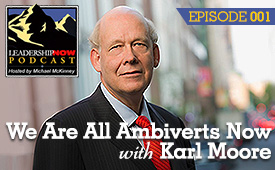
We Are All Ambiverts Now
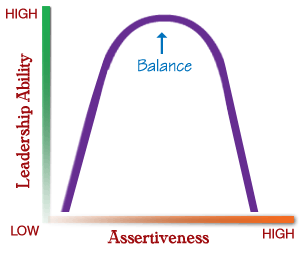
IT is not unusual to label yourself as an extrovert or an introvert—two terms that Carl Jung introduced in 1921. We do have proclivities one way or the other. But there are times when we need to be an extrovert, and there are times when we need to be an introvert. Effective leaders are flexible enough to balance the two extremes as needed. They become ambiverts. Ambiverts are those who can behave like introverts or extroverts depending on the situation they find themselves in. In We Are All Ambiverts Now, authors Karl Moore and Gabriel Mehl state that in today’s world, successful leaders are those who can be both. We live in a world where the loudest voice usually comes out on top. The extrovert’s readiness to engage socially and their “go-getter” approach fits with our preconceived notions of take-charge people. “Extroverts exude confidence and tend to stand out in a crowd. Our world has been constructed for extrovert leadership precisely because they seem competent and reliable at handling crises—they are loud, they are confident, and they let everyone know that they have a plan to fix the issue.” At the same time, extrovert leaders tend to dominate instead of listening and as a result often lack situational awareness. “The extrovert who lacks awareness will not seriously consider the opinions, sentiments, or needs of others. These qualities may harm the group chemistry and energy dynamics that this extrovert worked so hard to establish.” Introverts typically aim, then shoot. “We should not underestimate the power of a quiet-natured individual. Introverts are excellent listeners and thorough analyzers: they are capable of reading the room, considering and incorporating ideas into analysis, and contributing optimally to discussions. They also possess almost impeccable persistence, the capacity for creativity, and the capability to focus.” Extroverts tend to think out loud, whereas introverts process information internally before sharing. This characteristic of introverts can make for more balanced decision-making even if they are prone to overthinking. Neither approach is better than the other. Both approaches have their strengths, so an effective leader will know when to change their approach to best suit the situation. “The opportunity for advantage now lies in flexibility—how quickly and seamlessly leaders can alter their communication style on command and as needed. This opportunity for advantage lies with the ambivert.” Balance is the key. “Whereas introverts maintain a stronger inward life energy, and extroverts maintain the same thing outwards, ambiverts are characterized by their balance and adaptiveness.” Extroverts would be wise to listen more and talk less. Share their ideas much later in the process. Introverts, on the other hand, would be more effective if they stopped ruminating and took the leap. The authors give advice to introverts or extroverts who find themselves managing the other and how to blend a team of introverts and extroverts for the best business results. While the ambiverts’ flexibility and adaptability are a superpower, it puts them at risk of being perceived as inauthentic. Some may find them to be unpredictable. Open communication can help to ease misunderstandings. Consistency with your natural style is important, and not all situations require you to change your approach. Follow us on Instagram and X for additional leadership and personal development ideas.
Posted by Michael McKinney at 09:52 AM
03.27.26
The Leadership Quality Nobody Talks About in the Boardroom
EVERY year, organizations spend billions of dollars developing leaders in strategy, finance, and operational execution. Organizations sponsor employees through MBA programs, leadership academies, and executive coaching. They teach how to read a balance sheet, build a competitive moat, and manage a P&L. What rarely makes the curriculum is the inner work — the cultivation of self — that actually shapes how leaders make decisions under pressure; how they treat people when no one is watching, The word "spirituality" makes most boardrooms uncomfortable. It conjures images of incense and meditation retreats, not quarterly earnings calls and market strategy. And yet, the qualities that spiritual traditions have long cultivated — integrity, empathy, hope, purpose, a sense of something larger than oneself — are exactly what research increasingly shows drives long-term organizational performance. These are not soft skills sitting at the margins of leadership. They are the foundation. The real question isn't whether these principles belong in business. The evidence has settled that debate. The question is why we have kept them out for so long — and what it is costing us. The Cost of Leading Without Coherence The numbers are striking. According to Deloitte research, three global companies lost a combined $70 billion in market value as a direct result of trust failures — not market disruption, not technological obsolescence, but the erosion of trust. Meanwhile, Gallup's 2024 data reveals that employee engagement has hit a ten-year low, with just 31% of workers actively engaged and approximately 8 million fewer engaged employees than in 2020. These are not abstract statistics. They represent organizations hemorrhaging talent, productivity, and competitive advantage. The pattern beneath these numbers is consistent: leaders who default to authority, control, and short-term metrics create cultures of disengagement and, eventually, cynicism. Innovation slows. Collaboration becomes transactional. The best people start looking for exits. This is the coherence gap — the distance between what leaders say they value and how they actually lead. It is where organizations quietly break down, long before the crisis becomes visible on a balance sheet. And it is, at its core, a spiritual problem: the failure to integrate who we are with how we lead. What High-Performing Leaders Do Differently In researching this question through extensive interviews with CEOs, investors, and senior leaders across sectors, four qualities emerged with striking consistency among those who built genuinely high-performing, resilient organizations. These qualities — Hope, Empathy, Abundance, and Legacy thinking (HEAL) — are not personality traits or leadership styles. They are practices. Disciplines. Things you cultivate, not things you simply have.
The Business Case is Settled For those who still need the data before the philosophy, purpose-driven companies outpaced the S&P 500 by 10.5 to 1 over a fifteen-year period. These are not the results of luck or favorable market conditions. They are the compounding results of leaders who chose to build organizations with coherence, trust, and genuine purpose at their core. The Choice Every Leader Faces Leadership begins in the mind. The way a leader thinks, what they attend to, what they believe about people and about their own purpose, shapes every decision they make. The inner work of cultivating hope, empathy, abundance, and a long-term view is not separate from the hard work of building organizations. It is the hard work. It is the work that determines whether all the other work blossoms or collapses. Every leader faces a choice, often unconsciously: to lead from default, reactive thinking — the accumulated habits of a career spent optimizing for the next result — or to cultivate the spiritual and moral qualities that create lasting impact. The first path is easier, at least at first. The second is harder, but it is the only one that builds something worth building. That choice defines not just your organization's performance. It defines your legacy. Follow us on Instagram and X for additional leadership and personal development ideas.
Posted by Michael McKinney at 02:38 PM
03.03.26
Resolve Your Personal Dilemmas with Greater Confidence
WHILE we all seek expert advice to increase our chances of success, we also encounter situations in which no expert advice can uncover the right decision to make. For example, expert advice can’t tell someone how to decide between a position in the public sector or a private sector position that pays more but serves the public interest less. Such decisions represent dilemmas — situations that involve competing goals, aspirations, and demands. Moreover, dilemmas such as this career choice involve values and intrinsic motivations, which expert advice can’t address. An expert can’t tell you how to live out your values. Ultimately, only you can determine how to enact what you see as right, given your choices. Arriving at the right answer in such dilemmas involves introspection. It requires examining your values and relying on your sense of personal judgment — not only weighing information and drawing conclusions, but also evaluating the ethical aspects of a situation. A key means to enhance your personal judgment is to understand frames of reference, perspectives, and principles that can balance the competing — and potentially good — outcomes that compose a dilemma. Employing these six questions enables you to capture perspectives that can enhance your personal judgment when addressing dilemmas:
Let’s apply these questions to a specific dilemma: Imagine you are tasked with funding executive MBA programs for three employees in your firm. One employee, a rising star, has been accepted to an Ivy League program. Equipping this employee with a competitive MBA degree would assuredly be a financial benefit for your organization. Two other long-term, loyal employees who you want to retain have been accepted into a local executive MBA program. Funding their MBAs will reward them for their engagement and commitment. The cost of the Ivy League MBA program, however, translates to three executive MBA spots at the local institution, which is the amount your budget can cover. You face a dilemma: fund one high potential person and decline assistance to the two loyal, long-term employees, or reduce assistance to the rising star in order to fund all three. As you apply each of the questions above to your dilemma, you consider:
As you can see from this case, applying the questions intended to clarify your perspective leads you to conclude that privileging one individual with a degree at the expense of two other employees doesn’t uphold your organization’s values or the virtue of fairness. You resolve the dilemma by offering the employee accepted to the Ivy League program tuition assistance in the amount equivalent to full tuition at the local university, while also fully funding the two additional employees pursuing their MBAs locally. This solution allows you to recognize the high potential of the one employee seeking the Ivy League degree and reward the loyalty of the two longer-term employees accepted to the local program. It also respects their right to equal access to company resources. As this scenario illustrates, exploring a dilemma through six perspectives enables you to exercise refined personal judgment. (If you “pull back the curtain,” you’ll find that these six questions represent six types of philosophical ethical theories.) Today, we’re increasingly expected to navigate gray areas in which expert advice doesn’t necessarily pertain. Applying the approach outlined here to refine personal judgment calls will help you master this crucial skill for success in business — and more broadly in your life. Follow us on Instagram and X for additional leadership and personal development ideas.
Posted by Michael McKinney at 06:47 PM
01.16.26
Leaders Who Honor “In-Between” Periods Heighten Their Insight and Power
LEADERS are under tremendous pressure to stay ahead of the curve while increasing output and notching wins. The tendency is to rush from project to project, overcome hurdle after hurdle, and never stop for a breath. But truly successful leadership requires taking time for reflection between one project and the next. Rather than diminishing leaders’ effectiveness, pausing in between heightens their insight and power. In Tibetan Buddhism, in-between periods are known as “bardos.” In these intervals, the teachings tell us, “the intellect becometh ninefold more lucid.” Bardos offer us a rich opportunity to step outside our usual ways of seeing and discover fresh perspectives. Our busy-ness can make us feel we’re on track, when the reality is that we’re drifting like a boat that’s steadily and unnoticeably veering off course. Striving to meet today’s glorified standards of productivity, we think we’re taking care of what matters most when, in fact, we’re putting it off. Tomorrow you’ll analyze what went wrong and what went right with the latest project. Next week you’ll acknowledge your team’s efforts. Later in the month you’ll take time to better understand how the processes you’re overseeing work. Next year you’ll strategize for succession planning. Now, as the new year gets underway, make a commitment to honor intermediary periods. Resolve to set aside time between projects for conscious attention to your relationships, your principles, and your purpose. By turning your attention to this kind of reflection on a regular basis, you can reset your compass, course correct and enhance your leadership skills. Here are some questions to ask yourself when you take a pause: 1. Is there something I keep doing even though it isn’t working? According to the Buddhist law of karma, or cause and effect, every result has an origin. “Karma” means “act,” and it’s about how we determine what happens with our actions. Karma as action (rather than fate) is a concept with huge power. What’s occurring today is a consequence of your actions last year, last week, yesterday, and this morning. All of that, plus what you do now, will lead to results in the future. If you don’t want what usually happens to happen, do something different. In other words, stop doing things that aren’t working. You might start by identifying a behavior that isn’t getting the results you want. Perhaps you have too many meetings to prepare for other meetings. Or you micromanage instead of setting standards. Or you request reports and metrics that no one acts on. Once you pinpoint the action, you can change it. 2. Am I living in alignment with my values? Often, we behave in ways that aren’t aligned with our values. You care about developing talent but don’t devote time to mentoring. You believe in open discussion but quash dissent in meetings. You advocate work-life balance but expect employees to be available at night and on weekends. Recognizing these points of disjunction allows you to transform behavior patterns you weren’t aware of. As your values and behavior come into alignment, you experience increased personal and professional satisfaction. 3. If I only have one more year in this role, what do I want to prioritize? Impermanence is the central concept of the bardo teachings. However immortal we may feel, we — and everything and everyone we know — will end. What’s more, this can happen at any moment. Bardo in-between periods give us the opportunity to reflect on impermanence. This may feel dark and unnecessary (why spend the time that you’re engaged in your work thinking about it coming to an end?), but it helps us make the most of our days as we see that sooner or later things will change. Best-selling author Gish Jen became acutely aware of death when she attended a funeral for the first time. She realized, “‘Oh, my god! We’re all going to die!’” The consciousness of her own mortality that struck Jen at the funeral has never left her. She says, “For every book, I ask myself, ‘If it’s only [possible] to write one more book, would this be it?’” Ask yourself: If I only have one more year to… If there’s only one more chance to… By honoring in-between periods, we undergo a profound shift in our experience of leadership and indeed, of life. Instead of feeling like we’re rushing from hour to hour, day to day — our attention fractured as we try in vain to catch up with all that we want to do and must do — we become more centered and effective. We grow confident in the knowledge that we’re doing today, not later, what’s most important and aligned for us. Follow us on Instagram and X for additional leadership and personal development ideas.
Posted by Michael McKinney at 01:18 PM
11.07.25
Don’t Be Yourself
THE groundwork for the modern cult of authenticity was laid in our era by philosophers like Rousseau and others of his mindset who followed him. Their idea that any constraints laid on us or attempts to conform us by society make us inauthentic. But the fact is, we find out who we are in relation to other people and the communities in which we interact. Our uninhibited self is rarely our best self. In Don’t Be Yourself: Why Authenticity Is Overrated (and What to Do Instead) published by Harvard Business Review Press, author Tomas Chamorro-Premuzic asks, “What if chasing authenticity was an actual trap—one that oversimplifies human complexity, disregards the necessity of compromise, and leaves us ill-equipped to navigate the nuanced realities of modern life, which include focusing not just on ourselves and how we feel, but also on others?”` Our uninhibited, authentic self can hold us back from the potential we have. Contrary to what the authenticity cult predicates, success is rarely attained through radical honesty or by always showing every single side of ourselves. Instead, it’s a function of carefully managing your self-presentation—adapting to situations and showcasing the qualities that are best appreciated by others—while making an effort to conceal negative, undesirable, and irrelevant aspects of your personality. Chamorro-Premuzic presents us with four authenticity traps that encourage us to be our unfiltered selves regardless of the situation and refuse to compromise. The Four Authenticity Traps
Instead… You will be more successful if you keep these thoughts in mind:
The common thread here is humility and an other-focus. As leaders, the more you focus on yourself, the less you will care about the needs of those you lead. Your leadership becomes narcissistic. Focusing on being nice, ethical, and competent, and being perceived as trustworthy by others, especially followers, leaders often view authenticity as an end goal, as if it was a critical enabler of their success. However, focusing too much on authenticity—in this case, adhering too closely to the “just be yourself” mantra—will foster a narcissistic mindset that is not conducive to leadership effectiveness. Instead, leaders would be better off if they focused on being other-oriented, so as to understand how other people think and feel in order to enable them to work together. The question is, how can we best display our character and humanity in a way that is most beneficial to our goals and objectives? By shifting our perspective, beyond the assumption that others value our unfiltered or genuine self per se, we can unlock more effective strategies for navigating the complexities and cultural nuances of work and life. This approach, while less self-serving, comforting, or self-obsessed, empowers us to be more intentional about how we present ourselves, communicate, and connect with others. It allows us to balance sincerity with adaptability, personal values with professional demands, and emotional truth with strategic thinking. In doing so, we can become more effective, better performers who rise to challenges with an awareness of our limitations, better leaders who inspire trust and collaboration, and better coworkers who contribute meaningfully to shared goals. Follow us on Instagram and X for additional leadership and personal development ideas.
Posted by Michael McKinney at 08:22 AM
07.11.25
8 Beliefs That Will Make You Limitless
UNDERSTANDING how people’s minds work gives us a foundation to make change happen. Sometimes we get stuck until we find the insight or the perspective that makes all the difference. In The Difference That Makes the Difference: NLP and the Science of Positive Change, Josh Davis and Greg Prosmushkin present eight shifts in thinking that can be the difference to move change forward. The authors offer these tools derived from Neurolinguistic Programming to help people apply them in a positive way to help lift people up. 1. How We Experience the World Is Not the Same as Reality We don’t see reality. We see our perception of reality. Our worldview—our expectations—distort reality. We see what we think is important. “What we experience is not reality, it is instead a version of reality that serves our needs and is heavily influenced by what is going on in our minds.” People don’t react to reality—they react to their experience of reality. Those two things are not the same. So, if you want to understand someone or help them change, rather than trying to understand reality, you should try to understand how they experience reality. Doing so reveals how people get stuck and opens wide the possibilities for change. Once you learn how someone experiences the world, it becomes clear what to try changing in order to help them. You are then in a position to find the difference that makes the difference for them. This means that most of our limitations are of our own making. Your options and possibilities grow when you expand and enrich your mental model or worldview. Begin by presuming that you don’t know everything about yours or others’ mental model, and change will become easier. 2. Why Not Me? When you believe you can’t, you behave in a way to bring about the thing you don’t want. Believing that you can is a strong predictor that you will. How differently would you behave if you thought that if they can do it, it is possible for you as well? Believing that if it’s possible for someone, it’s possible for you is not everything, but it can be life-changing. Life is magical, but not magic. But taking on this belief is often critical in leading to these outcomes. Believing you can doesn’t mean that you can do anything and everything. But you can learn what approach others that have gone before you have approached what you are trying to do and adjust your mental model accordingly. 3. All I Need Is Already Within Me Do I have what it takes to do what I want to do? Progress to what we want always begins with the first step, no matter where you are. Focus on the process, not the result. If we believe that we don’t have what it takes, we will not make the changes to move us in the direction we want to go in. All we need to begin is already within us. Research has now also shown that the effects of this belief are reliable-when people believe they have the resources to change, they are significantly more likely to do so. This is true whether it is a personal or professional change. And the opposite has been found, too—even when people do have the resources, if they believe they don’t, they don’t take action and don’t change their situation. When we focus on what we have rather than what we don’t have, we can make the first step. 4. There’s No Failure, Only Feedback Too often, we take failure as a sign that we are not up to the task. We begin to doubt ourselves. We need to reframe our experience. It’s not failure. It’s feedback. Another step to get you where you want to go. We learn more completely when we see failure as feedback. Whenever we put ourselves out there and try to do something new, we run the risk that we may not do it well. People who choose to use a feedback frame process information about how they performed differently from those who use a failure frame. Even before one second has gone by after getting information about performance, the differences can be seen in the brain. When using a feedback frame, our brains give more attention to the information coming in and use it to improve future performance. Whereas when people see the information as judgment about themselves or whether they failed, then the brain does not capture or use the information coming in as effectively. 5. How My Message Landed Matters More Than What I Meant When communication fails, it’s feedback that you need to course-correct and try again. Fortunately, there is a useful solution for communicating well even when your intended message may not be getting through as planned—presume that the meaning of your communication is the response you get. Take that responsibility and you will take the right steps to find out what you are communicating and ultimately get the right messages across. 6. If At First I Don’t Succeed, I Must Try Something Else This advice is based on the idea that “in any system, the element with the most flexibility exerts the most influence. Most of the time, the person who is able to adapt to the situation on the ground is the one who gets their needs met.” Or perhaps you can put it this way: Insanity is doing the same thing over and over and expecting different results. (No, Einstein didn’t say that.) To be flexible, you need to keep the end goal in mind and think through these steps: 1. Clarify your ultimate need—your why.
7. Assume Good Intentions Get curious, not judgmental. Thinking we know everything puts a lid on our learning and effectiveness. “Whenever you encounter resistance, get curious about the other person’s positive intention first.” People most often do not do bad things for the purpose of doing bad things; they have a positive intention they are trying to work through. This doesn’t justify bad behavior, but if you can find a way to get at the positive intention, you have a chance to change those bad behaviors. Ask yourself, “Why was that important to them to say or do?” as many times as it takes to get the answer. 8. If I Knew Then What I Knew Then Dwelling on past mistakes and criticizing yourself only drains your energy and distracts you from forward momentum. This is true for ourselves and others: “People behave in the best ways they know how and make the best choices they can, given their mental model of the world.” Behavior makes sense in the context of the mental model in use. If we have unconditional positive regard for ourselves and others, we can have compassion in any context. The authors go on to provide 10 tools for understanding someone’s mind and then how to use this information to lead change in our own lives and those of others. Follow us on Instagram and X for additional leadership and personal development ideas.
Posted by Michael McKinney at 06:54 AM
04.11.25
Transition Points Are Fertile Ground for Reinvention
I didn’t start out as a founder. I started out as an arms dealer. Not in the literal sense — but in the early days of Silicon Valley, I was on the front lines of sales, business development, and corporate development. I knew how to close deals, spot trends, and move fast. I was valuable but always on the periphery of the real action. I was building. I watched teams turn ideas into companies and products into platforms. After a while, it became clear — I was contributing but not creating. So I made a move. I joined Ooma as a founding executive. We set out to reinvent home phone service and take on the telcos. It was bold and ambitious and taught me what zero to one really looks like. From there, I co-founded Jangl, a privacy-forward voice platform that lets people connect without giving out their real number. We raised money, built the team, and got real traction. Then, the market shifted, and we hit the wall. That kind of moment can knock you down — or wake you up. What I’ve learned across every chapter since is this: transition points represent some of the most valuable terrain upon which you’re ever likely to stand. They’re confusing, uncertain, and usually uncomfortable. But they’re also where reinvention happens — if you let it. Too many people try to erase what came before when they make a change. I’ve done the opposite. I’ve treated every shift in my career like compound interest. Sales taught me how to tell a story. Founding taught me to see around corners. Product leadership taught me to zoom out and engineer systems at scale. Every new move built on the last. That’s the difference between a pivot and a reinvention. A pivot is reactive. Reinvention is expansive. Recognizing when it’s time But how do you know when it’s time for a reinvention? Here are five signs that I’ve learned to watch for:
The key is to treat transition points not as gaps, but as launchpads. When Ooma ended, I didn’t run back to sales. I leaned harder into product. After two more startups, I shifted into leadership roles at companies like Facebook and VEVO, then helped build Disney+ and led streaming product and engineering at TelevisaUnivision. That kind of reinvention required unlearning, taking risks, and putting myself in uncomfortable rooms. But every time I did it, I unlocked new capabilities. Carrying forward what matters The trick is not to over-index on any one chapter — the startup that fails; the role that runs its course; the team that changes. All of it is temporary. What’s permanent is what you carry forward — the grit, the pattern recognition, the following your hunches. That’s the raw material for whatever comes next. Reinvention isn’t something you do once. It’s a muscle. And the people who stay relevant, energized, and dangerous in the best ways are the ones who keep flexing it. If you’re standing at a crossroads, don’t freeze. Don’t cling. Ask yourself: “Am I building something that reflects who I am right now?” And if the answer is no — what’s stopping you? Follow us on Instagram and X for additional leadership and personal development ideas.
Posted by Michael McKinney at 09:01 AM
02.10.25
8 Principles to Get You to Great
HOW do successful people think? The key to doing well is thinking well. It’s a way of being in the world. Becoming great means making the hard choices necessary to get you there. Performance coach Doug Hirschhorn advances eight principles in 8 Ways to Great that direct the decisions of top performers. Principle #1: Find Your “Why?” How questions bring up negative thoughts and inadequacies. “The reason most people go through life with big dreams but fail to achieve them is because they ask themselves ‘how’ before they know their ‘why.’” The why question energizes and motivates, “Knowing your ‘why’ is what’s going to get you to figure out how.” Ask yourself, “Why have I chosen this, and why am I still doing it?” Principle #2: Get To Know Yourself Identifying and understanding your strengths and weaknesses allows you to leverage your strengths and minimize the weaknesses that hold you back. I’m talking about the kind of self-awareness that allows you to acknowledge both your strengths and your weaknesses so that you can use them to balance each other and keep yourself going overboard in either direction. Self-awareness allows you to do more of what you’re good at and less of what you’re not. It can also send up the red flag that lets you know you’re about to do something stupid. Your weakness can force you to put guardrails in place that address your issue in such a way that it strengthens the habits that drive you forward. Principle #3: Learn To Love the Process To reach your goals, you need a step-by-step plan that becomes part of the process of reaching your target. Process thinking allows you to avoid distractions and prioritize the next step you need to take. If you allow yourself to get distracted, you’re likely to abandon the process and start making stupid, self-destructive decisions. I just want to emphasize how important it is to concentrate on the step you need to take right now and not trip yourself up by looking too far ahead. Principle #4: Sharpen Your Edge Your edge is a two-sided sword. One side is knowing what sets you apart from others. The other side is learning all you can to increase the odds of your success. Your personal edge is something you develop and lead with to help set you apart. “In a world full of choices, establishing an edge can make the difference between success and failure in whatever you do.” The external edge guides you when to take smart risks. “Remember that your overall edge is determined by leveraging your strengths, minimizing your weaknesses, and then gathering as much information as you can before making a decision.” Principle #5: Be All That You Can Be Do not compare yourself to others. If you do, you may be doing well compared to them but still not doing your best. You don’t want to be doing just good enough. Challenge yourself to grow beyond your present level. “The difference between challenging yourself to be the best you can be and just trying to beat the next guy is that excellence is a constantly moving target, so you’ll always have something to work for.” Hirschhorn says, “Don’t get sucked into external markers of merit. Measure your success in terms of how well you performed and not only the outcome.” Principle #6: Keep Your Cool It’s human to get scared. But you don’t want to act out of panic, ego, or insecurities. Remain objective with your priorities in mind. You don’t need to always be right. “You can win when you’re losing when you make the decision you need to make instead of the one you might want to make even though you know that decision might mean taking a painful loss.” Know when to cut your losses. When it comes to growth, fear comes with the territory. “Sometimes, being scared is the most rational reaction to a given situation. There’s no shame in that. It’s when people give in to those feelings that they get into trouble. As I frequently say to my clients, ‘Feeling fear is okay as long as you don’t act afraid or make a decision because you are afraid.’” When you feel like panicking, “remind yourself of the process you’ve been following and stick to it; do what you need to do, not what you want to do. There are always aspects of even the scariest situation that are within your control. Take control of what you can instead of letting the situation carry you away. Thinking negatively is sure to tip the odds of success against you.” Principle #7: Get Comfortable with Being Uncomfortable The perfect magical moment never comes. “Waiting for that last piece of the jigsaw puzzle or the exact alignment of the stars is what keeps most people tied to a job they hate or afraid to take the step that would get them to the next level in their career.” Winners act. “If you want to make a change—I mean, really want to make a change—you have to be willing to do it right now. Not later, not tomorrow, not after the weekend, not on January 1, and certainly not only when that eternally elusive perfect moment arrives.” Uncertainty creates volatility, but people react to it differently. The most successful people don’t freeze or panic or buy everything in sight. Instead, they take the time to look around and assess the opportunities available to them. Principle #8: Make Yourself Accountable Often, what holds people back is that they don’t have the structure or discipline to do what needs to be done consistently. “Unless there is some meaningful reward for performing well and an equally meaningful consequence for making a stupid mistake or breaking your own rules, you may not take the steps necessary to put your best-laid plans into action.” It is easy to get caught up in the moment and get distracted. The fact is, “For most of us, the answer is to enlist the aid of someone to whom we make ourselves answerable.” Follow us on Instagram and X for additional leadership and personal development ideas.
Posted by Michael McKinney at 10:24 AM
02.03.25
Think This, Not That
OUR mindset can either work for us or against us. A mind full of false narratives—false beliefs—will keep us from growing into our potential. Unchallenged, these negative beliefs will become the soundtrack we live by and keep us from moving in the direction of our best selves and change the outcome of our lives. Josh Axe identifies in Think This, Not That twelve mental barriers that obstruct personal growth and hinder success. Each comes with a critical mindshift—think this, not that—to realign our thinking and liberate us from our limiting beliefs. Mindshift 1: Create a Breakthrough by Unlimiting Your Beliefs We all have limiting beliefs like “I am not enough or not good enough” or “nothing good ever happens to me.” A belief changes the outcome of our life for better or worse. We need to identify our beliefs and determine if they are serving us well. Going from limiting beliefs to unlimiting beliefs is not like flipping a switch. It is a process taking one belief at a time. There’s one caveat when it comes to discerning your beliefs. You are not the things you say you will do; you are what you actually do. Beliefs are more than your feelings or deepest convictions. They align with your behavior; they demand action. THINK THIS: I can because…
Mindshift 2: Redefine Success by Becoming, Not Accomplishing Success is about what you are becoming as a result of what you do. “When you accumulate accomplishments while ignoring your character, it’s like building a house on sand. Eventually, your house will crumble and wash away.” Axe defines success as maximizing “your unique skills for the greatest good.” And this gets to the heart of leadership: “Your greatest potential is not just about you; it’s about us. It’s about influencing others. It’s about becoming the greatest you so you have the greatest impact on helping someone else become the greatest them.” THINK THIS: What’s most important is who I become.
Mindshift 3: Become Self-Aware to Get Where You Need to Go Self-awareness is knowing how you are percieved and knowing what is happening inside of you—an awareness of how you tend to respond to what is happening to you. It’s knowing your strengths and weaknesses. And importantly, it is knowing who you are now so you can become who you want to be. Having self-awareness allows you to interrupt your unconscious, emotion-driven reactions and control how you respond to your environment—to live intentionally and not on autopilot. Axe says, “Being aware of yourself and others compels you to stop and look at the needs surrounding you, not turn the other way. It frees you from the grip of self-interest.” THINK THIS: I am self-aware and choose not to lie to myself.
Mindshift 4: Find a Why or Risk Wasting It All Your why has everything to do with your purpose. Why do you exist? “The best version of yourself always starts with the why.” A meaningful life is built upon an other-focus. “A big part of your life’s purpose is seeing the pain or potential in others and acting with compassion to meet their needs.” It’s not about you. “The idea that purpose is found in pleasure fixes can’t be further from the truth. Studies prove that trying to manufacture this feeling of happiness actually leads to lower well-being and depression.” THINK THIS: My life has value, meaning, and a specific purpose to make this world a better place.
Mindshift 5: Rewrite Your Role in the Story No matter what role in a story you are playing now, if it is not working for you, you can change it. In his book Hero on a Mission, Donald Miller identifies the four characters we play: The victim, the villain, the hero, and the guide. The victim is the character who feels they have no way out—helpless and powerless. The villain is the character who makes others small. The hero is the character who faces their challenges and transforms. The guide is the character who helps the hero.” The role you choose to play affects the life you have. When you accept responsibility for your circumstances and take radical action to change, you automatically step into the shoes of a hero. That is how you begin to write your best story possible. What is your story? If it is the victim, you will never grow. Choose a story that transforms you. THINK THIS: I can own my story and edit my role.
Mindshift 6: Assemble a Team to Fulfill Your Dreams We need a team. “Life is better with people who make you better. One of the most effective ways to stay on track and reach your goals is to surround yourself with people who are more disciplined than you.” Think in terms of who my community can become. THINK THIS: Life is better with people who help me grow. NOT THAT: Life is better on my own. Mindshift 7: Build an Unshakable Identity So No One Else Does It for You Your identity keeps you grounded. Be intentional about who you are and build on that foundation. I believe four movements have led up to and created the modern identity: irreligion, rationalism, romanticism, and relativism. These four movements led to the foundational principle that undergirds the modern identity—that our life purpose and mission should flow only from within ourselves and should satisfy whatever we think will make us happy, typically in a materialistic and hedonistic way. Choose your identity. “When you think about who you are, consider whether the identity you choose will keep you flailing in your fleeting emotions, chained to the past, or moving forward into your best possible self.” THINK THIS: Figuring out who you are is important because it determines your future.
Mindshift 8: Bust Vices by Building Virtues Virtues are what build our character and transform us from the inside out. Personal values are built upon virtues. The seven virtues are wisdom, justice, self-control, courage, faith, hope, and love. All of these virtues work together to apply each in our lives for the benefit of all. For instance, you can’t practice true justice without love. Having a virtuous character runs deeper than just being a good person; it is doing the greatest good, which is the most loving thing you can do for everyone around you and for a lasting impact. The greatest good is only possible to accomplish with the underpinnings of the virtues of faith, hope, and love. Axe asks, “Are you aware of the vices that keep your potential at bay?” THINK THIS: A divine identity will motivate me to live and create with excellence, no matter who is watching.
Mindshift 9: Turn Off Opinions and Turn On Principles Principles guide the application of your virtues. Principles are timeless. Opinions, on the other hand, come and go. “If you want to enjoy success in your relationships, career, and health, choose a path that is lined with principles.” Listening both to everybody and to nobody will lead you down the wrong path. The secret is to listen and follow wise leaders who have had the best results in their businesses, their finances, and their relationships. Today, we often speak of my truth and your truth or, rather, my opinion and your opinion. There is such a thing as absolute truth. “My truth will make you as comfortable as possible. The truth will force you to change. My truth is dependent on what will make me feel good right now. The truth leads to a better outcome in the long run. Don’t seek to discover your truth; act with wisdom and courage to uncover the truth, which leads to life.” THINK THIS: Principles lead to successful choices.
Mindshift 10: Flip the Fear to Turn on the Growth Framing events in your life as “all or nothing” are part of a fear-based mindset. You’re thinking in terms of perfection, not growth. Ask, “What can I do better next time?” You live in fear because you’ve tied an event (or series of events) to your identity. Because you are so invested in maintaining this idea of perfection and setting unrealistic expectations for yourself, you’ll do anything to protect your self-image, including keeping up the lie at whatever cost. You won’t be honest with yourself or others. You’ll never grow beyond superficial status because the goal isn’t to develop your character and skills but to achieve, accomplish, and arrive-at least in the eyes of others. THINK THIS: Failure can lead to flourishing.
Mindshift 11: Visualize to Realize Start with the end in mind. Visualization is a way to see the path ahead to reach your dreams. It helps you to prioritize what matters most and give up those distractions that don’t take you where you want to go. THINK THIS: I can dream big and make things happen when I set the right steps in motion.
Mindshift 12: Power Up Your Potential with Positive Perseverance We all go through valleys, and if all we do is dwell on the negative, we will create a negative life for ourselves. There is such a thing as toxic positivity. It’s when you deny or distort reality and rely on platitudes such as “Everything will be okay.” On the other hand, positive perseverance is the fusion of hope, grit, and gratitude. Hope is “choosing to think and act in a way that is contrary to the negativity of our present experience.” Grit is “being all in to create your future self. And gratitude is an appreciation for what we do have and what is right “and taps into the abundance of the little things.” Self-talk matters. How much of what you say is uplifting and positive? “Don’t say anything to yourself that you wouldn’t say to anyone else. If you wouldn’t say the words you tell yourself to your best friend, shut that negative self-talk immediately.” THINK THIS: I have the power to choose positivity.
Follow us on Instagram and X for additional leadership and personal development ideas.
Posted by Michael McKinney at 11:39 AM
11.22.24
You’re Not Failing—You’re Growing! Powerful Mindset Shifts from J.K. Rowling and Dale Carnegie Everyone Can Use
WE’RE conditioned to fear failure. What if I fail?... I can’t fail this time... Failure is seen as a fatal mistake — whether to a relationship, a career, or a decision we’ve made. But failure is a lot more than that. It’s what grows resilience, inspiration, creativity, and success. It’s how we approach failure that makes a difference. I’ve seen my therapy patients take another look at a failure and realize it gave them room to grow. And there are two examples we can follow — from the author J.K. Rowling and self-improvement and leadership pioneer Dale Carnegie. While wildly different people on the surface, they shared a powerful sense of determination and overall resilience. How each approached failure contains lessons for us all. J.K. Rowling: Learning from Adversity It’s likely you’ve heard of the Harry Potter books and movies. But renowned author J.K. Rowling hardly started out as an overnight success. She was an unemployed single mother wrestling with depression when she discovered an escape — writing. She conjured up a world of wizards and witches, a place where her creative spirit could find solace and hope amidst the chaos of life. Her manuscript got rejection after rejection. But she persisted. Finally, Bloomsbury Publishing took a chance — and Harry Potter and the Philosopher’s Stone became an incredible phenomenon. The lesson we can take from J.K. Rowling is this: Instead of letting failure define her, she persevered — and turned failure into a personal victory. She refused to be pigeonholed by society’s rigid definition of achievement and shallow markers of success. What she found instead was that real success came from within — and failures and adversity were meant to be embraced, viewed as valuable lessons, and part of developing a powerful resilience. Dale Carnegie: Success Comes from Failure Twentieth-century self-improvement and sales guru Dale Carnegie published How to Win Friends and Influence People back in 1936. It was a runaway bestseller and remains a classic to this day. But Carnegie didn’t just set out to write a book and make his mark: he failed at countless endeavors first. Instead of brushing past them, he did the opposite: he wrote them down and kept them in a folder. He took a hard look and confronted his own shortcomings head-on. Here’s the lesson: By digging into his failures, Carnegie found invaluable lessons. He came to understand that setbacks were like an elixir for personal growth and self-discovery. He saw failures like his best buddies, always ready to teach him a thing or two. He cultivated a can-do spirit that enabled people to tackle challenges and overcome obstacles — and build a methodology from it that has had a profound influence on millions of people. So much for being afraid to fail. Once you know it’s an opportunity, you can learn from it. Your Turn: Four Mindset Shifts To use failure to achieve your own greatness, make these four simple but powerful mindset shifts: Make the Choice: Failure is like a boot camp for resilience, a grueling training ground that prepares us for life’s inevitable challenges. When it knocks us down, we face a pivotal choice: stay on the ground and wallow in defeat, or bounce back like we’re on a trampoline, ready to soar again. This choice is crucial: each time we pick ourselves up, we build mental and emotional muscles that equip us for future struggles. It’s a reminder that while setbacks can sting, they also offer us the chance to rise stronger and more determined than before. Get Creative: When our grand plans go belly-up, we’re often left scrambling for alternatives, which sparks our creativity like nothing else. This is the moment to ditch the beaten path, think outside the box, and try unconventional solutions. Some of history’s coolest inventions and groundbreaking discoveries emerged precisely because someone was willing to pivot and innovate after a failure. It’s amazing how necessity can lead to creativity. When faced with obstacles, we often tap into reservoirs of ingenuity we didn’t even know we had. So, the next time things go awry, embrace the chaos and let your imagination run wild! Shift Your Focus: Failure also serves as a powerful catalyst for developing a growth mindset. Instead of fixating on specific outcomes, we begin to shift our focus toward continuous improvement and personal development. This transformative perspective allows us to view failures not as endpoints but as valuable stepping stones on our journey. Setbacks become opportunities for learning, helping us build resilience and adaptability. It’s this growth-oriented mindset that enables us to conquer mountains as we learn to embrace challenges and find strength in the process rather than solely in the results. Be Humbled: Failure has a unique way of building character and humbling us. It’s a reality check that reminds us we’re not invincible superheroes — though let’s be honest, that would be pretty cool. It teaches us that everyone stumbles and that vulnerability is part of the human experience. This humbling journey helps us cultivate empathy and compassion for others, reinforcing the idea that we’re all in this together. Instead of placing ourselves on pedestals, we learn to appreciate the shared struggle of growth and resilience, which ultimately fosters deeper connections with those around us. Failure teaches us empathy and compassion for others facing their own failures. It forces us to question what truly matters to us and what success really means. It’s like a soul-searching journey that leads to personal growth and a more authentic and meaningful life. But here’s the catch — just experiencing failure won’t automatically make you a better person. You must be intentional about it. Embrace failure with open arms, reflect on its lessons, and take action. Only then will you truly transform setbacks into stepping stones to success. Follow us on Instagram and X for additional leadership and personal development ideas.
Posted by Michael McKinney at 09:36 AM
09.25.24
10 Habits of a Peacemaker
LAW professor Steven Collis is no stranger to polarized arguments. He specializes in the First Amendment. But he has found a way to have constructive discussions without them devolving into shouting matches or accusations. In Habits of a Peacemaker, he provides practical habits and skills to talk about hard topics in a productive way. These habits are more than tactics. They are a way to approach life and see other people. HABIT ONE: Intellectual Humility and Reframing Collis begins where all relationship (leadership) discussions should begin—humility. He states, “Most of us need to recognize that, most of the time, we don’t know what we’re talking about. That may seem offensive, but the sooner we recognize it, the sooner we can open our minds to open our minds to peacemaking and close the door on the kind of contentious behavior that damages relationships.” This is the foundation of all that follows. Judging others creates discord. We should know, too, that when we judge others, we don’t have all of the facts or context. We should take it slow. Conversations must be framed in such a way as to acknowledge the fact that we don’t have all of the information, and the interaction is really about seeking more information and not proving a point. “If someone else brings up the topic in a way that will inevitably lead to fighting, you can move to reframe the issue.” HABIT TWO: Seek Real Learning Building on Habit One, we need to learn from both those around us and from those who have come before us. It means that “we cannot be in a state of constant conflict with either group.” We are all subject to misinformation (really!). We get caught up in catchphrases that circumvent critical thinking. They are often misleading and imprecise, lacking in the intended meaning and nuances. We think we know what they mean by them, but most likely don’t. “It’s entirely probable that both you and the person invoking them place different meanings on them. It’s entirely probable the person invoking them knows exactly what the catchphrase means and has thought long and hard about that meaning. But it’s also likely that a person repeating the catchphrase isn’t sure they know what they mean by it.” Most catchphrases we hear have become an “unsophisticated argument for a sophisticated problem.” We need to diversify our sources of information. Understand the biases coming out of the sources you agree with and those you don’t. It will improve your understanding and knowledge and strengthen your position. And importantly, “Part of seeking real learning is recognizing that whatever conclusion we have reached may be proven wrong as we learn more than we know now.” HABIT THREE: Assume the Best about People Assuming positive intent is assuming the best about people and their intentions. Ask questions. By asking questions, we can better understand others and help them to understand their own views. “In all your inquiries, it’s important to remember why you’re asking questions. Remember: you are not trying to prove a point. You are trying to understand them better so that the two of you can seek ideas and solutions that will speak to both of you.” People act on what they know and understand, which may be very little. “What they have learned about humans is that we tend to reach conclusions based on our gut reactions to any given set of facts, then reason backward to justify conclusions.” We all have insecurities, and we are all subject to confirmation bias. We often project onto other people what we think about them, instead of discovering what they actually think. When we’re dealing with someone who we think is assuming the worst about us, our first step should be to ensure we aren’t just heaping upon them our own insecurities. HABIT FOUR: Don’t Feed People’s Worst Fears Kindness goes a long way and has more constructive powers than sarcasm and anger. Controlling our own emotions is key but not always easy, especially on certain topics that have a powerful hold on us. “The challenge, then, is not to change who you are. It is to reach a point where the topics no longer affect you as much.” Peacemakers are slow to state strong opinions. Listen more than you speak. HABIT FIVE: Hunt for the Best Argument Against You I love this point. Those who disagree with you generally have strong arguments for their position, but by seeking those arguments out “it will force you to better understand, articulate, and defend your own opinions. It may even cause you to—gasp—change your mind.” Peacemakers are not afraid of arguments or facts that challenge their worldview. They seek them out. They analyze them. If arguments or facts make them uncomfortable, they seek to understand why. Seek to learn where you might be wrong. HABIT SIX: Be Open to Change All of these habits come to nothing if you are not willing to consider the need to change your views. “With intellectual humility comes the recognition that there may be more to learn about any topic and that as we learn, our positions may change. Peacemakers do not fear that.” HABIT SEVEN: Spend Time with People The author confesses that he struggles with implementing this on a consistent basis because, as a law professor, he enjoys thinking about some of the hardest topics—constitutional law—of the day. The advice is simple: “Spend time with people doing uplifting things and talking about topics other than the hardest issues of the day.” Considering the delegates that drafted the Constitution of the United States, he observes: “In an environment where hostility could have easily prevented anyone from getting along, the delegates worked well with each other because they were forced to spend time together outside the debating framework. In short, they became friends. It’s hard to hate or discount the people you know well.” We are all on a journey. Key lesson: When we spend time with others and truly get to know them and the circumstances that led them to behave as they do, we tend to be less judgmental of them and more understanding of who they are and why they make the decisions they do. HABIT EIGHT: A Sliver of Humor Humor disarms your listeners. Not everyone finds everything funny. There are different types of humor. Collis lists five. It is important to figure out what kind of humor your audience prefers. Read the room. “While humor can be an effective tool, you must know when it is appropriate. Humor is like social media; use it deliberately, at least in the context of discussions about hard topics.” HABIT NINE: Seek Inner Peace “Peacemakers take the time in their lives to engage in habits that cultivate inner peace, which then permeates outward into the rest of their lives.” You can achieve this through practices like mindfulness, prayer, journaling, and reading. Schedule time to engage in any or a combination of these practices. HABIT TEN: Embrace the Discomfort of Non-Closure Human beings do not like to leave things open-ended. We lean into black-and-white thinking. This kind of thinking can lead us down the wrong path and into toxic discussions. Get comfortable in the gray areas and savoring differences. Obtaining education is not the same as obtaining degrees. True education, not mere degrees, seems to be able to soften our tendency toward dichotomous thinking. It allows us to bask in new information and in new discovery. That said, there are things we can be certain about. But keep in mind, “The decided are always gentle.” That means “there is a calmness and tranquility that comes to us once we have already made up our minds on a particular issue. We need not revisit it again and again every time we face it.” A life rule to follow: “Resolve to behave toward other people with a selfless desire to lift them up regardless of the consequences or who they are.” We can all strive to make other people’s lives better and brighter. Follow us on Instagram and X for additional leadership and personal development ideas.
Posted by Michael McKinney at 12:02 PM
09.13.24
Dynamic Drive: The 7 Keys to Sustainable Success
THERE is drive, and then there is Dynamic Drive. Dynamic Drive is about aligning what you do with who you are. Author Molly Fletcher says, “It’s about figuring out whether there are parts of your life where you are playing small or safe or are dissatisfied.” It’s about fulfillment. Dynamic Drive is about the journey. It’s about becoming. “Dynamic Drive is the process by which we implement and sustain intentional change. It’s a belief system that the ‘yeses’ will come if we stay the course, and the ‘nos’ along the way are just feedback.” To begin, you need a sense of who you want to become. It is your purpose. It’s what keeps you going when motivation fails you. Complacency is the enemy of drive. “Complacency is a feeling of self-satisfaction that keeps you from reaching your potential.” Success can lead to complacency, but you can’t remain in that state if you are to reach your potential. “Complacency happens when you don’t recognize that you’re stuck or you aren’t willing to do anything about it.” In a state of complacency, you miss the gaps between where you are and where you want to be. You’re compromised and on autopilot. You have to make a move. “Change is hard; it’s uncomfortable, particularly when you have been in a current state for a long time.” Dynamic Drive is the process Fletcher created by which we implement and sustain intentional change. It’s not about achievement. It’s about what you become in the process. “If the sole focus is achievement, what comes next are dark, empty, lonely moments.” There are seven keys to using the power of Dynamic Drive for sustainable success. First Key: Mindset The mindset she describes is a possibility mindset. A mindset that serves your purpose. “You are the narrator of your life story. The old story is usually tied to something that’s holding you back. The way you’re talking to yourself isn’t serving you. What you tell yourself matters, and it’s time to take control of that messaging.” Second Key: Energy Be intentional about how you spend your time. “You must have the guts to ditch the things that don’t bring meaning to our priorities in life. Invest more time in the things that sustain and replenish your energy and eliminate or better manage those things that drain your energy.” Third Key: Discipline Discipline is the bridge that takes you to your goals. “The bridge is the daily grind, the behaviors and habits that get you to your goals.” Take the long view and be intentional about every action you take. Fourth Key: Curiosity Curiosity leads to learning, and learning leads to growth. Curiosity that leads to action is the edge you need for sustainability. Curiosity “unlocks new opportunities and strengthens connections. A mixture of confidence and vulnerability is necessary to be curious. It takes both to acknowledge that you don’t have all of the answers.” Fifth Key: Resilience “Resilience is the ‘capacity of a system, enterprise or person to maintain its core purpose and integrity in the face of dramatically changed circumstances.’ Resilience is built through action. You can’t think your way into it; you have to do it.” It is important to understand, too, that “it’s inevitable that your Dynamic Drive will be interrupted—that’s what makes it dynamic. Resilience is the key to embracing the unexpected hiccup as just that, and not the decline of your Dynamic Drive.” Sixth Key: Connection Connections are built through conversations and time spent with others. Building a culture of support will help you to sustain success and maximize your impact through the success of others. Build relationships that amplify your Dynamic Drive. “Positive and ambitious friends and colleagues can inspire us to grow, learn, and push ourselves outside of our comfort zones. They introduce us to new opportunities or experiences we might not have considered on our own. Close friends often provide emotional support and encouragement.” Seventh Key: Confidence Confidence is the belief in your abilities. Confidence wanes at times. If it doesn’t, you probably aren’t pushing yourself as you need to. It doesn’t come from your comfort zone. Confidence comes through actions that push you. “Confidence helps you take action, and the more action you take, the more confident you become.” Discovering your purpose takes time and can change through the seasons of your life. “Purpose is something that you can uncover through doing, through action, and through showing up. Get clear on direction, do the work of reflection, and then take it out to the streets. You’ll continue to refine it. You’re molding it constantly. Putting yourself out there, even in less-than-ideal circumstances, allows you to learn about your purpose and to dig deeper into how it feels as you’re engaging it. You’ll see the gifts and benefits of a clear purpose when you start to live into it. Follow us on Instagram and X for additional leadership and personal development ideas.
Posted by Michael McKinney at 03:57 PM
08.09.24
The Way of the Champion
LACROSSE legend Paul Rabil wanted a guidebook for the road to being a champion. So, he went looking for guidance from some of the greatest athletes, coaches, entertainers, and entrepreneurs in the world. He wanted to know what made them great. What he learned he put into this book, The Way of the Champion. Champions aren’t born. They’re made through determination, discipline, and sacrifice. “It’s equal parts strategy, philosophy, psychology—and sheer determination.” Setbacks are expected. They are “opportunities to learn from, to adapt, and to come back stronger. A champion understands that success is upon a foundation of failures, where you choose to rise with unwavering resolve.” The Way of the Champion is divided into three sections: Amateur, Professional and Beyond the Game. In the early stage—amateur—the “goal is to find the thing you will eventually fully commit to. The thing you have potential in.” For the professional, it’s all in. “You have to invest more of your time, more of your resources. To get an edge, you have to do things your competition isn’t willing to do.” Beyond the Game is about impact. “Embrace the responsibility that comes with greatness and use your platform to effect positive change.” Each section is filled with concise essays—short and to the point without the usual fluff. Some lessons from each section: AMATEUR Let Go of Outcomes: “Success and failure come from the same place, so that’s where the archer points all of their attention: not on the outcome, but on the effort. Don’t think about creating a publicly traded company. Think about the problem that needs to be solved, and the value you’re creating for your customers. Let go of the target. The Voice No One Else Hears: How do I speak to myself? We all get into negative thought patterns. “The way to break a negative thought pattern? Be prepared with a positive one.” Be Coachable: “Talent is a commodity. Work ethic is a commodity. But the ability to take coaching and instruction, to hear a critique and then work to address it—that is rare. Be rare. Be coachable. A Week Off Is Really Two: “That the week I took off was two weeks. It was a week of not getting better and it was a week of getting worse. Two weeks less of improving at the things I’m in control of. So, a dividing line between success and failure is simply the ability to bounce back quickly. To accept that failure is part of this process. And never mope just because you messed up, never take a week off. Because it’s really two.” Study the People Who Shouldn’t Be Good: Study the people who shouldn’t be as good as they are. Don’t study the entrepreneur with a wealthy family background and practically unlimited resources who started a successful business. Study the entrepreneur who faced financial struggles, bootstrapped their venture, and encountered numerous failures before ultimately building a thriving company.” Be Great Everywhere: The grunt work is the champion’s work. “What distinguishes the greatest from the merely great is that the greatest don’t turn it on and off. They are wedded to certain behaviors and habits. They do them all the time. They strive for greatness every day, everywhere, on and off the field.” Confidence on Demand: “If you want to build your confidence, go build somebody else’s. If you want to feel good, go make your teammates feel good. Don’t wait for a pat on the back—go pat someone else’s, and it will come right back to yours.” PROFESSIONAL Go Deep: “If you’re struggling in life, I ask you if you have consistency. Turning pro, being consistent, being insane about your craft—requires sacrifice. There’s no more sampling and dabbling.” Confront the Brutal Reality: “Confront the brutal reality—right now. Of your current abilities. Of your injury. Of your team’s prospects. Of your height. Of the odds of making it into the big leagues. Of the situation you got yourself into. Don’t give in to wishful thinking. Don’t lie to yourself. Accept what it is, fully, completely, honestly. Then? Work doing something about it. Prevail in the end, somehow, someway.” The Pendulum Swings: “When you are at an extreme—when things are going well or unwell—remind yourself that the swing in the other direction is just a matter of time. That you can’t have the swing up without the swing down. And you can’t swing back up without experiencing the pain of the downswing. Just commit to the experience and trust that you’ll come around.” Know Who to Listen To: “I had to discern who I listened to—and who to accept feedback from. You have to be able to take the wise criticism and ignore the armchair experts on social media. You have to be able to sift through the noise to figure out what is and isn’t accurate. To know who to listen to.” Make People Better: “The way of the champion is not just a personal quest. It’s not just about your own progress. It’s not just about the heights you alone can reach. The effect you have on those around you is just as important—if not more so. Do you lift others up? Do you bring others along with you? Do you make people better?” BEYOND THE GAME Inspect What You Expect: “In every domain, whether it’s family business, sports, or entertainment, leadership stems from setting clear expectations and demonstrating the dedication and passion needed to surpass them. When leaders inspect what they expect, they cultivate a lasting culture of excellence that endures.” Ask For Help: “When I finally started practicing asking for help, I discovered three things. First, I rarely found anyone who didn’t want to help. People love to help. Second, I found I was building stronger relationships with those whom I showed this type of vulnerability toward. They could trust me. Asking for help is a pillar of honesty. And third, I was able to improve and get things done much faster with help.” We’ll See: “I’ve lost championship and gold medal games, gotten traded multiple times, been through a divorce, made bad investments and worse life decisions. I’ve come out on the other side understanding that there is no ‘good’ or ‘bad.’ Life is complicated. In the moment, at least, you can’t call it. Horrible things lead to incredible things, and vice versa, all the time. Best to accept all that happens. To embrace all that happens. To say to all that happens … We’ll see.” Follow us on Instagram and X for additional leadership and personal development ideas.
Posted by Michael McKinney at 08:08 AM
07.26.24
How to Use the Science of Personality to Make Better Decisions About People
SOME of the biggest decisions we will make involve judgments about people—who to hire, who to marry, which friends to have, what job to take, or which business partner to take on. Good people judgment becomes a critical skill in all aspects of life. There are hundreds of ways to describe someone’s observable behavior. On the whole, these can be cumbersome and confusing. Instead, organizational psychologist Richard Davis writes in Good Judgment: Making Better Business Decisions with the Science of Human Personality we can use a manageable personality framework that allows us to identify patterns of behavior and quantifiable characteristics according to an individual’s personality traits. Research into human behavior has determined that we can distill personality down to just a handful of five traits called the Big Five: Openness, Conscientiousness, Extroversion, Agreeableness, and Neuroticism. As the science shows, we can describe our personality as a function of all five dimensions. We tend to be higher or lower in certain dimensions than in others, and we also tend to manifest specific traits differently in our behavior. Even so, the Big Five are not enough, and no personality test can capture the complexity of human behavior. As Davis states, “It’s one thing to understand whether a person has a given trait, quite another to know how that person will express that trait in their actual behavior, which is what we ultimately care about.” Using the Big Five as a guide, Davis has constructed a personality blueprint for judging character. The five categories briefly explained are: 1. Intellect — How People Think
2. Emotionality — How People Express Emotions
3. Sociability — How People Engage with Others
4. Drive — Why People Do What They Do
5. Diligence — How People Get Stuff Done
These five categories are not independent but come together to make up who a person is. Context matters. “The specific ways that individuals express their personality traits also help to determine if those traits are helpful or disruptive. So much rides not just on the specific traits people appear to express but on their ability to master whether and how they express them in everyday situations. Personality isn’t permanent as described here. We can decide to push back against our latent tendencies if we wish, disciplining ourselves to behave differently and developing workarounds. So, how do we use this information? Casual conversations work well for understanding others’ personalities if you know how to conduct them. Like a journalist conducting an interview, we can employ five strategies to enhance our perception: build rapport, get people to talk about their past, ask power questions, interpret what you are learning and how it fits into one of the five categories, and calibrate the interpretation to the context and the way they present themselves. Consider too your own biases when judging others. And above all, be curious. Davis details each of these strategies, the questions we should be asking, and how we might best interpret the information we gather. Follow us on Instagram and X for additional leadership and personal development ideas.
Posted by Michael McKinney at 04:51 PM
05.17.24
The Negativity Fast or How to Clear Your Plate of Negative Thinking
WE are inclined to place a lot of weight on negative thoughts—far more than our positive thoughts. Our brains are wired for it. It’s called the negativity bias. And today it seems like we are thinking more negative thoughts than positive ones. And it’s not just us. Everyone seems more negative than they used to be, if not downright cranky. It becomes a vicious circle. We infect them with negativity, and they infect us too. How do we turn this around? Life is too short to spend most of our time immersed in negativity. Former negativity addict Anthony Iannarino wrote The Negativity Fast to help us implement a practical strategy to be more positive more of the time—to help us let things go. Iannarino covers ten behaviors that impact our relationship with negativity, like negative self-talk, complaining, empathy, gratitude, social media, and the way we frame what happens to us. To be sure, not all negativity is bad. We often have good reason to be negative. It is an appropriate response. But when we remain in a negative state of mind, we’re in trouble. Sometimes, we “talk” ourselves into a negative emotional state. We catastrophize events and situations. We assume the worst because we’re afraid things aren’t going to meet our expectations. Speaking of expectations, we often assume the worst of other people’s motives. You see, sometimes we’re negative precisely because we lie (even just to ourselves) about other people. We insist that they’re intentionally creating problems for us, and malice can be their only motive. One way to reduce your stress is to lie to yourself about why people do things that bother you. If you can remember a time when you were not at your best, even in public, you can empathize with them rather than throwing the first stone. Empathy is key for dealing with other people if you don’t want to get caught up in the drama. Another strategy is radical acceptance. Iannarino explains: You might have a difficult person or an event that triggers negativity. By accepting that it is what it is without judging it, you let it go. You don’t have to agree with a person to forget or forgive. Radical acceptance allows you to set it down and leave it right where it is. Being able to accept as they are, you accept that someone or something isn’t fair or that something should be different. Complaining puts you in a victim mentality and can place others in an environment that others perceive as toxic. Accept things as they are, and don’t complain. “One of the best ways to stop complaining is to turn your attention to solving the problem, addressing a challenge, or fixing what is broken. Instead of focusing on what’s wrong, you start to figure out what needs to change and how best to make things better.” When we complain, we are pointing out something that needs attention. The key here is that your complaint should be the beginning of a meaningful process. After you voice concern, you need to do something about it. On the other side of complaining is gratitude. Gratitude puts us in a positive frame of mind. We are looking for things to be thankful for in spite of what is happening around us. It shifts our focus. Reframing is the act of turning something negative into a positive lesson. You create a narrative that makes you stronger after a negative event. The traumas we experience can only limit us when we invest negative meaning into these events, telling and retelling the story. Your story or my story can be one of surviving and overcoming, or it can be one we tell ourselves to explain why we are something less after trauma. One way to be less negative is to reframe your negative events and traumas. Reframing involves addressing our assumptions about the world around us. “This means that one rebuilds one’s assumption world, incorporating the trauma information, but being able to find a new meaning or positive angle with this change in one’s life.” Our physical health affects our mental state. If you want to be more positive, you need to take care of yourself. The SHED anacronym helps you to remember the key areas of concern. Sleep (“the best meditation is sleep”), Hydration (drink more water), Exercise (it releases the feel-good endorphins and gives you more energy), and Diet (think less processed foods). When helping others, it’s hard to feel negative. “If you want to boost your self-esteem and dopamine, choose—kindness and prosocial behavior.” The Negativity Fast Challenge Over the course of 90 days, focus on eliminating as many sources of negativity as possible and replace them with something positive. Minimize or eliminate social media and other triggers in your life. Identify what triggers you. Which of the behaviors listed above could you work on? The world brings all kinds of surprises, including negative surprises. Remember, the goal here is not to be negative when situations call for negativity. The goal is to remove the sources of negativity that poison your mindset and reduce the quality of your life. You may revert to negative thinking in the middle of the challenge. That’s okay. Start over. The goal is not to be perfect but to reduce the negative thinking in your life. Follow us on Instagram and X for additional leadership and personal development ideas.
Posted by Michael McKinney at 07:17 AM
03.26.24
Ten Principles to Keep Our Anger in Check
ANGER comes down to a distortion of the self in relation to the world. It is the distorted view that we are the arbitrators of truth and justice. Anger assumes privilege. Anger exercised gives us a jolt of temporary superiority. It is fair to say that there is often much at work and the world at large to legitimately get angry about—when things are not working as we think they should. Anger always seems to be waiting in the wings. Our anger is too often out of proportion—that is to say, out of context—because our sense of self looms large. Not all anger is bad, but if we don’t deal with it appropriately, it will sap our conviction to do anything positive to improve the situation. Anger can alert us to take positive, constructive action when we keep it in check, slow down, and think. Anger is a choice we make. In Why Is Everyone So Cranky: The Ten Trends Complicating Our Lives and What We Can Do About Them, author Leslie Charles provides us with ten principles to keep our anger in check: 1. Live with purpose. Have a sense of who you are and what your life stands for. Connect your sense of purpose with your everyday behavior to keep your life meaningful and congruent. 2. Enhance your self-awareness. Stay focused on your purpose. 3. Quit judging others. Take the energy you put into criticizing, judging, or sniping at others and channel it toward behaviors you can actually do something about: your own. Give up trying to mind other people’s business and focus on what you need to do so you can become the person you want to be. 4. Capitalize on your innate wisdom. Trust what you know and start practicing the good habits and healthy behaviors that will enhance your existence. 5. Make conscious choices. Recognize when you’ve made the choice to get upset or angry. Although you can credit someone else for being the source of your bad mood, you’re the one who’s picked up the baton. Accept that you’re really not a victim of circumstances; you’re the victim of a poor choice: letting someone else ruin your mood. 6. Think of yourself as a winner in the game of life: celebrate the positives. Study the negatives so you can prevent their recurrence. 7. Surround yourself with support. Spend your time with people who care about you, like to hear about your successes, and openly allow you to share your “boast moments.” 8. Replace negative emotions with positive ones. Quit worrying about trivial matters or running your life by fear. Assume good news unless you know better. If it’s bad news, accept, adapt, or take what you consider to be the most appropriate action. 9. Stay connected. Invest in your relationships; enrich them. Yet people you care about know they’re important in your life through acts of appreciation. Be generous with compliments. 10. Choose compassion over crankiness. Instead of getting mad at some ill-mannered person who treats you rudely, think about how miserable he or she must be; think about what it would feel like to be that person at that moment. If we assume the best in people—positive intent—we would circumvent a lot of anger. Follow us on Instagram and Twitter for additional leadership and personal development ideas.
Posted by Michael McKinney at 10:52 AM
02.05.24
Mind Shift: It Doesn’t Take a Genius to Think Like One
THE REASON for writing Mind Shift is to destroy our internal limitations. Erwin Raphael McManus begins by reflecting on a statement he once heard, “Some people are simply structured for failure.” Based on our thoughts, we are structured or wired to behave within certain frequencies. If we think in toxic ways, we will get toxic outcomes. It takes a mind shift to move from where we are to where we want to be. “If my mind can be structured for failure, then it can also be structured for success.” It’s a choice. Most of us not only avoid near-death experiences, we avoid near-life experiences as well. We almost risk for love. We almost pursue our dreams. We almost overcome our fears. We almost live the life we long: for. We almost make the decision that would have changed everything. And then we get to the end of our lives and realize that we were so close. We were always just one choice away. “Every time you want to elevate your level of execution, performance, or effectiveness, it will require a mind shift.” McManus offers twelve mind shifts we can address to create the mental architecture for success. Mind Shift #1: It’s All About People Life is not about things. The quickest way to regret is to place things and experiences over relationships. “If we don’t know what really matters, we will spend our lives accumulating the very things that do not matter—discarding the things that matter most.” We can become so focused on our goals that “the people in our life may quickly go out of focus.” Mind Shift #2: You Don’t Need an Audience You don’t need an audience to reveal your greatness. “Greatness is always grown in private. You don’t need an audience to prepare for the biggest moments of your life. Commit to greatness when you have no audience. Discipline yourself and prepare yourself to be the best at what you do. Live as if today you may be given the greatest opportunity of your life. Be ready to step up when the call comes.” Mind Shift #3: You Can’t Take Everyone with You Not everyone shares your vision and is prepared to carry it forward. Two key leadership ideas: Leaders create clarity, raise standards, and call people to more. By definition, this creates a dividing line. Great leaders are not afraid to define what it means to be on their team, organization, or movement. They know their vision isn’t for everyone, and they recognize those with a shared vision. Great leaders also know that great teams form when there is a sifting process. Mind Shift #4: They Won’t Get It Until You Do It You are the proof of the legitimacy of your vision. Get on with it. “If You are playing it safe, you are playing to lose. The full measure of your gifts, and talents, and potential, and life, cannot be actualized if you are not willing to step into risk. You must choose between acceptance and uniqueness. If you’re addicted to affirmation, you will become a reflection of yourself rather than the genuine version of you.” Mind Shift #5: You Are Your Own Ceiling You can blame others or take responsibility for your life. When your brain is telling you that some external factor is holding you back, you give up your power to change your circumstances. “The questions we should be asking ourselves are: Where is it my responsibility? Where did I fail? What could I have done differently? You don’t want to internalize failure, but you absolutely want to internalize responsibility. Where does your thinking need to change?” Mind Shift #6: Talent Is a Hallucinogen We bet on talent, overlook character, and underestimate grit. Mind Shift #7: No One Knows What They Are Doing Starting is more important than knowing. You learn as you go. “When you are living with the delusion that you know everything needed in order to succeed, you have a huge blind spot, and you are less likely to learn the skills and knowledge that are crucial for your success. When you know you don’t know, you are perfectly postured for learning.” Mind Shift #8: Bitterness, and Other Poisons That Will Kill You McManus says that one of the hardest people to help is a bitter person. “When someone is discouraged, you can call out their strengths and tell them all the ways you admire them. When someone is grieving, you can love them and be present in their grief. But when someone is bitter, they are rarely open to the process required to find healing.” Bitterness is a choice, and it hardens your heart. “The reality is that when you are bitter, you are no longer in your own story.” Optimism is a choice—a discipline. “We must choose positive emotions, while negative emotions seem to choose us. It takes discipline to see the good when things are going bad. It takes discipline to see beauty in the midst of tragedy. It takes discipline to see the best in people when they let us down.” Mind Shift #9: You Find What You Are Everything has a frequency and if you get stuck in the wrong frequency you will attract the wrong people into your life. “The best assessment of who you are is not who you say you are, but who you are convinced others are. Here is the mind shift: You will find in the world what you bring to the world.” Love has a frequency. Hope has a frequency. Faith has a frequency. Courage has a frequency. Integrity has frequency. Compassion has a frequency. Generosity has a frequency. When you choose to live in these frequencies, you are drawn to those who are like-minded, and they are drawn to you. |
Mind Shift #10 Be Average (At Almost Everything)
We are not good at everything. Learn to say no. “The average in my life is not who l am. It is who l am not. Be good at something, but with the same level of intention, choose to be average at a lot of things.”
Mind Shift #11: Success Weighs More Than Failure
Success doesn’t make you a better person; it just amplifies what you already are. Success has a price tag. “While money, fame, and the trappings of success can be extraordinary outcomes of a life well lived, they make for terrible objectives. Your life purpose must be bigger than simply becoming famous, rich, or powerful. If these are the fuel of your life, you will always be running on empty. You will achieve everything you’ve ever wanted and still feel as if you have nothing. You must live for more. There is no level of success that will give meaning to your life. If you do not already have meaning in your life, all that you attain in life will have no meaning.”
Mind Shift #12: There Is No Such Thing as Too Much of a Good Thing
Make room for things that make you better. “Be ruthless in eliminating everything that is not a reflection of your best self.” Be extravagant with hope. “You cannot break a person who refuses to give up on hope. Hope is the magic behind optimism.”
You can’t be too forgiving. “The idea that I should be forgiven without limits is incredibly appealing to me. The idea that I should forgive others without limit is not as palatable. Relationships will only last as long as the forgiveness flows.” Follow us on Instagram and Twitter for additional leadership and personal development ideas.


Posted by Michael McKinney at 02:35 PM
Permalink
| Comments (0)
| Personal Development

YOUR entire life can change in one year. Fast forward one year and ask yourself, “Where do I want to be?” We have to believe that we have the power to create the life we want.
In Fast Forward: 5 Power Principles to Create the Life You Want in Just One Year, Wendy Leshgold and Lisa McCarthy say we often feel powerless because we are too focused on the present. “We can be so immersed in our present circumstances and in the stories we tell about them, we can’t lift our heads and gain perspective.” We can become so focused on the things we are lacking instead of the place we want to be.
To move forward, you need to take responsibility for the things you can control—your behaviors and reactions—and getting uncomfortable. To help you on your journey, they offer five Power Principles to bring clarity and the inner strength to move forward.
Power Principle 1: Declare a Bold Vision
You need a bold vision that motivates you to act—to go all in. A bold vision is energizing and possible, but it also is uncomfortable and requires growth and change. Your past experiences may cause you to focus on what you have to lose and play it safe. “The moments when you played big and didn’t succeed can dominate your thinking, and the longer you stay in a situation, the more attached you become to what you have rather than what you could gain.” Begin, then, by changing your mindset. “The most inspiring visions are those that are informed but not limited by our past and present.”
Share your vision with the people that can offer you the most support.
Because we aren’t intentional with our outlook, many of us are also postponing our happiness because we believe it’s tied to some future event or set of circumstances.
We’ve seen many relationships totally transform because somebody believed that something different could be possible—and then took action to make it a reality. Despite the limiting beliefs running through your head, you have the power to make this change happen.
Power Principle 2: Choose a New Perspective
You can choose your perspective on anything that happens to you. “Choosing a new perspective is one of the most empowering steps you can take to improve your life in the present and in the future.” It is important to define for yourself what will change in the way you think, behave, and speak as a result of your new perspective. Acknowledge your strengths and quiet your inner critic.
Power Principle 3: Plan the Work and Work the Plan
Be intentional with your time, energy, and focus. “Your reactive behaviors can and will derail you from achieving your vision and creating the life you want.” Identify those areas of your life where you are being reactive.
You have the time; you just need to use it differently. “Create a 90-day action plan that ‘helps you focus on small, actionable, specific steps to achieve important outcomes in your vision.” Create a “Say No” list.
Power Principle 4: Use Language of Action
Get out of the stands and onto the field. Use language that moves you forward. Complaining will impede your progress. “Language of action is direct, specific, and compelling. It brings people on board with your vision and plan.”
Transform your conversations and meetings into opportunities to build relationships, produce results, and make progress by setting a desired outcome ahead of time. “Ask yourself, ‘At the end of this conversation, what will they believe, how will they feel, and as a result, what will they do?’” Think about how you speak and eliminate language that limits your impact. The authors recommend:
Cut disclaimers: Phrases like “You might already know this,” This may not be the right idea.”
Stop apologizing: Apologizing when you’ve done nothing wrong undermines your credibility and power.
Eliminate “just”: Adding “just” before we say what we’re going to do makes it seem small or unimportant, as in “I’m just going to share this data.”
Be concise: Being concise is always more powerful.
Tell rather than ask: If you have a recommendation, make it clearly and confidently rather than asking for it. For instance, “Let’s set a time to review our proposal next week” instead of “Can we schedule a time to review our proposal next week?”
Use “and” rather than “but”: Substituting “and” for “but” will avoid disempowering people and putting them on the defensive. You want them to be open to your ideas and feedback. For instance, “I appreciate your insights, but we have another perspective,” versus “I appreciate your insights, and we have another perspective.”
Reduce filler words: Often, we fill time and gaps in our line of thought with words and phrases like “to be honest,” “um, “uh,” “like,” “actually,” “sort of,” “kind of,” “you know,” “right,” or “by of the way.”
Power Principle 5: Stop Talking and Get Curious
Most of the time, we listen unconsciously, and it comes at a high cost. When we do this, “we’re cut off from deeper relationships, from ideas that could propel us forward, and from the benefits of allowing other people to think out loud—all of which can help us achieve outcomes in our visions.”
Be interested. Don’t let the fact that you think you already know or should know something get in your way. Intentional listening and curiosity also means freeing yourself from solving other people’s problems. Instead of solving, coach. “You can empower the people in your life if you resist the temptation to try to solve their problems and instead coach them through their challenges. When you assume they have the answers already, your role is simply creating the time and space for them to show up as brilliant, creative, and resourceful.”
Each power principle comes with exercises to help you work through the thought process required to change your life one year from today.
Follow us on Instagram and Twitter for additional leadership and personal development ideas.


Posted by Michael McKinney at 03:57 PM
Permalink
| Comments (0)
| Personal Development
THERE are some impulses that do not serve us well, and if we are not careful, they will sabotage what we want and derail us. Les Parrott offers six in 3 Seconds: The Power of Thinking Twice. He claims it only takes three seconds to reconsider your first impulse and transform your life.
1. The Impulse to Give Up Before Trying
When faced with a problem that’s seemingly beyond your control, you are sure to feel helpless ... if you give in to your first impulse. You’ll say, “There’s nothing I can do about it.”
2. The Impulse to Shun a Challenge
When faced with a challenge that seems beyond your abilities, you are sure to feel overwhelmed ... if you give in to your first impulse. You’ll say to yourself, “It’s too difficult to even try.” But if you listen to that message, you’ll never discover what is often true: that you’re far more capable of facing this challenge than you imagined.
3. The Impulse to Settle for the Status Quo
When you have the opportunity to do what you dream of, what your heart longs to do, you are sure to feel unfulfilled ... if you give in to your first impulse. You’ll say, “I’ll simply do what happens to come my way.”
4. The Impulse to Shirk Responsibility
When you are in a thorny predicament and looking for excuses or ways to lay blame, you are sure to feel defensive ... if you give in to your first impulse. You’ll be tempted to say, “It’s not my problem.”
5. The Impulse to Do the Mere Minimum
When given an assignment at work or at home, you are sure to do the minimum required ... if you give into your first impulse. In fact, most of us did that during our elementary and high school years. Sure, some kids lived for “extra credit,” but they were in the minority. It’s tempting to keep following the easier first impulse throughout college and career, too.
6. The Impulse to Avoid Taking Action
When you look at plans that seem too big to tackle, you are sure to think and talk about them without actually doing anything ... if you give in to your first impulse. You’ll say, “I’m not quite ready, but I will be someday.”
To counteract these impulses, we need to learn secondary impulses. It only takes three seconds to momentarily stop and consider the outcomes we really want. “It requires a suspension of our natural inclination to remember that we have a choice in what we will say, what we will do, and who we will be. ‘In the study of one’s personal language and self-talk,’ said Sidney Madwed, ‘it can be observed that what one thinks and talks about to himself tends to become the deciding influence in is life. For what the mind attends to, the mind considers.’”
It only takes three seconds to empower yourself and do whatever it takes. “I can’t do everything, but I can do something.”
It only takes three seconds to say, “I love a challenge,” and do whatever it takes. “I’m willing to step up and give it an honest try.”
It only takes three seconds to forgo the impulse to take whatever comes your way, fuel your passion with a personal vision of your future, and do whatever it takes. “I’ll do what I’m designed to do.”
It only takes three seconds to take ownership, be unwilling to pass the buck and do whatever it takes. “The buck stops here.”
It only takes three seconds to choose to exceed expectations and do more than is required. “I’ll go above and beyond the mere minimum.”
It only takes three seconds to decide to do it now. “I’m diving in … starting today.”
Les Parrott tackles each of these impulses and explains why and how to replace our first impulse with a second impulse that serves us well. The second impulse involves risk. “When you disown your helplessness, you risk responsibility. When you embrace a challenge, you risk losing face. When you fuel your passion, you risk the comfort of what’s known. When you own your piece of the pie, you risk taking the blame. When you walk the extra mile, you risk being exhausted. When you quit stewing and start doing, you risk failure.” But it’s better than the risk of regret and making progress.
Instead of settling for “whatever,” learn to do “whatever it takes.”
Follow us on Instagram and Twitter for additional leadership and personal development ideas.
Posted by Michael McKinney at 08:50 AM
Permalink
| Comments (0)
| Personal Development
I FIRST encountered this equation in the context of peak performance in the sports world. The interference could come externally but often comes internally in an athlete — freezing up or choking on the spot. Yet others are able to push through interference from pressure or pain to realize their potential for top performance.
The equation also applies to our individual capacity for positive influence (+influence). We all have the potential to have a lot more +influence if we address the common obstacles that interfere with achieving our +influence attempts.
When the stakes are low — say, we botched the chance to change seats with another passenger on a plane — it’s not a disaster. However, in high-stakes situations, our doubts, self-talk, low awareness, ill-preparedness, and instinct-led execution can make or break our attempts. But with proper investigation and preparation, we can significantly reduce these drawbacks. This means not only making changes in our techniques but also becoming aware of how our internal interference unconsciously limits our choice of approach and, therefore, our impact on others.
Here are common obstacles to our ability to have a +influence, along with how to minimize their interference:
1. Doubts. When the solution to a problem isn’t evident, and others don’t seem motivated to investigate one, a sense of futility can set in. It’s very easy to have what CEO Seah Chin Siong of the Singapore Institute of Management calls “goal erosion,” defining it as “Doing what is easy, going through the motions, but not doing the hard things the ultimate mission requires.”
While it seems that no one person alone has the power to impact the situation, each person can make an attempt to have +influence. Acknowledging the current reality, including the issues, is a powerful first step.
People also tend to give up too early or to not try because of an assumption that may not be valid. Most endeavors struggle with a number of challenges — technical, social, and political. The more ambitious the project, the greater the obstacles. Many people let these challenges and obstacles stop them in their tracks rather than perceive them as inevitable steps to work through.
This is especially so when it comes to personal, interpersonal, or organizational issues, which are less straightforward to address. For example, we could be concerned with getting too personal (whether it’s our place to ask, whether she might be offended, and so on). While well-intended, this and other concerns are common obstacles that stop necessary conversations and attempts at +influence from occurring.
2. Self-talk. We have a lot of internal conversations occurring in our heads. The intent of our self-talk is to prepare and process, but it’s not necessarily oriented toward achieving +outcomes. A lot of self-talk is intended to keep us safe and to be considerate of others’ feelings, but it doesn’t prioritize what will raise productivity, satisfaction, and growth for ourselves, others, and the project or company.
These instincts need to be interpreted, reconciled, and directed by the command center of our brain to determine the best way forward. If the command center is misdirected, we might over or under influence. When self-talk is linked to the relationship we think we have with the person, a narrowly defined relationship can limit our legitimate influence attempts. If it’s too broad, it may cause us to over-reach.
3. Low awareness. Insufficient awareness, especially of pressures that impinge on the key people who need to think, feel, and act in order for the positive outcome to be achieved, can lead to ineffective or counterproductive influence attempts.
For example, a CEO might face pressure from investors and from the board chair, and influence attempts recognizing both will be more effective than something that recognizes only the more vocal concerns. The insightful +influence warrior identifies the key pressure points and then designs influence strategies that relieve that pressure in order to align others to the outcomes.
4. Ill-preparedness. Most people worry and agonize over issues and challenging conversations but don’t necessarily put in the time to prepare for the conversation. Rehearsing the presentation is a far cry from proper preparation for making a +influence. More is needed, including gathering information on the people involved, determining where conflicts may arise, and identifying their possible solutions. Sufficient preparation can more than double the effectiveness of a challenging +influence attempt.
A conversation with each stakeholder concerning pressure points and interests can inform any influence attempts. The higher the stakes, the more systematic analysis and preparation will be needed.
5. Instinct-led execution. Instincts are our “innate, typically fixed pattern of behavior in response to certain stimuli.” They’re powerful but can also be misguided. They enable us to respond instantaneously to danger and opportunity but are problematic when the situation or stakeholders differ from those past situations. Following our initial instincts can result in avoidable mistakes.
These days, it’s safe to assume that our current or future challenges are unlike those from the past. The people around us are different, and the issues we confront are likely to be more complex. Like it or not, we need to deal with diverse, conflicting, and challenging contexts.
For example, American culture often finds confronting a conflict acceptable, but many Asian cultures, for example, might be offended by a direct confrontation.
Instincts aren’t always necessarily right or wrong. Take the time to sense more deeply what’s really going on and consider different ways to address the situation. The best solutions inevitably leverage logic and emotion to have +influence on ourselves and others.
To find out your +influence effectiveness, take this simple +influence assessment.
Follow us on Instagram and Twitter for additional leadership and personal development ideas.

Posted by Michael McKinney at 06:04 AM
Permalink
| Comments (0)
| Personal Development
TOO MANY LEADERS have not made the journey from their head to their heart. It is not uncommon to assume that to be effective, leaders must be superhero leaders. That is, they must be infallible, unflappable, and fearless.
Hortense Le Gentil writes to dispel that notion in The Unlocked Leader and become what she terms human leaders.
Hiding behind their superhero leader façade, they’re not sure how they can connect differently with people at work. They don’t know how to be vulnerable, authentic, and empathetic in a way that unleashes the best in others. In short, they don’t know how to be human leaders.
The transformation from superhero leader to human leader is a deep inside job and not the application of gimmicks and smooth words. It becomes a way of being both in and out of work. It begins with understanding the mindsets that do not serve us well —mindtraps—then shifting those mindsets and building new ones. Le Gentile takes us through that transformative process in depth. There is no shortcut.
She writes that there are four practices that strengthen our ability to connect with others:
Learn to Listen More and Speak Last
Human leaders have moved from quarterback to coach. “Their job is no longer to handle the ball and score points; it is to inspire and support the players to give the best of themselves and make sure they play as a team so together they can score points.” This is most often facilitated by listening more and talking less. Positioning yourself to speak last also encourages listening more.
Cultivate Your Empathy
Empathy is the “ability to connect to other people’s emotions or experience.” To see the world through their eyes. Focus on commonalities and not differences.
Empathy also means understanding how you affect others. “Your empathy practice also includes adjusting what you say, how you say it, and what you do accordingly.” At the same time, she cautions that “Being able to connect to someone else and experience the world from their perspective doesn’t mean accepting or excusing everything they do or say. Empathy doesn’t exclude showing tough love when necessary.”
Practice and Role-Play Conversations
Connecting with others on a new level may feel awkward at first. “Role-playing various scenarios eases the anxiety of the unknown and makes it easier to react in the best possible way in the heat of the moment.” Eventually, it will become who we are.
Learn to Set and Maintain Boundaries
A lot has been said about the value of authenticity and vulnerability in leadership to better connect with others. But vulnerability without boundaries is not vulnerability. She writes, “Opening a door so people at work can peek into our head and our heart, however, doesn’t mean sharing all our emotions and all our thoughts with everybody. It also doesn’t mean abandoning our privacy or forcing colleagues and team members to let go of theirs.” To establish proper boundaries, the following questions are helpful:
1. Is this relevant? Why are you telling the story? What is the message you are trying to share?
2. It is helpful? A key question. “Effective human leaders do not lose sight that the point of being authentic and vulnerable is to support, encourage, and motivate people by creating and strengthening human connections. Offloading your anxiety or frustration onto your colleagues in the name of authenticity may make you feel better, but that kind of authenticity isn’t helpful to anyone else and therefore defeats the purpose.” She adds, “Sharing about yourself without showing interest in, and care for, others doesn’t strengthen human connections: it only screams, ‘me, me, me!’”
3. Am I undermining my competence as a leader? “Saying you’re out of your depth or worried about the future is likely to fill your team with anxiety and make them wonder whether you should be in charge and why they should follow your lead. Asking for help to become better at what you do, however, sends the message that you’re not perfect but that you are keen to keep improving.”
4. Am I still feeling professional and comfortable? “If you’re sharing more than you’re comfortable with, you’re no longer authentic. Instead of being yourself, you become someone who’s trying too hard to be vulnerable—which, ironically, comes across as painfully inauthentic.”
Human leadership doesn’t start and stop at the office: It happens everywhere and in each moment. It also happens at home, and those who’ve embarked on the journey can attest to the enormous difference it has made in their personal life.
Empathy is contagious, and because leaders set the tone and have more leverage, they are in a privileged position to make a difference.
Follow us on Instagram and Twitter for additional leadership and personal development ideas.

Posted by Michael McKinney at 10:26 AM
Permalink
| Comments (0)
| Personal Development
RETIRED University of Michigan, Director of Athletic Counseling Greg Harden asks us to learn how to get out of our own way. Stop for a moment and think about your own life. What’s holding you back? How often are you…
… your own worst enemy?
… overthinking?
… worrying about how other people see you?
… beating yourself up?
… worrying about things you can’t change?
… dragging around yesterday’s baggage and feeling sorry for yourself?
Be honest with yourself about what’s holding you back. “This will only increase your commitment to the ultimate mission: Learn how to control the controllables. Practice, train, and rehearse controlling your own thoughts and actions.” You are the only person who has control over your own mind. Commit to staying out of your own way every day.
Follow us on Instagram and Twitter for additional leadership and personal development ideas.
Posted by Michael McKinney at 06:51 AM
Permalink
| Comments (0)
| Personal Development
, quickpoint
BECOME your own best friend. “I can’t teach Tom Brady how to throw a ball,” says Greg Harden. “I can’t teach Desmond Howard how to catch the ball. I can’t teach Michael Phelps how to do a perfect flip turn. All I can do is teach you how to become the world’s greatest expert on one subject: yourself.”
The former University of Michigan Athletic Counselor Greg Harden has worked with world-class athletes like Tom Brady, Michael Phelps, Desmond Howard, and hundreds of business leaders and professionals from all walks of life and shares the cumulative wisdom from working with them in Stay Sane in An Insane World: How to Control the Controllables and Thrive.
How do you become your own best friend? There are three things high-performers have in common.
First of all, be coachable. “The first thing that Tom Brady and Desmond Howard had in common is that they were hungry for input, hungry for information, hungry to learn.”
Second is their belief in the process of self-improvement. “It’s a three-step process in which you commit to doing what it takes to make yourself better, then you do the hard work to improve your performance in EVERYTHING you do, and then you maintain that performance over time.”
The third thing is an intangible Harden calls the edge or an extra gear. It’s “the ability to turn it up when you need to, even when it feels as if you were already giving 100 percent. To decide that you’re going to win. To decide that you’re going to find a way to push yourself, and everyone else around you, to another level.”
The path to this place is what Harden repeats over and over: “Control the controllables.”
Our ability to keep functioning, both together and as individuals, as everything gets turned upside down all around us—to focus on those things that we can control when everything else seems to be spinning out of control—is more valuable right now than it has ever been.
When Tom Brady first came to Michigan, he spent a lot of time on the bench. He was discouraged, distressed, and overwhelmed. He said, “The coaches don’t believe in me.” Harden said, “You’re right. Why should they believe in you if you don’t believe in yourself.” He added, “If you believe in yourself, it doesn’t matter what anyone else thinks. You’ve got to believe, whether you are playing, starting, or sitting on the bench, that you are capable, you are qualified, and you are confident.”
You want to believe that the hard work of practicing, training, and rehearsing for success will give you the right mindset to turn troubled times into valuable lessons that get you closer to your goal.
“The greatest competition you’re ever going to face is yourself.” You must adapt or die. “You must train yourself to adapt to every possible circumstance, deal with any situation, use any object as a weapon to defend yourself. You adjust your thinking based on the changes that confront you. You roll with the punches. You improvise. You adapt.” Or you die. Again, the theme that runs through everything he teaches is to control the controllables.
Harden says we all need what he calls the Four A’s: Attention, Affection, Approval, and Acceptance. When you think about your purpose in life and your motivations is important to keep the Four A’s in mind because “your motivations, the human desire to satisfy those basic emotional needs, are the 4 keys to understanding which of your attitudes, and behaviors are helping you achieve your goals—and which ones are holding you back.” Self-defeating attitudes and behaviors come from trying to satisfy those needs in the wrong way.
Sportscaster James Brown once said on 60 Minutes that Harden was “Michigan’s Secret Weapon.” There is a lot of solid advice that can be applied to any of us in any area of life.
Throughout the book are inspiring testimonials from people Harden has worked with. They share where they started mentally and then what he told them, and how his insights played out in their life and careers.
Ward Manuel remembers Harden telling him that “It’s not like when something bad happens in your life, you’re supposed to stop thinking about it. It’s going to bother you; it’s going to put you back on your heels a little bit. The message is, don’t let it be the only thing that you think about. Don’t let it stop you from finding a new way forward.”
Olympic gold medal winner Samantha Arsenault suffered a serious shoulder injury while training for the Olympics that threatened to take her out of the water and derail her self-image and everyone’s expectations of her as a world-class swimmer. Harden told her: “The only thing you even have a shot at controlling is how you see yourself. How you respond to this adversity. How you reframe your own thoughts. Because thoughts are real, Samantha. And the thoughts you’ve been having, how scared you are—it’s all to be expected if you’re a human being. If you are a robot, then you get a pass. Nothing to worry about, go to the shop and get your shoulder repaired. You’re good to go. But if you’re a real human being, then what does that mean? It means you’re getting tested right now. And you have the opportunity, right now, to decide what kind of person you’re going to be. You’ve got to decide that with or without your sport, your life is going to be amazing.”
Michigan soccer player Michael Parke (now Professor Parke at the London Business School) was depressed over not getting time on the field, and he remembers Harden telling him, “This is not about soccer. This is about you becoming a man. Your job is to be as confident as you can be, regardless of what the coaches think of you. And to be ready, so that when your opportunity comes, you can take hold of it and never look back. Stop trying to change the coaches. Focus on what you can control. Control the controllables. Practice, train, and rehearse giving 100 percent until your coaches have no choice but to play you.”
Follow us on Instagram and Twitter for additional leadership and personal development ideas.

Posted by Michael McKinney at 06:05 AM
Permalink
| Comments (0)
| Personal Development
LIFE IS HARD at times for everyone. And we all make mistakes. Sometimes stuff happens, and it hurts. There are, without a doubt, a lot of things going on around us that can easily take you off-track. It’s easy to get frustrated, cynical, and angry. Reality can be hard to process. But a few grounding rules will help us prosper in spite of it.
Performance strategist John Alston and Emmy Award-winning director-producer Lloyd Thaxton present nine uplifting and inspirational Reality Rules for dealing with trying times in Stuff Happens (and then you fix it!): 9 Reality Rules to Steer Your Life Back in the Right Direction. They offer the rules with stories and a few exercises to help us get the point.
Here, in overview, are the nine rules with the author’s comments:
Rule #1: It’s Not What Happens to You That’s Important, It’s How You Respond
Realize that you can’t change others, but you can and do influence them by how you respond. How do you respond when stuff happens? You say, “Next!” Saying “Next!” is like asking, “Okay, what do I do now, in this instant, to handle this and move on?”
Rule #2: To Win, You Have to Begin
Take that first step. Not feeling like doing the right thing is no excuse for not doing the right thing! Up to now, you’ve operated on the stories you believe in, your own personal little dramas, your own soap operas that you act out every day. If you want to change your life for the better, you have to change your story.
Rule #3: Knowledge is Power
What you don’t know can hurt you. Ignorance has the power to stop, delay, and prevent prosperity and growth. If you are to make the best of the journey, you must know the nature of the challenge. You must know the nature of the reality and what it demands, and the nature of the field and terrain on which you will travel. You must have the facts.
Rule #4: Be Prepared
Some stuff will happen for sure. Not preparing for what you know will come is detrimental to your well-being in the face of reality.
Rule #5: Working Hard at What Doesn’t Work, Doesn’t Work
If it’s not working, it’s time to change. And the first thing you have to change is yourself. If stuff keeps happening to you, it’s time to analyze what you keep doing that isn’t working. Although things occur that may not be your fault, your response when stuff happens should be to accept some responsibility and make changes in yourself.
Rule #6: To Change Your Life, Change Your Mind
Feelings never tell us what to do. They are only messengers that tell us that something needs attention. Most people who react negatively to angry feelings are people who have simply never learned how to positively cope when stuff happens. Your attitude3 is the ultimate weapon in the battle for strengthening relationships and gaining that competitive edge, and getting back on track.
Rule #7: Gratitude Is the Most Powerful Attitude
Say “thank you” when you wake up in the morning. Life is a gift. Don’t trash it.
Rule #8: Make It 100 Percent Okay to Accept Criticism
Most people love to learn, but they hate to be taught. You see, teaching includes criticism, and most people can’t stand to be criticized. How about you? Criticism doesn’t mean that the critic is right. However, just take the time to listen and consider, “Hey, maybe I can make a little adjustment here, a little tuck there. Maybe I can set some higher goals for myself.” Test it. We need the criticism.
Rule #9: The Power to Choose Is Within
A part of making it all work is acknowledging that there are rules and principles that, when followed, make a positive difference in how we manage stuff. Some people get more than their share of bad stuff because they just don’t get it. They make the wrong choices, and stuff happens.
Consider these five compass points when making choices:
In the end, the authors remind us, “Some get it. Some don’t. Some will. Some won’t. Those that do, do. Those that don’t, don’t. And that’s what it’s all about.”
Follow us on Instagram and Twitter for additional leadership and personal development ideas.
Posted by Michael McKinney at 05:59 AM
Permalink
| Comments (0)
| Personal Development
HUMILITY is the basis of servant leadership. Dale Burke explains what humility looks like and what it does in contrast to pride in How to Lead and Still Have a Life: The 8 Principles of Less is More Leadership.
1. Humility accepts responsibility. Pride blames others.
2. Humility promotes objectivity. Pride lives in denial and ignores the truth.
3. Humility increases teachability. Pride is close-minded and defensive.
4. Humility stimulates creativity. Pride lives inside our heads.
5. Humility expands flexibility. Pride is rigid and demands my way.
6. Humility boosts team morale. Pride inflates the self and deflates others.
7. Humility fosters loyalty. Pride looks out for the self and takes credit.
8. Humility pursues excellence. Pride sees itself as great but actually settles for mediocrity.
9. Humility brings balance. Pride demands control and has to do it all to keep control.
10. Humility promotes and maintains relevance. Pride lacks connection with others.
Follow us on Instagram and Twitter for additional leadership and personal development ideas.

Posted by Michael McKinney at 08:53 AM
Permalink
| Comments (0)
| Personal Development
IN MY thirty-plus years as a business coach, I have seen thousands of brilliant, charismatic, and driven thinkers make it to their dream positions in high leadership and thrive there. While they all had wildly different career paths, they all agreed on one thing: The road to success leads out of your comfort zone.
At one point in their career, all the top-level executives I have coached had to take a risk and accept an assignment, team, or job they didn’t feel entirely comfortable with. Their career risk paid off – but it doesn’t always. So, when you take your own leap of faith, how can you make sure you stick the landing? Here’s what I have learned.
Imagined Inadequacy: Dealing with Imposter Syndrome
As you move out of your comfort zone and into a position where you lead a larger group of people with a variety of skills and responsibilities, you won’t be able to solve every problem with your technical expertise alone. And when you’re out of your depth, it’s easy to feel like an imposter at times.
Imposter syndrome means feeling inadequate and unqualified, and simply not good enough. It’s often paired with a sense of irrational dread and the constant worry that everyone will one day find out that you are a phony and really not as competent as you pretend to be. This feeling can stifle your potential as a leader, impair your ability to see a problem objectively, and lead to stress at work – and yet, it’s a common issue: Between 70 and 90 percent of adults experience imposter syndrome when they push themselves out of their comfort zone.
What can be done to combat it? First, recognize that the feeling is normal. If you don’t feel a little bit insecure from time to time, you might be getting overly confident or even arrogant – and that’s a much more dangerous path to be going down.
Secondly, make use of the resources around you to gather more expertise. Ask yourself: “Who do I know who has a piece of the information I need?” Take advice from peers whose expertise you can trust and adjust your own perspective accordingly. While you should never dismiss your own experience and gut feelings, don’t be afraid to bring someone on board who might know more than you about a specific topic.
Pinpointing Contributions: Your Unique Value-Add
There is a third, even more powerful antidote to imposter syndrome which involves understanding what you uniquely bring to the table. Once you know your primary value-add, you can worry less about what you don’t know and focus more on what you do know.
Even when you are doing something completely new, you’re never starting completely from scratch. Some of your knowledge and experience will be applicable and transferrable to this new domain.
And no one expects you to know it all. There are many other ways of adding value: Think about people you have worked for in the past whose leadership you admired. Consider the way they influenced you – the words they said that you found inspiring and motivating, the time they took to hear you out, the ways in which they gave you advice and coached you. What made you appreciate them?
Great leaders that span across multiple functions and areas are not hired to be an expert in every single field. They are valued for their ability to see the big picture, to connect across domains, and to inspire others to get their best work done. Your job is not to know everything, your job is to enable everyone to make their best contribution.
Nurturing Networks: The Power of Relationships
Your ability to tap people in your network and beyond, to inspire them and to entice them to join you are the essential components of how you’re going to manage the risk you have taken on. To succeed you will need to have the right kind of conversations with many different people.
You’ve probably heard this piece of advice in the past, but it’s the hardest one to get right. There’s a reason why it’s called the art of leading people and not the science.
Why are people following you now that your content knowledge is no longer your defining quality? It could be that they will want to interact with you because they sense you believe in what you are doing. They may follow you because they like you. They may respect you as a person and appreciate how you treat people. And they may follow you because they are excited about the team that you’ve brought together and look forward to working within this group of people.
In addition, people will want to work with you because they’re confident about their own ability to help articulate the future, define the problem, come up with the solutions, and chart the course. That lets you off the hook from having to know all the answers. Your skill now is in bringing that group of people together, encouraging them to have ownership, and finding the best in each of them.
Inspiring Climates: Taking Your Team to the Top
In your new position, you still own the decision about direction. You still own the outcome. But that doesn’t mean you will succeed by dictating the steps to get there. Your ability to bring people together will come from your understanding of each person on your team and how their individual goals and strengths align with the interests of the company.
What do the people on your team care about? What are they individually motivated by? Where are they at their best? Where are they at their worst? You will bring your team members to a new level by creating the conditions that let them realize their aspirations and allow them to be their best.
Entering a New Comfort Zone
When you move out of your comfort zone, you enter an uncharted territory full of possibility, but also full of unfamiliar roadblocks. In order to once again feel comfortable and thrive in your position, you’ll need to combat your own feelings of insecurity and understand the new kind of value you bring to the table. In addition, your success will be dependent on how well you can bring people together who are excited to discover the path to a better future with you.
That’s the secret to getting out of your comfort zone.
Follow us on Instagram and Twitter for additional leadership and personal development ideas.


Posted by Michael McKinney at 08:42 AM
Permalink
| Comments (0)
| Personal Development
SUCCESS is not a destination but a journey. And each achievement opens yet another door to our potential. The achievement feels wonderful, but just when we thought we reached to top, we feel the burden of the invitation to take another step into our newfound potential. We’re in what Laura Gassner Otting identifies as Wonderhell.
Wonderhell is that place between who you are and who you are becoming. The wonderful excitement of who you are and the burden (hell) of the realization of who you can become.
In Wonderhell: Why Success Doesn’t Feel Like It Should . . . and What to Do About It, Otting presents the ride of your life like entering an amusement park—Wonderhell. And every success invites us back to the entrance to take the ride again.
Just when we thought we could rest on our past, we are invited into a future of new opportunities. We step into the Imaginarium, and we can see the new life we want to have. It’s bigger and bolder, and we enter Impostertown. Who am I to take this next step? Who do I think I am? Otting wisely points out that we are not who we think we are. We are not what others think we are. We are who we think others think we are.
It’s time to deal with our inner voice. “Standing on the edge of our incompetence” makes us fearful and feel like an imposter. “You could run from this fear. You could hide from this future. You could lie to yourself about what you want. Many people do, swallowing that dream down into their belly, where it becomes a cancerous lament, festering away disguised as malaise, dissatisfaction, or worse, prudence.”
In Impostertown we see the fortune teller and enter the Hall of Mirrors, the Tent of Oddities, and the Haunted House. We learn to make our own luck, let go of the things that hold us back, and turn our limitations into invitations. Stick to the facts. They are greater than our emotions. “The more we observe and absorb information about a potential change, the more we begin to understand how to make that change happen,” and make our own luck.
Once we’ve gotten rid of that internal voice in our head that limits us, we now enter Doubtsville. We face the uncertainty, the discomfort, and doubt about our new potential. It’s a rollercoaster of emotions. You will never be ready. Control what you can control and take the first step. Accountability motivates.
Much of the fear and anxiety that comes from all of the external voices. In Doubstville, we learn to create boundaries over who we listen to. We turn up the volume on those who believe in us and turn down the volume on those who only see our faults and obstacles. “Got a family member who always worries you’re taking too big a risk? Share some details of your plan when you’ve already got it in place. Bear in mind: most of the people who are busy sharing opinions wouldn’t have the time to do so if they were just as busy as you, bringing their own goals to fruition.” Who do you need to have on your team?
You’re on your way, but there’s one more dimension to the amusement park: Burnout City. “Wonderhell isn’t just a place you visit once. If you have a vision (and the stomach for going after it), you get to come back over and over again. Anticipate this repeat voyage—and even welcome it!—and you’ll live to tell the tale. But the key isn’t just to survive Wonderhell. Your goal is to thrive in it.”
You might be tempted to hold on to where you’ve already been, but that will slowly steal your wonder and leave you with nothing but the hell.
Performing the same roles and responsibilities over and over—even as this brings you greater and greater success—leaves you with nothing but emptiness and tedium.
If this sounds familiar, it’s time to break the monotony and step into the unknown. Say goodbye to your past success, and prepare to jump out of that perfectly-functional-but-entirely-automated airplane. Increase the challenge. Build a new offering. Or pack your parachute and move on.
Understanding how the rides work reduces our stress and helps us to enjoy the ride. If we are in Wonderhell, we’re on the right track to live out our potential.
Follow us on Instagram and Twitter for additional leadership and personal development ideas.

Posted by Michael McKinney at 12:00 PM
Permalink
| Comments (0)
| Personal Development
REMAINING clam in moments of urgency when things are coming apart at the seams is the subject of Grace Under Pressure: Leading Through Change and Crisis by John Baldoni.
Good leaders do three things, writes Baldoni. One, they take care of their people. Two, they take care of themselves. And three, they prepare for the future. What pulls them all together is grace. Grace is the “catalyst for the greater good.” Grace is critical to creating a connection with others that leads to positive forward movement. “When it comes to dealing with change and crisis, grace becomes evident in how we treat one another.”
Baldoni looks at the three characteristics of good leaders through the lens of grace. In all three areas, Baldoni stresses the importance of community. It’s good for the organization, it’s good for you, and it’s good moving forward into the future and whatever it may bring. “Communities by nature are places where people feel they belong.” But it’s more than that, says Baldoni. “It is more than a place to work; it becomes a place to be.”
We seek to create community where individuals feel empowered to lead with conviction rooted in wisdom, compassion gained from suffering, and good examples learned from experience.
Three lessons regarding community:
Grace makes this possible. “Grace facilitates our ability to connect with ourselves more genuinely so that we can contribute more humanly with others. Such connections are essential to keep oneself together when everything around seems to be falling apart.”
Here are some thoughts in brief from each of the three sections on how to demonstrate grace under pressure:
Good Leaders Take Care of Their People
Build resilience through divergent thinking throughout your organization. Become a better listener. Be direct and honest but inspire hope in the face of uncertainty and crisis. How can I make things better for others? How can I find humor in the situation?
Good Leaders Take Care of Themselves
Anchor yourself on the values that are most important to you. Even in a changing world, they will not change. Prioritize what is most important. Be intentional. Confront your biases and be willing to change. Assume the best in others.
Good Leaders Prepare for the Future
A crisis often elicits innovation. It is important that we are open to it and encourage it by listening to others. Be patient. “Having patience gives us the space to learn and enables the heart to direct and our character to rise to the fore.” Baldoni advises, “Speed to the chase, but wait for the opportunity.”
Grace is more than a thought. It is a practice. It is something we do. In the final section of the book, Baldoni presents pithy and practical chapters for practicing grace under pressure. He highlights the many and sometimes subtle mindsets that motivate grace into action.
At the end of the book, Baldoni summarizes his thoughts in a handbook and challenges us with a Grace Under Pressure Self-Assessment.
Grace Under Pressure means meeting:
Anger with composure.
Denigration with respect.
Sadness with abundance.
Insults with smiles.
Selfishness with selflessness.
Hoarding with generosity.
Life with gratitude.
Follow us on Instagram and Twitter for additional leadership and personal development ideas.


Posted by Michael McKinney at 01:42 PM
Permalink
| Comments (0)
| Leadership Development
, Personal Development
IT ALL STARTS with perception. Everything we feel, every choice we make, and everything we do all starts with our perception of our environment. Our perceptions automatically influence our feeling, and they in turn, automatically influence our actions. Perception is powerful.
Erik Van Alstine takes us through the various ways the See-Feel-Act Progression influences everything we do in Automatic Influence: New Power for Change in Work and Life.

When trying to change, we need to get to the root of the problem—our perception. “Change is hard. But when we change the way we see, we strike at the root, automatically influencing emotion and behavior.”
The secret to automatic influence is to start with perception. Perception is the power button. One click changes emotion, behaviors and, ultimately, the outcome of our lives.
At the same time, our perception is a bit unruly. Our perceptions are prone to error. It isn’t as straightforward as just seeing. “Perception is a combination of feeds from reality and imagination” —our inner and outer worlds. We just think we are seeing things as they really are. When we see wrong, we feel wrong, and then we act wrong.
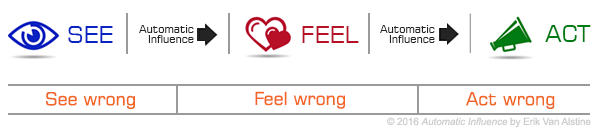
When we start seeing how blind we are, it changes things. We take time to listen, to clarify, to understand. We don’t just listen to be polite. We listen because we want to. We know that we’re making assumptions and mistaking them for facts, and without double-checks and outside help, we’ll make critical mistakes.
As leaders, we need to love and care for those we steward—especially those who are different from us. Our perception of others is what triggers that feeling and behavior in us. What triggers love? “Seeing people are people, of equal value and with equal needs as ourselves. Love is the automatic response to seeing people right. When we see people as they are, we feel love and are motivated to serve people instead of using people or ignore people.”
We naturally seek the maximum good in our lives. That is, the best we can have given the circumstances we perceive. That leaves us wide open to do bad. For the most part, evil leaders—bad characters—are doing what seems right to them based on the reality they see. We all pursue the maximum good as we see it. “It means people can see wrong and feel wrong and act wrong in response, all the while believing they are seeing right, feeling right, and doing right.” Doing wrong can feel right. We deceive ourselves.
Our choices and our need to justify those choices create biases. The long-term effect of that is that we “carry those biases forward to the next situation. Years later, that bias might still be guiding us. Which means there could be hundreds of bad beliefs boxed up in the basement of our minds, distorting the way we see and creating automatic evil.”
What do we do? We need to carefully manage our attention. Stay focused on the right things. Widen our perception through constructive feedback. Our minds filter what we see. We don’t see everything. There is our perceived reality and our ignored reality. As a result, “there’s a really good chance that we’re seeing the wrong things, that our way of seeing is sabotaging our highest and best, because we don’t have the right information.” Or we choose to ignore it.
Another way is to abandon happiness as a goal in our life. “Happiness is a secondary and subjective reality that can lure us into thinking we see right when we aren’t.” We can be happy about the wrong things because of how we see a situation in our life. Happiness is driven by the way we see. It comes in the feel stage of the progression.
Our emotions, too, can affect our perception. “Perception is the initial trigger of emotion. But emotion can have a powerful influence on the way we see things next.” So too, with our behaviors. They too can influence the way we see things next.
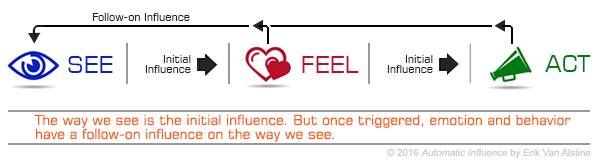
When intervening in situations with others, it is wise to remember the See-Feel-Act Progression. People change for reasons that seem right to them, not you. By asking questions, we can help others build an effective case for maximum good from their perspective. By asking questions, we may guide them through their perceptions and outcomes, as they see it, we can connect them to shared goals.
Van Alstine describes how the way we see automatically influences humility, love, happiness, and energy. Our attitudes, too, are a matter of perception. “An attitude is a pattern of emotion driven by a pattern of perception. Perception is the power source, automatically influencing our attitudes.”
The better we understand the See-Feel-Act Progression, the quicker we can sort out our emotional and motivational lives. And better influence the lives of others for good.
Follow us on Instagram and Twitter for additional leadership and personal development ideas.

Posted by Michael McKinney at 07:05 AM
Permalink
| Comments (0)
| Personal Development

BECOMING teachable and action-oriented clears the way for success. It also sets the stage for The Shortcut by four-time luge Olympian Ruben Gonzalez.
The Shortcut is a business fable full of critical life principles. It is the story of the arrogant and underperforming regional director Johnny Valentine who is on the verge of losing his job. Wanting him to succeed, his boss directs him to the Olympian Café.
The old-world Olympian Café is a place designed around the sharing of timeless wisdom and life-changing conversation. It is here that Johnny meets his mentor, RG. Through a series of conversations, he begins to lay the foundations for success beginning with curiosity (“Always be green and growing.”) and advises him to “find the right leader—someone who has done what you want to do and follow the leader right away, get started, and don’t quit (“If you have to cross a minefield, it makes sense to follow someone who’s already crossed it.”).”
Remember, action produces confidence. Inaction strengthens fear. Every time you take a risk, you expand your comfort zone. Always do the thing that scares you most. All the best things in life are on the other side of that fear.
Don’t be afraid of not knowing. Johnny asks a successful colleague to help lead him out of his old thinking. Through his visits with RG at the Olympian Café, Johnny meets a series of people that share their journeys and the lessons they learned.
Your dream has to become an obsession, or when difficulties arise, you will quit. RG tells him, “When there’s hope in the future, there’s power in the present.”
There can be miracles if you believe and if you’re willing to take massive action. But you have to be willing to go through the struggle if you want to taste the sweet taste of victory. I see people everywhere seeking to live balanced lives. What they don’t realize is that the only way to move up to another level, the only way to achieve their dreams, is to get temporarily unbalanced. You have to temporarily give things up to get to the next level. The faster you want to progress, the more unbalanced you need to get.
Success is simple, but it’s not easy. You’ll constantly be subjected to tests of persistence and courage as you pursue your dream. It’s going to take everything you’ve got. But the good news is you have what it takes. If it truly is your dream and if you persist, the dream will reveal its secrets to you. It will. Find the right leader, follow the leader, then be the leader.
That’s the shortcut to success.

Follow us on Instagram and Twitter for additional leadership and personal development ideas.
Posted by Michael McKinney at 06:50 AM
Permalink
| Comments (0)
| Personal Development
PROBLEMS come our way. They always do. And too little of the associated stress is not good. We become disengaged, demotivated, and unfulfilled. But with too much stress we become overloaded, and we just feel like shutting down. But in between is the Challenge Zone.
International crisis management specialist Ben Ramalingam writes in Upshift: Turning Pressure into Performance and Crisis into Creativity, that between the two extremes is the “sweet spot” where we experience a healthy level of stress.
We start to move toward this sweet spot when we switch from perceiving a stressful situation as a challenge rather than a threat. This is where we start to move from the left- or right-hand below-par-performance sides into the peak-performance zone. We click into being at the top of our game: into Upshifting.
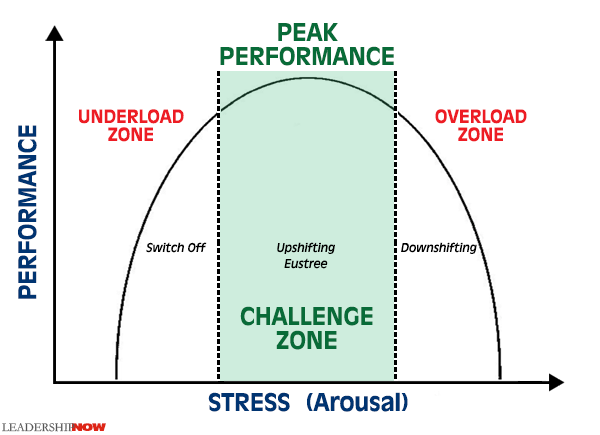
Necessity is necessarily the mother of invention. “Evidence and experience suggests that most of the time, the pressure of necessity actually leads us to convention, not invention. When we are under pressure, most of us gravitate towards the safe, the tied and tested.” We actually need three ingredients to capitalize on necessity and turn it into peak performance: Mentality, Originality, and Purpose. When all three are present, we have Upshift.
The Upshifting Mentality
The upshifting mentality is the switching process. We have all formed over time how we deal with stress. “A threat is a stress that we feel we can not handle, because we do not feel we have the resources to meet the demands of the situation.” How we see a circumstance in our mind determines how we react to it. We have mindsets anchored in beliefs that cause us to see stress as enhancing or debilitating. It is a mental game. It is something that we deliberately learn, practice, and improve on.
Exposure to adversity in moderation can develop the mindset we need to cope with future pressure situations and give us an enhanced stress inoculation. We develop this naturally from early on through play-fighting.
Original Thinking Under Pressure
What we’re looking for here is divergent thinking—the ability to explore multiple possible solutions in order to generate creative ideas. This is opposed to convergent thinking, which is the process of figuring out the most effective answer to a problem.
Divergent thinking is more likely “when we appraise a situation as a challenge. Being in a challenge state means we are more willing to explore possibilities.”
Purpose
A purpose in our lives creates meaning in our circumstances. What we all need is not a tensionless state but, as Viktor Frankl stated, “the call of a potential meaning waiting to be fulfilled by us.”
Harvard professor Teresa Amabile “found that in situations where pressure can’t be avoided, you can get people to be creative by instilling a meaningful purpose, where they have a sense that there is an important, urgent need for the work they do. As Amabile puts it, ‘Often we have no choice about being under the gun. But if we want to be creative, we have to learn to dodge the bullets.’”
Upshifting is not a given. It is a repeatable set of behaviors that, over time, become engrained habits, ways of thinking and relating, and, ultimately, a way of being.
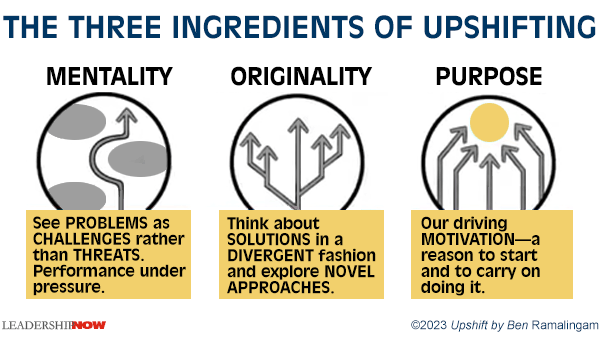
Six Upshift Archetypes
As Ramalingam points out, “Upshifting builds on our individual and distinctive problem-solving skills and styles.” He has identified six Upshift archetypes, which he discusses in detail, sharing examples of individuals who share those characteristics.
They are:
Challengers—preferred by those of us who are skilled in constructively disrupting the status quo around us. Social activist Rosa Parks.
Crafters—understand and experiment with social, physical, and technological processes. Inventor Thomas Edison.
Combiners—those who fuse ideas from disparate fields and endeavors. Inventors the Wright brothers.
Connectors—create bridges and networks between different kinds of people with no sense of social hierarchy. Revolutionary Paul Revere.
Corroborators—push for logical and critical thinking to prove that new ideas work—or don’t. NASA mathematician Katherine Johnson.
Conductors—orchestrate different minds to bring about change. President Abraham Lincoln.
Which approach do you habitually turn to?
Follow us on Instagram and Twitter for additional leadership and personal development ideas.
Posted by Michael McKinney at 08:06 AM
Permalink
| Comments (0)
| Personal Development
NO MATTER WHAT you are doing, you can be motivated by the work you do. Even if you hate your job, you can learn to love any activity. The key is to create excitement around the experience of doing what you do – intrinsically. It is an inside job.
Performance coach Stefan Falk has written Intrinsic Motivation: Learn to Love Your Work and Succeed as Never Before to help you do just that. We can learn to love any activity by rewiring our brains to Focus on Exciting Outcomes or FEOs.
The foundation for doing that is found in five success principles that have worked for Falk and others he has shared them with:
The end goal of all of these principles is to cultivate excitement which enables you to love what you do. We sabotage ourselves when we make excuses for not loving our work. The most common excuses are too much to do, too stressed, poor relationships, and unfair performance assessments. There are toxic work environments that reflect on where you work and not why you hate your work. Falk says, “unless you are in an exceptionally bad working environment, in which case you should leave, your excuses are obstacles of your own creation.”
So, what’s the answer to this conundrum? The answer is in learning to master your mind. Falk offers “proven step-by-step tools and approaches that will make it easier and less energy-consuming for you to master your mind and to think and act deliberately in your professional life.”
To get your head around how to make Exciting Outcome-Focused Behavior or FEOs part of your normal way of operating at work, you need to understand that your work tasks have nothing to do with whether you love them. What makes a work task or activity lovable is how you think about the result you want to achieve. The more exciting that result is to you, the more time you’ll spend thinking about how to best perform that activity.
What makes this so difficult to do is that we too often think of work as work and not something we are to enjoy. And we (and our organizations) are activity focused.
Organizations thrive on activity-based goals such as “Develop the process for customer complaints,” “Move our data to the cloud,” or “Execute our digital transformation.” The common denominator among almost all company goals is their lack of clear and exciting outcomes. Most professionals are evaluated and rewarded based on whether they have executed an activity and not on what they achieved by doing so.
We have the power to think about our work in ways that make it lovable. Every task can be made interesting because every task has endless complexity and can be performed with endless variations. That, of course, requires that we overcome our reluctance to expend energy on deliberate thinking. For example, Falk considers the simple task of asking a colleague for information. We might ask ourselves:
• What exactly do I need to know, and how do I express it?
• Why is it important for me to know this, and is this the right time?
• Is my colleague the right person to ask, or are there others who are more suitable?
• Is there anything I need to know that is available in ways other than talking to this colleague?
• If talking to this colleague is the best and most efficient way to find out what I need to know, how do I organize the conversation so that I minimize use of my colleague’s time?
• Is there anything I can do that will make my colleague feel that he or she has gained something from the conversation?
That is certainly intentional thinking.
Falk then offers chapters discussing approaches to our work arranged from easy, moderate, and demanding to implement. These include:
• Set expectations every day and bring home something exciting and interesting to tell your kids
• Pursue a daily theme that excites you
• Create a time budget and track your time every Define your most important goals for every workday
• Set weekly or monthly stretch goals for skill development and effectiveness
• Don’t participate in negative talk
• Develop aspirations for how you want to be perceived
• Make a habit of asking for feedback
• Don’t avoid difficult people; embrace them
• Develop your people into stars
And many more.
Intrinsic motivation happens when you feel challenged. You will need to constantly increase the complexity and challenge of your work. The way you perform your tasks can always be improved, even if you perform them well. To be an intrinsically motivated person, you will need to look for moments when you should be challenging yourself rather than performing on autopilot.
No workplace, good or bad, will matter if you haven’t mastered your mind. That said, a good workplace will make it easier to engross yourself in your work. More importantly, you should look for an organization that is “designed to enable its people to experience a sense of autonomy.”
Follow us on Instagram and Twitter for additional leadership and personal development ideas.

Posted by Michael McKinney at 07:11 AM
Permalink
| Comments (0)
| Motivation
, Personal Development
THE SCOTTISH POET Robert Burns wrote, “The best-laid schemes of mice and men often go awry,” in a poem to a mouse whose nest was disrupted by the plow. The implication is that things rarely go just the way we want.
Disruptions fall all along the spectrum from “the whatever” to “the paralyzing.” From my-coffee-is-too-hot to the death of a loved one; from the game was canceled to a divorce. Some we quickly move past, and some stop us dead in our tracks. Some disruptions are predictable and some we never saw coming. But they all make us uncomfortable because something is not going the way we planned it. And it seems no matter what we do, we are frustrated by our inability to control it. The world doesn’t always bend to our wishes. Things don’t always go the way we planned them to go for absolutely no good reason. Events happen for which we have no good explanation.
King Solomon also reflected on the same thought in his book Ecclesiastes. He wrote:
I returned and saw under the sun that—The race is not to the swift, Nor the battle to the strong, Nor bread to the wise, Nor riches to men of understanding, Nor favor to men of skill; But time and chance happen to them all.
It’s a good description of the world we live in. It’s not very logical. It’s not very hopeful. It doesn’t always make sense. Sooner or later, bad luck hits us all. It doesn’t matter who (or what) you are—man or mouse—disruption is a way of life. From the disruption of birth to the disruption of death, life is full of change. Wanting things to go our way, we fight against these disruptions. We get angry, we blame, and we get depressed, and we ask, “Why is this happening to me?” We fight against whatever is making us uncomfortable. We want it to end so we can get back to the way we were.
But we can’t go back. Disruptions either change us or they leave us stuck going nowhere. If our emphasis in life is to hang on to what we have, what we are, then one day we will find ourselves running on empty, living meaningless lives.
For some disruptions, it is fair to say, “Get over it,” and move on. For others, something much deeper needs to happen, more akin to healing. But whether the disruption is big or small, there is a quality that is critical to our success that connects them all. Our ability to deal effectively with any disruption is determined by how resilient we are.
A good definition of resilience is our capacity to maintain our core purpose and integrity in the face of dramatically changed circumstances.
Resilience is our ability to roll with the punches and deal with these disruptions in a more positive and creative way. I remember my parents telling me, from early on, to roll with the punches—don’t let situations knock you off course. It’s the idea that your circumstances don’t determine your future. Resilience is our ability to bounce forward no matter what life throws at us. And I say bounce forward because, as we all know, most disruptions leave us nothing to bounce back to. Who and what we were has been forever changed.
Resilience means learning to deal with the uncertainty of life as a given. We should anticipate our plans going awry and prepare for it, but most of us are not remotely prepared to deal with real disruptions. Sidestepping a disruption in our life makes us more vulnerable to the next one.
The mistaken impression that life should always be happy does not prepare us for the tragedy and danger of this world. When something goes wrong, we want someone to fix it. We lack resilience.
A bubble-wrapped life is a fragile life. The most comfortable life is the most fragile and the most likely to collapse under stress. In our comfort, we don’t build the resilience we need to deal with life. So, when someone or something suddenly messes with our plans, we are hit harder by them because we lack the skills and mindset to deal with them. The Roman statesman Cato thought that almost any form of comfort as a road to waste—a road taking us nowhere.
A resilient person is not fragile. A resilient person leans into the problem. As a result, the resilient person actually lessens the time they spend learning and healing. They move through the stages of grief more quickly.
Resilience doesn’t come easy, and it is built over time— difficulty by difficulty—but it requires a shift in our thinking. We must see difficulties differently if we are to build resilience and the capacity to grow from them. The suggestion here is that when you are faced with a problem, there is something of value going on.
We need to shift our thinking about problems and disruptions for a good reason. It builds perseverance and resilience. Problems are tests. And like any test, it is designed to help you see where you stand. The way we think about a problem—our attitude about a problem—will determine how we handle the problem.
Resilience is rooted in our belief system. How we come out on the other side is determined by our attitude. For most of us, that is a huge shift in our thinking because what we want to do is to fight against any disruption and any uncomfortableness to make it go away.
This shift requires that we get out of our own heads and see our life from another perspective. It doesn’t mean that we are happy about the problem, but that we can be happy in the problem.
It means that we own the problem. We meet it head-on, and we use it to our benefit. It changes not only our perspective on problems but our perspective on life. We will face adversity and challenges of all kinds. Our future depends on our ability to bounce forward.
Follow us on Instagram and Twitter for additional leadership and personal development ideas.
Posted by Michael McKinney at 09:31 AM
Permalink
| Comments (0)
| Personal Development
WHEN WE THINK of success and influence, there’s more to it than just IQ and EQ. What pulls it all together and contributes to our ability to show up and achieve our goals is the sum total of our experiences and what we take away from them. What we’re talking about is our Experiential Intelligence or our XQ.
In Experiential Intelligence, author Soren Kaplan describes XQ as “the combination of mindsets, abilities, and know-how gained from your unique life experience that empowers you to achieve your goals.” He adds, “XQ provides a holistic way to understand what’s needed for success in today’s world by getting in touch with the accumulated wisdom and talents you have gained over time through your lived experience.”
Lessons learned from our experiences alone do not make for Experiential Intelligence alone. XQ is a framework that provides a lens through which we can view our experiences. We create meaning or intelligence through a process that is based on three elements or building blocks:
Mindsets: Your attitudes and beliefs about yourself, other people, and the world. These attitudes and beliefs can either get in your way or propel you forward. When you fully tap into your XQ you’re able to uncover the self-limiting belief you hold.
Abilities: Your competencies that help you integrate your knowledge, skills, and experiences so you can respond to situations in the most effective way possible. “Abilities are specific competencies that bridge your mindsets with your know-how. Your abilities represent broader approaches to how you do what you do, so you can apply what you know how to do in different contexts. Your mindsets guide what you see as possible as desirable, which influences where and how you decide to apply your abilities.”
Know-How: Your knowledge and skills. This includes both formal education and tacit knowledge that is learned through practice or performing.
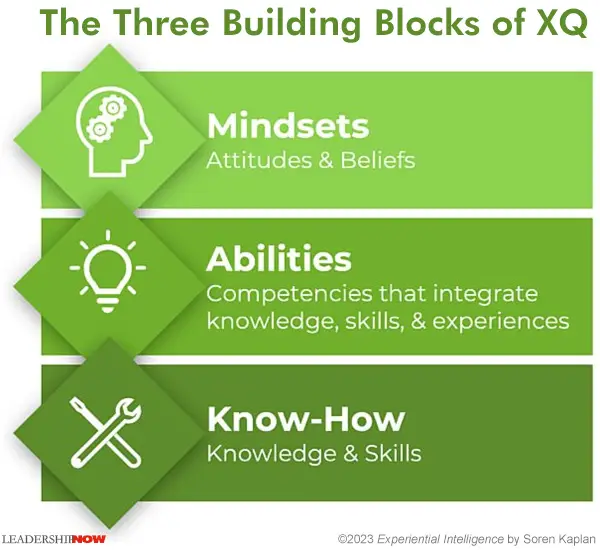
Mindsets, abilities, and know-how collectively comprise XQ. When we treat these components as building blocks, with know-how as the base, abilities in the middle, and mindsets at the top, we get a progression from the tangible to the more amorphous when it comes to self-awareness. Understanding that you possess certain knowledge and skills generally comes more easily than seeing your broader abilities. Recognizing that you possess specific mindsets that influence your thinking and behavior is even more challenging.
You can grow your XQ. Unfortunate experiences in your life can prepare you for a better future. “Embracing your XQ means looking for the unrealized assets you already possess and you’ve developed because of your experiences, whatever they may be.”
You grow your XQ in three ways: Reinventing your attitudes and beliefs (mindsets), Enhancing your abilities, and Building your knowledge and skills. Going deeper into your mindsets is the powerful thing you can do to drive significant change and breakthroughs.
Look for connections you have made between things that don’t belong together. Look for links between your past experiences and how they influence you today and decide what to keep and what to let go of or reframe. It usually requires taking a broader view of your experiences.
Kaplan provides specific questions and methods to dig into each of the three areas. Online you can take the XQ Assessment.
Kaplan also goes into developing for your team and organization using five strategies: Connecting the dots to find focus, Rewriting unwritten rules, Exploring uncertainty to discover new opportunities, Crating experiences to spark positive change, and Amplifying strengths to amplify impact.
Properly understood, XQ goes beyond just finding more creative solutions but grows your influence and gives you a better lens to hire and develop people for and in your organization.
Follow us on Instagram and Twitter for additional leadership and personal development ideas.


Posted by Michael McKinney at 07:38 AM
Permalink
| Comments (0)
| Personal Development

CHAOS and uncertainty are a part of life. Are you making the most of it?
To make the most of a turbulent world we need to be able to balance our emotions with a rational and deliberate thought process in real time that allow us to learn and thoughtfully and creatively move through the circumstance or what authors Jacqueline Brassey, Aaron De Smet, and Michael Kruyt, call Deliberate Calm.
Here’s the problem. At the very moment, we need to thoughtfully address the situation and select the behavior best suited for it, we instinctively do the opposite. In Deliberate Calm: How to Learn and Lead in a Volatile World, the authors refer to this as the Adaptability Paradox: “ At the very moment when we need to break free from our habitual patterns and creatively engage with the unfamiliar, complex, or uncertain situation and choose a new and innovative response, it is the very unfamiliarity, complexity, and lack of certainty that render us unable to do so.”
Deliberate calm is about adaptability and self-mastery. It is about awareness, learning agility, and emotional self-regulation.
Beneath the surface of our behavior is our core identity, made up of thoughts, feelings, and beliefs that we have developed and refined since childhood. Negative self-talk only reinforces this. Together they form the foundation of the mindset that sets in motion our behavior. Mostly this seems to work for us. It seems to protect us and our core identity. But in volatile situations, our ingrained reactions cause us to miss opportunities to learn and grow in more productive ways. The ability to detach ourselves from our thoughts and feelings is the first step forward. We need to develop Dual Awareness.
Dual Awareness is having an “awareness of both our external and internal environments and how they impact each other.” Being able to do this means “we can recognize that our intense feelings are actually gifts. They are messages telling us that our typical behaviors may not be the best fit for the situation we are facing.” Dual Awareness has three layers: awareness of the situation and what it calls for, awareness of what is going on for you in the moment, and then responding effectively as a result.
This helps us to recognize when we have entered an Adaptive Zone. In this zone, “we are facing challenges that require us to do something new that isn’t easy or natural for us to do, and if we fail, there are real consequences. The circumstances have outgrown our existing capabilities, and our normal habits, patterns, and behaviors no longer work for us the way we need or want them to.”
When faced with an Adaptive Zone, it is time to shift into learning mode. Our default mindset can create blind spots.
In those moments, however, we can accept and acknowledge our limited view, learn from the experience of others, and try to see things through their lens, we will expand our view of the world and solve far more complex problems than we ever could on our own.
The question then becomes, “What would I need to believe in order to respond differently?”
When we find ourselves in an Adaptive Zone, it is common “for all of us to blame others for our problems when we are in protection and operating from our default mindset and behavior patterns. We believe that the way we are seeing things is objectively true, so we do not look inward and examine other possibilities or the ways in which our own point of view might be skewed. This leads us to blame others or circumstances outside ourselves for our problems instead of taking ownership and finding ways we can change to create a better outcome.”
We easily cling to what we know and what has worked for us in the past in the face of uncertainty, even though it is not working because it is comfortable and gives a sense of control.
Having an overriding purpose helps us to remember why we do what we do and helps move us out of the familiar and embrace the Adaptive circumstance we face and learn from it.
When two different mindsets collide, we typically find conflict. But “when handled well, with an open mind instead of judgment, defensiveness, or blame, conflict can in fact, be a major catalyst for learning.”
Without Dual Awareness, we run the risk of being triggered in a state of protection, judging and blaming others, and beginning to form negative opinions about them. Then we perceive what they say and do in light of those opinions.
And when we constantly look for confirming evidence of our opinion through the very lens that created it, there is no doubt that we are going to find it.
Instead of blaming each other and looking for evidence of our own prejudgments, we start to see each other more fully as complete, complex, three-dimensional humans whose behavior in a given situation might reflect something much more complex than what we see on the surface. This often starts to promote more understanding, trust, empathy, and intimacy as we feel more comfortable sharing deeper elements of who we are.
The path to practicing Deliberate Calm is to “consciously design your life so it is easier to remain grounded and present no matter what is going on around you.” The Deliberate Clam model rests on four pillars: awareness, purpose, relationships, and energy. The book’s appendix provides a way to access where you are and create daily practices that will help you develop your Deliberate Clam muscle.
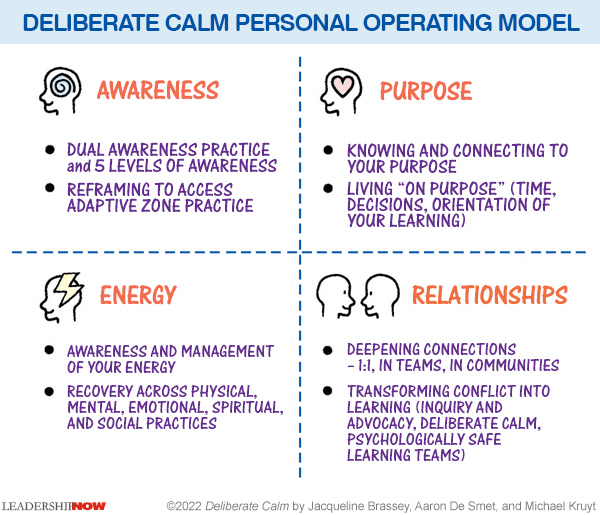
Follow us on Instagram and Twitter for additional leadership and personal development ideas.

Posted by Michael McKinney at 07:26 AM
Permalink
| Comments (0)
| Personal Development

IN 1954, Dr. Julian Rotter began measuring what he called a student’s locus of control. He said you either had an external locus of control or an internal locus of control.
Those with an external locus of control believe that fate or external forces control the outcomes of their lives. Life is happening to me. They are so busy reacting to life that they’ve turned everything over to others—it is someone else’s responsibility. For example, to say, “A professor gave me a bad grade,” reflects an external locus of control. This happened to me. “They did this, so I had to do that.”
People with an internal locus of control are people who believe that they are responsible and in control of their own success. They take personal responsibility. “I own this.”
Your perspective on a problem will determine your experience in dealing with it. Your experience is based on your perspective. You usually can’t control what is happening to you, but you can control your perception of it and, thus, how it affects you. If you have an external locus of control, then you flat-out don’t believe that.
You need to shift your focus. It’s not an easy shift to make. I know. It is natural to turn inward when in the midst of a problem or disruption. But the way out, the way to healing, is to see your problem as part of a larger whole—a different context. We must expand our thinking.
Every problem has the potential to give you a firmer foundation from which to deal with the next disruption. It builds resilience.
To get where you want to go, you’ve got to go through the stuff that you’re in the middle of. Perseverance implies a process—a journey. And it is in that journey, if we stick with it—if we persevere—that we develop maturity and completeness. Our tendency in this journey is to try to avoid all of the discomfort, disruptions, and problems that come our way. We fight against it.
We need to reframe that. It’s not about what you are fighting against but rather understanding what are you fighting for?
We are fighting for resilience. We are fighting for strength. We are fighting for perseverance. We are fighting for patience. We are fighting for growth. We are fighting for hope.
Instead of asking, “Why is this happening to me?” ask, “Why is this happening for me?” You can redeem your circumstance. So many times, I think all of us can look back and think, “Wow. I would never have become the person I am today without what happened to me. I wouldn’t have chosen it. I wouldn’t wish it on anyone else, but it built something valuable in me. And I’m better for it.”
Follow us on Instagram and Twitter for additional leadership and personal development ideas.
Posted by Michael McKinney at 08:47 AM
Permalink
| Comments (0)
| Personal Development

STUDIES have shown that humility is one of the most important characteristics of successful leaders. A leadership expert wrote in Forbes magazine that “humble leaders listen more effectively, inspire great teamwork, and focus everyone (including themselves) on organizational goals.”
The leader’s strongest tool is humility. It intensifies credibility.—John Dickson
When I left the White House to work at the State Department protocol office, I was honored to bid farewell to President Reagan in the Oval Office in a “one on one.” (There’s actually a video of it floating around the internet—a little embarrassing since I fawned over him, but I meant every word I said and will remember the experience forever.) At the end of that special meeting, he presented me with a replica of the plaque displayed on his desk:
There is no limit to what a man can do or where he can go, as long as he does not care who gets the credit.
I took those words to heart, although sometimes it can be hard to live up to such an ideal. I often reflect on Reagan’s example of humility and generosity of spirit. He was an extraordinary human being and larger than life—a former movie star, governor of California, and ultimately leader of the free world—but he treated everyone with respect and courtesy and made everyone feel valued. He was not falsely modest—Reagan was aware of his exceptional gifts, his purpose, and his significant role in history—but he was, deep to his core, a gracious and humble man.
One of the most approachable leaders I had the pleasure of working with was Nelson Mandela. My friend Bill Sittmann (may he rest in peace) was the executive secretariat at the National Security Council in the George H. W. Bush White House. Nelson Mandela had been recently released from his long prison term in South Africa. I had just started my business, Practical Protocol, so Bill referred me to the group organizing Mr. Mandela’s visit to the United States. They hired me to organize the visits to the White House, the State Department, and Capitol Hill.
It was a tremendous honor and incredible opportunity to spend just a little time with the Nelson Mandela. Was he as advertised? Absolutely. Charming, kind, soft-spoken, and very approachable—in a word, humble. Even then I could feel how lucky I was to have the chance to work for and to serve such amazing individuals. I was deeply humbled in the process.
Think of other great leaders: Martin Luther King Jr., Gandhi, Mother Teresa, Abraham Lincoln. None of them believed they were more important than their messages, nor more valuable than those who followed them. They engaged, empowered, and inspired others because they were humble. They lived to be in service to others. They did not seek credit or admiration for their work, but neither were they weak or passive. Their humility supported a boundless strength of character that created the environment for so many people to trust in them, believe in their causes, and help them achieve their goals.
We might think that humility is the opposite of hubris (excessive pride or self- confidence; arrogance that ultimately leads to a downfall). However, we can think of humility as the ballast or center of a seesaw. Humility balances out the extreme characteristics of hubris and lack of self-worth. We are at our best selves when we understand that we are “not nothing” but rather that we are “not everything”! We are just one part of a larger part of the infinite.
People with hubris arrogantly believe that their way is the only way and that they are the only ones who know how to accomplish something. Shakespeare’s Macbeth is a classic literary example of hubris and its consequences. Today, we might point to the despicable Jeffrey Epstein as the ultimate symbol of hubris. He and those he collaborated with thought themselves untouchable. We see what became of him. As of this writing, we have not yet witnessed the inevitable downfall of all those associated with him. There will be a price to pay for hubris—there always is.
Humility doesn’t require us to abandon our self-confidence; Lincoln was not insecure, and he knew he was up to the task. But he respected and appreciated the strengths of others, and always sought the counsel of his cabinet before making a significant decision. A recent study found that gratitude and humility are self-reinforcing. If we are truly grateful, we receive an understanding of our place in the mix of all humanity. Offering our best qualities to the world while honoring those of others can humble us and help dissipate the destructive energies that are taking up so much space in the world. Humility doesn’t care about winning points, keeping score, or seeking approval from any outside source. The same can be said of the civil life in general: civility isn’t about getting credit for doing the right thing. To me, it’s about developing character and integrity that resolutely reside within us and then listening to that inner voice, our conscience. If we do this, with none the wiser, we succeed in exhibiting what I now consider the core component of civility: humility.
Follow us on Instagram and Twitter for additional leadership and personal development ideas.

Posted by Michael McKinney at 10:07 AM
Permalink
| Comments (0)
| Leading Views
, Personal Development
LEADERSHIP is all about relationships—even difficult ones. It would be great if we got along with everyone, but not everyone we encounter makes that easy. At one time or another, we all run into difficult people. Sometimes they are just difficult, and sometimes we make them that way.
Amy Gallo shares insights and approaches for dealing with the difficult people in your life in Getting Along: How to Work with Anyone (Even Difficult People). In this excellent reseource, she offers research-based advice to help us not just to navigate the situations made difficult by people in our lives but to transform them into positive, constructive relationships. All relationships can change over time, even the good ones. And most can be transformed for the better if we are willing to put in the time and effort.
The general lack of empathy we see today only complicates this situation. It is important to reframe the difficult situation to see it from the other person’s point of view. In this key insight, Gallo says when faced with a difficult person, “You must create the necessary space to choose a response that will result in growth instead of conflict.”
Gallo covers in detail eight types of difficult people we might encounter. And some people display more than one. She provides helpful dos and don’ts for dealing with each type.
The Insecure Boss – “I’m great at my job … right?”
We all have times when we wonder if coworkers think we’re smart, if we have what it takes to nail a presentation, if we said something wrong in a meeting, or if strangers are judging the way we dress or look. While feeling insecure at times is natural, problematic behaviors include micromanaging, unfairly criticizing others, or constantly seeking reassurance when people attempt to conceal or compensate for their self-doubt.
The Pessimist – “This will never work.”
There are a lot of reasons that pessimists see the world the way they do, and gaining a deeper understanding of what makes them tick can help. For instance, defensive pessimists—those with a negative outlook who feel they can do something about it—can be helpful. Their worry enables them to take preventative steps. It’s easy to get dragged into a pessimistic colleague’s outlook. You may become demoralized, worry about negative consequences more than ususal, or start to feel like your actions won’t make a difference at work.
The Victim – “Why does this always happen to me.”
People who think of themselves as victims share several key traits with pessimists, but they believe other people or circumstances are at fault for the disappointing or distressing outcomes. Victims are often consumed by who is to blame, which never happens to be them.
The Passive-Aggressive Peer – “Fine. Whatever.”
Gabrielle Adams, a professor at the University of Virginia who studies interpersonal conflict at work, defines passive aggression as not being forthcoming about what you’re truly thinking and using indirect methods to express your thoughts and feelings. Often it’s driven by the fear of failure or rejection, s desire to avoid conflict, or a drive to gain power.
The Know-It-All – “Well, actually …”
Unfortunately, this archetype has likely persisted, not just in workplaces but in society, because we often reward overconfidence. If people who were humble and admitted that they didn’t always have the answers regularly rose to power, perhaps fewer of us would have stories to tell about know-it-alls in our lives. But we love confidence—in ourselves and in others.
The Tormentor – “I suffered, and you should too.”
A “tormentor” is a senior person (sometimes your boss and sometimes not) who has earned their way to the top, typically making sacrifices along the way, and then mistreats others below them. They appear motivated by the idea that because they suffered, you should too.
The Biased Coworker – “Why are you so sensitive?”
Prejudice can be expressed in explicit and implicit ways. Deciding if, when, and how to confront discrimination is complex, especially because you may fear that you’ll be penalized for how you handle it. However, the responsibility for addressing bias shouldn’t fall to those who are on the receiving end, and delivering feedback can sometimes be the right thing to do.
The Political Operator – “If you aren’t moving up, you’re falling behind.”
Everyone must engage in office politics to some degree. We need to advocate for our ideas and our accomplishments to secure support and funding. However, it’s different if your colleague is fixated on getting ahead and has a take-no-prisoners approach.
She offers nine principles for getting along with anyone, and for me, this is the essential section of the book.
Principle 1: Focus on what you can control
People change if they want to change, so focus on what you could do differently. Gallo writes, “I’ve been in many situations where I thought, If I can just explain this to the other person, surely, they’ll understand. We’ve all fantasized about saying or doing the perfect thing that forces a rival to see the light, to realize the error of their ways and vow to completely reform.” It is a fantasy. She adds a thought from Adam Grant, “All I can do is try to understand their thinking and ask if they’re open to some rethinking. The rest is up to them.”
If your strategy for getting along with another person depends on them changing, good luck with that.
Principle 2: Your perspective is just one perspective
It is not realistic to expect that you will see eye-to-eye on everything with others. “Naïve realism is the tendency to believe that we’re seeing the world around us objectively, and if someone doesn’t see it the same way, they’re uninformed, irrational, or biased.” Then there is the fundamental attribution error that assumes a person’s behavior is a result of their personality rather than the situation they find themselves in. As a result, we tend to make assumptions about others that are not true, and reaching an agreement on the “facts” is highly unlikely. My view is just that—my view.
Gallo recommends, “Instead of rehashing the past—a tactic that usually leads to nothing but hard feelings and deadlock—try to focus on what should happen going forward.”
Principle 3: Be aware of your biases
Our interactions are shaped by our biases. “Even our definition of ‘difficult’ behavior can be shaped by the prejudices that we carry into the workplace.” Know your biases, so you can monitor them more closely.
Principle 4: Don’t make it “me against them”
“If it is ‘me against you,’ the situation becomes polarizing. There’s someone who’s being difficult and someone who isn’t, someone who is right and someone who is wrong.” To move past this thinking, “Imagine that there are three entities in the situation: you, your colleague, and the dynamic between you.” In this way, you can separate the people from the problem.
Principle 5: Rely on empathy to see things differently
“We often perceive slights to be worse than they intended to be.” We make ourselves the victim. We all “make erroneous attributions about each other’s intent to do harm, how much harm was caused, how severe the issue is, how guilty the other person feels, etc.” This is not only unfair, “But it nudges you toward wallowing, revenge, or other unproductive responses rather than getting along.” Give the other person the benefit of the doubt. See the situation from the other person’s perspective.
Principle 6: Know your goal
When addressing a difficult situation, know what you want. “Identifying your goal will help you avoid getting pulled into any drama and stay focused on constructive tactics.”
While you may say your goal is to get along, your hidden agenda—payback for example—will “color your interactions, causing you to use language or a tone that is excessively critical or condescending, compromising your ability to achieve your stated goal.”
Principle 7: Avoid gossip, mostly
Notwithstanding studies that indicate, on a positive note, that gossip may keep people from behaving selfishly or badly because they don’t want others talking badly about them, I believe gossip should be avoided at all costs. Gossip divides, diminishes others’ ability to change, infects others with your biases and interpretations, and can destroy your ability to heal a relationship. Gossip is not a good basis for building and maintaining relationships.
Principle 8: Experiment to find what works
There isn’t one right answer. Improving a relationship will “feel far more manageable if you start coming up with two or three ideas you want to test out. Often, small actions can have a big impact.”
“Keep refreshing the approaches you try and be willing to abandon ones that aren’t producing results.
Principle 9: Be—and stay—curious
In any relationship problem, “it’s easy to tell yourself, ‘This is the way it’s always going to be’ or ‘Why should l expect them to change?’ or ‘We just don’t get along.’ I won’t tell you that it is going to be fun or even pleasant to do what you need to do to salvage a troubled relationship, but complacency and pessimism will get you nowhere. Instead, adopt a curious mindset.”
Gallo advises, “Assume you have something to learn and believe that the negative dynamic can turn around.” Approach difficult relationships with a growth mindset.
Follow us on Instagram and Twitter for additional leadership and personal development ideas.

Posted by Michael McKinney at 06:00 AM
Permalink
| Comments (0)
| Human Resources
, Personal Development
EVERY organization needs leadership. Whether you work in small enterprising entrepreneurship or a Fortune 500 conglomerate, sound leadership is required for progress. Experts will agree that effective leaders must have superior qualities, skills, and talents that influence the workforce to complete the organization’s mission efficiently and effectively. Regardless of the organization’s vision and mission statement, leadership is a fundamental requirement.
The TEAM LEAD Model of Self Leadership by Joe Wolemonwu offers an eight-step model that gives every leader the tools to move their agency forward.
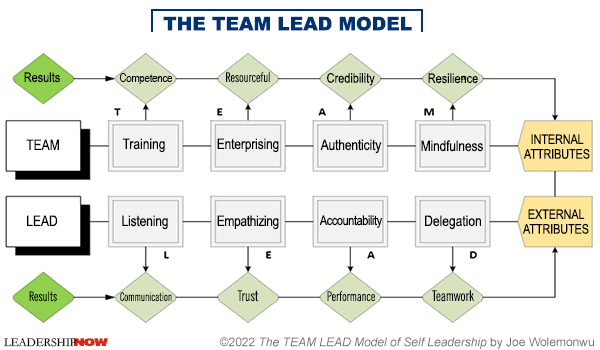
T.E.A.M. L.E.A.D. is an acronym for Training, Enterprising, Authenticity, Mindfulness, Listening, Empathizing, Accountability, Delegation. This model identifies eight leadership requirements, accomplishments, and skills a leader must have to be effective. In essence, this model offers a quicker rate of acceleration in all quadrants of the organization by the consistency of the leader’s conviction and commitment to excellence.
A leader must possess all of the eight core T.E.A.M. L.E.A.D. attributes to be more effective. The Team Lead concept is a self-leadership approach to leading a team. Four attributes with the acronym T.E.A.M. and internal attributes the leader must possess, while the remaining four L.E.A.D. show external attributes that enable the leader to lead the team effectively.
Training enhances performance, grows knowledge, makes a leader Competent, and boots productivity through learned skills.
Enterprising develops a leader’s capacity to generate ideas and skills that make them creatively Resourceful. A resourceful leader always finds a way to take advantage of a situation.
Authenticity gives a leader Credibility and makes people appreciate your leadership.
Mindfulness creates Resilience and happiness and increases productivity. It helps regulate your emotions. It enables you to have a greater level of emotional intelligence.
The second part begins with Listening. Listening helps a leader Communicate effectively and makes them more charismatic by keeping them engaged and makes them more charismatic by keeping them engaged in a conversation. It helps improve the leader’s relationships with others.
Empathizing with others helps build Trust and encourages open communication and effective feedback.
Accountability helps to improve Performance and enables people to be in control of their actions.
Delegation helps promote Teamwork by creating a mentorship environment that supports learning and development with credible skills to grow and work effectively as a team.
T.E.A.M. L.E.A.D. focuses on growing the leader internally first and having those qualities exhibited and passed on to the entire organization as a fundamental recipe for success and progress. As organizations are constantly evolving and transforming as it progresses, the same applies to the leader, who must acquire new knowledge to remain relevant and effective in leading the organization. When an organization stagnates, it dies, consequently failing to produce the goals of its mission. A leader must also intellectually grow while constantly adopting some personal attributes and skills which accentuate goodness and effective leadership.
The most common measurement of a leader’s effectiveness is assessing group performance and the scope to which the goals and objectives of the group are met. The degree to which this can be measured is a strong indicator that leaders can influence their subordinates and lead them to achieve the organization’s strategic objectives. The questions that should be asked to measure a leader’s competency in accountability, for example, are as follows:
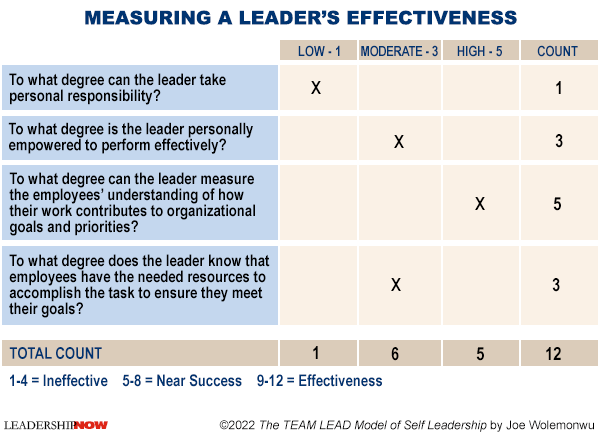
The TEAM LEAD Model of Self-Leadership serves as both a workbook and reference manual. Again, the book shares a reflection leadership concept that most leaders overlook.
Reflective practice accelerates improvement in your leadership skills and enables you to better understand yourself and others. Leadership reflection makes a leader gain a better understanding of themselves (value principles, knowledge, ability, and skills), learn from past experiences, and adapt and respond to new leadership challenges. The Team Lead Model of Self-Leadership is simple to apply but requires a commitment from you to grow yourself. If leaders want to bring out the best in their team, they must first bring out the best in themselves.
Follow us on Instagram and Twitter for additional leadership and personal development ideas.
Posted by Michael McKinney at 08:53 AM
Permalink
| Comments (0)
| Personal Development

CHANGE is frequently a challenge, but in times of wide-ranging, disrupting, unavoidable change, it can be disquieting. Jason Feifer, the editor-in-chief of Entrepreneur magazine, has written a book for anyone facing an uncertain future, not just entrepreneurs. That’s most of us.
Build for Tomorrow is about how we can be good at change—especially change that happens to us—sometimes more like a crisis. When faced with change, Feifer has found that we experience four phases when we are faced with change we didn’t initiate. The question is, how fast will we move from Panic! to Wouldn’t Go Back? Build for Tomorrow is designed to help us do just that.
1. Panic!
Panic is natural, but staying in this stage blinds us. In this state of mind, we can’t accurately see what we are faced with. “We become impatient for solutions, do not consider all the information available, and make counterproductive decisions.”
A couple of the reasons we get stuck in Panic mode is because loss is easier to see and feel than gain. We naturally extrapolate loss, so we must counter it by extrapolating the gain. We also believe that yesterday was better than today.”If we’re surrounded by the belief that yesterday was better, we’ll become less open-minded to future opportunities.”
Sometimes we feel like we got where we are by sheer luck—the right place at the right time. But if we can get some perspective by asking ourselves three questions—What did I overcome? What skill set did I have then that I still have now? And what do I know now that I didn’t know then?—we can build on where we are and move forward.
2. Adaptation
When confronted with change, it is easy to tell ourselves that “something is happening to me.” But that is not a productive thought because it makes us the victim. We feel out of control and acted upon.
We reason that “change is scary because it seems all-encompassing and permanent,” and it will change us in all-encompassing and permanent ways, and as a result, we lose our identity—who are we anyway? But Feifer says, “We are not what we do. We are why we do it.” We need to get to the why.
To adapt to the change we face, we need to widen our bands. Get out of our heads. We tend to think that everyone is thinking like us. They aren’t.
Look beyond the moment. Build for tomorrow. The time to change is not “at the moment of pain—it’s at the moment of awareness.”
Feifer makes the interesting point: work your next job. If we focus only on what we are doing now, we will only be qualified to do what we are doing now. But if we focus on what we could do and learn what we must, then we set ourselves up for tomorrow and the inevitable change that is coming. “Goals can be motivating but limiting. It is a direction but not a map, and it cannot define your whole journey. If you look ahead too narrowly, you’ll miss all of the promising off-ramps in your periphery.”
3. New Normal
The new normal is another temporary state on our journey through life. If we are to embrace a change, we need to “identify parts of our old experience that do not change, and then use them to reframe the new opportunity in front of us.” Some things never change, and they play a part in what is changing.
“You acclimate to a New Normal by seeing things as they are instead of how they were.” Try asking, “What is this for?” Instead of trying to stop or control the impending change, asking what”-is-this-for” opens us up to opportunities and gives us a new purpose and way of showing up in the world. It is a question we should constantly ask about everything we do like, what is your time for? Or What is small talk for? (“Small talk is a way to establish mutually that you’re both people who are capable of interacting.”)
4. Wouldn’t Go Back
What we once thought was impossible is now the real opportunity, and we wouldn’t go back. “True opportunity exists in the unknown.”
To reach our Wouldn’t Go Back moment we must reconsider the impossible. That is to say, we take another look at the things we once discarded—the things we thought were impossible, illogical, too difficult, too radical, too ridiculous to even consider—and explore whether they were the real opportunity all along.
If you’re looking for a competitive advantage, ask yourself, “But Really.” On the surface, we think we know, but really there is something else going on. Only by asking but really, can we drill down to what is the fundamental difference. In your personal life, “I may be dissatisfied with my job, but really I’m being pushed to better identify what I love and how to pursue it.”
Not all change is good, of course, but change is certain. And when it comes, we need to position ourselves to move through the four stages as quickly as possible.
Instead of defining ourselves firmly—I am this, I do that—we must recognize that everything we do, as well as everything we are, is simply the next thing in a long line of next things. Everything is the next thing, part of a continuum of successes and failures are doors opening and closing.
Follow us on Instagram and Twitter for additional leadership and personal development ideas.

Posted by Michael McKinney at 12:19 PM
Permalink
| Comments (0)
| Change
, Personal Development
IN SITUATION after situation, we are faced with the choice of adopting a Learner mindset or a Judger mindset. The Judger mindset comes quite naturally to us. We all do it. And we have Learner moments as well.
The Learner mindset opens us up to possibilities while the Judger mindset leaves us, at the very least, in an unproductive state. The Learner mindset is a choice. The Judger mindset is a reaction to our circumstances.
The trick is to be mindful of the path we are on and make the appropriate adjustment. We make that adjustment by changing the questions we are asking. That is the premise behind Marilee Adams’ book, Change Your Questions, Change Your Life.
Marilee offers a helpful Choice Map to help us to zoom out and look at where we are at any given time and make the most productive choice. As a leader and coach, it is important to understand that “you can’t help anyone from a Judger place.”
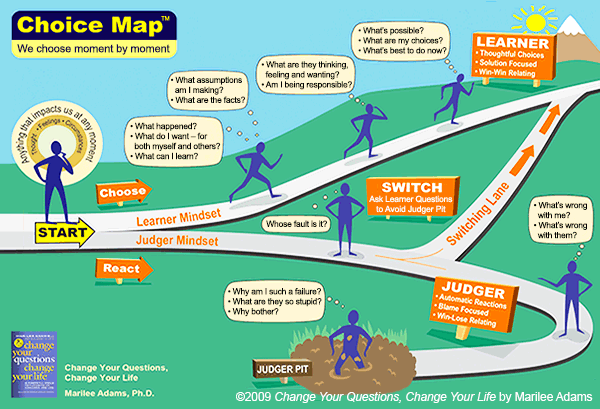
Think of the Choice Map as a self-coaching tool that helps us to be more aware, and that helps us chart more effective paths through our lives—and for getting better outcomes in whatever we do.
We’re making choices moment by moment by moment though we don’t always recognize it. Many of our choices may be embodied within routines or habits we’ve developed over the years, some of them so necessary in our everyday lives that er barely notice they were once choices.
Most of the time, we’re shifting back and forth between Learner and Judger mindsets, barely aware we have any control or choice. Much of what we experience can just seem true or real or logical to us. We go along as if what we experience is the way things are. Real choice begins when we are mindful enough to observe our own thoughts and feelings as well as the language we use to express them.
It is worth rereading that last paragraph. We struggle to grow because, as she writes, “Much of what we experience can just seem true or real or logical to us. We go along as if what we experience is the way things are.” To lead is to be aware of that fact.
When there is conflict, the Judger element is there. “Whenever two people find themselves in conflict, whoever wakes up to their own Judger has the ability to turn the situation around.”
Judgers and Learners ask different questions. If you are on a Judger path, you need to change your questions to switch to the Learner path.
Judger questions constricting questions and sound like this:
What’s wrong with me?
Whose fault is it?
Why am I a failure?
Why can’t I do anything right?
Why are they so clueless and frustrating?
Haven’t we already been there, don’t that?
Why bother?
On the other hand, Learner questions are expansive, energizing questions that sound like this:
What happened?
What do I want?
What’s useful about this?
What can I learn?
What’s the other person thinking, feeling, and wanting?
What are my choices?
What’s best to do now?
What’s possible?
With the Judger agenda, the costs can be tremendous. The future can only be a recycled version of the past. If you’re working from the Learner program the power is on. The juices is flowing. You can make a new future for yourself.
Marilee makes an important distinction between having good judgment and being judgmental. Good judgement is essential, but judgmentalism is destructive. “Exercising judgment is about thinking things through and making informed choices.” But being judgmental is about “fault-finding or being critical or dwelling on the negative.” She adds that the “Judger mindset is the enemy of good judgment.” When you think Judger, think judgmental.
If we can accept the fact that we gravitate to Judger and choose Learner, we can make progress by changing the questions—asking switcher questions like: Am I in Judger mode? Is this what I want? Ho else can I think about this?
Marilee has also developed a workbook to help work through triggering situations and adapt and develop a learner mindset. It’s a helpful companion to the book.
In the workbook, she outlines the Judger and Learner attributes. The chart below is very useful in understanding the change your questions, change your life program.
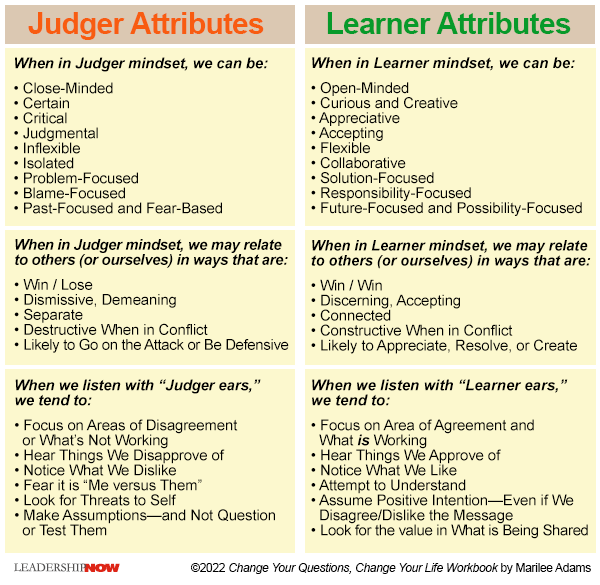
Judgmentalism limits our leadership. Our influence is diminished as it puts distance between ourselves and others.
Follow us on Instagram and Twitter for additional leadership and personal development ideas.


Posted by Michael McKinney at 06:40 AM
Permalink
| Comments (0)
| Personal Development
MOST of us think that our beliefs are truth. But beliefs are not facts. Rather, they are a core part of our perceptual lens – the way we view events based on past experiences – and thus very powerful in shaping our everyday experiences.
There are all kinds of perceptual lenses, and each of us tends to use and overuse our own few personal favorites. For example, when someone has a competitive lens, they will relate to almost any situation as though it is a competition, whether or not any such competition exists. Someone with a binary lens will relate to most situations as if there is only one right answer, and everything and everyone else is wrong.
In my coaching practice, I ask every client to talk about the most important beliefs they hold about themselves, their family, work, money, and more. It’s a way into understanding their perceptual lens. Often, this is the first time they’ve ever given this topic any thought, and many get stuck. It’s not that they have no beliefs; they just can’t “see” them. We work together to tease out these lenses. Some of the more common ones are listed here. Do any resonate with you?
Impeding Lens: “I’m not as competent as people think; I’m a fraud.”
Usually, this belief is not accurate. You hold it because you’re highly critical of yourself. Deep down, you simply think you are not good enough.
A better choice: “I can build confidence.”
Instead of discounting your entire self as incompetent and fraudulent, turn it around and get more detailed and granular. Ask yourself, “Where, specifically, do I need to improve? Where do I need to shore up my knowledge or experience so I can be confident in my abilities?” That’s a more helpful lens than walking around with an excuse for feeling like you’re not good enough. In other words, we say, “You don’t think you’re confident. Okay, let’s identify where—and then let’s fix that.”
Impeding Lens: “I am successful because I work harder and longer than anyone else.”
This approach is not helpful for a couple of reasons. First, you are on the road to burnout, and while you are burning out, you are going to miss out on your family, playtime, rest, and life in general. Second, it could be a sign that you don’t have the right aptitude for your job. Let’s take a simplistic example to make the point. If somebody is an accountant and they don’t have the aptitude, it’s very hard for them to do the same amount of work as the guy in the office next door who loves the work and finds it comes easily to him.
A better choice: “How do I achieve balance?”
Instead of insisting that you work harder and longer than everyone else, switch your focus. Ask yourself: “How can I achieve similar results and also feel more in balance?” This will lead you to place more emphasis (thoughts, moods, and actions) on prioritizing, delegating more effectively, and leveraging the 80/20 rule, where 80 percent of your success stems from 20 percent of your efforts. That means you need to select lenses that allow that to happen.
So often, we have a habit of overworking, or being a perfectionist or spending much longer than needed without a measurably better result. Adding “balance” into your lens of productivity will lead you to a way of working that ultimately gets more done, more effectively, and sustains your well-being over the long haul.
(Potentially) Impeding Lens: “If I want it done right, I have to do it myself.”
This lens is fine if you want to be an individual producer. Stay with it, and you will be amazing. However, you will never leverage yourself and your skills to be able to develop people or have two thousand people under you, because you won’t be able to delegate. If you want to be a senior leader, this lens won’t work. That said, not everyone wants to be a senior leader, and that’s okay.
A better choice: Create a safe, secure, supported team.
If you do want to be a leader, you need to truly understand that you can’t do it all by yourself. You need to accomplish your goals through others, and that means you need to create followership, and people won’t follow you unless you make them feel safe, secure, and supported as you lay out the clear objectives you want them to accomplish.
Whatever your beliefs, the majority were indoctrinated in you throughout your formative years. You learned and absorbed them from your parents, teachers, friends, and even the media—TV, movies, radio, newspapers—you consumed. Now, with adult eyes, you can reconsider and ask yourself: How are those beliefs serving you? What outcomes do they create? Do they consistently help you experience a better life for yourself and those around you? Do they build you up, and build others up, creating optimism, possibility, and a sense of opportunity? You can’t be human and be without any lenses, but you can be aware of your lens, as well as be intentional about choosing an appropriate lens for any given situation.
Follow us on Instagram and Twitter for additional leadership and personal development ideas.
Posted by Michael McKinney at 07:30 AM
Permalink
| Comments (0)
| Personal Development
IN music, there are only 12 notes. It’s how you play them that matters. In 12 Notes on Life and Creativity, Quincy Jones shares how he played his.
This is an autobiography that serves to highlight teachable moments. His biographical stories make each of these lessons come alive. It’s not a formula for success but a conversation about the “lessons he’s learned, the advice he’s received, and the conclusions that he has come to about life and creativity that have allowed him to live an enriched life, full of highs and lows.” His words will enrich you.
Note A: Recycle Your Pain into Purpose
Having lived almost 90 years, Quincy says that the best part is being able to “look back on each stage of life and see the visible threads that held it all together.”
With the inevitability of hardship in this often broken world, it’s important to understand what fills your voids and also where you are projecting yours. The moment you slip into a victim mentality, not only are you faced with having to deal with external problems, but you’ve also given yourself a whole new set of internal problems that will only stunt your growth as both a human and a creative being.
Note A#: If You Can See It, You Can Be It
Quincy didn’t grow up in the best of circumstances, but he relentlessly pursued hope. It’s easy to believe that you are stuck wherever you are and nothing will change, but you can outgrow your circumstances—the pollution of your surroundings.
Growth is just a journey from mind pollution to mind solution. In other words, you have to sift through the dirt of whatever situation it is that you find yourself in, so that your future isn’t polluted before you’ve even had a chance to create it.
Quincy says survival is an act of creativity. “It’s a matter of seeking out new ways to stay inspired, and creating paths that lead to a better future for yourself, and in turn, others.”
Note B: You Gota Go to Know
Step outside your comfort zone—you gotta go to know. But to go, you have to know your history—personal and national. History is important.
You’ve got to know where you come from in order to get where you want to go. Without that foundation, you won’t know who you are, and you sure can’t expect to create truthfully without knowing the truth.
Everything we do is an extension of the history that came before us, and if we don’t recognize it, we’re in danger of repeating some of the same nonsense that went down in the past. It’s a beautiful thing to reflect and learn, rather than to reject and repeat.
Note C: Establish Your Guideposts
Guideposts create a foundation for you to build a life on. They define who you are. “Set up guideposts that routinely remind you of who you are, apart from the distraction of life.”
With a general understanding that our thoughts play an important role in the direction of our paths, it’s essential to remain proactive in training those thoughts to continue pointing north, with the assistance of guideposts, whatever form they may come in for you.
Note C#: Always Be Prepared for a Great Opportunity
If you prepare in advance, you will be ready when the call comes without thinking it over. Practice so you will be ready for the right opportunities that will come your way. Always do your best.
Everything in your life is a chain reaction, and your ability to deliver will usually be judged based on your last encounter.
It doesn’t matter what job title you have, or if you feel as though the work you do is insignificant; do it to the best of your ability.
Note D: Sharpen Your Left Brain
Learn the science behind your craft. Go deep. It will change the way you create. “Without taking the time to fine-tune your skills, your efforts will be built on a foundation that is bound to crumble once it is put to the test.”
Quincy says, “Once I learned how to properly notate music, or sync music to picture when I began film scoring, or produce compelling live shows using scientific methods, I was able to take my artistry to the next level. Learning how to sharpen my left brain has been largely influential in how I’ve approached every creative endeavor.” It gave him credibility, too. He mixes “science with soul.”
Note D#: Avoid Paralysis from Analysis
How quickly can you get unstuck? That's what matters. Quincy offers four practices to help with this.
We so often dismiss our greatest ideas, thinking they’re supposed to make some type of grand entrance when, in reality, they may often just present themselves in the form of a whisper.
Note E: The Power of Being Underestimated
Don’t focus on what other people think of you. There will always be people who will diminish you. Instead, focus on your goals and what you are capable of. “If people overestimate you, they get in your way, but if they underestimate you, they get out.”
Instead of chasing fame, lean into your time of obscurity, or position of unexpected greatness, to plan and prepare for your next endeavor.
Note F: Do What’s Never Been Done Before
Don’t compare yourself to others. “It’s easy to look at others and justify why they can and you can’t.” Think big. “I’ve found beauty in the unknown by simply giving my mind freedom to explore.”
I have to warn you though: Big dreams don’t come without big failures. Things get tough and you will make mistakes. Repeatedly. We’re human and we’re going to flounder, but it’s what you do to get back up that matters. If I allowed myself to stay in the downward swings, then I’d still be there.
Success is a cumulative process; it’s not a one-time event.
The more opportunities you have to win, lose, or barely make, the more chances you’ll have to convert those experiences into fuel. You don’t learn as much just from winning or playing it safe.
Note F#: Understand the Value of Relationships
This lesson is profound and largely lost on too many today:
If you do everything correctly, but don’t take heed to this next lesson I’m about to share, then it will all go to waste. So, please hear me when I say that you need to work on yourself just as much as you work on your art. As my former music teacher Nadia Boulanger always used to tell me, “Quincy, your music can never be more or less than you are as a human being.” It doesn’t matter how talented you are—or how many number-one hits you get—if you don’t work on who you are first.
Your personal life and your professional life are linked. What you do in private impacts what you do in public.
You must have humility with your creativity, and grace with your success.
Everything in this business, and life, revolves around relationships—the people you meet, and most important, how you treat them.
Bandleader and pianist Count Basie taught him a great lesson about integrity, recounted in this Note that you have to read. He also told him, “Learn to deal with the valleys, because the hills will take of themselves.”
Note G: Share What You Know
As recounted on the pages of this book, Quincy benefited from the lessons taught to him by the musical greats. Mentors that took the time with him to give him confidence and develop his potential. We all need mentors and can be mentors.
There really would be no such thing as a generation gap, if we only had enough people willing to lift each other up, instead of tear each other down.
My mentors have undoubtedly shaped the person I am today, and without their love and guidance, I might still be stuck in the darkness of my past. So, may we all continue to keep the light on for ourselves and for others. As Clark Terry always used to quote from The Three Stooges, “If at first you don’t succeed, keep on suckin’ ‘till you do suck a seed!”
Note G#: Recognize the Value of Life
Quincy has had a few near-death experiences in his life. These near-endings became beginnings for him.
We often think of life as a series of events that happen to us. As a result, we neglect the fact that it’s often a series of actions that we do to ourselves.
I can assure you that simply being alive and present in your everyday life is the hights form of creativity.
How will you play your 12 notes?
Follow us on Instagram and Twitter for additional leadership and personal development ideas.
Posted by Michael McKinney at 08:23 AM
Permalink
| Comments (0)
| Personal Development
HOW do you get from A to B? Most of us want to evolve beyond today. A coach can help. But what do you do when you can’t afford a coach? Or the coach you want isn’t available? You learn to coach yourself.
In Take Charge of You, David Novak and Jason Goldsmith say you can’t leave your personal growth to chance. But coaching yourself doesn’t mean going it alone. Instead, “it means you are constantly looking for ways to grow yourself and for anything and anyone who can help you do that.”
As in any coaching situation, you begin by getting to understand who you are and what you want. What brings you joy? Where do you want to see yourself?
When you choose a destination in this self-coaching process, you are choosing a direction for where you want to take your life or career in the future. Once you do that, the work becomes about planning your route, making steady progress, dealing with the inevitable potholes and roadblocks along the way, and maybe even making changes on the fly if circumstances change.
It is important that you develop a coaching mindset—meaning “being open to whatever is going to drive your growth and performance.” Like a good coach, you don’t have all of the answers. So you need to be open, flexible, and ready to explore. Reframing your experiences will help you remain open to the lessons you could be learning.
I liked their explanation of reframing as some people think of it as lying to yourself:
Reframing isn’t an exercise in wishful thinking, and it isn’t an exercise in denying your feelings … Instead, reframing is an exercise in choosing a more productive way of thinking about anything you are up against.
A big part of the self-coaching mindset is knowing your own mind. Know what thoughts are getting in your way, perhaps creating self-fulfilling prophecies in your life. What situations trigger negative thoughts? How are you responding to roadblocks? The authors provide various exercises to help you take control of your thoughts. These are all opportunities to grow.
Self-coaching means taking responsibility for the ideas and insights you need to move you forward. Ask people who have done something similar to what you want to do. You don’t need to find the best in the field. You just need to find the person that knows a bit more than you now.
With these insights, you can now take insightful actions—actions that are both “informed and inspired.” Make a list of all of the actions you need to take to get you closer to the person you want to be. Break them down as much as possible.
Before you begin your journey, make sure you know where you are—your current reality. It is essential that you keep your eye on your goal “while you make decisions about what you want to do and where you want to go in life. Does that mean that every single thing you do will be joyful? Of course not.” You may not be doing exactly what you want to do right now, but you are learning things to help you get where you want to go. In the beginning, focus on making sure you have the experience and skills to be good at whatever it is you want to be when you get there.
The path to achieving something new will always be a question mark until we walk in it. So what do we do with that question mark? We can start by admitting we won’t have all the answers up front, and we don’t need to.
Always focus on the next step rather than focusing on all of the ings you have to do. Focus on the process. A consistent effort makes all of the difference.
A word about setbacks: they are inevitable.
Life isn’t static, so even when you master something, there will still be new obstacles to come. That’s just how life works in any field, in any industry, in any context, at any time, for any and every person out there.
Accept setbacks as a given and the next one as just another opportunity to coach yourself through it and become more resilient in the process.
Just because something didn’t turn out the way we wanted it to doesn’t mean that it never will. It just means that it hasn’t happened yet.
Every setback is an opportunity to learn a lesson and grow.
It is helpful to build motivation into the process. How? Remind yourself what matters, connect with your future vision, and share your intention with others.
Take Charge of You is full of helpful exercises to help you through the self-coaching process. A good portion of those exercises cover the right mindset, gaining an understanding of who you are, how you think and respond to situations. This is the tough groundwork we must go through to find that inner sense of joy we want. Do that right, and the rest becomes much easier.
Follow us on Instagram and Twitter for additional leadership and personal development ideas.

Posted by Michael McKinney at 09:18 AM
Permalink
| Comments (0)
| Personal Development
WHENEVER I have to opportunity to hear Peter Legge speak, I take it. Always interesting and practical. Recently he shared the following from his father:
My father Bernie Legge had a well-developed philosophy about success, which was based on seven basic principles. When I was 11 years old, he sat me down and shared them with me, and I have since shared them with countless others. Let me share them with you.
Finally, my father liked to quote Sir Winston Churchill when he famously said, “Sometimes it’s not enough that we do our best, we must do what is required.”
Follow us on Instagram and Twitter for additional leadership and personal development ideas.

Posted by Michael McKinney at 07:41 AM
Permalink
| Comments (0)
| Personal Development
WE must be clear. Bad choices lead to regret. We don’t want regrets. But regrets themselves are not bad. And they can lead us to better choices. In that sense, they have the power to change our life.
In The Power of Regret, Dan Pink claims, “Regret is not dangerous or abnormal, a deviation from the steady path to happiness. It is healthy and universal, an integral part of being human. Regret is also valuable. It clarifies. It instructs. Done right, it needn’t drag us down; it can lift us up.” That’s good. Consequences clarify.
Anyone who says they have no regrets is in denial. It is very human to make poor choices and regret them. We also make good choices that we should celebrate. Poor choices do derail our hopefully steady path to happiness.
When we do make poor choices and feel regret, it is Pink’s wish that we deal with it constructively to “make better decisions, perform better at work and school, and bring greater meaning to your life.” The Power of Regret is a path to a better and more intentional life.
Hindsight creates regret or what is termed counterfactual thinking—“If only I....” Finding what you can be thankful for if the situation could have turned out worse than it did—gratitude—can lead to the thought, “At least... .” (“At Leasts don’t alter our behavior or boost our performance in the future, but they do help us reassess the present.”)
What Can Regret Do For Us?
Sometimes we just can’t stop ourselves even though we know better. We just keep digger the hole we’re in deeper. A London Business School study found that “getting people to think about a previous escalation of commitment, and then to regret it, decreased their likelihood of making the error again.” Not surprising.
Pink finds three broad benefits to regret when handled correctly:
1. Regret Can Improve Decisions
Learning from regret helps us is makes us stop and think. They slow us down. “We collect more information. We consider a wider range of options. We take more time to reach a conclusion.”
We need the ability to regret our poor decisions—to feel bad about them—precisely so we can improve those decisions in the future.
2. Regret Can Boost Performance
If we take the time to think about what and how we did, we can often improve our performance next time. Even reflecting on what other people have experienced can improve our own choices and outcomes.
To be sure, regret doesn’t always elevate performance. Lingering on a regret for too long, or replaying the failure over and over in your head, can have the opposite effect.
3. Regret Can Deepen Meaning
Sometimes asking ourselves “What if” can lead us to a greater appreciation of what we did or didn’t do. “Conducting a ‘midlife review’ focused on regrets can prompt us to revise our life goals and aim to live afresh.”
But as Pink observes, we often don’t handle our regrets properly. The feelings surrounding regret can be handled in three ways: ignore them, overindulge them or think about them. It has to do with our philosophy on what feelings are for. If we think feelings should just be ignored and dismissed, we just delay facing the emotions we have locked up inside. If we think that feelings are for feeling—to be indulged—then we run the risk of rumination and regurgitating past mistakes that impedes growth. On the other hand, if we believe feelings are for thinking, we face them and use them for improving future behavior.
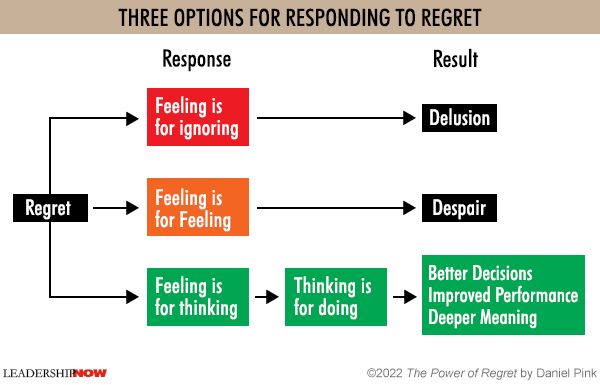
Framing regret as a judgment of our underlying character—who we are—can be destructive. Framing it as an evaluation of a particular behavior in a particular situation—what we did—can be instructive. Suppose you forgot a loved one’s birthday. A regret about being a clueless, uncaring person won’t help.
However, if it is a reoccurring regret, it’s probably is a character issue.
Pink identifies and discusses four core regrets: foundation regrets (our failure to be responsible, conscientious, or prudent), boldness regrets (the choices we didn’t make), moral regrets (when we behave poorly or compromise), and connection regrets (neglecting relationship).
We have regrets of action (things we did) and regrets of inaction (things we wish we did). Pink informs us on how to be deal with each kind.
We can also use the specter of regret to alter our behavior before the fact and avoid regret altogether. This is also known as counting the cost and thinking actions through to consequences.
Anticipating our regrets slows our thinking. It applies our cerebral brakes, giving us time to gather additional information and to reflect before we decide what to do. Anticipated regret is particularly useful in overcoming regrets of inaction.
But anticipated regret can cause us to overthink, resulting in decision paralysis and risk aversion. Interestingly, Pink shares studies that show that overthinking regret can increase our sensitivity to regret—“both experienced and anticipated.” They had regrets “before they made their choices. After they made their choices. While they made their choices. Whatever the situation, they always imagined the possibilities of something better if only they had acted accordingly.” This doesn’t lead to the productive feeling is for thinking regret response.
What is the solution? “Our goal should not be to always minimize regret. Our goal should be to optimize it. To make it clearer, Pink offers the Regret Optimization Framework, which leads us to devote our time to only the four core regrets.
Pink concludes: “Regret makes me human. Regret makes me better. Regret gives me hope.”
Follow us on Instagram and Twitter for additional leadership and personal development ideas.


Posted by Michael McKinney at 09:13 AM
Permalink
| Comments (0)
| Personal Development
WHILE growth is never easy, we are at our best when we are growing. And the more we grow, the more we are capable of growing. It would make sense then that we are intentional about it. Sometimes we don’t know where to start or get tired or overwhelmed by the effort, but there is a pattern to it that, when we understand it, can help us achieve the growth we seek.
In Smart Growth, Whitney Johnson says that “every new skill learned, every challenge faced, takes the form of a distinct learning curve”—an S Curve. Along that curve are six stages of growth whereby we can pinpoint where we are along that curve and prepare ourselves for what to expect and how we should respond.
As illustrated in the chart below, there are three phases—Launch Point, Sweet Spot, and Mastery. Each phase has two stages, making up the six stages of growth: Explorer, Collector, Accelerator, Metamorph, Anchor, and Mountaineer. “Each phase of the S Curve of Learning is marked by its own distinctive characteristics, frustrations, and thrills.”
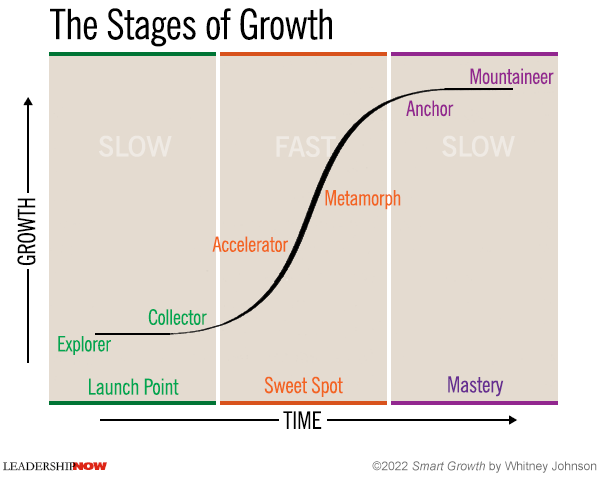
Launch Point
At the Launch Point, we are exploring opportunities—new S Curves. We begin at the Explorer stage. Many opportunities will present themselves, but we want to focus on those that will take us where we want to go. This stage will feel slow as we work through the questions we need to ask. For example, Is it achievable? Is it familiar yet novel? Does it align with my values? And Is the reward worth the cost?
It’s when you do your homework before committing to a course of action. Not all S Curves lead to where we want to go. Being true to your why results in growth. You are conscious of your life’s purpose; you’re focusing your time and effort in areas that further your purpose.
Once we choose a course of action, we become the Collector. We are gathering evidence that we are on the right curve. Again, progress may seem slow here, but it is essential so that as you move into the next phase, you don’t regret it.
Sometimes it’s hard to get started. The slow pace at the launch point of a new S Curve can defy us. But if we take time to explore, we will find the right fit. By collecting quantitative and qualitative data and resources—and curating to eliminate the deadweight—we prepare to tip into the sweet spot of momentum.
Sweet Spot
We now hit the rising slope of the S Curve. The pace becomes faster. “We are gaining confidence that we can become who we set out to be, hope swells as our growth accelerates.”
We are now at the Accelerator stage. We are producing more results with less effort. We want to spend as much time of our day working on our chosen S Curve.
There are fewer gaps in your knowledge, and you have a good sense of where the remaining gaps lie. You’re making connections, deliberate choices about how you want to grow, and those choices become more automatic as stress and growth approach equilibrium.
As you grow, what was once was unfamiliar to you is becoming automatic. You are becoming what you set out to be. You are a Metamorph.
This stage is exciting because everything is working; it feels fast-paced compared to the earlier stages, and you are exhilarated by the combination of challenge, productivity, and growth. Similarly, your brain chemistry shifts from the headwinds of stress response to providing supportive dopamine rewards as your predictive model improves.
Make the most of the sweet spot for as long as possible, because that’s where you are going to do your best work. This is where the magic happens, where caterpillars become butterflies.
Mastery
At the top of the S Curve we have accomplished what we have set out to do. The new you is the new normal. We are now in the Anchor stage. It’s time to reflect and celebrate. Things slow again.
The Anchor stage is a brief season of rest and reflection before you take the next leap. With your celebration complete, outline what you’ll do next. Is now the time to reconsider compelling opportunities you turned down to stay focused. Are you drawn toward a radically different S Curve such as a career pivot or a move? Anchoring gives you stability and confidence. Chart your next steps from this point of strength.
At the top of the learning curve, you are a Mountaineer. Once you reach the summit, it’s time to find the next mountain to climb. It was hard work to reach the top, but it’s time to find a new adventure—a new launch point.
Learning is the oxygen of human growth. When learning diminishes, so do we. Learning is essential to our continued development, particularly in adulthood when the sponge-like mindset we had as children hardens into a more fixed range of assumptions.
Precarious as it is, the peak of an S Curve can—ironically—feel like a good place to stop. Getting here was hard. We may be tempted to rest on our learning. But leaving may prove difficult if we linger, and our learning-hungry brain begins to starve.
Ecosystem
We need a growth ecosystem. We don’t climb our S Curve alone. Nor should we think we can. We need support and guidance. And those may be different people as you move along the S Curve.
On the launch point, we need support: Teachers, trainers, and truth tellers to help us explore and collect data to determine whether we should continue on a particular curve.
In the sweet spot, we need focus. We need people to honor our growing need for autonomy, coaching us as we gain in competence and stature.
In the mastery phase, we need people who can celebrate with us as we drop anchor on our new self.
We also should contribute to the growth ecosystem for the growth of others. There are people who need us.
Our greatest legacy will be how we draw from our stores to help others grow. We must balance our take with our give, not depriving others, not poisoning the system. We must add sunshine. We must encourage young stems to grow.
Smart Growth is a remarkable look at how we grow. Whitney has provided us with a new way to look at life—intentionally. A way to see a pathway to our potential. The S Curve provides that pathway and an understanding of how we grow—slow, fast, slow. We learn how to manage through the entire growth process—Launch Point, Sweet Spot, and Mastery.
What I have presented here is just a brief overview. There are so many insights found here to help you and those around you grow. And the case studies and stories just make it all the more compelling. Each section ends with a summary for Smart Growth leaders to help us grow our people. You find information on how to manage people at each phase based on both their career stage and the type of organization in which they work.
Follow us on Instagram and Twitter for additional leadership and personal development ideas.

Posted by Michael McKinney at 08:13 AM
Permalink
| Comments (0)
| Change
, Personal Development
EVERYONE can lead in a positive way, but not everyone will do what it takes to make that happen. Some are content to lead unintentionally for better or worse—leading unintentional lives setting a pattern of aimlessness for others to follow.
But there is the vast majority of leaders who intentionally lead in a way that has a positive impact. Then there are those that do uncommon things that make us all step back and ask how they did that. Performance coach Ben Newman has written about 11 ways the greatest leaders lead in Uncommon Leadership.
Newman looks at the leadership of eleven leaders and asks what drives them to places of uncommon leadership. There is no single answer. It has been the choices they made. Mindsets they adapted. Each leader’s path was unique but similar. The story of their individual leadership journeys can serve to inspire us to step into uncommon leadership.
From coach Nick Saban we learn that every choice counts. “The way you do one thing is the way you do everything. No matter what you do, you must approach every task the same way and with the same degree of high performance, self-accountability, and mental toughness, every time.”
From leadership expert Jon Gordon, Newman has learned that “We are continually growing and changing. Every time I feel like I’ve grown into the person I should be, Jon is there as a reminder that I must continue to grow and change to become a better version of myself and what I am capable of achieving.”
From NFL underdog Will Compton we see how critical the right mindset can be. “When you take responsibility for your thoughts, you put yourself in charge of one of the few things you can control. In this way, you can develop your own mental standard for the challenges you face. It’s not easy, but when you learn to set aside your feelings, you toss aside useless baggage, enabling you to focus on the thoughts and actions that matter.” To come from behind, “You must set a standard for yourself and be unshakeable and unwavering as you work toward your goals.”
Coach Chris Klieman shows us that our edge is in the details—what you chose to focus on. “When your willpower is unbreakable, it allows you to overcome any fears of failure. Faith and inspiration provide focus and clarity that will lead you to the goals in your life.”
Basketball skills trainer Drew Hanlan reminds us that “success comes from the work you put in during the unseen hours.” Hanlan believes in reverse-engineering the skills you need. “Breaking things down into their smallest pieces often reveals solutions that you can’t always see when trying to see the whole of the situation. When you can listen, analyze, change course, and solve problems, you will become a leader. Problem solvers are leaders, and those who find creative ways to achieve desired outcomes are uncommon leaders.”
Desire is the foundation of passion; passion is the foundation of mental toughness. Mental toughness is the foundation for developing a standard for yourself, and the right standard, intelligently and diligently applied, creates success.
From entrepreneur Andy Frisella we can see that leadership is not for everybody because some aren’t willing to put in the work, set their ego aside, and lead. “You can’t lead others until you first learn to lead yourself. Learning from your setbacks is only part of the key to success. Making changes is the other.”
To succeed, we have internal voices that prop us up, get us through tough times, and feed our brains with messages that allow us to create mental toughness. But the downside of this is that sometimes, our ego gets in the way. We confuse our ego with reality, or the two openly compete for our attention, and that creates conflict. That happens to a lot of people. It’s frustrating when you think you’re doing everything you should to be successful, and you’re still not.
We often don’t realize that the missing piece is to be honest with ourselves: to recognize when something is not working.
From mixed martial arts fighter Tyron Woodley we know that “you don’t need a lot of people to support you, as long as you have the right people in your life to support you.”
High jump champion Chaunté Lowe we learn about the power of embracing adversity—in her case, cancer. “You don’t have a choice about the hand you’ve been dealt. But you do have a choice as to how you respond, how you choose to fight your situation. It’s easy to become depressed and fight within yourself: to battle between wanting to give up or not.” Newman adds, “to fight your best fight is to win—that is the real victory.”
The best NFL wide receiver Jerry Rice asks, “How can somebody not give 100 percent when it’s 100 percent their choice?” Newman says, “Jerry credits his success in part to his All the Time Mindset, which means you do things only one way all the time. Your approach to off-season training, in-season practices, and game-day prep are no different than when you step on the field for a game on Sunday. Performing at 100 percent becomes second nature because that’s all you do. In fact, it’s all you know how to do, every moment of every day, all the time.”
The extreme life of David Goggins teaches us that the “only way to gain mental toughness is to do things you’re not happy doing. You must be in a constant state of positive growth and change. You are either getting better or getting worse, but you are never staying the same.”
Finally, Newman looks to his mother, Janet Newman, who died just before his eighth birthday. She was a teacher who never stopped teaching until the very end. She taught him that “our life’s circumstances are much less significant than our responses to them.”
You only have a small say in how long you’ll live. But you have an almost unlimited ability to choose how you will live while you are alive. You can choose passivity, or you can choose to be an active participant in your own life. You can choose to be a victim, or you can choose to fight and do whatever you can to overcome obstacles in your life.
Her life demonstrated that we need to be mindful of everyone in our life.
Never underestimate your ability to be a good leader, even if it only means being a good dad, mom, sibling, grandparent, or friend. You may only impact or lead a single person. However, we are all connected on this planet, and the seed you plant could travel far, with untold impacts to bloom and affect others.
Follow us on Instagram and Twitter for additional leadership and personal development ideas.


Posted by Michael McKinney at 09:01 AM
Permalink
| Comments (0)
| Personal Development
SUCCESS in life is always the result of a series of (mostly) correct choices. Investor Bryan Cressey has distilled choices he has made and the lessons he has learned from them into the book, Be a Winner: Life’s Handbook for Joy and Success. He covers everything from life lessons, entrepreneurship, connecting with others, to investing and traps to avoid.
He notes this important understanding he came to realize as he started out in life: “Sometimes in life, you must be satisfied, and happy, with your accomplishments all alone—without praise from others—and learn to be motivated by your personal praise for yourself.”
An important series of questions he asked himself at age thirty-eight, and we should all ask ourselves at any age, is, “What primary attribute would define me? How did I want to be? What would be noticeably different about me?”
Below are nineteen keys or choices that he has learned throughout his life journey, with a selection of his comments on each.
Why does planning backward work? We can only climb that hill one step at a time. But for big dreams, we usually cannot see a clear path to the top—we may try one step, encounter difficulty or frustration, and give up—because we don’t see the way forward! Planning backward gives us the steps.
You will probably be positively surprised by what you can accomplish.
My greatest education has not come from school but from my mistakes. Life and success are trial and error. Life is more fun and much easier, when you admit mistakes and learn from them.
We have a human instinct to think we’re smart, which can backfire if we don’t transcend it. Humility allows learning and learning drives success in all you do.
Devise some creative ways to help your firm break some new ground in your first couple of years. Don’t accept the way things are done as the optimal way; mentally question everything significant.
Before deciding the next job you want, carefully figure out what your goals and values are, i.e., what you live to do. If it’s what you love and enjoy, you will succeed.
Choose to work with an outstanding mentor who will teach you how to succeed in your chosen endeavor.
This key to success is the least recognized. Pick the right industry, or profession, to participate in. The secret is to get in an area with enough growth, profitability, possibilities to create great opportunities for you.
Years ago, many of my friends headed into the then-popular business or real estate development and banking. These businesses are highly cyclical. Entering at the peak of the cycle, those friends had an eventful twelve months: graduation, first job, recession, termination.
Don’t let others tell you what you should do with your life. Decide for yourself. This will enable you to create your world more as you want it to be—not as others hand it to you.
The world is not a priori serious. Some people make it that way. Some people think they must act seriously to be thought learned and capable.
Good things will come to you when people trust you. Keeping the bar higher force you to learn to be better, and you will. If it’s in the gray zone, don’t go there. To maintain a great reputation, you need to avoid even the appearance of possible impropriety. Perception becomes reality.
I’ve seen many individuals that are so compelled to succeed fast that they fail. How? Because they jump from thing to thing, believing each one will propel them to the top—they never do anything long enough to become truly good at it. Don’t be in a hurry; take time to become great at what you enjoy.
And don’t be in such a hurry to evaluate your own wins and losses. The unexpected will sometimes happen.
I’ve been without money and had lots of it, and I guarantee you it doesn’t correlate much with happiness. Figure out what you want to do with your life that you’ll find satisfying, gratifying, and do it.
Even a narrow specialty is a big market in our world’s economy. Winners are those who become the best at something.
It will enhance your reputation, and you’ll quickly gain more responsibility.
And contribute more to that success than is expected of you.
Examine constantly whether you are doing what you want. What we regularly do becomes a routine, and a routine can become a rut we may remain in unless we exercise a little paranoia and assertively assess whether we are letting parts of our life travel in a rut. We must proactively change and grow rather than passively letting life happen to us.
Success goes not to the person who works the longest hours but to the person who gets their most important things done.
Follow us on Instagram and Twitter for additional leadership and personal development ideas.

Posted by Michael McKinney at 11:08 AM
Permalink
| Comments (0)
| Personal Development
FAR too many people accept their current reality as what will be. “Each day,” says Sean Glaze, “we are faced with two options. Either we choose the path of complacency, or we chose the path of commitment” to improvement and growth.”
We often begin to look for external solutions for the frustration we feel. But we take that frustration with us wherever we go. The solution is to deal with what is going on inside of us. But instead of growing, we are rearranging. We want circumstances to change rather than change ourselves. When the dust settles, more often than not, all of the rearranging will result in the same frustration in a new context.
This makes Sean Glaze’s book Staying Coachable so relevant and important for our times. It’s an engaging story about a father and a son—Wallace and Max—who decide to hike The Narrows in Zion National Park. Both are frustrated—Wallace over changes at work he is resisting, and Max over the new coach and basketball tryouts. On the hike, they meet Gayle, a wise woman who listens and agrees to help them with their frustrations if they are committed to change and growth. Gayle shares the lessons her husband learned as a coach before he died and she experienced in her own career.
My husband used to say, “frustration is a magnificent and powerful tool. Like a hammer, you can use it to build something impressive—or wreck something you worked hard to build.”
Turns out most people want to get better, but they want to do it their own way. That usually means doing what they already know, which is just repeating the same stuff that got them stuck.
Staying coachable is a commitment to growth. “Being uncoachable is really about being stuck in a comfort zone that a person refuses to acknowledge or leave.”
Glaze says there are four main ceilings that limit our growth: the ceiling of contentment, ignoring reality, personal pride, and knowing without doing.
After they part ways, she agrees to share four questions they will have to grapple with over the ensuing months if they are committed to getting unstuck and improving.
Four weeks later, the first question comes, and it is about hunger: What specifically do you want? Where do you want to be by when? Who are you trying to impress?
You have to want something enough to disrupt the inertia of the status quo.
Success is about selection and commitment. Complacent people refuse to choose.
We are often cured of our most dangerous faults when we witness the consequences in others.
Question two deals with honesty: Where are you now? What “numbers” accurately measure your desired performance? What obstacles exist to achieving the success you seek? This is hard because “many people find it difficult to acknowledge where and what they are without prejudice.”
If you want directions anywhere, you must pinpoint the place you are starting from.
You need to know the skills and strengths you possess that you will need to make use of. You need to know the gap between where you are and where you want to be.
Where are you in relation to your team? Are you willing to fill a role that is uncomfortable to ensure the team can succeed?
What is best for the team, not convenient for you.
Does the team need you to take on a different role?
Question three deals with our willingness to accept help—humility: How do you respond to mistakes or criticism? Who are a few valuable mentors that you can learn from? This question is meant to “inspire you to reflect on how you have handled feedback or the people who shared advice with you in the past. You can’t pour growth into a cup already full of assumptions and ego.”
Criticism is not a dead-end; it is a detour to somewhere better.
You need other voices because 90% of your daily thoughts are the same ones from the day before—and the same thoughts lead to the same actions and same results.
Humility understands that growth doesn’t merely mean changing ourselves. It means allowing others to change us, to hold us accountable, and help us shed unhealthy behaviors we’ve learned, so we are introduced to a better version of ourselves that we otherwise would not have discovered.
The final question comes down to habits: What will you do differently? What are you doing occasionally that you will now do consistently? What are the current distractions that you will stop doing?
Your habits are external evidence of your internal commitments.
Simplicity in understanding does not always translate to simplicity in execution.
The hard thing they must do to succeed, the challenge they must master, is more often doing small, simple things with extraordinary consistency.
Whatever you want to be better at, identify what you can do differently that will create different results for you and your team. And remember—successful people do not negotiate with themselves.
How will you acknowledge your progress? Disciplined effort declines without encouragement.
Staying Coachable is a book for everyone. And there is not a better time than the present to read and apply the lessons found throughout this book. Stay coachable!
Follow us on Instagram and Twitter for additional leadership and personal development ideas.
Posted by Michael McKinney at 01:22 PM
Permalink
| Comments (0)
| Personal Development
IT’S NOT surprising that the “growth potential of most businesses is limited by the emotional intelligence of their leaders,” writes Gary Vaynerchuk in Twelve and a Half: Leveraging the Emotional Ingredients Necessary for Business Success. (And it’s 99% free of the language you have come to expect from Vaynerchuk.)
The soft skills always have mattered, but they are hard because we have to work on ourselves. (It is incidentally why no one is a born leader.) Because they are hard, we avoid developing them as we should if we can get by with it. And through various periods of history, we could. Today, we can’t—and shouldn’t.
Vaynerchuk states that “modern society’s definition of a ‘smart business decision’ is disproportionately predicated on analytics. Business leaders tend to find safety in the ‘black-and-white.’ They find safety in the academics, math, hard data, and what looks good on spreadsheets.” He believes that it is the soft skills is the strength that “will help you survive and flourish.”
He identifies twelve ingredients of emotional intelligence free from the ranting you often hear on this subject that comes across as a way to make the ranter look with it. (There is a thirteenth ingredient—candor—that he gives half because it is something he struggles with—balancing kindness with candor.) He emphasized that all twelve are important and, while equally valuable, they “must be deployed in different proportions in different situations. As you navigate every second of your life, you need to add different ingredients at different times.” Here are the twelve with selected Vaynerisms:
1. Gratitude
Gratitude is a perspective on life. We panic when we compare ourselves to others. “People look upward at those who rank higher, but they don’t look downward at the billions ranked lower.” We have more to be grateful for than we think.
“Be thoughtful and honest with yourself about your missteps, but don’t start dwelling on them,” or it will become the jail you live in. There’s no value in that, says Vaynerchuk.
In the face of disappointment, gratitude is my chess move to limit dwelling on it.
If you draw energy from gratitude, you’ll find that it lasts much longer than energy drawn from insecurity, anger, or disappointment.
2. Self-Awareness
It’s one thing to be self-aware. It’s another thing to look in the mirror and say, “Hey, you’re not good at X.”
Insecurity often leads to avoidance. People tend to be the most avoidant with their own flaws.
Confidence makes self-awareness easier. I’m willing to take a hard look in the mirror and acknowledge all the problems I have in my life. I’m willing to separate who I am from who I wish I could be, a challenge for those who are insecure.
3. Accountability
I think of accountability as the brakes. It stops the momentum of pain that comes from blaming others.
I have to accept that in some way I made a decision that put me in that situation.
Much of the day-to-day angst people face comes from a feeling of helplessness. Accountability can potentially reverse that.
4. Optimism
Choosing optimism over pessimism is, at the end of the day, wildly practical. It doesn’t mean being naïve or blind to the downsides in business or in life. In fact, I’m more aware than most about what could go wrong. I just believe I’m capable of navigating any challenge.
Optimism makes playing the game more enjoyable than winning it.
5. Empathy
Empathy is my ear to the ground. It naturally pairs with curiosity.
When you’re empathetic, you recognize why people behave the way they do.
Empathy is like a cheat code in business and life. I actually think it makes the other eleven and a half ingredients easier to use. You can handle any situation if you can feel the feelings of others involved.
6. Kindness
[Kindness] is about being kind to those who have put me in a difficult position.
Being kind when you’re under pressure is tough. It’s easy to blast off and curse people out when you’re feeling stressed. It takes internal strength to be the bigger man or woman, but it’s an important trait that can differentiate you from others.
You can be kind, be candid, and hold your ground all at the same time.
7. Tenacity
Tenacity should never equal burnout.
Being tenacious is about telling yourself, “I enjoy my process so much that I am able to push through what others normally view as obstacles along the way.”
Conviction and tenacity work hand in hand. When you have conviction in what you’re doing, it’s easier to be tenacious.
8. Curiosity
Curiosity mixed with empathy can lead to intuition. Then, after experiencing or “tasting” that intuition, you can develop conviction.
To maximize the value of curiosity, you need a strong work ethic. You need a strong desire to continue learning, no matter how much you’ve accomplished.
9. Patience
When you have a good relationship with time, the pressure is lifted, and you can do so much more.
A staggering number of people from eighteen to thirty feel anxiety about their careers because they don’t have a good relationship with patience.
Patience can give you permission to dream bigger.
10. Conviction
Conviction is the north star that keeps you on track, helping you be tenacious throughout your journey, despite the inevitable difficulties. Without conviction, you’ll miss big opportunities and lose because of other people’s opinions, which is most devastating of all.
11. Humility
Humility is a requirement if you want to cultivate a lasting positive reputation and leave an admirable legacy. Leaders can’t sustain success without it.
Humility creates a comforting feeling of safety that helps you move quicker in business.
Humility keeps you from overthinking the aspects of content creation that slow most people down. Does my picture look nice enough? What will people think of these colors?
12. Ambition
People tend to have an unhealthy relationship with ambition partly because they use it as a cover-up for their insecurities. Some people set goals to build successful businesses or secure prestigious titles in organizations so they can prove something to their parents, their significant others, or their high school friends who doubted them. Their ambitions are great, but their motivation is based more on insecurity than curiosity or self-awareness.
Part Two of the book gives a number of real-life scenarios after which Vaynerchuk gives his perspective on which ingredients would have worked best in that context. It is helpful in understanding how these twelve ingredients work together for a good outcome.
His responses include:
By starting with empathy and curiosity, you can get clearer feedback. Then accountability and conviction can help you decide what to do next.
If you look at every decision you make through the lens of optimism and layer it with kindness to yourself, there’s almost never a wrong decision. If you look at it through pessimism, there are problems with every decision.
When people are hurting on the inside, they lash out by blaming others. They desperately look for a coping mechanism, which usually comes in the form of pointing fingers.
The reality is, when you complain about something, you’re giving it mental leverage over you.
Anger and insecurity can create short-term boosts, but they’ll rarely sustain you. In some cases, they can lead you to a dark place mentally over time.
When you’re in a partnership, empathy and humility come first, not conviction.
Part Three concludes the book with exercises to help you develop and grow in each of these twelve areas.
Follow us on Instagram and Twitter for additional leadership and personal development ideas.

Posted by Michael McKinney at 07:20 AM
Permalink
| Comments (0)
| Personal Development
ROBERT DILENSCHNEIDER looks at the lives of twenty-five accomplished men and women and asks what they were doing at around age 25 that led them to become the people they became in Nailing It: How History’s Awesome Twentysomethings Got It Together. Specifically, he looks at the influences like education, parents, friends, and events in the world that helped them make the choices they made.
Businessman and former ambassador Donald Blinken explains the motivation behind this book in the foreword:
This book was born out of Bob Dilenschneider’s concern about how demoralizing it is for many young people to consider their futures. Young people that believe that their education may be useless and that their career opportunities have fallen apart before they have even started out. The book is written to demonstrate that many of history‘s most accomplished people were in similar situations when they were at about the same stage in life. Some, without knowing it, were already on the path to success. Some had fallen off that path and had to find it again. Some didn’t even know that for them there was a path. Yet, in the end, all of them found their way and made memorable contributions.
Success is rarely a straight line. There is no ideal path to follow. The key is to avoid distractions, accept criticism as information to guide you, and build resilience to inevitable setbacks.
Here’s a short excerpt provided by the publisher from the chapter about Roberto Marinho, who at an early age inherited the Brazilian newspaper his father had founded. Under enormous pressure, he showed the patience and determination to learn his craft and, as a result, rose to a position of national prominence.
For nearly seventy years, Roberto Marinho had dominated print journalism and the radio and television industries, building on the shaky foundation of inheriting—when he was barely into his twenties—the newspaper that his father had founded just weeks before he died. His media properties achieved immense clout in Brazil and beyond, rivaling the status of their American counterparts. His personal wealth, in 2000, was estimated at $6.4 billion.
To tell you the story of how Roberto Marinho came to be so influential and successful, I’ll start with his newspaperman father, Irineu Marinho. As the son of such a man myself, I can imagine the energy—and family support—it took to accomplish what Irineu did.
In rapid-fire succession, the salient facts of Irineu’s career are these: As a student at the age of 15 in 1891, Irineu founded a branch of a Portuguese royal literature society in his birthplace of Niteroi, Brazil, as well as two newspapers; he became a correspondent for a third newspaper the next year. In 1894, he moved to Rio de Janeiro and continued his career with the established publications Diario de Noticias, A Tribuna, and A Noticia. In 1903, he married; his first child, Roberto, was born on December 3, 1904 (five additional children would follow). In 1911, he cofounded A Noite, the first evening newspaper in Rio de Janeiro. In 1922, he was jailed for four months for helping instigate the revolta tenentista of that July. In 1924, he took his family to Europe in search of improved publishing techniques, more sophisticated equipment, and so forth. During his absence, a coup of sorts removed him from A Noite. In 1925, he founded O Globo—and died of a heart attack in August 1925, less than a month after the first issue of O Globo. He was 49, his son and heir Roberto not quite 21.
Roberto had accompanied his father to Europe. Trained as a joiner and a mechanic and no stranger to hands-on work, Roberto acted as Irineu’s secretary during the prospecting trip and then took a job as a cub reporter on the new newspaper.
What was the fledgling reporter to do now? He knew what was expected of him: to fill his father’s shoes. Did he want such unexpected journalistic and business responsibility at such a young age? And at a time of personal grief? Clearly, newspaper publishing, a strong work ethic, and entrepreneurship were in Roberto’s DNA, but was it enough? As devoted as he may have been to his father, did Roberto have different dreams for his own future that he put aside?
What a push-pull Roberto must have experienced! Many of us have been in a similar situation in our lives. To the young man’s credit, he seemed to embrace his destiny, something not everyone can do, or wants to do. Moreover, he was humble about it.
According to a retrospective on his life published in The Independent, Marinho “insisted on working his way up from the bottom, learning all aspects of the business.” He had been at his father’s side the entire time when O Globo was being founded. Now he would step forward and follow in his footsteps, but respectfully, earning his place. A journalist named Eurycles de Mattos was put in the position of editor-in-chief, with Roberto as his secretary. He took that position because of his inexperience, but he treated it as a learning opportunity. And then, in 1931, with the death of de Mattos, Roberto, now 26, took over the position of editor-in-chief.
After 1931, Roberto Marinho never slowed down. He quickly assured some financial security for O Globo by republishing U.S. comics in Portuguese and went on from there.
“A mix of pragmatism and stubbornness helped him build his empire,” wrote The New York Times in its obituary. The “Brazilian Media Mogul” methodically increased O Globo’s circulation, expanded into radio (1954) and television (1965), and, in the five years before his death, founded successful tabloids in Rio and São Paulo. To all that in the late 1960s he added a string of magazines and a publishing house.
But in the long run, it was the Globo television network, known as Rede Globo, that became Marinho’s most important enterprise. Rede Globo signed up 113 affiliated stations, extending its reach into every corner of Brazil—according to one analysis, it eventually covered 99.98 percent of the country— making Roberto one of the most influential men in the nation regardless of who the president was.
One key to TV Globo’s popularity was its telenovelas, well-crafted soap operas that were hits not only in Brazil, but all over the world, including in Britain and the United States. And the network’s populist news coverage gained enormous audiences because, Marinho said, it gave Brazilians “a new way of viewing the world.”
Dilenschneider also looks at the lives of Mozart, Mary Shelley, Grant, Einstein, Helen Keller, Elizabeth Kenny, Branch Rickey and Jackie Robinson, Coco Chanel, Golda Meir, Edith Piaf, Akio Morita, Audrey Hepburn, Christa McAuliffe, Steve Jobs, among others.
Follow us on Instagram and Twitter for additional leadership and personal development ideas.

Posted by Michael McKinney at 09:40 AM
Permalink
| Comments (0)
| Personal Development

WE ALL NEED white space – open, unassigned time. We need it for better relationships, mental health, and better productivity. Juliet Funt writes in A Minute to Think, “without space, we can’t sustain ourselves.” It is the missing element in our lives, and we need to get it back.
Funt suggests that first, we need to take strategic pauses to recuperate, reduce, reflect, and construct. They help us to separate. When you can’t take long stretched of pen thinking time, Funt uses what she calls the Wedge. “The Wedge is a small portion of white space inserted between two activities. It’s used specifically to pry apart actions or events that without it would have been connected.”
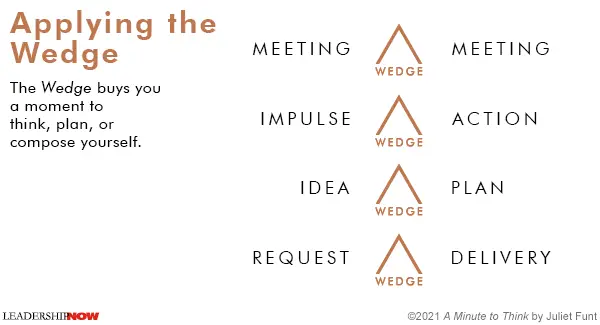
What keeps us from doing this are the Thieves of Time. “Four key drivers propel companies, teams, and human beings at work: Drive, Excellence, Information, and Activity. Despite being positive and helpful to us in their basic nature, these forces are also the biggest reason white space withers.” When taken to extremes, they reduce our effectiveness. They look like this:
We mindlessly accept a meeting invite because we are driven. (Associated with burnout and overdrive)
We overtweak a presentation because we want to be excellent. (Associated with perfectionism)
We go too deep into dashboards and data because we want to be informed. (Associated with overload)
We impulsively grab the next to-do on our list because we feel we should always be active. (associated with frenzy)
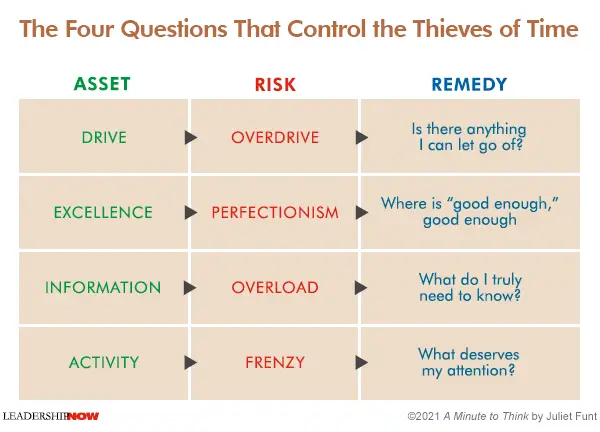
You deal with these excess use of these strengths by asking the following Simplification Questions:
Drive – when it turns into overdrive – needs to hear: Is there anything I can let go of?
Excellence – when it turns into perfectionism – needs to hear: Where is “good enough,” good enough?
Information – when it turns into overload – needs to hear: What do I truly need to know?
Activity – when it turns into frenzy – needs to quiet its flailing long enough to hear: What deserves my attention?
She also goes into using the Wedge to deal with the mirage of hallucinated urgency. The kind of urgency that we manufacture and causes us to “constantly and thoughtlessly interrupt our colleagues” and the kind of urgency that others place on us. Start to deal with it by putting a Wedge between what comes to mind and anything we do about it.
Funt reveals to us in A Minute to Think the core issues that invite the busyness into our lives and then provides us with practical applications to defeat them. It is geared to working professionals, but people young and old, working or not, deal with these same issues that diminish the quality of their lives. The busyness mindset that we have unintentionally adopted leads to shallow thinking, the acceptance of other people’s thinking, and the knee-jerk reactions that are so prevalent today.
Follow us on Instagram and Twitter for additional leadership and personal development ideas.
Posted by Michael McKinney at 07:44 PM
Permalink
| Comments (0)
| Personal Development
SCOTTISH philosopher Thomas Carlyle is said to have written, “No pressure, no diamonds.” And it’s true. We need to rethink how we think of pressure and how we manage it. In The Power of Pressure, Dane Jensen says, “Pressure isn’t just a nasty by-product of life, it’s an essential input into high performance. A life well-lived requires pressure.” If we can link pressure to growth, we have a great foundation to work from.
So, while most of us try to eliminate or avoid pressure, maybe we need to see it as an ally. Jensen provides the understanding to do just that. He says, “pressure has patterns, and those patterns repeat.” What creates pressure is the need to do something, and that distinguishes it from other states like stress, fear, or grief. Unfortunately, just when we feel the need to do something, “our body’s default response to pressure robs us of the very abilities that can most help us manage our response to pressure.” That’s the paradox of pressure. We can become so narrowly focused under pressure that our ability to process information shrinks, and our ability to absorb helpful information diminishes. Over the long haul, if we stay in this high-pressure state, this narrow focus can become our brain’s default. So, we need a strategy.
Two Kinds of Pressure
Broadly speaking, there are peak pressure moments — “short, violent bursts of extreme importance and uncertainty” — and there is pressure over the long haul — “periods of grinding volume mixed with importance and uncertainty along the way.” To manage them well, we need to respond differently to each.
Peak pressure moments are those that have a beginning and an end and “with a clear range of outcomes” like a race, a test, or a speech. When the moment is over, so is the pressure. “In peak pressure moments, the goal is simple: perform.” It is about “performing to the peak of your abilities instead of shrinking from the moment.”
Long haul pressure is different. It can be pressure leading to a peak pressure moment, or, more often, it can simply exist. “This type of long haul can come on gradually, as additional sources of pressure are slowly layered on, one by one, until you realize you are no longer sleeping well at night or are feeling emotionally overwhelmed, unable to focus.”
Jensen has identified three factors common to all pressure that exist in some combination: high importance, high uncertainty, and high volume. Together they form the Pressure Equation:
PRESSURE = IMPORTANCE x UNCERTAINTY x VOLUME
Importance has to do with the importance of the outcome. If you see the outcome of a situation as important, it will create some kind of pressure. But combined with uncertainty, it becomes intense pressure. Volume is what makes pressure relentless — the volume of importance. And we can all relate (well, most of us) to this from an example in the book:
No team of people, no matter how capable or well-meaning, can truly attend to 189 things — which means that inevitably some of these important, uncertain items will migrate to the periphery, creating pressure each time you think of them and feel the sting of guilt over there neglect.
With this in mind, we need to become what Jensen calls Pressure Ambidextrous. That is to say, learning to be “better at both performing in peak pressure moments and approaching the long haul with a sense of challenge, commitment, and motivation.” This is where his Power of Pressure Model is helpful.
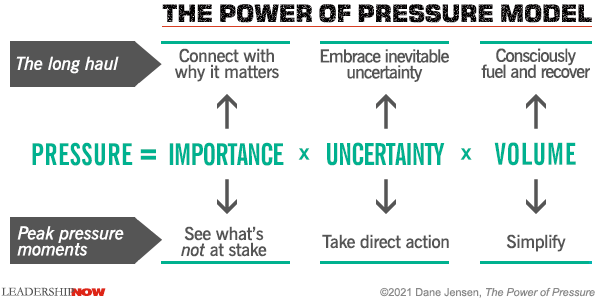
Jensen takes six chapters to explain the strategy for each type of pressure and how we can best use it to our advantage. Each chapter has fresh, well-thought-out perspectives, behaviors, and insightful questions to guide us through the model. He gives this overview of each strategy as it relates to the two pressure types:
Long Haul Importance: Connect with why it matters. Over the long haul, navigating importance is about creating a clear line of sight from the day-to-day grind to what matters most to you. It’s about keeping importance front and center in the midst of all the ups and downs that accompany any busy life. When our daily decisions become disconnected from what matters to us for too long, it is hard to sustain a sense of commitment to the journey.
Long Haul Uncertainty: Embrace inevitable uncertainty. High performers adopt a mindset over the long haul that embraces the uncertainty inherent in our lives. This mindset consists of an often challenging combination of accepting that there are things we cannot control (and that therefore may not go our way) while at the same time holding a sense of optimism about the future. It is a belief that if we focus on our own actions, everything will work out as it should. Optimism is the difference between simply accepting uncertainty and actually embracing it.
Long Haul Volume: Consciously fuel and recover. Navigating the volume of the long haul is impossible if your body isn’t given what it needs to keep up. The long haul requires sufficient sleep and an approach to food and movement that supports your ability to show up energized, with an even emotional keel, to tackle another high-pressure day, week, or month.
Peak Pressure Moments Importance: See what’s not at stake. In peak pressure moments, we often give the stakes too much weight. Consciously or unconsciously, we focus everything we have to win or lose, and lose sight of what won’t change regardless of the outcome. Learning to see the entire picture — both what’s at stake and what isn’t at stake — is vital to regulating emotion and performing well in peak pressure moments.
Peak Pressure Moments Uncertainty: Take direct action. Direct action is our biggest ally when it comes to taming uncertainty. Identifying what we can control and then focusing on making progress (however small) is the surest antidote to uncertainty under pressure. This requires first separating out what you can control (your behavior and mindset) from what you can’t (other people and outcomes). In many ways, direct action is the central skill in navigating peak pressure.
Peak Pressure Moments Volume: Simplify. One of the greatest derailers of performance is distraction. When it comes to volume in our peak pressure moments, the imperative is quite straightforward: eliminate it. Put aside anything that isn’t directly related to performance so that your focus can be complete and total. Of course, that is easier said than done.
Jensen says that much of this boils down to attention control. “The ultimate solution to the pressure equation is being able to consciously and deliberately direct the spotlight of our attention to focus on the thoughts, beliefs, and habits that support us rather than undermine us.”
The Power of Pressure is an outstanding book, and you can find whitepapers to support these ideas on his website.
Follow us on Instagram and Twitter for additional leadership and personal development ideas.
Posted by Michael McKinney at 03:20 PM
Permalink
| Comments (0)
| Personal Development
TAKING ON A POSITION of leadership comes with assuming risk, encountering organizational challenges, and being a moral role model for an organization. I believe a person who is not willing to make the sacrifice to take on such a role should step aside and let someone else do it. Three attributes that are critical to taking on the mantle of leadership are decision-making, resiliency, and character.
Leaders must have the courage to make decisions with well less than perfect information. Jack Welch, who led General Electric as its CEO from 1981 to 2001observed that mid-level leaders at GE struggled with having the courage to make a decision. Rarely does a leader have the luxury of making a decision with 100% of the information available. Still, a leader must decide. If a leader waits while trying to gain perfect information, he or she will lose an opportunity.
Leaders who have led organizations for almost any period of time all have one thing in common. They have had to face adversity at some point and guide the organization through challenging waters. This takes resiliency on the part of a leader, and it takes a leadership approach that helps build resiliency among the team and the organization itself.
Character is the foundation of leadership. Although toxic leaders might achieve some success over the short term, it is character-based, servant leaders with strong values who gain sustained success and results.
Escape To Freedom
A soldier I met at a Vietnam War commemoration ceremony several years ago has a story that exemplifies decision-making, resiliency, and character in spades. As I mingled with members of the crowd at the ceremony, I happened upon a man that was wearing a U.S. Army dress uniform. He wore the rank of Chief Warrant Officer 3 and had pilot wings on his chest. I asked if he had served in Vietnam and he gave me a curious answer.
He said he served in Vietnam but not as a U.S. Soldier. He explained that as a soldier in the South Vietnamese Army he fought alongside the U.S. Army, flying UH-1 helicopters. The UH-1 helicopter is also known more affectionately as the Huey.
CW3 Chieu Le then went on to tell me the rest of his story. He was in Saigon on April 30, 1975, the day the U.S. Embassy in Saigon fell. Since he fought alongside U.S. Forces, he knew that if he were captured by North Vietnamese soldiers entering the city he would be put to death or severely tortured.
He made a decision. He fired up a Huey helicopter. By the time he began to lift off the ground about 20 others were clinging to the helicopter as it sputtered into the air. Le had no flight plan and really no idea where to fly to. This was not a pre-planned mission, and no one designated a route or objective. His intent was to succeed, not to fail, even though this was an extremely risky venture. As he applied power to the engine of the chopper, he whispered a prayer to his higher power to mitigate the risk.
He began flying east over the South China Sea. He could not hide his anxiety as he talked into the radio handset, he held in the palm of his sweating hand. He began to transmit over the radio as he watched the South China Sea pass below him. He used the distress call that first originated at Croydon Airport in London in 1921 and that is still used today. Le called out, “Mayday, mayday!” He followed by letting whoever he hoped was listening know that he was the flight of freedom. He called out over and over, “Mayday, mayday, this is the flight of freedom.”
He could see the needle on his fuel gauge point closer to empty as he flew over the endless sea below. Finally, he received a reply. It was the USS Midway, conducting operations in the northern area of the South China Sea. The Midway vectored Le and the passengers he carried toward the ship and Le hit the carrier deck harder than he expected with his chopper literally flying on fumes. As he exited his helicopter Le wanted to hug every crew member on that ship. The ship’s crew escorted Le to a bunk so he could get some rest. As he drifted off to sleep, Le made sure he thanked that same higher power he prayed to as he began his flight of freedom.
Le made his way from the Midway to a refugee camp in Austria, then to a refugee camp in Arizona, and finally, he made his way to a refugee camp at Ft. Indiantown Gap, Pennsylvania. It was in Pennsylvania that he put roots down. He joined the Pennsylvania Army National Guard and was proud to wear the uniform of the country he had fought alongside in southeast Asia. He became qualified to fly the Huey again and rose to the rank of Chief Warrant 3 before he retired from the military with well over 20 years of faithful service.
Le is a leader who made a courageous decision when the outcome was uncertain. He proved to be resilient, not only during his flight of freedom, but afterward as he made his way from one refugee camp to another. He continuing to show the positive energy, fitness, and spirit of vulnerability that allowed him to overcome challenges that probably would have been too much for many others to bear. Finally, he demonstrated strong character and values. He cared about others as evidenced by the risk he took to fly over 20 other people to safety on that fateful day in April 1975.
But there is another element to this story and that is the necessity of “team.” Although it might appear that Le accomplished a great feat alone, he will be the first to tell you that is not the case. He will tell you the back story about the maintenance crew that had prepared his Huey, so it was able to make the audacious flight. The crew on the Midway answered his distress call and then calmly guided him in and assisted with his landing on the deck of the carrier as the fuel tank on his helicopter ran dry. There were teams at the refugee camps who provided for his basic needs. Finally, he was able to join one of the finest team of teams in the Pennsylvania Army National Guard.
Ultimate success is never about one person, but it is about a team working together to bring a vision to a successful conclusion. The story of Le’s escape toward freedom and his accomplishments afterward is a story of courage, resiliency, and character that all leaders would do well to learn from. Le had the courage to lead.
 Like us on Instagram and Facebook for additional leadership and personal development ideas.
Posted by Michael McKinney at 08:33 AM
Permalink
| Comments (0)
| Personal Development
TOO OFTEN we are busy looking for the next thing. The problem is our experiences tend to be shallow. We miss out on the richness of being in the moment. To counteract this, we try to find balance. But balance doesn’t create greatness.
The solution is not balance, says sports executive Scott O’Neil in Be Where Your Feet Are. The answer is to make “the most of each moment and ridding ourselves of the toxic habit of constantly looking forward to the next thing.” Finding balance is “like aspiring to be in the middle.” On the other hand, “being present, focused, committed, and hardworking at home and at work is the path to finding success and fulfillment.”
To that end, O’Neil offers, through the use of stories both personal and from scores of others, seven principles to keep you present, grounded and thriving. The stories and the grounding principle he draws from them really make each of these seven principles come to life. I offer one of the insights from each.
#1 Be Where Your Feet Are
With so many distractions, it is harder today than ever to be where your feet are. It has also never been more important.
I don’t believe the good life is about finding balance between work and home. It’s about living the moments we have where and when we have them.
To be more present, O’Neil offers a four-part process:
#2 Change The Race
In those times when we feel stuck, unable to get out of the funk we are in, we need to change the race:
The most critical things to keep in mind include knowing when you need to change the race you are running and not shutting down—remember that isolation is your kryptonite when things are going badly. Engage people in your life and do not let ego or pride get it the way of good decision-making or getting help.
#3 WMI – What’s Most Important
The world is filled with universe moments, which is when things happen for a reason and people, places, and events seemingly drop into your life with purpose.
Today the world moves faster and there seems to be more chaos than calm, it’s likely worth exploring your own centering force—whether that’s faith, church, prayer, meditation, running, yoga, or anything else that helps enhance your level of peace, increase your level of calm and provide a more centered life.
#4 Fail Forward
Failure is a better teacher than success. Failure is a more effective teacher than success. It’s rarely enjoyable, but it is critically important to be a student of life.
Stop competing, stop pressing so hard, and start opening yourself up to people and learning. Stop trying to prove what you know and begin to express that you’re intellectually curious. Be interested versus interesting.
#5 Be The Purple Water Buffalo
Be an extraordinary teammate. Hold the team above self.
The purple water buffalo attitude can also be summarized in this expression: if there is a piece of paper on the ground, bend over and pick it up.
We have to solve problems when we see them. Don’t wait. If something goes south, fix it. Now.
#6 Assume Positive Intent
What if you assumed positive intent from those with whom you connect, no matter how many alternative and less generous assumptions were possible?
Why? Because we often have preconceived notions about what other people are thinking and what their intentions are, and typically these preconceived notions are negative. More importantly, they are at best clouded and at worst wrong, and they always impact your ability to be effective.
#7 Trust The Process
In a world dominated by instant gratification and obsessed by the spotlight of now, Trust the Process is the commitment that you will keep the long-term view at the forefront of your planning and decision-making. Trust the Process is about understanding the mistakes and taking the time to revisit what went wrong and why, and then leverage that information to get smarter and make better decisions in the future.
Like us on Instagram and Facebook for additional leadership and personal development ideas.
Posted by Michael McKinney at 06:37 AM
Permalink
| Comments (0)
| Personal Development
WHAT DOES it take to thrive? It seems to be an elusive goal. Gallup research has found that about seven in 10 people are struggling or suffering in their lives.
In Wellbeing at Work, Jim Clifton and Jim Harter report that beginning in the late 1950s, Gallup sought to discover and quantify the difference between the best possible life and the worst possible life. Currently (2021), “Gallup has found that 17% of the world’s population is suffering (worst life), 59% is struggling, and 25% is thriving (best Life).”
So, what does this mean to leaders? People bring the whole person to work. “Work should be a stabilizing force in people’s lives. And employers play a central role in shaping the whole person.” People who are not “thriving in their lives are much more vulnerable and add risk to your organization.”
61% higher likelihood of burnout often or always
48% higher likelihood of daily stress
66% higher likelihood of worry
Double the rate of daily sadness and anger
If you follow this blog, it is obvious to you that this impacts relationship, creativity and innovation, energy, and trust.
From the Gallup global surveys of wellbeing, there emerged five essential elements of wellbeing that differentiate a thriving life from a suffering or struggling life. These are all aspects of your life that you can do something about. Interestingly, Gallup found that the most important element is career wellbeing.
Thriving is having a positive view of your life in each of these five areas.
Career Wellbeing: You Like What You Do Every Day
“My job and my manager are the two strongest links to net thriving.” Many find spending time with their manager to be the worst time of their day. We can fix that by improving employee experiences and teaching managers to be better coaches.
What can leaders do?
Social Wellbeing: You Have Meaningful Friendships in Your Life
Social time builds friendships. Friendships mitigate division, bias, gossip, and office politics. Gallup found that “almost all forms of social time boost mood, but technological remote forms such as texting and social media have thresholds—mood drops after moderate amounts. While both remote and in-person socializing is beneficial, in-person interaction has the greatest impact on mood. But that doesn’t mean you have to overdo it or that social connections have to drain time to be effective. Create regular opportunities for people to get to know one another through work.”
Financial Wellbeing: You Manage Your Money Well
Almost half of Americans live paycheck to paycheck. Money may not buy happiness but properly managed, it creates more opportunities and freedom. Raises in income affect happiness to a point. “Above an annual income of 90,000 on average, daily emotions do not improve with increases in income.”
Leaders can help by providing financial planning, investing, and savings resources and tools.
Physical Wellbeing: You Have Energy to Get Things Done
“Your organization’s ability to bounce back from a public health crisis, or any crisis, depends on how resilient your employees are.” So, encouraging healthy choices is a win/win. We have the most control over sleep, exercise, and diet. All three can improve our immunity and mood.
Community Wellbeing: You Like Where You Live
Communities help people know that their lives matter outside of work too. “No matter how digital society has become, people still live in physical places that form the foundation of their social lives.” Not just being a part of something but caring for others fights against stress and negative emotions.
Like the other four wellbeing elements, community wellbeing feeds, and is fed by, the other elements of wellbeing. Those with high community wellbeing have active lives, are more likely to be engaged at work, and have more frequent social interactions. In the same way, physical health and financial security make giving and volunteering possible.
While career wellbeing is foundational to the other four elements, it is important that they are all in balance. “All things being equal, thriving in what you do every day makes for stronger relationships, a more secure financial life, good health, and greater community involvement.” If you are on the low end of the scale on any one or more of the elements, then that’s where you need to start to move toward thriving. The elements are all interrelated, so focusing on just one area will cause you to fail overall. “Those who had an imbalance in points across the elements had the lowest wellbeing—in particular when they gave an overabundance to financial wellbeing.”
If you want to build a thriving culture, you need to avoid the four risks:
People need, especially in a crisis, four leadership traits as a signal that their life will be OK: Hope (Is there a clear plan for the future?), Stability (Am I well-prepared to do my work?), Trust (Does my manager keep me informed?), and Compassion (Does my organization care about my wellbeing?). These help to build a net thriving and resilient culture.
The authors dig deeper into implementing wellbeing practices. As knowing your employee strengths “is the first step to having the most individualized, positive and effective wellbeing conversation with them,” they have included an appendix that ties in with the CliftonStrengths profiles. A very useful tool, along with the condensed action guide you will also find in the appendix.
Like us on Instagram and Facebook for additional leadership and personal development ideas.

Posted by Michael McKinney at 08:24 AM
Permalink
| Comments (0)
| Personal Development

WHO are the stars in your constellation? What kind of constellation do you want to create?
Connection is a superpower. Susan McPherson says that connection comes down to one simple question: How can I help? Business relationships often come across as transactional—what can that person do for me? But they can and should be meaningful. Business connections are a chance to thread “people together to create something bigger and unknown”—to build a constellation of people that share not only “your values and your vision but also those who challenge you, expose your blind spots, and broaden the diversity and breadth of your network.”
In her book, The Lost Art of Connecting, McPherson explains how we can make every relationship meaningful and rewarding. To begin to build your constellation, you have to be yourself and ask yourself the following questions:
Who do you need to be around you to be your best?
What are your unique values and strengths?
What unique contributions can you make?
The answers to these questions will point you toward who you want to be connected with to best fulfill your career and life’s purpose. And when you find that—magic can transpire.
Once you are good at building meaningful connections, you can facilitate them for others as well, amplifying the effect. The truth is that whether or not a connection is meaningful honestly has very little to do with the other person. Feeling lonely, isolated, or disconnected is an inside job. How connected you feel is determined by the meaning that you ascribe to that relationship.
The difference between feeling alone and happy versus alone and lonely comes down to expectations.
We rely too heavily on technology when it comes to connecting. “We have succumbed to this culture of transactional networking via social media. We have these massive networks of people online, but it becomes more about quantity and less about quality.”
To build a meaningful constellation of connections, McPherson has created the Gather Ask Do Method.
Gather
Gather begins with an assessment of where you are and who you currently know. “Every single person you know—regardless of their experience or background—can help you in some way.”
How do you create the conditions for relationships to flourish in your office—whether it’s physical or virtual—and among potential partners? Refocus the goals of traditional networking by prioritizing what in front of you: who you know, your current skills, and existing contacts. Do not underestimate the power of connections unrelated to your business plan. Reach out to your current network and zoom in on the challenges they face: How can you help or support? By doing so, you will make yourself an invaluable asset, a trusted resource for others that will outlast the gains from a quick LinkedIn follow.
She has sections on invite to get invited, how to be where others are, getting uncomfortable, making virtual more personal, and connecting with fountains and not with drains.
Ask
Ask is where you begin to connect the dots (stars) that you have gathered together for your constellation. Connecting starts with asking: How can I help? “This changes the dynamic immediately. It alters your view and fuels learning too. This approach can dissolve the fear of failure, too, as when you’re helping others, it’s less about ‘success’ or what you ‘get’ and instead points you toward the expertise or experience you have to offer.”
When I think of the Ask part of my constellation approach, It’s really also about getting to know this person who may become a meaningful part of your life. Listen to them, take in their advice and what they say, follow up on their advice and what they recommend, and close the loop with them, building trust and transparency.
The Ask phase of a relationship never ends. You are constantly tending to these relationships and building on them. If it ends after one ask, it’s a transaction, not a connection.
Good advice: “Engage a curious mindset: What does this person in front of you know that you don’t? It doesn’t matter who they are—they know something (likely, a lot of things) that you don’t.”
Do
The Do phase is following up—quickly and effectively. Make a daily practice of following up on the meaningful relationships in your life.
Regardless of where or how you met someone, follow up, deepen the relationship—right after you meet them. You can simply write to say, “Let’s stay in touch.” Or “I’d like to follow up on the work you’re doing and get to know you better.”
If you can find people’s uniqueness or “secret sauce,” what I call their “chief differentiating factor,” and show it to them, they’ll never forget it.
Like us on Instagram and Facebook for additional leadership and personal development ideas.

Posted by Michael McKinney at 07:28 AM
Permalink
| Comments (0)
| Personal Development

TECHNOLOGY was supposed to give us more leisure time, but instead, it distracts us. We are pulled out of the present and into lists of things we feel we should be doing. Instead of getting time away from work, we take our work with us. It’s a trap to make us feel time poor.
Time Smart by Ashley Whillans helps us to move from time poverty to time affluence. The key is how we think about time and money.
Would you rather have less money and more time or work more for more money and have less time? We tend to overvalue money and undervalue time. Because we tend to spend as little money as possible, we rarely think of trading money for time. We make trade-offs between time and money all of the time. “All of these decisions powerfully shape the happiness we derive from moments, from days, from our entire lives.”
Whillans identifies six traps that make us time poor. That is too many things to do and not enough time to do them. To become time smart, we need to recognize these time traps in our lives: technology (constant interruptions that fragment our time), a money/work focus (I’ll work hard now so I can afford more leisure time for a later that never comes), undervaluing time, busyness as status, aversion to idleness, and saying yes believing we’ll have more time later than we do now.
How do we begin to turn this around? Whillans says to start with determining whether you are more money focused—willing to sacrifice time to have more money—or time focused—willing to sacrifice money to have more time. One is not better than the other but, “people who value money, and are in a position to be happier that way, still benefit from making time-related choices.” Our focus can change over time. The older we get, the more time becomes a major focus.
We should make leisure time, but it should be the right kind. “Free time devoted to active leisure—activities like volunteering, socializing, and exercising—promote happiness far more than spending time engaged in passive leisure activities like watching TV, napping, or online shipping.”
Fund time by outsourcing tasks or parts of tasks that you don’t like. Do less comparison shopping (we spend hours of time to save just a few dollars), or driving two miles out of your way to save ten cents on a gallon of gas. Account for your time.
Even though research shows that “people who value time are happier, healthier, and more productive than those who value money over time, turning all of this into time-affluent habits is not easy to do let alone wrap our minds around it.
Whillans offers eight strategies to become better at prioritizing time:
1. Address Your Why
Ask why you are doing what you are doing. If it is just to kill time or for no reason, then stop doing it. One exercise that she had that stood out to me in this regard was the substitution list. Add activities that are a better use of your time. Like this:
Phone games before meetings / INSTEAD: Chat with colleague
Website surfing before and after lunch / INSTEAD: Walk for 15 minutes before lunch, do nothing after.
Looking through, choosing Spotify playlists in the morning / INSTEAD: Get on the road, let Spotify choose playlist.
2. Allow (or schedule) Slack Time
While you want to substitute in time-affluent activities, you don’t want to pack your schedule with them. Slack time allows for spontaneity. “Prioritizing efficiency makes us more likely to miss opportunities to connect with weak ties: people who are likely to bring us creative ideas and new opportunities.”
3. Know Your Calendar Mindset
Whillans is referring here to two calendar mindsets: Clock-Time People and Event-Time People. Clock-time people don’t move to a new activity because it feels right, they do it because it is time to do it. On the other hand, Event-time people allow events to shape their schedule. There is a time for both. Know your basic approach and follow through on your plans accordingly.
4. Create Intentions
Be intentional about how you spend your time with specific action statements. If you want to read more books, say, “I will use my commute to listen to books on tape.”
5. Implement Rewards and Punishments
If your time goals are going well, reward yourself. If not, you need to implement a cost. Apps like Beeminder “takes $5 from your credit card for every goal you don’t meet.”
6. Engineer Defaults
Turn off your notifications. Check less often. There are also apps—Freedom and Ransomly—to help you do this. Just say no. “Several of my colleagues already do his by engineering an auto-response in email to say, ‘Thank you for your message; as a rule, I check email once a day at 8:30 a.m.’”
7. Recognize and Fight Mere Urgency
When faced with important tasks, we sometimes procrastinate and work on simpler, less important activities as an avoidance mechanism. If it is not urgent and important, schedule it for later or delegate it to someone else.
8. Make Leisure Leisurely
Are you actually enjoying the leisure time you have created? Separate the value of the activity from the cost. “Do not think about how much the vacation cost or whether the house cleaner was worth the financial investment. Instead, think about how nice it is to spend extra time with your friends and family.”
We need to take the long view of our lives. Whillans says, “You need to look ahead five to ten years and think about how big life choices will influence your time choices.” In a study of graduating college students, they found that “students who prioritized time were happier than those who prioritized money.”
Time is not money. Money is time. And we all have only so much of it. It’s time to make time a priority before we run out of it.
Like us on Instagram and Facebook for additional leadership and personal development ideas.

Posted by Michael McKinney at 12:03 AM
Permalink
| Comments (0)
| Personal Development

RESILIENCE is what carries us through life to reach our goals. Pain will always be with us, but if we can learn to lean into it and get comfortable with being uncomfortable, we can live a more fulfilling life.
Resilience is what Brent Gleeson’s book, Embrace the Suck: The Navy SEAL Way to an Extraordinary Life is all about. He writes, “To avoid pain is to basically deny our potential. We can’t develop psychological resilience without experiencing emotional pain and suffering.” Resilience is about perspective and embracing reality.
The most mentally and physically tough people I know constantly practice the fine art of building resilience—deliberately pounding away at the boundaries of their comfort zone in pursuit of their passions and causes greater than themselves. Simply put, they choose adversity over mediocrity and continue pushing forward despite the odds stacked against them.
By strengthening our minds, we can overcome obstacles and pave the way to an intentional life. Gleeson provides us with several mental models to help us navigate misfortune, pain, and uncertainty. One simple but effective model Gleeson offers for this is the Five-Step Root Cause Analysis. When we understand cause and effect—the consequences of our behavior—we can grow and move forward. Observe, learn, and grow.
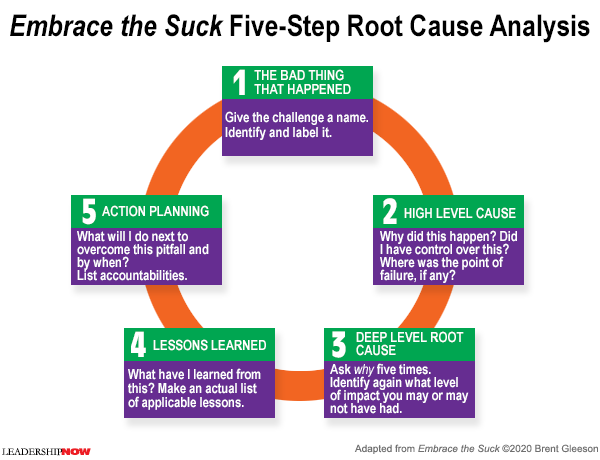
Gleeson uses the example of being laid off—the bad thing that happened to you. The High-Level Cause is at they had to downsize, keeping only the top performers. But as you dig deeper, focusing only on those issues you can control, like your actual or perceived underperformance, you can discover something actionable. Then ask what you did well and what you could work on and list them in step four. Then in step five, make specific goals that are concise, realistic, and time-bound, starting with an objective statement like “I will never lose another job for underperformance.”
A useful tool for learning to identify and then control what you can control. This personal feedback loop will “place you in a constant state of course correction and improvement.”
Of course, we need to be clear about our values. Your values help you know what winning looks like. “Essentially, any action or choice should clearly fit within your value lane markers. Deviation outside those markers typically ends in tragedy. You need to ask yourself what you are willing to do to live by those values and, even more importantly, what you are unwilling to do to avoid deviation.” Like removing temptations.
When working towards our new goal, we have to remove anything that stands in the way of it. “Remove every opportunity for temptation and distraction—any obstacle or competing priority. Maintain total mission focus.” Develop self-control.
Temptation is just a reality of life. Without it, there would be no such thing as willpower. Life will test you on a regular basis. So be prepared to ace the test!”
Only focus on what’s in your immediate control. Ignore everything else.
Maintaining focus on what is in our control and ignoring (or at least deprioritizing) everything else is a core tenant of the growth mindset and applies equally in achieving goals and overcoming obstacles in our personal and professional lives.
And as Gleeson points out in chapter 7, chose wisely what you suffer for. “Life is a series of choices.” Successful Seals training students make it through because they “accept it as a means to a better end.”
And he encourages, “If you stumble, find the root cause and move on. Don’t let yourself get wrapped up in guilt, anger, or frustration, because these emotions will only drag you further down and impede future progress.”
Throughout the book, you will find many mental models with practical steps to move you forward. Models like Eight Failure Realities, Five Steps for Taming Temptation, Practicing the Things That Suck, Mastering Self-Discipline, and a model for Violent Execution, among others.
How willing are you to embrace the suck? Go to war with yourself.
Like us on Instagram and Facebook for additional leadership and personal development ideas.

Posted by Michael McKinney at 08:05 AM
Permalink
| Comments (0)
| Personal Development
, Problem Solving
WE get distracted from what matters to us by our personal projects. Charlie Gilkey says in Start Finishing that a project is “anything that takes time, energy, and attention to complete.” There are projects that keep us busy, and then there are projects that help us thrive—get us to the next level.
To get to the place where our soul longs to be, we’re going to have to convert our ideas into doable projects at the same time that we’re going have to get real about all the projects we are doing. The problem isn’t that we’re lazy or incapable—it’s just that we’re not doing the work that’s going to enable us to thrive.
Luckily, you already know the doing you need to do to move you toward thriving. Yes, it’s tied to the idea that’s nagging you.
To get moving, we will need to find a place in our schedule for our best projects—the ones that make us thrive. The reality of finite time means we have to choose what is most important to us here and now. To make that happen, we need intention, awareness of ourselves in relation to our work, boundaries, the courage to move forward, and discipline. (IABCD if you are into that) “Our innate talent, creativity, and drive combined with discipline are what make us forces of nature.”
There are consequences to not doing our best work. We wither, and we begin to suffer from creative constipation.
Creative constipation is exactly what it sounds like. We take in ideas and inspiration that get converted into aspirations, goals, and projects, and at a certain point, if we’re not pushing them out in the form of finished projects, they start to back up on us.
And like physical constipation, at a certain point, we get toxic. We don’t want to take in any more ideas. We don’t want to do any more projects. We don’t want to set any more goals or plans. We’re full and fed up.
That inner toxicity becomes the broth that flavors all our stories about ourselves and the world; your head trash gets more pronounced and intense, and what we see in the world goes from bright to dark. Creative constipation leads o behaviors in which we lash out at the world—and sometimes even more intensely at ourselves. We become resentful of other—even people we love—who are doing their best work.
Gilkey covers how to make space for your project and the obstacles that get in the way of that and how to work your plan.
Start finishing today.
Like us on Instagram and Facebook for additional leadership and personal development ideas.


Posted by Michael McKinney at 08:16 AM
Permalink
| Comments (0)
| Personal Development
MARC EFFRON believes anyone can be a high performer. That is a person “who consistently delivers better results and behaviors, on an absolute and relative basis, than 75 percent of their peers.” In 8 Steps to High Performance, he identifies eight proven performance drivers that we have the ability to implement.
Effron theorizes that each of us has factors that are the fixed 50 percent that affect our performance. They are things like our intelligence, core personality, and socioeconomic background. Some of these are genetic, and others are part of our environment growing up. (Which we can change if necessary as we grow older.) So it makes sense that we focus on practicing the things we can control that have the most impact on our performance.
The other half, he calls the flexible 50 percent. These are things in your control, like how you set goals, behave, develop, network, present yourself, and manage your sleep. Most of these boil down to getting out of your own way.
The 8 steps to high performance are:
Step One: Set Big Goals.
This step is, not surprisingly, critical. You can’t deliver big results if you don’t have big goals. And those goals should align with what matters most to the organization. “Bigger goals, focused on the right things, allow you to demonstrate higher performance. Bigger goals also test your capabilities and build self-confidence in your ability to deliver great results in the future. Since bigger goals are also more challenging to achieve, you’re forced to build new skills and capabilities to achieve them.”
Step Two: Behave to Perform.
You can control your behavior. Your behavior is what sets you apart, and it is what your boss and others you work with pay attention to. Effron shares some baseline behaviors that can help your performance—ability to connect, innovate, inspire, and model—and eleven behaviors that can derail your effectiveness like being excitable, skeptical, leisurely, bold, eccentric, a perfectionist. “High performers work hard to identify the most productive behaviors, learn new behaviors where needed, and stop showing the less helpful ones.”
Step Three: Grow Yourself Faster.
The more you grow, the better you can perform, and the more opportunities you will earn. Create a Personal Experience Map by asking experts in your field to identify the most meaningful experience for you to gain. “As working professionals, we grow our capabilities about 70 percent through our experiences, about 20 percent through others, and about 10 percent through formal learning.”
Step Four: Connect.
Build networks both inside and outside of work. “Those who connect more effectively have higher performance because they’re able to get more insights, favors, and answers from more people. And it’s almost entirely controllable by you.”
Step Five: Maximize Your Fit.
Continue to grow into the needs of your organization. “You’ll only stay a high performer if you adapt your capabilities and approach to what your company needs at the moment.” What does your company need for you to deliver?
Step Six: Fake It.
We manage impressions all the time. “As your career evolves, your continued high performance will require you to show new behaviors. How fast you adapt to these behaviors will help differentiate you as a high performer. Some of these behaviors won’t come naturally to you, and you may not be fully convinced they’re the right way to manage or to work.” Guess what? Growth is uncomfortable at first. Fake it until you get it right.
Step Seven: Commit Your Body.
“Your body plays a critical role in your performance; it’s important to eat right, exercise, and get enough sleep.” When it comes to sleep, quality is more important than quantity. Six and a half to seven hours is the sleep sweet spot. While studies seem to indicate that exercise matters a little and diet has no measurable effect on high performance, I think that may be short-sighted. And the two certainly play into long-term performance. It’s a package.
Step Eight: Avoid Distractions.
Effron dismisses many of today’s management ideas. And we do have to careful of the latest fads enlisting them as some sort of solution to all of our problems. He picks apart the strengths movement, emotional intelligence, 10,000 hours of practice, and growth mindset, among others. In the limited perspective he describes for each of them, he is right, but a thorough understanding of these concepts provides valuable insights for being a high performer. For example, emotional intelligence has very little to do with personality and is more about understanding your effect on others. Weaknesses need to be managed and often improved on, and a growth mindset is not about individual intelligence. Al of these ideas will help you increase your performance.
When looking over the 8 steps, evaluate yourself on which ones you have mastered and which ones you need to work on. You might not be able to hit all of the steps but take those you need to work on, one at a time, and you will be headed in the right direction.
8 Steps to High Performance is quite valuable in showing you how to get out of your comfort zone to begin to contribute to your potential. Each chapter ends with a section called “What Can Get in the Way” that highlights some of the rationalizations and obstacles one might encounter in taking the next step in their development.
Like us on Instagram and Facebook for additional leadership and personal development ideas.


Posted by Michael McKinney at 01:27 PM
Permalink
| Comments (0)
| Personal Development

WE are conditioned to believe that to be happy, for life to be good, everything should be going our way. Life is supposed to be comfortable when done right. Most self-help books are based on this line of reasoning.
But when you think about it, a constant state of comfort is numbing to the human spirit. It takes us nowhere. What really makes us feel alive are those times when we are challenged, pushed, distressed. In those moments, opportunities arise, our mind expands, and we grow—we learn.
What do you do when life ambushes you? When you are disabused of the status quo. Times like this can either shut you down or open you up. Ambushes create a question.
Former Navy Seal Jason Redman says when a life ambush— “a catastrophic series of events that knock the wind out of you, pin you to the pain, and forever alter your reality” —hits you, you must overcome. You must get off the X.
The X is the event that hit you. And we can get stuck there—sometimes for years. He says people respond to life ambushes in three ways. They are destroyed by it and can’t stop rehashing it. Or, like most people, they get through to the other side, but it is always a struggle for them. Or the third group turns the ambush into a launching point.
In Overcome: Crush Adversity with the Leadership Techniques of America's Toughest Warriors, he shares the story of he was caught in an ambush that left him severely wounded, almost losing an arm and half of his face shot off. He was caught on the X—the “kill zone, the point of attack” –bleeding out, sure he was going to die. He had to stay awake to stay alive. He had to overcome.
What would you do? “How you handle a life ambush, how you handle any crisis, is dictated by how well you lead yourself, and how well you lead others.” After an ambush, you have to take back control of your life and move from defense to offense or what he calls the Overcome Mind-Set. “Self-discipline is the best way to take control of your life again after an ambush.”
Your first move is to get off the X. Identify the issue and find a new direction. You have to REACT: Recognize your reality, Evaluate your position, Assess possible exit routes, Choose a direction and communicate it, and Take action. Moving is the key to getting off and staying off the X.
Once you’ve been through a life ambush, it’s so easy to look back at where you were in the past and think, “Getting back there is my goal.” It isn’t. It can’t be. You have to figure out what your new 100 percent is and build on it.
If there is an advantage to experiencing a life ambush, it’s the clarity it can bring about what is truly important in your life. Crisis crystalizes your thinking, and you become clear about where you stand—often for the first time.
Redman believes there are five areas of your life that when maximized will help you to face any ambush when it comes. The key self-leadership areas are physical, mental, emotional, spiritual, and social.
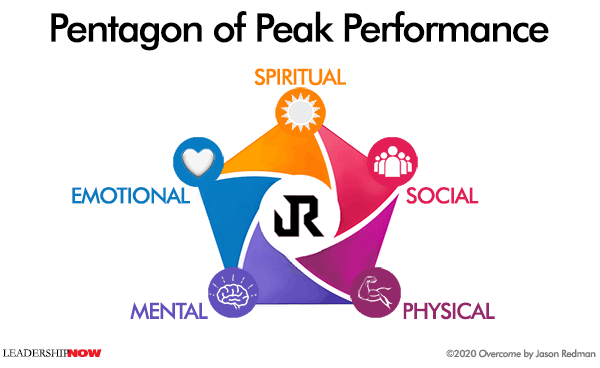
Physical Leadership: “If you are ignoring your physical health, you’re in denial about the risks you are unnecessarily taking. Physical fitness is not just about being ripped or strong; it is about having the energy needed to lead. Physical fitness is the base. Everything is supported by this base.”
Mental Leadership: “You build mental leadership through broadening your perspective, increasing your knowledge, and getting outside of your comfort zone. An interesting recommendation from the Brain Center was to find a sport that requires balance, like paddle boarding, surfing, or even cycling. These exercises are great for mental training because you are using the muscles on both sides of your body, causing your brain to use both hemispheres.”
Emotional Leadership: “What we do with our emotions is a choice. We choose to allow ourselves to get angry and explode. We choose to verbally express our negative thoughts and frustration. Controlling our emotions begins by understanding the scope of our emotions and what patterns we typically fall into when we react.”
Social Leadership: “Often in those hardest moments you only have your close friends and family, and if you did not take the time to nourish those relationships, you will be trying to overcome the near impossible, climbing out of a deep hole without a rope or assistance.”
Spiritual Leadership: “Spiritual leadership means recognizing that you are a unique part of a much larger world and picture, and investing time and resources to make your community and world better. If you struggle with spiritual leadership, try a simple practice: gratitude. Gratitude forces you to look outside of yourself, to focus on something beyond your problems.”
If you are not maintaining each of these five areas, you will undermine your ability to lead others.
A Crisis Is a Launchpad
Overcome offers an approach to get you off of your X with a never-quit attitude. It’s about breaking down the barriers in your mind and keep moving forward despite your fears. It’s about perspective and gratitude.
A life ambush is miserable when we go through it. Maybe we don’t fully recover from it, but it creates a whole new path. So many people get stuck on what they lost or what they no longer have. They want the past so much that they’re not willing to turn around and look forward at what is in front of them. They fail to even consider, “Okay, what are my new opportunities, and could something better come of it.”
Choose to overcome—very good advice from someone who walks the talk.
Like us on Instagram and Facebook for additional leadership and personal development ideas.

Posted by Michael McKinney at 04:32 PM
Permalink
| Comments (0)
| Personal Development
, Teamwork
MICHAEL J. FOX has lived with Parkinson’s disease since 1991. He says he has developed a sort of détente with the disease that requires adaptability and resilience—and a lot of his characteristic optimism. But recently, on top of that, he had a spinal cord injury that required surgery and months of rehabilitation, going from wheelchair to walker to cane to finally walking. And then he fell.
In his book No Time Like the Future: An Optimist Considers Mortality, he writes that the fall brought him “down in more ways than one. It isn’t that I am hurt; I’ve been hurt many times. I’ve been through a lot, suffered the slings and arrows. But for some reason, this just feels personal.” He says, “Make lemons into lemonade? Screw it—I’m out of the lemonade business.”
The accident created doubt. How could he put a positive spin on this? How could he encourage others if he didn’t have what it took? He told Kate Coyne at People magazine:
“I went on to think, ‘Who am I to put out hope? Like optimism is a panacea? Just commodify hope and say it’s something you can use to make your life better?’”
“Parkinson’s, my back, my arm … it still didn’t add up to moving the needle on the misery index compared to what some people go through,” he continues. “I thought, How can I tell these people, ‘Chin up. Look at the bright side. Things are going to be great?’”
But through it all, he reclaimed his optimism and found the foundation of optimism.
“Optimism is really rooted in gratitude. Optimism is sustainable when you keep coming back to gratitude, and what follows from that is acceptance. Accepting that this thing has happened, and you accept it for what it is. It doesn’t mean that you can’t endeavor to change. It doesn’t mean you have to accept it as a punishment or a penance, but just put it in its proper place. Then see how much the rest of your life you have to thrive in, and then you can move on.”
No matter what our situation is, gratitude brings joy into our life. Life will always present us with difficulties, but gratefulness helps us push through. Gratitude is what turns a bad year into a good one—a challenge into an opportunity.
See how others have found something to be grateful for this year—2020.
Robert Frost told a reporter in 1954: “In three words, I can sum up everything I’ve learned about life. It goes on. In all the confusions of today, with all our troubles . . . with politicians and people slinging the word fear around, all of us become discouraged . . . tempted to say this is the end, the finish. But life — it goes on. It always has. It always will. Don’t forget that.”
Be grateful.
Like us on Instagram and Facebook for additional leadership and personal development ideas.


Posted by Michael McKinney at 01:01 PM
Permalink
| Comments (0)
| Personal Development
WE LEARN from experience. We’d be silly not to. But the question becomes, what are we learning? Experience is a powerful teacher, and therein lies the problem. We may think we are gaining wisdom, when in fact we are just reinforcing the wrong lesson just as powerfully.
In The Myth of Experience, Emre Soyer and Robin Hogarth write that “while experience still leads to learning, there is no guarantee that its lessons accurately represent the reality of a situation.” We naturally assume that what we see is all there is.
Experience rarely gives us a complete picture of the situations we face. What we think is reality is just what we can see. And this is true in certain circumstances—in learning environments that are kind. In kind learning environments like cycling and tennis, “decision makers receive abundant, immediate, and accurate feedback on their actions and the rules of the game remain largely constant.” If everything we did was like tennis or cycling, then the lessons we gain from experience would be fairly reliable. But many/most experiences in life are not like that.
Much of the time, our circumstances are not that reliable. Our activities fall into the category of wicked learning environments, “where experience is constantly subject to a variety of filters and distortions.” That means what we think we are experiencing does not correspond with reality. These circumstances “may not only fail to represent a given situation accurately but also constantly feed us a convincing illusion. The rules can change suddenly and dramatically, rendering our institutions obsolete.”
So, what do we do? Rejecting what we think we know can be very difficult.
Two Crucial Questions You Need to Ask
Recognizing that what we are experiencing may not be connected to reality is the first step. Next, ask two questions about what you are experiencing:
What’s missing?
Is there something important missing from my experience that I need to uncover is I hope to fully understand what is happening?
And What’s irrelevant?
What irrelevant details are present in my experience that I need to ignore to avoid being distracted from what is happening?
How We Learn from Experience
Our experiences quickly become part of a story we tell ourselves. And these stories become the basis for the judgments and predictions we make. They help us to form cause-and-effect relationships. While these stories can be beneficial to us, they can also be too simple to adequately capture the reality of the situation. And we can see stories where none exist—no cause-and-effect. When we tell this story enough, it can be hard to accept anything else.
If not handled with care, our experience can make us believe in the wrong causes, expect unrealistic consequences, evaluate performances inadequately, make bad investments, reward or punish the wrong people, and fail to prepare us for future risks. Worse, we may not even notice that we are acting upon faulty stories and fail to revise them in a timely and appropriate way. As a result, we may end up solving the wrong problems, using inadequate methods, and failing to achieve our objectives.
And we need to be careful about learning from the experiences of others. We’ve all seen and read them: The 8 Things Billionaires Do Every Day. What the Most Productive Do Before Breakfast. 10 Common Traits of Effective Leaders.
These lists can be helpful in that they get us to think about our habits and give us insight into what’s possible, but how accurate are they. I mean, did all of the people interviewed diligently do everything on the list? Are these things they do the result of their success or the cause of their success. Are they predictive? What about people who did these things and failed?
As with virtually all complex problems in life, the value of any strategy for success depends on context and circumstances.
The road to success for some people and organizations may involve unfairness, deceptions, or other unethical behaviors. These costs are also often overlooked when people experience, analyze, aspire to, and glorify the resulting achievements. Yet we may find that successful ends can’t be justified by immoral means.
For all these reasons, even if they sound convincing and commanding, lessons of experience based exclusively on others’ success are unreliable. They’re likely to leave us with a belief that success is more objective and predictable than it really is.
If we are to learn the right lessons from experience we need to ask ourselves, what’s missing and what’s irrelevant from our situation. And The Myth of Experience illuminates the way.
Like us on Instagram and Facebook for additional leadership and personal development ideas.

Posted by Michael McKinney at 05:43 PM
Permalink
| Comments (0)
| Personal Development
, Thinking
NO ONE likes to look stupid. And it keeps us from trying new things or exploring those crazy ideas and dreams that we have been carrying around. The trick, of course, is getting to the place where you don’t care what other people think of you. And that’s easier said than done.
It’s not as simple as telling yourself to just do it. Comedian, entrepreneur, and author of The Art of Making Sh!t Up, Norm Laviolette says the way to get to that place is to slowly step into it as you would train for a marathon. You wouldn’t just run a marathon. You would start with short runs and gradually build up.
Maybe you don’t immediately hit the open mic stage, but rather you sign up for an improv class. That’s all, just sign up. You don’t even have to commit in your mind to go, just execute the simplest first step, which is signing up. You don’t even need to tell anyone! Then once you do that, force yourself to go to the first class. No commitments after that.
What you will find is that you now have put yourself in a situation where “looking stupid” isn’t perceived as stupid at all, and what you are doing is actually the new normal. Sure, you are taking a risk by being in an improv class. But ultimately it is a very mitigated risk, because the entire environment is set up in such a way that everyone is facing that risk together.
Since everybody is facing the prospect of potentially looking stupid, ultimately no one does. As this new normal starts to feel more and more comfortable, you start to rewire your brain and how it perceives what is considered “stupid looking.”
You can apply this to anything. And it is infinitely easier when we realize that other people are not thinking about us as much as we think they are. What are they thinking about? Themselves. Feel liberated yet? We are the ones that give people permission to hold us back from being creative and trying new things.
And then there are those who cast doubt when we tell them what we are up to. Laviolette says you need to take control of the conversation.
I have found that making a strong declarative statement along the lines of “So, I’m doing X now,” tends to stop other people from offering overly negative judgments about what it is I’m doing. It is easy for people to point out why you shouldn’t begin something, but it is much more difficult for people to tell you why you should stop doing something, especially if you follow up with the reason why you like doing it. Even the biggest blowhard tends to not want to crush someone else’s good vibes.
The declarative statement takes the power of judgment away from the responder. Once you state what it is you are doing, most people tend to shrug their shoulders and think to themselves, “I guess she is doing that now.” They may approve or disapprove, but ultimately if they see that you are already committed, they tend to move on to other subjects.
The fear of looking stupid is all in our heads. When we step out, we grow.
Like us on Instagram and Facebook for additional leadership and personal development ideas.
Posted by Michael McKinney at 06:10 PM
Permalink
| Comments (0)
| Creativity & Innovation
, Personal Development
EMOTIONAL INTELLIGENCE is a prerequisite to good leadership. To attempt to lead without it is self-serving. It may get the job done, but it’s all about you. It’s not the kind of leadership that brings others along.
Emotional intelligence (EI) is an awareness of not only our own but other’s emotions and the ability to manage those emotions in ways that help people move ahead in dealing with difficult situations.
In Leading with Feeling, Cary Cherniss and Cornelia Roche worked with 25 leaders to analyze how they actually used their EI to deal with challenges and build relationships with others. They observed abilities and competencies common to leaders who have EI. Breaking that down from a practical perspective, they were able to outline nine practical strategies for understanding and developing EI.
The first two strategies provide the foundation that the other practices build on. One must first acknowledge the emotional climate they are dealing with. And this not really a once and done step. It is ongoing as emotions change over time.
1. Monitor the Emotional Climate
Most of the outstanding leaders were not just aware of their emotions or skillful in identifying what emotions other people were experiencing. They actively looked for subtle signs of emotion in order to influence the course of events. It was an active, purposeful process, and when they detected a potential problem, such as discouragement among the top management team spilling over and infecting the rest of the employees, they took action.
This is not to say a leader succumbs to the same emotions, but awareness allows them to deal with the situation more effectively.
2. Express Your Feelings to Motivate Others
Knowing your own feelings allows you to manage them and present them constructively so that you set the right tone. In my view, wearing your emotions on your sleeve is not appropriate for a leader.
Leaders ideally should maintain an even keel in order to help others manage their own emotions. In short, it is usually better for leaders to express emotion but maintain control.
In one example, “Yolanda did not try to minimize the emotions stirred up by this situation. She actively engaged with those emotions and with those who were feeling them. She allowed herself to feel the emotions and then used the emotions to guide her own actions.”
3. Consider How Your Own Behavior Influences Others’ Emotions
This is a critical component of self-awareness and emotional intelligence. It is not a manipulation to understand that our words and actions can dramatically impact the emotions of our team for better or worse. For instance, “when leaders become angry, they tend to discourage their subordinates from sharing valuable information with them” to their own ruin. It behooves any leader to take measures and a thoughtful approach in anticipating what their team needs.
4. Put Yourself in Others’ Shoes
Emotionally intelligent leaders try to gain the perspective of others to get a fuller take on the situation. It leads to better decisions. Doing this is best done face-to-face.
All people like to be respected and understood. An awareness of their experiences is a show of respect and gets to not just the how but the why of people’s feelings. This strategy helps to increase empathy “which contributed to better relationships, but it also contributed to better analysis and action.”
5. Use Your Understanding of Emotion to Figure Out the Underlying Dynamics of a Situation
What are their feelings telling us? There is often more to a person’s emotions than what we see on the surface or the emotional dynamics of the situation. This is important to decipher organizationally before implementing a change program.
6. Reframe How You Think About the Situation
It is critical to remember that “the way in which one thinks about people and situations affects the way in which one manages emotions.”
We found that the leaders in our study reframed the way they thought about emotions in five different ways:
Adopting an inquiring mindset also can help us to use other reframes. It helps us to appreciate just how complicated and messy the world is, and switching from a “judging” mindset to an inquiring one can help us avoid the blame game.
7. Create Optimal Interpersonal Boundaries
Consider managing emotions by modifying the situation by creating more rigid or more flexible boundaries around the topics people discuss or the boundaries between you and others. Leaders in the study “often established, maintained, or tightened boundaries in order to mitigate disruptive emotions. However, they also loosened boundaries, which encouraged the expression of positive emotions, to facilitate the development of better relationships with peers, employees, bosses, or clients.”
8. Seek Out Others for Help in Managing Emotions
When it comes to managing emotions, the nest leaders value the help of others in the form of advice or simply sharing the emotional burden. “It turns out that seeking out and using the help of others is often the most emotionally intelligent thing that a leader can do in critical situations.”
9. Help Others Develop Their Emotional Intelligence Abilities
Emotionally intelligent leaders also coach others in the management of emotions. Most often, this is done one-on-one to raise awareness with a colleague. Coaching others in this way requires control over your own emotions, sensitivity, and the ability to create an atmosphere of trust.
These nine strategies are not linear. We tend to use some strategies more than the others. You will return to strategies 1 and 3 over and over again. It is not a science but an art.
Like us on Instagram and Facebook for additional leadership and personal development ideas.

Posted by Michael McKinney at 06:10 PM
Permalink
| Comments (0)
| Personal Development
WE tend to think that we are who we are and there’s not much we can do about that. But the fact is, we choose our personality and who we are. Your personality is shaped by the choices you make over time.
Benjamin Hardy takes to task the idea that we were born hardwired as he person we are, and we cannot change that in Personality Isn’t Permanent.
Personality tests are part of the problem. I like to think of them as a snapshot and not a life sentence. They are like a frame in a movie—just a part of the story of your life. They tell you where you are and, in that way, they are very valuable.
Personality tests are self-reported. Our view of ourselves is constantly changing based on our current focus, context, and emotions.
Anyone who’s ever done something great with their life had to transform themselves from who they are to who they became. They had to act accordingly beyond their current personality and circumstances to eventually do what they did and become who they became.
The following myths limit your growth and potential. Freeing yourself of these myths will help you to take charge of the person you want to become.
Myth #1: Personality Can Be Categorized into “Types”
There are no personality types that lock us into a way of being. These labels we take on tend to excuse us from taking personal responsibility for the behavioral outcomes we experience. We are not as limited in our responses as a personality test would make us believe. We are not stuck.
Under this paradigm, the way you react to life is just “who you are,” and you shouldn’t be ashamed of it. You shouldn’t try to change who you are, and you couldn’t if you tried. Even if those traits are limitations, there is nothing you can do about it. Just live with the constraints God or your DNA has given you.
We can shape our personalities to serve our goals. “Your personality should come from your goals. Your goals shouldn’t come from your personality.”
Myth #2: Personality Is Innate and Fixed
Our personalities change over time. Who do you want your future self to be? Based on where you want to go, what kind of person do you need to be?
Who you want to be in the future is more important than who you are now, and should actually inform who you are now. Your intended future self should direct your current identity and personality far more than your former self does.
We should use our future self as the filter for developing our personality now. “Your future self should be evolved and different from your current self. Successful people start with a vision of their future self and use it as the filter for everything they do.”
Myth #3: Personality Comes from Your Past
The idea that you are defined by your past or that the past is the best predictor of your future is true, but not because you can’t change. You simply haven’t for another reason. Hardy lists four reasons that keep people stuck in their past:
Past events should inform and change our present and future because we are learning from them. If not, we shortchange our futures. “How we describe, interpret, and identify with our past has far more to do with where we are, here and now, than it has to do with our actual past.” British philosopher Alain de Botton once wrote, “Anyone who isn’t embarrassed by who they were twelve months ago isn’t learning enough.”
Myth #4: Personality Must Be Discovered
Our personality, like our passion(s), is created by us. It’s not discovered. It’s designed. We need to be intentional about it. It is a by-product of the decisions we make. Hardy’s friend Kary is trying to find herself and her passion without success. Hardy comments:
What Kary fails to understand is that inspiration follows action, not the other way around. Lightning isn’t going to strike for her. Unless and until she takes action, her confidence and imagination will remain low. She needs to decide what she wants and begin moving forward. With progress—even minuscule progress—her clarity and confidence will increase, opening the door for greater flexibility and change.
Myth #5: Personality Is Your True and “Authentic” Self
Your “authentic self” is a moving target, especially if you are one to explore possibilities and are growing. To define yourself with a fixed, authentic self is self-limiting and rigid. It lacks imagination and a growth mindset.
Your authentic self is what you most believe in and who you aspire to be. Moreover, your authentic self is going to change. Being authentic is about being honest, and being honest is about facing the truth, not justifying your limitations because you don’t want to be uncomfortable having hard conversations.
The Gap and the Gain
Hardy devotes the rest of the book to showing us how to deal with and move on from each of these prevailing myths of personality. He deals with important issues like transforming your trauma and shifting your story by living in the gain rather than the gap and focusing on what is missing.
When you’re in the gap, you can’t enjoy or comprehend the benefits in your life. All you’re focused on is why something wasn’t how you thought it should have been. For instance, you might live in a great house. But if you’re in the gap, then all you might see is what’s wrong with your house. You may have an amazing partner but only see what you believe to be wrong or missing in them.
As we get older, we tend not to put ourselves into new contexts, so our personality become predictable. Stanford psychologist Lee Ross says, “We see consistency in everyday life because of the power of the situation.” Hardy adds, “Putting yourself in new environments, around new people, and taking on new roles in one of the quickest ways to change your personality, for better or worse.”
Your personality is your choice.
Like us on Instagram and Facebook for additional leadership and personal development ideas.

Posted by Michael McKinney at 02:58 PM
Permalink
| Comments (0)
| Personal Development

HOW we react to our circumstances makes all the difference. Whether we are defeated by them, hardened by them, or whether we transform them depends on our mindset.
Jon Gordon and Damon West present the story of The Coffee Bean. The story follows high school student Abe who is weighed down by worries about football, criticisms, negativity, and his parent’s relationship issues. His science teacher Mr. Jackson helps him to shift his perspective through a metaphor on life.
Life is often like a pot of very hot water. It can be a harsh, stressful, and difficult place. You’ll find yourself in environments and facing conditions that test who you really are, and can change, weaken, or harden you if you let them.
Mr. Jackson asks him to consider what happen to a carrot, an egg, and a coffee bean when they are boiled. The carrot is weakened. The egg becomes hardened. But the coffee bean transforms its environment—the boiling water. Mr. Jackson tells him:
No matter how hard things get, or how hopeless things look, don’t give up. Realize that we don’t create our world from the outside in. We create it and transform it from the inside out.
If you think you are a carrot, you will believe the power and forces outside you are more powerful than who you are on the inside, and you will become weaker.
If you think you are an egg, you will believe the negativity in thew world has the power to harden your heart and cause you to become negative like the world.
But is you know you are a coffee bean, you will not allow the outside world to impact you. You will know the power inside you is greater than the forces outside you, and with this insight, you will transform your environment and the world from the inside out.
This is a powerful lesson for life. And as the story continues, we also learn that it is easy to forget when the pressures and circumstances around us become great. Fear and worry are powerful emotions that easily sidetrack our best intentions and critical thinking skills. In these times, remember, we can be the coffee bean.
The story is well told and worth getting into the hands of people you know and care about.

Like us on Instagram and Facebook for additional leadership and personal development ideas.
Posted by Michael McKinney at 09:54 AM
Permalink
| Comments (0)
| Personal Development
A S CHALLENGING and vulnerable as receiving feedback can be, giving it can also be quite difficult. And for us to be successful leaders, teammates, parents, friends, spouses, and human beings, it’s important to give feedback effectively to those around us.
According to a study conducted by psychologist Tessa West of NYU for the NeuroLeadership Institute, we have an automatic fight-or-flight threat response in our nervous system when we’re receiving feedback, which exists just as significantly when we’re giving it. So, it’s essential to have some compassion for ourselves when we’re in situations where we have to give feedback to others. And it’s also important that we enhance our capacity—emotionally and practically—for giving feedback.
There are four key things to remember when giving feedback to others. Keeping them in mind can help us get past the defensiveness and self-criticism that is often triggered by feedback so that it can be well-received and have the positive impact we’re intending.
1. Intention
It’s critical to check in with ourselves about the intention behind our feedback. In other words, why are we giving it in the first place? Do we genuinely want the other person to be more successful? Are we annoyed with this person and want to let them know why? Do we have any conscious or unconscious bias? Are we trying to prove something or defend ourselves? Do we want to control them or the situation?
There are all kinds of reasons why we give feedback to others, and sometimes there is more than one. But being real with ourselves about our motivation can help us determine whether it’s even going to be helpful. Assuming we decide that it is, making sure our intention is genuine and positive will make it more likely that the person will be receptive to it. And by giving feedback to others on our team with positive intention, we set the tone for our culture in this regard.
2. Permission
Unsolicited feedback, even if it’s spot-on and valuable, can be hard to take and even disrespectful. Asking someone if they’re open to our feedback, while sometimes stressful, is important to do and much better than just launching into it. This is true even if we’re their boss, parent, or mentor, or in any other type of relationship where permission for our feedback may seem implied. Making sure that we have explicit permission to give feedback shows that we respect and value the person to whom we’re giving it. It also usually makes feedback feel less like judgment and more like help, allowing the person to be more receptive to what we have to say. Creating a team standard that we have permission to give each other feedback is also important. And, even if we do that, asking someone for specific permission in the moment before giving it is essential.
3. Skill
Giving feedback effectively takes skill. And even though it can be challenging, it’s definitely something we can improve upon the more we practice and dedicate ourselves to doing it. Because giving and receiving feedback can be a vulnerable experience for everyone involved, it requires attention, commitment, awareness, and courage to do it well. It’s often the hardest type of sweaty-palmed conversation. The more willing we are to do it, the more we can develop our skill of giving feedback successfully. And there are, of course, different ways to give feedback effectively. Oftentimes, we may give it directly and explicitly as part of a review, development conversation, or team debrief. Other times it may be subtler and not even seem like feedback at all, but more of a question, suggestion, or conversation.
4. Relationship
The most important aspect of giving effective feedback is the relationship we have with the person or people we’re giving it to. We can have the most positive intention, explicit permission, and a lot of skill in how we deliver it—but if our relationship isn’t strong or it’s actively strained, it’ll be very difficult for us to give feedback to someone and have them receive it well. I could get the same exact feedback from two different people but react to it quite differently depending on my relationship with each of them. Let’s say, in one case, I know the person cares about me, appreciates me, and believes in me. I’m much more likely to be open to their feedback and to take it positively. Therefore, making sure the relationships we have are strong and authentic helps us ensure that we can give feedback effectively when we need to do so. If the person giving feedback is someone I don’t know as well or may have some unresolved issues with, it’s less likely that I’ll be open and take their feedback well. If we find ourselves in a situation where we have to give feedback to someone with whom we don’t have a strong relationship, it’s important to know that this will definitely have an impact. Anything we can do to acknowledge this in an authentic way and work to enhance or improve the relationship will bene t our ability to provide feedback to them in the present moment and in the future.
All four of these things—intention, permission, skill, and relationship—are important to remember when giving feedback. And they’re also important to think about from a growth mindset perspective when receiving feedback. We want to be sure to check in with and pay attention to what the other person’s intention might be with their feedback for us, to explicitly grant others permission to give us feedback, to communicate about how we like feedback to be given and to proactively work to strengthen our relationships with the people around us.
Giving and receiving feedback isn’t easy, but it’s so important for our growth and development, as well as that of our team. Being able to embrace and even enjoy the sweaty-palmed nature of feedback is something that can allow us and our team to perform our absolute best.
Like us on Instagram and Facebook for additional leadership and personal development ideas.
Posted by Michael McKinney at 03:00 AM
Permalink
| Comments (0)
| Personal Development
COVID19 is a health crisis; an economic crisis; a social crisis; a political crisis; and a geopolitical crisis. It is a crisis dominated by unknowns and huge downsides. It is an existential crisis — life or death. It generates personal fears, insecurities, and stress, all of which can inhibit high-quality thinking, decision making, and effective collaboration, which is mission-critical in such times.
How does one lead on a daily basis in an environment which is volatile, uncertain, and constantly changing?
How does one lead in an environment where the trade-offs could be stark: human life or human financial survival versus organizational financial losses?
How does a leader keep his or her emotional balance in order to role model the desired behaviors needed to enable the highest levels of organizational — human cognitive, emotional, and behavioral performance?
Such an environment requires leaders to be the best thinker they can be, the best compassionate listener they can be, and the best collaborator that they can be. That requires leaders to manage their fears, insecurities, and ego in a way that enables Hyper-Learning — the continuous ability to learn, unlearn and relearn by adapting to the reality of the world as it evolves overcoming the natural human reflexive way of being that values efficiency, speed, confirmation of what one believes, the affirmation of one’s ego and cohesiveness of one’s mental models.
Leaders will need to bring their “Best Self” to work every day — to bring your Best Self into every meeting and into every conversation. Being your Best Self requires you to be more “selfless’’ and more “other” oriented. That requires “Inner Peace, which is having a Quiet Ego, a Quiet Mind, a Quiet (calm) Body, and a Positive Emotional State.
How well one leads, thinks, and engages with others depends on how well one manages and optimizes what’s going on in one’s mind, brain, and body. Inner Peace is based on science and ancient philosophies and is a state of inner stillness and calmness that enables you to embrace the world with your most open, non-judgmental, fearless mind with a lack of self-absorption. Inner Peace helps you reduce internal noise and distraction and helps you align your mind, body, brain, and heart — so you can better engage with the outer world.
Inner Peace enables heightened awareness, reflective listening, and high emotional engagement with others and the highest levels of critical, innovative, and emergent thinking, all of which are needed to lead in disruptive times.
Inner Peace does not come easily. It requires the daily use of practices. It requires rigor and self-discipline and acceptance of the science which clearly states that we are suboptimal learners and thinkers who are “wired” for speedy efficient processing; seeking confirmation of what we believe; affirmation of our egos; and maintaining cohesiveness of our mental models — none of which enables the highest performance in volatile and uncertain situations which require Leaders to “be good at not knowing” and at enabling the highest levels of collective intelligence within their teams.
Personal Daily “Inner Peace” Practices
Achieving Inner Peace takes deliberate daily practice. Here are some practices that have worked well for leaders that I know well and for myself.
Start each day with a 3-5 minute Mindfulness Meditation Practice building up over months to 20 -30 minutes each morning. Then do a 5-7 minute Deep Breathing Practice (such as Coherent Breathing); then review your list of Daily Intentions (a short list which you need to create of how you intend to behave each day in each human engagement) and visualize yourself behaving in those ways.
For example, here are some of the behaviors in my Daily Intentions List: “Be Kind; Be Caring; Be a Positive Life Force, not a Negative One; Smile; Maintain Inner Calm via Deep Breathing; Be Really Present; Really Listen; Don’t Rush to Judge; “Yes, and” not “Yes, but”; “My hypothesis is”; Listen to learn not to confirm and “Slow Down” to be totally present. Mentally visualize yourself behaving in your desired ways. Visualize, for example, how you would behave to be kind.
During your day, be very aware of your heart rate, your body- feeling hurried or rushed or stressed so that you can take a couple of minutes to “Slow Down” via deep breathing to become calm before each meeting. Be disciplined and schedule four 10-minute breaks in your day to be alone and just to calm your mind and body — to re-center yourself. Get yourself into a positive emotional state where you can enable others appropriately. Do not go into a meeting carrying emotions or thinking leftover from your last meeting. Take 2-3 minutes and regain your calmness — your inner stillness — your Inner Peace before you start each meeting.
At the end of your day, reflect on your performance using a Journal. Where did you lose your Inner Peace? What triggered that? How can you prevent that happening again? What could you have done differently? Where did your behavior hinder the highest levels of team performance? How could you have behaved differently to enable others? Is there someone you need to make amends with?
And before you go to sleep every night, do a 3-5 minute Gratitude Meditation where you visualize people in your life that helped you along the way to become who you are, including your closest loved ones.
The Inner Peace Invitation
I invite you to embrace Inner Peace — the daily foundational Journey to becoming your Best Self. The Journey is not linear. The Journey is not one of perfection. The Journey is both hard and joyous. You will be amazed at the impact that it can have on you, your organization, and your home life.
Like us on Instagram and Facebook for additional leadership and personal development ideas.
Posted by Michael McKinney at 06:57 AM
Permalink
| Comments (0)
| Personal Development
RYAN GOTTFREDSON begins his book Success Mindsets, with the question, “Is your thinking the best way to think?” It is an extremely important question to ask and one that rarely gets asked. It’s easy to overlook this question because if I thought something was wrong in the way I thought, I would change it—maybe. After all, we’re pretty comfortable with our own thoughts. We all think we are right.
While you may be reluctant to see to admit it, the thing that stands between where you currently are and the greater success in your life, work, and leadership is yourself—in particular, your thinking that your thinking is the best way to think. But the reality is that if you want to go from your current state to a more successful state, you must think about and see the world in new, different, and better ways.
How we show up in the world, how we experience the world, and how we respond to it is a reflection of our thinking. When we think differently, we behave differently. Behind our behaviors is our mindset. It comes down to our mindset. Our mindset is the filter through which we view our environment and, subsequently, what is going on inside of us—our thinking and emotions.
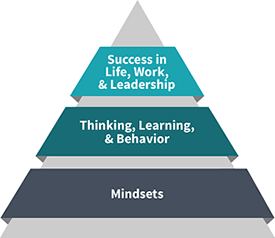 As the pyramid at the right suggests, “if our current thinking, learning, and behaviors are not generating the success we want, we need to shift our focus from ‘fixing’ or changing our thinking, learning, and behaviors to the level below: our mindsets.” We have to get behind what drives everything we think and do.
So, if mindsets are so powerful, Gottfredson asks, “What mindsets do I need to have to be more successful?” He relates an example of dissatisfaction in his own life and concludes with an understanding that his mindset was largely negative. He began to realize that his general “funk and perceived lack of success was not because of the organizations that I worked for and the people within. Rather, I had negative mindsets that were driving me to operate in ways that limited myself.”
Gottfredson provides a framework for us to begin thinking about our own mindsets. By bringing together research on mindsets from various sources, he has assembled four sets of mindsets that we need to be aware of and evaluate our place along the continuum of each. They are fixed/growth mindsets, open/closed mindsets, prevention/promotion mindsets, and inward/outward mindsets. (Each are describe in more detail here.)
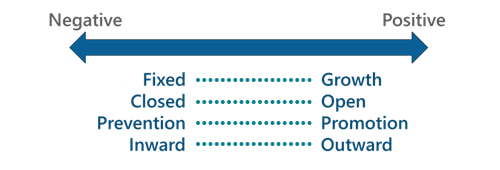
Success Mindsets covers each of these in detail and explores ways to improve in each area. In addition, he has developed an assessment to help you better understand each of these mindsets, find out where you stand on each, and ways to improve.
An unhealthy mindset is at the core of most of our issues. If we are “blind to our mindsets, we will misdiagnose our problems, treat them only at the surface level, and continue to be frustrated.”
Think of some of the most common organizational problems:
• Poor leadership and management
• Inability to effectively initiate and navigate change
• Lack of inclusion
• Low employee morale and effectiveness
At the root of each of these issues lies negative mindsets.
For most of us—of the thousands of people that have taken Gottfredson’s assessment, that’s about 95%—we tend to function on the negative side of at least some of the four sets of mindsets. But we can improve—change our mindset—with some conscious effort.
We come by our mindsets for the most part unconsciously. From our experiences, our mind automatically forms conclusions about the world and how we should react to it. Those conclusions are not often logical or as informed as they should be. Over time we develop a mindset—a way of looking at the world—that is based on those assumptions repeated over time. Depending on our environment those habitual ways of thinking become our mindsets that either do or don’t serve us well. It is in our best interest to look at our mindsets and ask if they reflect the kind of person we wish to be going forward. Success Mindsets helps us to do just that.
Like us on Instagram and Facebook for additional leadership and personal development ideas.
Posted by Michael McKinney at 12:02 AM
Permalink
| Comments (0)
| Personal Development

You and a friend are having a picnic by the side of a river. Suddenly you hear a shout from the direction of the water—a child is drowning. Without thinking, you both dive in, grab the child, and swim to shore. Before you can recover, you hear another child cry for help. You and your friend jump back in the river to rescue her as well. Then another struggling child drifts into sight … and another … and another. The two of you can barely keep up. Suddenly, you see your friend wading out of the water, seeming to leave you alone. “Where are you going?” you demand. Your friend answers, “I’m going upstream to tackle the guy who’s throwing all these kids in the water.”
THIS metaphor sets the premise for Dan Heath’s book Upstream: The Quest to Solve Problems Before They Happen.
We live in a downstream world. We have a bias for downstream action. We spend most of our time reacting to problems downstream rather than dealing with the source of the problem that is found upstream.
Heath argues that “we should shift more of our energies upstream: personally, organizationally, nationally, and globally. We can—and we should—stop dealing with the symptoms of problems, again and again, and start fixing them.” That seems pretty obvious. So why don’t we? Time after time, we find ourselves reacting over and over again.
Heath identifies three barriers to upstream thinking:
Problem Blindness
Problem blindness assumes that the problem is natural or inevitable, and there’s nothing you can do about it. And we shrug it off. “That’s just the way it is,” we conclude. So, we don’t try. “When we don’t see a problem, we can’t solve it. And that blindness can create passivity even in the face of enormous harm.”
A Lack of Ownership
Complacency. What problems do we see around us that we could fix, but don’t? Moving upstream requires that we take ownership of the issues personally. “I choose to fix this problem, not because it’s demanded of me, but because I can, and because it’s worth fixing.”
Tunneling
Tunneling is a condition where you find that “when people are juggling a lot of problems, they give up trying to solve them all. They adopt tunnel vision. There’s no long-term planning; there’s no strategic prioritization of issues.” When we are in a negative or scarcity mindset, we become “less insightful, less forward-thinking, less controlled.”
Here are listed seven fundamental questions that upstream leaders must answer:
In clarifying these questions, Heath reveals some of the big issues through a wide variety of case studies that keep us from moving upstream.
Part of what makes downstream efforts so popular is that the results are quite tangible. “Downstream efforts restore the previous state.” If my relationship is broken, and I fix it, the intervention was a success. If I do take preventative measures, I’m fixing what may or may not have happened. The issue arises, too, that I’m putting effort into something that is not broken. Is that necessary?
We pay to fix problems, but we are not as keen to put money into preventing problems. “We can pay to fix problems once they happen, or we can pay in advance to prevent them. What we need are more businesses and social entrepreneurs who can figure out how to flip payment models to support the preventive approach.”
There is uncertainty in fixing upstream problems, especially when they are not reoccurring. When preparing for a distant threat, it’s often difficult to tell if we are avoiding a disaster or preparing for something that will never happen. Is it worth the effort? “Organizations are constantly dealing with urgent short-term problems. Planning for speculative future ones is, by definition, not urgent. As a result, it’s hard to convene people. It’s hard to get funds authorized. It’s hard to convince people to collaborate when hardship hasn’t forced them to.”
Heath asks, “How can you personally move upstream?”
He recommends that we “be impatient for action but patient for outcomes.” We need to get moving, but often the change we seek takes time. Also, “macro starts with micro.” Break the action down. Get specific. And finally, “favor scoreboards over pills.” Think in terms of continuous improvement. “Data for learning” rather than “data for inspection.” Test and learn and test again.
Upstream is a direction, not a destination. Any movement upstream is a step in the right direction. You can get a little ahead of the problem by or you can go further upstream and look for the more systemic issues.
“When there’s a recurring problem in your life, go upstream.” When we don’t deal with problems upstream, we are destined to deal with them over and over again.
Like us on Instagram and Facebook for additional leadership and personal development ideas.


Posted by Michael McKinney at 11:07 PM
Permalink
| Comments (0)
| Personal Development
, Problem Solving
WE ALL want to leave a legacy. We all crave meaning in our lives. It’s not just a millennial thing.
Meaning in life comes from the contributions we make beyond the self. Those contributions become your legacy.
All of this leads to life’s greatest question: What are you doing for others? Tom Rath addresses this question head-on and presents a path for contribution—a map for creating meaning—in Life’s Greatest Question.
While your talents are nature’s best building blocks, they serve the world best when your efforts are directed outward—not inward. Being “anything you want” or “more of who you already are” doesn’t add value to society unless it provides something others need. Simply put, your strengths and efforts must be focused on specific contributions you can make to other people’s lives.
Work can be fun and improve our health if we can reframe what we do to how do I help. Reorient your thinking about what you do to how am I serving others—the “humanity of what we do.” But rather than relying on your company to determine your contribution, “figuring out how you can make a greater contribution through your work has to be driven by you.” In other words, “Great jobs are made, not found.”

To that end, Rath introduces the Contribify inventory. It is “designed to help you gain a better understanding of who you are—for the sake of doing more for other people.” Upon taking the inventory, you will come away with the top three areas that have the most potential for your contribution from a list of 12 primary Contributions: Initiating, Challenging, Teaching, Visioning, Connecting, Energizing, Perceiving, Influencing, Organizing, Achieving, Adapting, and Scaling.
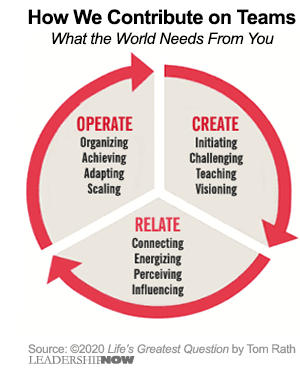 Each of these 12 primary Contributions is categorized within the three basic needs of all teams: Create, Operate, and Relate. “If a team is lacking in any one of these three major functions, it is almost impossible for the group to be effective, let alone thrive.” Each of us has definite contributions we can make to the teams we serve. Understanding group contributions in this way helps us in at least three ways. First, it allows you to more effectively match who you are with what your team needs. Second, it helps to map out how diverse the team is an what the needs are who might need to be brought into fill in gaps. And third, individually we can see where we better see how we might maximize our efforts as we contribute to the team.
Rath makes a very good point regarding the obsession with passion. “Instead of following your passion, find your greatest contribution.”
This is one of the critiques of the “follow your passion” advice—that it presumes you are the center of the world, and pursuing your own joy (not service of others) is he objective. I have found that those who leave a lasting mark on the world, in contrast, are always asking what they can give.Life’s Great Question leaves you with a lot to think about and a structured way to go about it. It provides language to what is often a very nebulous exercise.
Like us on Instagram and Facebook for additional leadership and personal development ideas.

Posted by Michael McKinney at 03:33 PM
Permalink
| Comments (0)
| Personal Development

WE’VE HEARD that hard work is the secret to success. But all too often we see that hard work is not enough. What then?
We need an edge.
Laura Huang explains just how to gain that advantage in her insightful and encouraging book, Edge: Turning Adversity into Advantage. “Certain people seem to be endowed with a unique advantage in which they can execute faster and better and get the things they need, because they are positioned in such a way that others help them move forward. You can create your own edge and open doors—wide-open doors—for yourself.”
Having an edge makes hard work go further. Those that have an edge, Enrich, Delight, and Guide to make their Effort go further.
We must put in the work, but “when you create an edge, you create tailwinds that help you capitalize on your hard work more effectively.” We all face biases, prejudice, and harmful (to us) perceptions and attributions. But these can be the key to overcoming the adversity and roadblocks we face. “For most of you,” she writes, “it will be about positioning yourselves as an antidote to stereotypes, which will allow you to guide the perceptions of others, delight others, and ultimately will result in others seeing the unique value you can provide.”
Enrich
Huang begins with Enrich because it is the foundation of our edge. To do this, we begin by finding our “basic goods.” Those basic things that make you, you. “Creating an edge starts with pinpointing your basic goods and defining your circle of competence, and operating inside that perimeter.” It’s how you enrich.
Your history and your story are part of your basic goods. Don’t underestimate where you’ve been planted—grow there.
Our constraints provide us with a unique way to enrich when we own them—when we use them to see differently. “Don’t let the constraints that others create prevent you from identifying the problem for you, and hence the solution for you.”
Delight
Getting the door to enrich is made possible by our ability to Delight. Delight opens the door, so we can enrich. It’s how we deliver our value.
What is delight? It is the unexpected. “When we delight, we violate perceptions, but in a benign way. Delight unsettles and challenges beliefs about your context, grabbing the attention of gatekeepers and making way for you to show how you enrich.”
There is value in planning to delight, but it is important that you stay flexible and be looking for opportunities to delight. “Authentically delighting in situ requires you to be constantly fine-tuning, as well as constantly attuned to how you can shape situations to present the opportunity for your talents and core competencies to become apparent.”
Delighting requires you to have an opinion or point of view—being authentic while having the audacity, or the stomach, you might say, to take a bold, surprising stance.
We all have the capacity to enrich. But when you are able to also delight, that is where the real magic happens. That is how you allow them to let you in, and how you build your edge.
(As an associate professor at the Harvard Business School, Huang offers a great section on the advice she gives the students and entrepreneurs she coaches on the high-concept pitch, the two-sentence pitch, and the extended pitch. She states that “no pitch should be longer than one minute—after that, you should be in full conversation mode.”)
Guide
Once in, we Guide how others perceive our work and our worth. “It is inevitable that we will be affected by how other people view us and how they perceive us when we are merely trying to ‘be ourselves.’” We should keep in mind too that other's perceptions of us are to a large extent about them.
Huang says we should look for patterns in our life—what rhymes. “Don’t go for absolutes go for directionality.” This is very helpful. Rather than adopt labels, we should identify directions for three reasons:
Going for directionality, rather than absolutes, helps you manage the impressions of others and guide their perceptions. You can be more fluid and adaptive.
If you go for general directionality, you’ll be more likely to avoid striving for goals that don’t leverage your strengths and that make it harder for you to create advantages. Self-awareness, in and of itself, is an elusive goal. We never really know ourselves, the best we can do is to find general directionality.
And finally, going for directionality allows you to simply move toward something that feels right, while already finding ways to cultivate an edge.
Self-awareness is knowing what we put out there and how it will be perceived by others. “Guiding entails being purposeful in helping others frame the attribution that they make about us.”
Don’t let them make assumptions. Give them the data points so that they can draw the trend line that you want them to see. Tell them, rather than allowing them to guess, about your future potential.
By providing directionality, you determine what is meaningful for them to know.
Effort
Effort works with the edge you are creating to inform you of the things you should be putting your effort into—things that you can enrich, delight, and guide. It’s in this combination that your effort then works harder for you. “Effort reinforces your edge.”
The optimal conditions for creating an edge are those in which bitterness and regret do not restrain you; they embolden you. Even if you are perfect, the world isn’t. Acknowledge and accept this, and you have already begun to create your edge. The secret is to know that the deck is stacked, and that life is not fair. But you put in hard work plus, regardless. Don’t let success define you, but don’t let failure define you either. Play the long game, not the short one.
Like us on Instagram and Facebook for additional leadership and personal development ideas.
Posted by Michael McKinney at 06:22 PM
Permalink
| Comments (0)
| Personal Development
IF WE ARE HONEST with ourselves, we know there are times we need help. We just don’t want to ask for it. We’re confident we can figure it out. In time.
But here’s the thing. There’s nothing we are going through or trying to figure out that others haven’t blazed a trail for us already. We just need to ask.
Wayne Baker says, “you never know what people know—or who they know—until you ask. Asking for help can mean the difference between success and failure.” In All You Have to Do Is Ask he identifies eight reasons why we don’t or won’t ask. As a result, we leave a lot of answers, solutions and resources on the table for no good reason. And here are eight no good reasons:
That last reason—the fear of seeming selfish—relates to the proverb that it’s better to give than receive. That’s true. We want to be givers, but that doesn’t make receiving a bad thing. “There’s no giving without receiving, and there is no receiving without giving. And it’s the request that starts the wheel turning.”
Baker offers a quick scientific assessment in the book (or online) to determine what style of asking/giving you tend to choose. And it is a choice. Are you an overgenerous giver, a selfish taker, a lone wolf, or a giver-requester? These types all represent “choices you can make about how you want to operate in the world.”
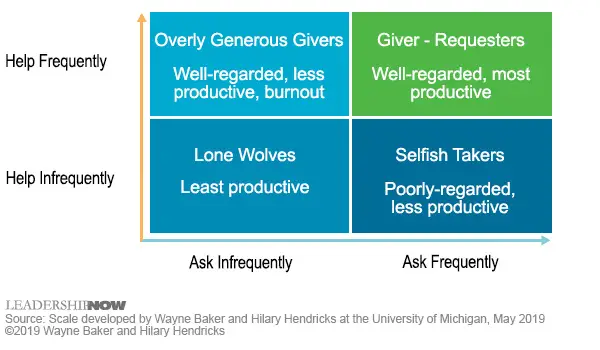
The place to begin is to understand and articulate your needs. Know what you are trying to accomplish and when. With that in mind, formulate a SMART request. That is a Specific (“a specific request yields more help than a vague one”), Meaningful (“Why is the request important to you?”), Action-oriented (What action do you want to be taken?), Realistic (it may be a serious long-shot, but within the realm of possibility), and Time-bound (“every request should have a due date”) request.
After you have formulated your request, you need to figure out who to ask. Who knows what you need to know or who you need to talk to? Go outside your usual circle of contacts. Then ASK. And a good piece of advice: “Rejection is just an opinion. And opinions change. In other words, you can find ways to turn a no into a yes.”
Baker offers much more specific advice and examples throughout but let me mention two tools that have proven effective that Wayne Baker and Adam Grant have developed. The first is Reciprocity Rings.
Reciprocity Rings
A Reciprocity Ring is a group activity consisting of 20 or so people that gather together and share a request with the group one by one. “Other members of the group pause to consider how they could help: Do I have the resource the person needs? Of not, do I know someone in my network who might be able to help? Because it’s much easier for people to make a request when they know that everyone must make one, every participant is required to make a request; asking is the ‘ticket of admission’ to the Reciprocity Ring.”
Reciprocity Rings have been implemented successfully at Google, General Motors, IBM, Citigroup, UPS, and others.
Givitas
Givitas is a collaborative technology platform that provides a safe platform for requesting, giving, and receiving help across boundaries across a vast scale. It helps you share widely beyond the usual suspects.
Platforms like Givitas allow people to get what they need without having to repeatedly tap all the same experts or all the usual go-to people because requests are decentralized and broadcast across the vast network.
Thanks For Asking
We’ve all asked for help only to be rebuffed or made to look stupid. Of course, we recognize and reward people for giving help, but we don’t typically reward people for asking for help. “How our request is received, how we are treated, and how the help is granted determines whether we get discouraged, or encouraged to make asking a personal practice.”
With both organizational and individual success at stake, we need to rethink our responses to asking. “Recognizing, appreciating, and rewarding those who ask is as critical as doing the same for those who answer.”
Baker shares informal and formal ways we can as individuals and organizations recognize, reward, and encourage asking. Asking improves individual performance and effectiveness.
All You Have to Do Is Ask will change your appreciation of asking. It certainly changed my view.
Like us on Instagram and Facebook for additional leadership and personal development ideas.

Posted by Michael McKinney at 05:34 PM
Permalink
| Comments (0)
| Human Resources
, Personal Development
, Positive Leadership
, Problem Solving
DESPITE what the title Teaching By Heart might imply, it is really a book about servant leadership. It is a journey into self-awareness so that you can serve those you lead or seek to influence in spite of your self-doubt, anxieties, and insecurities. It is a remarkable book and a perfect means to refocus your leadership development this year.
Professor of management and organizational behavior at Harvard University, Thomas DeLong, writes, “I’ve found that the best teachers are also leaders, and the best leaders are also teachers.” I completely agree, and it is easy to see the parallels.
Using himself as a case study, DeLong generously shares what goes on in his head and heart as a teacher. He shares what he has observed how in a teacher’s “best moments, they can life people up, and in their worst, let them down.”
You will learn what it takes to teach and lead better. You will gain a better understanding of yourself. Through his introspection, you will come away with a better grasp of your own patterns of behavior. You will understand the need to ask yourself: “What is it that I do consistently that assists me living and teaching, that leverages my talents in unique ways? Just as important, you need to understand those emotional or behavioral patterns that sabotage your efforts to make a difference.”
As teachers [and leaders], we focus more on our inadequacies and failures than on our strengths and accomplishments. I’ll deconstruct why this is so. I will walk you through the heaven and hell of teaching by dissecting and analyzing what I’ve experienced in the Harvard Business School classroom.
After thirty-five years of teaching, DeLong still has anxiety about teaching. To counteract the doubt and anxiety on the days he teaches he must get into the classroom early. “Rather than listen to irrational thoughts and feelings, I need to engage with the ‘enemy.’ I need to look students in the eyes and engage. I need to get out of my head and be interested in something other than my thoughts and feelings and insecurities. The pattern that surfaces is he either/or syndrome. Will I leave the classroom with a feeling of either success or failure? So even if you aren’t a teacher who is wrapped up in your own doubt and insecurities, you should know what your patterns are—the tendencies and habits that either serve or disrupt your effectiveness.”
“As the instructor, you need to increase the probability that your students will see and experience and feel what you want them to experience.” This doesn’t just happen. This is a challenge for teachers and leaders.
Self-Awareness and Growth
This self-awareness is a negative and a positive—a negative because it caused me to beat myself up continuously over my real and imagined shortcomings, a positive because it helped me become cognizant of my patterns.
By remonstrating with myself over my actions, I hope I decrease the chances that I’ll repeat this bad behavior. I still might. But I trust that I will do it less.
On Knowing Students
I am freer as a teacher if I feel I know the students on some level, better able to adjust and adapt o their requirements. My hope is to turn their mindset from one of certainty to curiosity where their assumptions can be tested, confirmed, or revealed to be false.”
The Power of Covenant versus Contractual Relationships
As leaders, we create a covenant with those we lead. A covenant is a good way to think about a leader’s relationship with others. Three elements make up the covenant leaders make with their people. “I promise to set direction with you, to secure your commitment, and help you execute. If I do these things, you’ll succeed and so will the company. This is the covenant leaders establish with their employees, and it drives performance far better than salary and perks.”
Teachers create this covenant with students in much the same way leaders do with employees.
First, students must know that they are in safe, competent, understanding hands. The first dimension is built on faith.
Second, students need to know that teachers care about them and their work. They learn this through feedback, interactions in the classroom, and observing them interact with their peers.
Third, students must feel like they are learning and growing and developing. They need to know that they are being stretched and pushed and challenged with new knowledge, that their assumptions are being tested, and they must gain new knowledge about themselves.
Contractual relationships are transactional. It’s all cognitive. “Contractual leaders and teachers worry about their image, how they are perceived by their boss—a manager or department head. They possess little empathy for others because their goal is to survive where they perceive themselves to be unwelcome.”
Reflections
The ideas expressed here are valuable to leaders in many roles—parents, teachers, pastors.
One of my goals for the students is to have them stand back and face their own life path. An underlying assumption is that the students will do less harm if they are aware of why they do what they do. They will hurt themselves and others less if they understand the purpose and path they are on. I don’t pretend that they should have an answer, but I would like them to be asking questions about their journey before, during, and after the experience at HBS.
As I gaze out the window and reflect, I question whether I’m helping students become more adaptive. Will they make it through their next crucible with greater resilience? Can they maintain a clear head in times of crisis? Do they become paralyzed with fear? Do they wait for someone else to save the day? Are they unable to be the people they were before they experienced the hardship? I want them to be able to keep tough feedback in perspective. I want them to be able to be direct when a tough conversation is necessary?
We need to have “road miles” so that we, through the process of elimination, understand the intersection between our values, motivations, and needs.
I try to highlight that we need not only to focus on the integration of work and play, of home and work but to be more aware of the quality of life we create with those who are near and dear to us.
Avoid Focusing on the Negative
If we use external criteria to define success or happiness, we will come up short, given the powerful influence of our negative-remembering reflex. Everything gets distilled and reduced to one reflection or observation. The technical term for this cognitive process is asymmetric effect with a negative bias. It holds us captive in everyday life.
I find myself returning to the internal dialogue that reminds me of my negative or self-doubting narrative than my self-affirming story. I find that my negative voices are louder than my positive ones, and so I lose confidence and my classroom persona is diminished—I am unwilling to push myself as a teacher, failing to try something new or push boundaries, since these classroom behaviors all carry risks.
The goal, then, is to remind ourselves that we possess a positive story, not just a negative one.
Three Guiding Questions
DeLong offers three guiding questions that will help guide our efforts to be authentic and genuine:
1. How do I experience others? What do we believe about others? The answer will inform how we interact with others.
2. How do others experience me? How do I portray myself to others?
3. How do others experience themselves when they are in your presence?
Teaching By Heart is a very relatable book that all leaders should read. Leadership comes in many forms, but we all deal with the same issues. DeLong’s journey will help.
Like us on Instagram and Facebook for additional leadership and personal development ideas.
Posted by Michael McKinney at 06:56 AM
Permalink
| Comments (0)
| Personal Development
BAD gets into our head and it stays there leaving very little room for the good in our lives. We tend to focus on the bad, even in the face of a lot of positive things. Our brains are wired that way. It’s the negativity effect: the universal tendency for negative emotions and events to affect us more strongly than positive ones.
John Tierney and Roy Baumeister (the first researcher to identify the negativity effect) describe the phenomenon well in The Power of Bad:
We’re devastated by a word of criticism but unmoved by a shower of praise. We see the hostile face in the crowd and miss all the friendly smiles. The negativity effect sounds depressing—and it often is—but it doesn’t have to be the end of the story. Bad is stronger, but good can prevail if we know what we’re up against.
Because of this, we have learned that it takes about four good things to overcome just one bad experience. It’s a rule of thumb, but it is useful to keep in mind when dealing with others and to understand our impact on those around us. “Being able to hold your tongue rather than say something nasty or spiteful will do much more for your relationship than a good word or deed.” Good relationships are more about what you don’t do. “Avoiding bad is far more important than doing good.” You don’t get much credit for going the extra mile, but you pay a big penalty for doing something bad.
So how do we eliminate or a least minimize the bad? The negative?
Not surprisingly, the more insecure you are, the more likely you are to act and think negatively. And our negative thoughts become a self-fulfilling prophecy dragging us deeper into the cynicism and doubt that undermines us. Negative thinking makes us small.
Positive people “literally see a bigger picture. Their eyes sweep a wider field of vision instead of just focusing on what’s straight ahead, as they do when prompted with negative stimuli. Positive emotions broaden your perspective and enable you to build skills that help you flourish both personally and professionally.”
We look for bad things. “Even when things are going your way, the amygdala keeps looking for the cloud behind the silver lining.” We create fears. They can become runaway trains that cripple us. When we do discover a fear, we need to put it in perspective. How important is it really? Rationally override the feeling by talking about it. How would you advise someone else in the same situation? Know what triggers your fear and calm yourself with coping statements. And breath. “A deep breath is a signal to the body that we’re safe.”
Depressed people suffer from extreme negativity bias in the way they see themselves, the world, and the future. Depressed people focus relentlessly on their weaknesses and failures, ignoring their strengths and diminishing their successes as flukes. They interpret one setback as a fatal mistake and imagine it, leading to the worst possible outcome.
Researcher Bethany Teachman says, “People with phobias want to avoid panic attacks, but that’s not the right goal to start with. The first goal is to stop caring whether or not you have a panic attack. A panic attack is uncomfortable but not dangerous. It’s a false alarm—a fear of fear. Once you make the decision to tolerate it, you get a sense of mastery, and eventually, the fear loses its power over you, and the panic attacks don’t come anymore.”
What should we do when delivering bad news? Many think that the best thing to do is to deliver it gradually or after some good news, but research says most people would rather have the bad news first and straight. The criticism sandwich doesn’t really do what we hope it would because the “brain doesn’t logically process threatening information.”
For praise or other good news to make a lasting impact, the brain must transfer it from the short-term working memory into long-term memory. This process gets disrupted when good news is followed by something negative. The brain uses so much energy to focus on the new threat that the previous pleasantness gets lost because of an effect called retroactive interference.
If you have to deliver bad news or criticism, the authors recommend that first, consider your objective. Are you simply delivering bad news, or are you trying to get someone to change?
When people heard first about their bad traits and then their good ones, they ended the experiments in a better mood, but they were also less inclined to do work to correct their bad qualities. The ones who heard the bad traits last were more worried but also eager for self-improvement. It’s not easy to motivate without demoralizing, but you can compromise by concentrating on the good feedback toward the end while also finishing up with a clear reminder of what's wrong and how to fix it.
From there, the authors advise us, among other things, to ask questions, and then once we’ve gotten the criticism across, use the power of bad to your advantage. (Good insights on delivering criticism begin on page 99.)
Hell motivates us more than heaven. Penalties for mistakes make us learn much more quickly than rewards. The fear of looking fat motivates us more to lose weight than the hope of looking slim. The advantage of penalties is that they are “so powerful that you often don’t have to use them. Rewards have to be doled out continually, but the mere threat of a penalty can make a lasting impact.”
When bad things do happen to us, our response becomes the key issue. While many people experience a traumatic event in their lives, most—four out of five—trauma victims did not suffer from post-traumatic stress disorder (PTSD) afterward. “Instead of being permanently scarred, they underwent post-traumatic growth (PTG). Studies have found that more than 60 percent (sometimes 90 percent) of trauma victims undergo post-traumatic growth, including ones who initially showed symptoms of PTSD.
Our response to life is everything. “The growth comes not from the trauma but from the way that people respond to it to become kinder, stronger, and more mindful of the joys in life.” When things do go wrong—and they will—force yourself to see it from another perspective. “People of all ages can counter the power of bad by consciously rewriting their narratives, focusing on their blessings, and savoring the good moments of their lives.”
In 1841 Scottish journalist Charles Mackay published Extraordinary Popular Delusions and the Madness of Crowds. In it, he writes, “Men, it has been well said, think in herds. It will be seen that they go mad in herds, while they only recover their senses slowly, and one by one.” It’s up to each of us to see that good prevails.
Like us on Instagram and Facebook for additional leadership and personal development ideas.
Posted by Michael McKinney at 07:34 AM
Permalink
| Comments (0)
| Personal Development
, Positive Leadership

HOW WE SHOW UP in life matters. Our intentions, energy, and presence matter. The impact we have on others depends on how we show up. We create the culture by who we are. As a leader, this is critical to our mission.
Anese Cavanaugh invites us in Contagious You to be the leader we want to be—the culture we want to lead. We’re contagious for better or for worse.
It all begins with awareness, and she provides a self-assessment for that. “Awareness is about 70 percent of the battle with the other 30 percent being what we choose to do with it.” With that done, contagious you becomes a matter of adopting a mindset of personal responsibility and be clear about what you want to accomplish. To make that practical she offers the Five Steps to Intentional Impact Framework:
Outcome. What is the outcome you want to create? This should be tangible and something you can see or touch. You would not have created this outcome without the meeting, conversation, project, and soon.
Impact. What is the emotional impact you want to have? How do you want people to feel? How do you want to feel? You will create an emotional and energetic experience with your presence and actions either way.
Show up. How will you have to show up to create the outcome(s) and emotional impact you desire? What will your presence be? Your quality of listening? Your body language? Your attire? Anything that impacts how you show up here.
Believe. What will you want and need to believe in order to show up that way? Make this authentic. If you’re having a hard time finding something useful and real to believe, go deeper. What’s the truest thing you can believe to help you show up well and congruent?
Actions. What actions will you need to take to make it all so? What will you actually have to do? Before, during, after?
All steps are important and should be taken in order. You can use this framework for a particular meeting or event, or you can use it to craft a vision for yourself in everything you do. What is the you, you want others to see? It becomes a state of mind that you bring to everything you do. It brings the energy and sets the tone to any interaction or situation we encounter. When things are going well, it’s easy to imagine making this happen—managing our energy. But when things go wrong—when someone insists on sucking the energy out of you—then what do you do? Again, this is where awareness plays a big part.
There is an “inner game” and an “outer game” of leadership playing at all times. The inner game being the intentions, energy, beliefs, mindset, well-being, presence, and who we are. The outer game being what we actually do in our communication, skills, and interactions with others. The inner game drives the outer game. And no one can play your game but you.
As leaders, we need to strengthen what Cavanaugh calls our Intentional Energetic Presence or IEP. “The more we tend to this proactively, the stronger it becomes, and the easier it is to command our energetic presence at will. This ultimately allows us to respond and lead in the most appropriate, helpful, and effective ways possible”—no matter what kind of situation we find ourselves in.
The bulk of the book explains how to strengthen our IEP. Once you begin to strengthen your IEP, you will be better able to reboot your presence in the moment apart from what is going on in your life or in the room you walk into. Another goal is to create a presence strong and energetic enough to allow others you come in contact with to step into it as well. This makes it easier too, to deal with “the people who may be more challenging to work with, you can better serve, navigate, and lead them with clarity, grace, and effect—without burning yourself out, getting sucked into their stuff, or giving yourself away.” In this way, we are able to create intentional impact. The key is knowing what we are, what we want to be, and what we actually do.
Our energy is generated from the inside out, as is the experience we’re creating for ourselves, which can be felt by those around us. Whatever we’re feeling internally is generating an experience externally, and whatever is happening externally influences our experience internally. We proact and react. We project and receive.
The stronger, more present, and more intentional we are, the easier it is to create our experience, to decide what we’ll take on, to know when we’re projecting our energy on others, and to be more intentional about it all. Which means we have great influence on creating a positive and productive experience and on being positively or negatively contagious. When we own this and support it with our well-being, we can more effectively partner with and influence whatever is happening versus be reactive or victim to it.
That said, most of us know this intellectually, but in practice, it’s another thing. We tend to be guided by our emotions and the emotions of those around us. Which, as I’ve mentioned is great when all is positive, but when things turn negative, it is too easy to get caught up in a negative, downward spiral. Knowing this, Cavanaugh provides very practical methods and frameworks to turn this around to become the leader we intend on being. There are no silver bullets here. There’s a lot of self-work, but then that’s what the best leaders do.
Like us on Instagram and Facebook for additional leadership and personal development ideas.
Posted by Michael McKinney at 08:09 AM
Permalink
| Comments (0)
| Personal Development
THE ONE SKILL that matters more than any other in leadership and life is the ability to connect with others. We generally learn this through example, but if those we emulated didn’t know how to do it (or its importance), we are at a disadvantage. It is, unfortunately, one skill that is rarely taught in any formal way.
While technology has made connecting easier and more convenient it has also “changed the way we communicate, behave, and think,” writes John DiJulius in The Relationship Economy. This has led us to a “dramatic decline in our people skills. The pendulum has swung over to high tech and low touch.”
A study by the Relational Capital Group revealed that 89 percent of senior leaders believe that relationships are the most important factor in their success year over year. However, the study also revealed that only 24 percent of those leaders actually do anything intentionally to promote building those relationships. Finally, the study further indicated that less than 5 percent of organizations actually have any specific strategies for helping the professionals develop and strengthen the relationships required to achieve their goals.
That’s where DiJulius and The Relationship Economy come in. “The Relationship Economy is about building a culture that recognizes the importance of each individual and making everyone a part of a community that is working toward something bigger—a community that makes them feel cared for.”
Hospitality entrepreneur Chip Conley said in a TED talk that “Almost 40 percent of us in the U.S. workforce have a boss that is younger than us and that number is growing quickly. Power is cascading to the young like never before because of our increasing reliance on digital intelligence. We are seeing young founders of companies in their early 20s scaling them up to global giants by the time they get to 30. And yet we expect these young digital leaders to somehow miraculously embody the relationship wisdom we older workers have had decades to learn. It’s hard to microwave your emotional intelligence.”
We need a plan, and this is an easy place to start. After we meet someone, we can begin by learning at least two facts about their FORD—that is, their Family, their Occupation, their Recreation, or their Dreams. It’s not about grilling your customers and coworkers, but genuinely showing interest in them as part of the natural flow of conversation. Listening is a skill we need to develop. (Common and often unintentional mistake: “Never steal someone’s thunder. Suspend your own ego and let them enjoy their own story. This is a tough one for many because when someone brings up something that you have in common, you can get excited to share your experience.)
DiJulius offers seven traits for effective communications and explores them throughout this book. You will also find ways to track interactions in your organization.
1. Compassion and Empathy — “Highly empathic people have an insatiable curiosity about strangers.”
2. Engagement and Warmth — Employees who love what they do put customers at ease. Smile.
3. A Drive to Serve — Focus on the customer and the experience they are having. How do they feel after their encounter with you?
4. Ownership — Acting with the same care as the owner of the company would. Do what it takes to ensure a happy customer.
5. Charitable Assumption — Always assume the best in people.
6. Presence — Be in the moment. Do not allow distractions. DiJulius says, “Carpe Momento: seize the moment. There is no better motto for reminding us that any connection with others—especially building relationships—depends on being fully engaged with them.”
7. The Desire to Exceed Expectations — Like a drive to serve, always be looking for ways to go above and beyond other people’s expectations.
It’s always about building relationships. “Strangers are where your greatest opportunities lie—they’re future connections, friendships, resources, experiences, laughs, and good times.” No one succeeds alone.
Like us on Instagram and Facebook for additional leadership and personal development ideas.


Posted by Michael McKinney at 08:07 AM
Permalink
| Comments (0)
| Personal Development

THERE IS NO SUBSTITUTE for character. Better systems, better laws can’t make up for it. Without good character, leaders can go south fast. The problem is that there is very little attention paid to how to develop good character. We learn best by example, but it is wise to look into the lives of others and understand the outcomes of their lives as a result of their character or lack of it.
Four-star U.S. Navy Admiral and former Supreme Allied Commander of NATO James Stavridis gives us a comprehensive look at ten admirals in Sailing True North. He looks at their differing character traits and personalities and the effect it had not only on their careers but on those they lead.
He begins 25oo years ago with the Greek Themistocles and moves forward to the lives of 14th-century Chinese admiral Zheng He, Sir Francis Drake, Horatio Nelson, Alfred Thayer Mahan, John Fisher, Chester Nimitz, Hyman Rickover, Bud Zumwalt Jr., and finally, Grace Hopper. While each of their voyages on the open sea was demanding, it was “vastly easier than the inner voyage we all must sail every day of our lives. That voyage of character is the most important journey each of us ever makes.”
Stavridis writes this out of a growing sense that “in this postmodern era that we are witnessing the slow death of character, driven by a global culture that has turned increasingly away from classic values—honesty, commitment, resilience, accountability, moderation—to a world that moves at breakneck speed and refuses to slow down and consider what is right and just.” Sadly, he notes too that “we have lost the ability to hone our character in private, and our lives are on display seemingly from the moment we are born. We overshare publicly and under-reflect privately on what our individual voyages mean.”
It is good for us to slow down and look at these lives and use what we learn to adjust the course of our lives to be the best we can be. There is much we can learn from others. Biographies provide us with feedback on our own lives in a most palatable way if we take the time to apply what we learn.
None of these admirals was perfect, but we can learn from them all. “The nature of any human is not what they do when the choices are easy, and the metaphorical sun is shining, but rather what they do when the options are morally ambiguous, and the seas are rough.”
Some of the navigational advice we can learn from the lives of these admirals is:
A leader should avoid getting into a position where the only way to persuade an audience is by an almost magical feat of rhetoric.
Great leaders learn how to balance inherent uncertainty with a firm-enough grasp of context to enable decisive action.
Finding the balance between determination and an open mind is one of the ongoing tests of character for us all.
The most defining issue of character is curiosity.
That combination of relentless perseverance and an unbounded desire to “seize the new” is very, very rare in leaders.
You need the deepest reserves of character—strategic patience especially—to implement vision. Rickover was a curious combination of someone who was supremely tactically impatient, to the point of real anger, but had deep reserves of strategic patience to implement a long-term vision—a very rare combination in terms of character, and it served him well.
A little innovation today is often the best insurance against epochal change tomorrow. I often ask—and especially encourage young leaders to ask—what any organization I lead is doing right now that is going to look really wrong fifty years in the future.
Stavridis shares ten character traits that he has learned from the admirals he showcases and from his own experience as an admiral.
At the top of his list is creativity—“a willingness to embrace the new, despite the difficulties and challenges of doing so.” You must find a way to bring along the nonbelievers. Second is resilience. Learn from your experiences and set new goals and keep moving. Third, he lists humility. Arrogance is toxic to a leader. “It is a lot easier to be resilient when you are humble to begin with.”
The fourth quality is the need to find balance in our lives. Most of the admirals he lists in the book failed this test. After all, ambition often drives the lack of balance in our lives. Fifth is honesty—“being truthful no matter the cost.” Make truth a habit. Sixth is empathy. “Most of us are terribly self-centered.” See outside yourself. “A virtuous person begins every encounter with the world not from their own perspective alone, but rather by trying to understand the situation, mindset, and challenges that others are facing.”
Seventh is believing a sense of justice matters. Self-control is at work here. Eighth is decisiveness. Ninth is determination. Never give up, as Churchill said, “except in convictions of honor and good sense.” The final character trait he lists is perspective. We can’t take ourselves too seriously. “We need to understand that in the end we are but sailing in a tiny ship on the boundless sea.” A good sense of humor goes a long way toward maintaining a proper perspective.
Like us on Instagram and Facebook for additional leadership and personal development ideas.
Posted by Michael McKinney at 12:01 AM
Permalink
| Comments (0)
| Leadership Development
, Personal Development
WE ARE ALL DISTRACTED, and we are faced with more and more reasons to be distracted. And while some distractions seem to be adding to our life, they are actually undermining our growth. Distractions take us away from what we should be doing and kills our momentum.
But the problem with distractions goes deeper than that. It’s an emotional issue. Clay Scroggins deals with the root problem and the impact it has on our leadership in How to Lead in a World of Distraction and offers some solid advice.
Sometimes we use distractions to distract us from what we don’t like going on inside of us.
When something we don’t like screaming inside us, we always find something outside—and external distraction—and turn it up. And it works. That outside noise distracts us for a time. In mutes the inner turmoil, the uncomfortable emotions, the pain, the inadequacy, the discomfort, the memories. It hides whatever we don’t want to feel or experience.
We allow our emotions to control our lives instead of taking control of them, and it puts a lid on our growth. “If we think the answer to our emotions is to cancel class, run to social media, or use masking tools to avoid what’s inside, it’s no wonder we’re getting the results we’re seeing.”
As leaders, we need to be aware of the distractions that affect us and deal with what is going on inside of us. “A leader that doesn’t know themselves is a dangerous guide.”
Scroggins offers four noise-canceling habits that will allow you to turn down the noise low enough and long enough to tune into the emotions going on inside you. “The only way to combat the old habit of distraction,” says Scroggins, “is to develop new habits to create space for emotional curiosity.”
1. Simplicity
Know your why. “Find that one sentence that defines why you do the things you do, and it can have massive repercussions on your life moving forward. When you clarify your why—and by that, I mean the answer to every ‘why do you do what you do’ question—you can start to live and lead effectively.”
He suggests we ask four questions of ourselves: What are the things I no longer need? What can I afford to get rid of? What are the things keeping me from what matters most? And how can I organize my life so that I know exactly what I’m looking for and I can easily see what matters right away?
Your why becomes the filter through which you can decide what you spend your time on.
2. Speaking to Yourself
Yeah. That voice inside our heads. That voice that tells us who we are and what choices we should make. The point is, it’s our voice so we can control what it says.
Distractions, like social media, create insecurities. And that insecurity takes us in all kinds of unhealthy directions. “That’s how the voice inside your head works. It snowballs the negative things you hear and say throughout your day in powerful ways. But here’s the good news: the reverse is true as well.”
The antidote is reminding ourselves of “specific truths that counter the lies perpetuated by our negative self-talk.” We have to regulate what goes in our heads. “Self-talk is the means through which you regulate what’s going in and out of your brain. It’s the way you control the narration, so the voice speaking to you adds value and makes you better.” He adds, “filter out the noises that aren’t adding value.”
Your self-talk should be about the kind of person—the kind of leader—you want to be. Scroggins offers two good questions: “What would a great leader do here?” and “What advice would I give someone else who was in this situation?” They give you some objectivity in your particular situation.
3. Silence
It is important to get away to a quiet place. It can be anywhere you can find some solitude. “Solitude means being alone with yourself long enough to learn who you are.”
4. Pressing Pause
You have to plan for a time-out. Create a “sabbath” your life. Taking a fast from social media is a good way to slow down and create some space in your life. But not just social media. “What keeps you from finding rest?”
“When you turn down the noise, you give yourself the gift of evaluation.” It also helps you find your rhythm. It helps you to re-center your life and realign with your why. You can step back from all of the noise and see the bigger picture.
One of his most important and insightful chapters is the last chapter, Master Control. Growing as a leader means taking control—mastering control. And specifically, what is going on inside of us. To begin, there are two questions we should think about:
What are you going to allow to control you?
Who are you going to allow to control you?
Positive emotions release dopamine and serotonin, and we keep coming back for more, and they can take control. So far, so good. But negative emotions will produce the same effect, and so we keep them around as well, returning to them again and again. In their own way, they also make us feel better. “Negative emotions can be intoxicating. And as with an addictive substance, the more you take the bait on them, the more your tolerance of them grows. And the more your tolerance grows, the more you create the patterns that keep you coming back for more.”
Scroggins observes:
The busier my life gets, the louder the nose. The louder the noise, the cloudier my future feels. The less clarity I feel about my future, the more I’m tempted to take the bait on negative emotions.
Clarity doesn’t equal certainty, but it is vital to your leadership. “You can lead others better when you feel like you know where you’re going in your own life.” So, raise the volume of your influence by turning down the noise.
Like us on Instagram and Facebook for additional leadership and personal development ideas.

Posted by Michael McKinney at 04:58 PM
Permalink
| Comments (0)
| Personal Development
WHO IS looking out for you?
“No boss or mentor drove my success—although they did open doors for me. My success came about through a combination of hard work, continual learning, fortunate career choices, and a bit of luck—by being in the right place at the right time,” writes Ron Williams. Williams is best known for his tenure as CEO and Chairman of Aetna, where he transformed a $292 million operating loss into $2 billion in annual earnings.
In Learning to Lead, Williams shows how anyone can grow and succeed as leaders. He grew up in a working-class family in one of the poorest neighborhoods of Chicago in the 1960s. The book is exceptional. He weaves the experiences of his career with the lessons we can all learn from them. Well told and insightful.
He begins by asserting that the single most important asset you have is you. As a result, you need to focus on getting better. “Two things are essential: a deep personal commitment to excellence in everything you do and a commitment to continual improvement.” He encourages us to strive to become 15% better each year in concrete and actionable ways. To do that you need to really think about what you are going to do differently. If you want to be extraordinary, you need to stretch yourself above the average person.
Exceed your job description. Do it for you and build a reputation. “By sticking to tasks listed in your job description, you are refusing to demonstrate your ability to perform at a higher level. Why should anyone think of you as a potential leader when you’ve provided them with no evidence to suggest it?”
For him, his underprivileged background represented an opportunity. “The world and its people were a puzzle for me to solve.” He reframed his world. It is our mindset that often makes it impossible to escape the box we find ourselves in. “Reframing is about creating a new mental landscape with a larger scope of freedom, a greater degree of flexibility, and a set of alternative ways of approaching any problem—which can often lead to new and unexpected solutions.”
You know you need to reframe when what you hear around you is, “Everybody knows” and “It’s obvious that.” “It’s a sign that you and your colleagues may be trapped in a box of your own making—one in desperate need of reframing.”
On the topic of mentors, Williams believes that they are helpful, but you shouldn’t spend your time looking for one. “Mentors come along without planning. Mentorship must arise naturally out of the situation rather than being forced.” However, and his is key, “that doesn’t mean you can’t make a conscious effort to learn from the people around you. As you work on learning to lead yourself, you should also seek out others whose examples, experiences, and insights can be of value to you.”
When people do (or seem to) get in your way, rather than finding blame, assume positive intent. You can choose how you respond to negative events. We don’t need to take it personally. “If there’s something that will make you feel really good to say—something you are itching to say—don’t say it. Blowing up in the face of provocation is a way of losing power, not of claiming it.” Assuming positive intent has been one of William’s secret weapons throughout his career. It is an “empowering strategy that disarms defensiveness and turns potential enemies into allies.”
When leading others and you are faced with opposition to a project or deadline, Williams says that the leader’s job is to ask a lot of pointed questions. “When people protested that a particular deadline I suggested was ‘impossible,’ I would ask, ‘Can you help me understand how you determined that?’ or ‘What are the factors that led you to conclude it’s impossible?’ I avoided starting my questions with the word why, having long ago discovered that ‘why’ questions tend to make people feel defensive—and respond accordingly. By contrast, the more oblique wordings I used directed attention away from the blame game and exactly where I wanted it—toward uncovering the root causes behind their objections.”
A leader also needs to ask questions that lead people to think about the problems they face in a new way; to overcome their mental barriers—“those unquestioned assumptions, unexplored options, or unchallenged rules of thumb that keep people stuck at a low level of achievement.” These mental barriers cause us to reinforce them with information that supports them and ignore the evidence that should alert and enlighten us. We hurt ourselves and our organizations when we act on our untruths.
Williams includes a chapter on managing up and down and presents his Two-Up/Two-Down System. “Paying close attention to the ideas, information, and concerns of the people around you—especially those operating from a different perspective or from a different location in the organizational hierarchy—is key to leadership success. Learning to correctly grasp what I call strategic intent of those in important positions above you and below you in the organizational hierarchy is a vital leadership practice, one that you should try to make into a daily habit.”
Williams provides lessons in communication, creating a positive culture, defining reality, and many more. Putting in practice what he presents here does not require extraordinary gifts. “Your own abilities can suffice to make you an effective leader—provided you focus on the daily challenges around you and then work doggedly, thoughtfully, and positively with the people around you to overcome them.”
There is a lot of emotional intelligence contained in this book. Reading it is a good way to develop your own EQ and check your self-awareness. Use Learning to Lead to prepare yourself answer the call to lead when it comes.
Like us on Instagram and Facebook for additional leadership and personal development ideas.
Posted by Michael McKinney at 12:10 PM
Permalink
| Comments (0)
| Leaders
, Leadership Development
, Personal Development
“The greatest good you can do for another is not just to share your riches but to reveal to him his own.”— Benjamin Disraeli
WHEN I WAS a young Army lieutenant, I met with my Assignment (Personnel) Officer, Major Tom Montgomery in Washington D.C. on my way to Germany in the summer of 1977. I never expected that he would become my first true mentor.
There was no contractual agreement or even a discussion about such a relationship, and through all these years, I’ve never mentioned the word “mentor” to him. But, throughout our relationship, our conversations have given me volumes of knowledge about leadership and a host of other topics.
I saw in him a leadership style similar to my own, just more seasoned. I wanted to learn as much as I could from him and use similar techniques as my own leadership responsibilities grew. He helped me get certain jobs and I worked directly for him once. We remain great friends to this day.
Receiving mentorship is a vital element in learning about leadership… and being a mentor is a responsibility of all great leaders.
I believe there are four types of mentors: assigned, self-appointed, sought-after, and what I call “virtual.” I have experienced all four. The first three are rather self-evident in terms of what they mean. What I’ve found the most valuable, however, is this last one, virtual.
What do I mean?
Virtual mentorship is something you do on your own. You simply pay attention to all of the people around you and learn from them. This can apply to both your professional and personal life. Pay attention to what others do or say that is particularly smart or good, then adopt it as your own habit. Notice also when a leader does something incredibly dumb or harmful to others, then put that in your leadership reservoir as well, so that you will never do the same. We’ve all seen good and bad behavior and said to ourselves: “If I ever get into that position, I hope I behave—or do not behave—like that.”
Think of your life as a journey carrying a backpack, and observed behaviors are rocks you find along the path. Pick up both the good and bad—the good for future use and the bad to remind you not to repeat what those rocks represent. I’ve got plenty of rocks in my backpack—of both kinds—that I’ve picked up along my life’s journey. All great leaders learn something from those they encounter along their journey.
It’s also a good practice to acknowledge those who provided meaningful lessons. I regularly cite those who taught me something that I now use myself. I also store away lessons that I want to avoid from leaders who I don’t want to emulate, though I generally refrain from naming them.
Perhaps one of the greatest periods during which I learned from others was my time in the Pentagon in the late 1990s. My 23 years of service to that point had been exclusively within Army ranks, with no duty served in another military branch. But in 1996, when I became a new brigadier general, I was assigned to the Joint Staff in the Pentagon.
I served during this time with a number of great military leaders who influenced me. Lieutenant General Pete Pace (later Chairman of the Joint Chiefs of Staff) was the J3 of the Joint Staff. I had to brief him each morning. My immediate supervisor was first Major General John Van Alstyne, then later Rear Admiral Tim Keating (who eventually became the Pacific Command Commander and Northern Command Commander as a 4-star admiral). Brigadier General Jim Conway (later Commandant of the Marine Corps) was a fellow 1-star and Colonel David Petraeus was the Executive Officer for the Chairman of the Joint Chiefs of Staff, General Hugh Shelton.
Lieutenant Colonel Terry “Guts” Robling served there as well and would later become my boss as a three-star general when he commanded Marine Corps Forces Pacific and I was his civilian Executive Director. That was a particularly interesting relationship, as he was a lieutenant colonel when I was a brigadier general in 1996. While he didn’t report to me, we knew each other and occasionally worked together. Seventeen years later, I reported to him.
I remember our first discussion in his office in 2013, where I made clear that while we had a different relationship in the Pentagon, I was perfectly fine working for him. I remember him saying he was, as well. He was very comfortable in his own skin. We got along great in the two years of his command tenure and remain good friends to this day.
Good leaders don’t patent their behaviors; they willingly pass them on. I have borrowed many leadership techniques—perhaps most of them—from others who freely gave them up, and from some who didn’t even know I took them. Let your greatest legacy be that you pass on the best-of-breed leadership traits you’ve learned from others.
I freely pass on mine. Many are in my new book, Leadership: The Art of Inspiring People to Be Their Best.
Like us on Instagram and Facebook for additional leadership and personal development ideas.

Posted by Michael McKinney at 10:13 PM
Permalink
| Comments (0)
| Leadership Development
, Leading Forum
, Personal Development

FEEDBACK HAS A LOT OF BAGGAGE associated with it. Feedback is not always well-intentioned and is used to punish, demean, or manipulate. When well-intentioned we don’t always do it right. We dump on people, we’re biased, we miss the overall issues, and present it in a way that doesn’t sound helpful. And we, of course, wanting to be right and accepted don’t see it as the gift that it is.
As a result, you will find people avoiding it altogether—whether on the giving or receiving end of it. Or you will find people trying to take it to a higher lever and state that what we need and really want is attention. Positive attention is the way to go. Build on strengths. But sometimes we need to tame our strengths for our own good, and sometimes we need to manage our weaknesses. And frequently we have no idea unless we are told. We need feedback.
In contrast to the desire of some to dumb down or avoid feedback, authors Tamra Chandler and Laura Grealish have decided to deal with feedback head-on in Feedback (and other dirty words): Why We Fear It, How to Fix It. Done right, feedback is not only a good thing, it is essential to growth and performance. They say we need to do more than tweak our feedback practices, we need to completely rethink the what, how, and why.
They begin by defining feedback as “Clear and specific information that’s sought or extended for the sole intention of helping individuals or groups improve, grow, or advance.” This forms the basis for their Feedback-Fixing Movement.
“Every great feedback experience,” they write, “is anchored in fairness, focus, and frequency.” Fairness is about trust. “When trust and fairness are absent, because either the feedback itself or the Extender [of feedback] seems unfair or biased, the Receiver retreats into protection mode.” We generally associate feedback with criticism because that’s sadly the only time most people speak up.
Focus is about making the feedback specific, targeted, and brief.” When we dump on people, they shut down and the feedback moment is gone. “Dishing out bite-sized portions of off-the-cuff gratitude, recognition, direction, or coaching can move the performance needle much more effectively than hours of training sessions, development seminars, or dismal laundry lists of your rights and wrongs from the past year.”
Frequency is the accelerator. “Connecting frequently speaks volumes. It says, ‘I’m paying attention, what you do is important and notable, and you are a priority.’” Informal and spontaneous is the secret to frequency.
To revolutionize feedback, the best thing you can do right now—especially as a leader—is to become a Seeker of feedback. That is, become a person who proactively requests feedback from others with the intention of self-development or growth. It helps you in a couple of ways. First, you are the example you need to be, and second, to be a seeker lowers the fear associated with feedback because you choose the time and place, the issue and the extender of feedback.
The authors offer the Seeker several tips to effective feedback seeking. First, ask in advance, giving the Extender(s) time to think. (Asking more than one person provides you with a better picture of what is actually happening.) Give them permission to be candid with you. They are most likely as uncomfortable with it as you are. Third, ask them to start noticing based on the nature of the feedback you are requesting. And finally, make the choice to do something with what you have learned.
I found the chart below helpful in wrapping your mind around the proper way to deliver feedback. The considerations are many but going through the chart will help you not only form the conversation but get a handle on your intention for giving feedback in the first place.
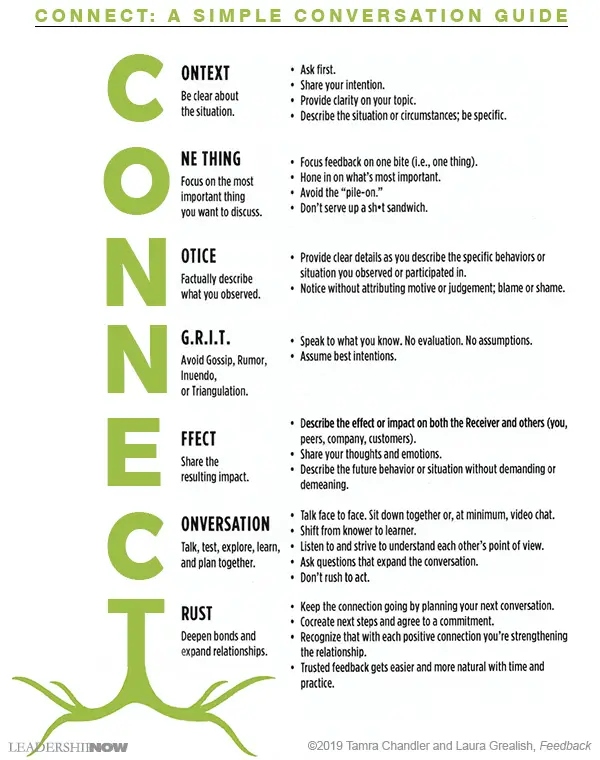
Feedback (and other dirty words) is full of helpful insights and constructive interpretations of the scientific studies and data regarding the issue of feedback. It is a comprehensive look at feedback and well worth reviewing in terms of both delivering and receiving feedback.
Like us on Instagram and Facebook for additional leadership and personal development ideas.
Posted by Michael McKinney at 02:16 PM
Permalink
| Comments (0)
| Human Resources
, Personal Development
BOBBY HERRERA has a message and the message is “We all struggle. Inside every struggle is a gift. Leaders share their gifts with others.”
We tend to not share our struggles or the lessons we learn from them. They are painful and very personal. But Herrera—CEO and cofounder of the HR service company Populus Group—say that’s exactly what leaders do. And that’s why he is sharing his stories and lessons in The Gift of Struggle.
One of the core principles at the Populus Group is that “everyone deserves the opportunity to succeed.” It makes sense, and it drove Herrera, but he felt like the people working with him didn’t share his passion and didn’t understand why he did what he did. But once he shared his story—his struggles—they connected, and it gave them meaning. It not only changed the employees but more importantly, it changed him. He understood them better and became a more compassionate leader.
If you don’t step up and tell the story that gives you identity and purpose, your people will be left on their own, trying to guess what matters to you and why. Without fulfilling work, they will make assumptions about your mission—or lack thereof—and leave when they find a competitor who offers what you’ve withheld. Until then, they’ll give you just enough to check the box and get through the day.
His journey to founding and building the Populus Group is full of ups and downs. But every struggle left him with a gift he used to grow and overcome. The stories he shares are relatable and illuminate the gifts that will help you become a better leader.
Here are overviews of some of the gifts you will learn:
Share What You Imagine—Build Together:
These organizations don’t allow “ROE” (“return on ego”) to compromise the integrity of the culture. Enduring cultures are never enforced by a top-down hierarchy. Everyone lives in a culture, and therefor everyone must use their voice to contribute to it.
Own Your Part:
Leadership amounts to wanting more for your people than we want from them.
Always be a Student:
If you want to be a wise leader someday, you must fiercely apply what you learn. You must also be selective when choosing who you will study.
Not Everyone Will Summit:
The guide said, “I can’t recall a climb when everyone made it to the top. It’s possible, I guess, but it seems like something always happens.”
There is no actual summit in business. There are peaks and valleys—the business cycles we endure, the victories and pain points within an organization—that we experience as highs and lows. And yet as long as our doors remain open, there is no final endpoint, only new challenges, problems, innovations, and solutions.
And applying this gift to people, I thought this was eloquently put:
It’s is important to realize we are all climbing our own mountains. Everyone you hire started their career climb before you met them, and they will continue climbing for a long time after their tenure with your company is over. All of us are working within our own set of constraints, goals, and unexpected life events that shape our journey.
We all climb for different reasons, so it’s important to honor people’s dreams. Your job as a leader is to encourage the growth of your people and to appreciate their particular contributions to the ongoing climb of the company. Regardless of when a person chooses to strike out on a different course, celebrate your time together. Life is a sequence of intersections, shared efforts, and differing goals.
Herrera says, “struggle is the currency of progress.” We need to become students of struggle. Welcome it into our lives as a tool for growth and increased meaning. Strength comes from our struggles. When you view your struggles as a gift, you will become a stronger, more resilient, and more compassionate leader.
Like us on Instagram and Facebook for additional leadership and personal development ideas.

Posted by Michael McKinney at 11:47 AM
Permalink
| Comments (0)
| Personal Development
WE SPEND SO MUCH TIME focusing on credentials, experience, intelligence, and presentation. And yet, what is crystal clear to me after 20 years in leadership roles is that those ingredients, while important to success, aren't enough if you've forgotten the fundamentals of being positive, learning from others, being honest and the kind of person people want to work with.
I wrote the book Always and Never: 20 Truths for a Happy Heart, to help center readers on guardrails for living and leading at your best. When you step outside of these boundaries, your professional and personal life are likely to suffer, holding you back on both fronts. Read, reflect, and recommit to these Always and Nevers, and realize the kind of future you've been planning for.
#1
ALWAYS be in charge of your thoughts
What you say and how you feel starts with the way you think. The way you think about everything is in your control. Thoughts are like seeds that need to be watered and nurtured with real knowledge, by real experts and real friends. A curious, open mind lets in the necessary sunshine.
Never forget that you are in charge of the way you think and a healthy mind requires ongoing fertilization.
#2
ALWAYS listen before speaking
And then listen some more. Listen to understand, to demonstrate empathy, and to give the gift of your time and attention. Listen with your eyes as well as your ears. This requires slowing down long enough to truly see the person in front of you. When people want to talk, especially loved ones, they’re rarely seeking answers from you. They want a sounding board, reassurance, and to connect with someone close to them.
Never dominate the conversation; you have two ears and one mouth for a reason.
#3
ALWAYS follow the Golden Rule
Buddhism, Judaism, Hinduism, Confucianism, Christianity, and Islam all subscribe to a version of the Golden Rule in their religious teachings. It’s a simple notion that has endured through the ages. Treat other’s the way you’d like to be treated. Kindness, patience, being first to say I’m sorry are the hallmarks of the Golden Rule, and the rewards to you are long-lasting: inner peace and a life of no regret.
Never let the mean acts of others cause you to break the Golden Rule.
#4
ALWAYS tell the truth
The truth has everything to do with intent. When intentions are pure and not mixed with anything else, there is the capacity for truth. In your daily consumption of information and interactions be aware of sources involved and their potential motives. People who spread rumors and half-truths are always recruiting new members.
Never gossip or waste time with those who do.
#5
ALWAYS do as you say you will
Make your commitments a priority, and you’ll earn something invaluable-- trust. The ability to build and keep trust is worth more than anything else you can bring to the table. There is no skill, degree, or talent that can replace it. Trust is the connective tissue between you and every important relationship in your life: your parents, spouse, boss, coworkers, and friends.
Never undermine trust placed in you by others by not keeping your word.
#6
ALWAYS place a high value on you
The most important relationship you will ever have is the one you have with yourself. Take care of your health and finances on a daily basis. Make your voice the loudest you hear, and the first one you listen to about your hopes and dreams. The compelling force for happiness and success in your life is you and only you.
Never allow others to determine your ability and potential.
#7
ALWAYS be a student
G. Bernard Shaw is credited with the adage “Youth is wasted on the young.” Wouldn’t it be great to preserve all the wonders of youth as we gain the wisdom and knowledge that comes long after high school and college? There is something you can do to maintain your youthful outlook on life—always be a student. Seek out opportunities where you aren’t the smartest person in the room and learn. Read books and magazines that broaden your horizons. Continuing your education in formal and informal ways will keep you young and interesting.
Never think you’re too smart or too old to learn something new.
#8
ALWAYS separate opinion from fact
Opinions are just that, one person’s view. They can be wrapped in fear or prejudice. Opinions can make people as impervious as steel preventing the passage to clear thinking or new possibilities. Keep your mind free of opinions and focus on acquiring real knowledge. Be selective about people who hold themselves out as experts. The best knowledge possible is that which comes from your first-hand research and experiences. Get the facts before you make big purchases, cast your vote, or try to influence others.
Never mistake opinion for fact.
#9
ALWAYS see the beauty in mistakes
Allow yourself to see mistakes in a whole new light. Learn from them, and one day, your mistakes will provide material for the stories you tell, your heartfelt advice to others and your expanding book of self-confidence. Always forgive yourself and others for making mistakes. Make decisions based on the best information you have and be confident you will be able to handle the outcome.
Never allow mistakes to cause shame or prevent you from trying again.
#10
ALWAYS share credit for success
If you want to be known as a team player, to be included in big projects and considered for promotion, look for ways to acknowledge others and their contributions. In fact, the group is always smarter than any one person, so why not embrace it and say so. When you make co-workers feel a part of something, they are inspired to do their best. People who inspire are literally pushed up the ladder by their peers.
Never allow your desire for praise overrule recognition for the group.
These principles come to you as a loving reminder, moment of reassurance, and reaffirmation of all that is important today and will be for the rest of your life. It comes from someone who has learned through experience these change-proof concepts the hard way.
I hope you'll share them with those you love. I hope it brings you comfort, joy and all the blessings of a life well-lived.
Like us on Instagram and Facebook for additional leadership and personal development ideas.
Posted by Michael McKinney at 09:45 AM
Permalink
| Comments (0)
| Personal Development
JERRY COLONNA helps start-up CEOs make peace with their demons, the psychological habits and behavioral patterns that have helped them to succeed—molding them into highly accomplished individuals—yet have been detrimental to their relationships and ultimate well-being. In Reboot: Leadership and the Art of Growing Up, he does just that.
He states that much of what he has learned about growing up came from learning to lead. Reboot is a peak into his life and the lives of leaders as they come to terms with who they are and what is holding them back. It’s like listening to a coaching session.
Who we are shows up in our leadership. Sometimes, we use the organizations we lead to make ourselves feel better about our unresolved issues. When we don’t like what we see, we have to be honest and ask ourselves, how have I been complicit in creating the conditions I say I don’t want?
In Reboot, he says things like:
The back of the warrior is strengthened by knowledge of knowing the right thing to do. The soft, open heart is made resilient by remembering who you are, what you have come through, and how those things combine to make you unique as a leader.
On learning to lead yourself he says:
Learning to lead yourself is hard because it requires us to look at the reality of all that we are—not to fix blame on ourselves but to understand with clarity what is really happening in our lives. Learning to lead yourself is hard because it is painful. Growth is painful; that’s why so few choose to do it.
A client tells him, “It’s like this—if I’m not panting, I feel like I’m not working.” He responds with:
There it is. That same old haunting belief system. Run faster and faster, telling oneself that the way to be is to do; do more, faster, and just maybe you’ll outrun war, cancer, and the other demons that cause you to doubt your worth, your lovability, and your own voice.
Colonna challenges leaders to show up as you are.
When we stop the bullshitting, the pretending that we’re crushing it, that we’ve got it all figured out, we run the risk of being overwhelmed by the realities of all that we carry—the burdens we’ve convinced must remain secret to keep us and those we love safe, warm, and happy. But the spinning prevents us from being who we really are. You might as well tell me who you are because if you don’t, I’m going to invent things, and those things will stand between us, keeping us from being close.
His thoughts on grit are illuminating. He begins by telling us what grit is not:
False grit is brittle. It’s the sense that we are nothing if we can’t take a punch. In fact, we define “taking a punch” as the ability to not feel pain when we are pinched. False grit is dangerous. It feeds a stubbornness that, in turn, can feed delusion. We mistake the tendency to delude ourselves that our relationship will improve—our companies will succeed—if only we double down on our old patterns, grip the steering wheel until our knuckles whiten, and bear down. Stubbornness is not the hallmark of the warrior. Leaders who persist out of stubbornness, believing themselves to be gritty, are, at best, delusional and, at worst, reckless.
On the other hand, true grit is kind.
True grit is persistent. True grit persists not in holding on to false beliefs against all evidence but in believing in one’s inherent lovability and worthiness. True grit is the leader believing in the team’s purpose, its capacity to overcome obstacles, and the relevancy of the cause. True grit acknowledges the potential of failure, embraces the fear of disappointment, and rallies the team to reach and try, regardless of the potential of loss.
True grit, the capacity to stick with something to the end, stems from knowing oneself well enough to be able to forgive oneself. To have inquired deeply and steadily enough to find the deep sense of purpose that is beyond a personal mission statement. In that knowing of oneself, one is then able to stand as a single, warrior amid a community of brokenhearted fellow leaders.
Like us on Instagram and Facebook for additional leadership and personal development ideas.

Posted by Michael McKinney at 01:05 AM
Permalink
| Comments (0)
| Entrepreneurship
, Personal Development
GRACE, a concept present in all of the world’s major religions, has a divine meaning. Grace, in a secular sense—that is on a human level—is about perspective. A perspective larger than ourselves. A perspective that reaches to a purpose beyond who we are alone. In short, our connectedness.
Grace is a critical part of who great leaders should be. To that end, John Baldoni has tackled for us in Grace: A Leader’s Guide to a Better Us, an attribute that is in short supply today. Grace is something all leaders should model for the benefit of those around them so that it spreads to society in general.
Grace is foundational to service. Baldoni writes:
Love, sacrifice, truth, and courage are virtues made actionable by grace. We may be disposed to do what is right; grace gives us the impetus to act upon doing it. Grace then becomes the inspiration for treating individuals with generosity, respect, and compassion. It manifests itself as action in the name of others, and it energizes us to act upon our beliefs.
To help us better understand grace and to help us intentionally apply it in our leadership, Baldoni explores grace from five perspectives with this acronym:
G is for Generosity: the will to do something for others.
R is for Respect: the dignity of life and work.
A is for Action: the mechanism for change.
C is for Compassion: the concern for others.
E is for Energy: the spirit that catalyzes us.
Generosity
Gracious people give of themselves. Gracious people leverage who they are and what they have for the benefit of others. Baldoni shares a great quote from British Prime Minister Benjamin Disraeli, “The greatest good you can do for another is not just to share your riches but to reveal to him his own.”
Gracious leaders share time, knowledge, and power. They cultivate a selfless approach to life. Generosity emanates from an abundance mindset. A selfless person, even in the midst of personal adversity, can find something to share with others. That attitude is contagious.
Respect
Self-awareness opens the door to respect for others. A fully self-aware person knows her faults as well as her strengths. Such awareness compels the self to acknowledge the dignity of others.” Humility plays a big part here. Respect and self-respect fuel each other. They grow together.
Action
Grace is intentional. A reactive mind rarely manifests grace. While grace that has been shown to us comes freely, it requires effort for us to generate it ourselves. Grace means rising above a perceived slight.
Grace is often manifested in clarity of purpose and civility. Civility is a decision we make. “No matter what leaders may feel inside, they think before they speak. They focus not on themselves, but on the needs of others—on healing.” Instilling civility in the workplace is the job of leaders.
Compassion
Gracious people have the capacity to forgive and show mercy. “Grace enables us to take the higher road, to think more clearly.” It meets rage with love and civility.
Gratitude enables compassion—both gratitude expressed and felt. “Gratitude is that capacity to care. We need to reframe our lives with a constant awareness of just how important feeling gratitude within ourselves is because it actually helps our overall well-being.”
Energy
Grace requires energy. “It renews itself through practice as well as by taking in life, doing one’s best, enjoying the highlights, mourning the losses, and do so in the full spirit of life. In forgiveness, mercy, joy, and humor.” Grace draws energy from a positive outlook and an abundance mindset.
When we demonstrate grace in our leadership, it spills into other areas of our life as well because it is an approach to life. Our example encourages others to begin to think that way as well. Grace—in all of the dimensions Baldoni explores in this book—is a value that has fallen on hard times. It is time to revive it in our personal lives, in the workplace, social media, and in public discourse.
Grace celebrates grace as well as advocates for it. Baldoni shares many examples of people from all walks of life who demonstrate grace in their lives. They are an inspiration to us all.
Grace reduces the space between us. Our environment often pushes us into negativity; into the differences between us. Grace intentionally overlooks the negative and leverages the positive. It finds the connection and promotes it.
Baldoni breaks the often intangible idea of grace into down-to-earth actionable behaviors that we can all intentionally implement into our lives. You will find a self-assessment tool of 20 questions to help you take an honest look at how much you have allowed grace to fill your thoughts and behaviors.
Like us on Instagram and Facebook for additional leadership and personal development ideas.

Posted by Michael McKinney at 01:08 PM
Permalink
| Comments (0)
| Leadership Development
, Personal Development

AS LEADERS, we can and do introduce stress into the workplace. Charles Fred initiated a study of over 4000 post-startup business to find out why, after they had experienced early growth, had stagnated.
What the researchers found is a problem in the way employees approached their roles, solved problems, and interacted with each other; poor-performing firms showed working environments of intense stress.” The responsibility for that rests on those that influence how others work and interact within the workplace—the leaders.
Our culture baits us into a non-stop frantic pace with the inevitable unintentional behaviors. Many leaders believe that they are just setting the bar for high performance. Our bodies react by producing cortisol and adrenaline to help us keep up, but over time it becomes unproductive stunting the “very tool we need to prosper in today’s environment: our cognition. So, when we require mental acuity, we experience diminished recall. When we need sharp thinking and problem-solving, our minds are full.”
Into this environment, Charles Fred introduces a leadership discipline that inserts pause and calls it The 24 Hour Rule. “The discipline of pause focuses on the simple notion of creating a space between you and the persistent and perilous stimulus from a frenetic world.” It is the role of the leader.
Pause is not a delay but a discipline. It’s not a waste of time; rather, it affords us the time to deliberate before we act. It allows us to control how we respond and react to others, whether it takes five seconds or 24 hours. Most importantly, it does not delay our ambitions or dampen the need to hustle.
Unfortunately, leaders don’t have a contained workspace or a controlled set of procedures to give us the method to pause. Instead, we begin each day with unknown situations, variables well beyond our ability to plan and prepare. For these reasons, a leader must use self-discipline—the ability to mentally call a time-out, to get rest, to run through a checklist—despite overwhelming temptations to quickly react or respond without doing so.
It is the one thing we have complete control over. Fred writes, “I’ve learned that I can truly only regulate one thing: the way in which I respond and react to another human.”
When we look at the highlight reel of successful people, it gives us the impression that they are always on—always producing. As we watch from the sidelines, we create for ourselves a false set of expectations. We introduce unnecessary stress into our lives and work as we try to keep up. The thing is, it’s not real. Top producers insert pause into their work. We need the self-discipline to do the same by letting go of a false ideal.
The 24 Hour Rule is a well thought out and well-executed booklet. Fred provides three steps for building self-discipline around pause. It is a quick read but one that is worth spending some time thinking about.
How will you introduce pause into your leadership?
Like us on Instagram and Facebook for additional leadership and personal development ideas.
Posted by Michael McKinney at 06:48 AM
Permalink
| Comments (0)
| Personal Development
THERE IS a counterintuitive mindset behind Michael Hyatt’s productivity system. Productivity is not about doing more faster. Rather it’s about achieving more by doing less as a result of focusing on getting the right things done. It’s about what you are not doing.
We undermine our potential when we try to do everything. The goal of productivity and the foundation of the Free to Focus system is to free you to pursue what’s most important to you. It’s about freedom. Freedom to focus, Freedom to be present. Freedom to be spontaneous. Freedom to do nothing.
To that end, Michael Hyatt presents in Free to Focus, 9 actions grouped into 3 steps.
STOP
To start, you must stop. Step back and ask yourself, “Should I be doing this at all?” Reflect on your objectives and why they matter.
Formulate: What do you want your life to look like? What matters to you most. “Productivity should ultimately give you back more time, not require more of you.” Freedom is the goal. What does that look like for you?
Evaluate: Where are you now? What should you be doing? It’s time to separate the valuable activities from your busy work. Evaluate what you do and could do based on two key criteria: passion and proficiency. You’re happiest doing things that you are good at, and you love doing. There are four zones of productivity that we typically operate in: the Drudgery Zone, Disinterest Zone, Distraction Zone, and the Desire Zone.
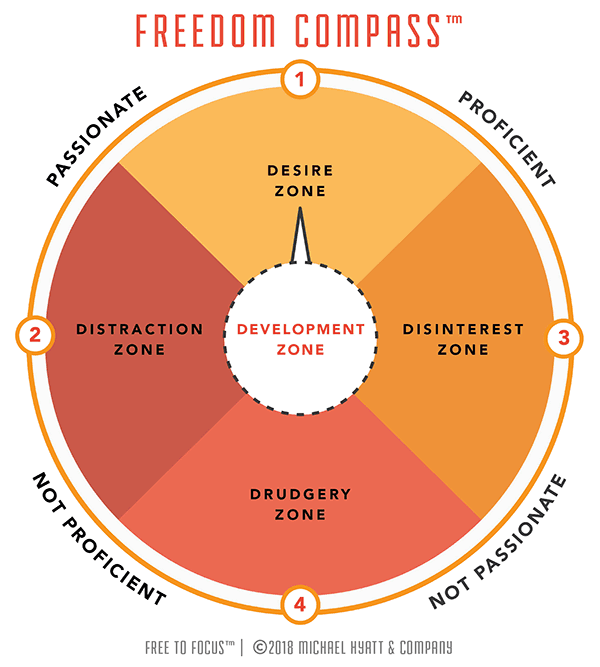
The desire zone is where your passion and proficiency intersect and where you can make the greatest contribution. Obviously, this is where you want to be functioning most of the time. Hyatt adds a fifth zone called the Development Zone. This is an area where you are passionate about and developing a proficiency, or passionate about but not yet proficient. We need to evaluate all of our tasks and place them in the appropriate zone.
Rejuvenate: Make time to rejuvenate. We can increase the energy we direct at our why when we sleep, eat right, move, connect, play, reflect, and unplug.
CUT
Eliminate: Every yes contains a no. Time is a zero-sum game. Ask yourself, “What will I have to give up in order to say yes to this opportunity? or Will saying no to this allow me to say yes to something better?” “By cutting away the nonessentials, you create space, for the things that really matter to flourish.”
Automate: This step is not just about using technology more effectively; it’s about creating routines that you don’t need to think about, creating templates and processes. “If you ever find yourself thinking, There has got to be an easier way to do this, you should always assume there is. Then go find it.”
Delegate: Should I be doing this job at all? Tasks in your Drudgery and Disinterest Zones should be delegated. The items in your Distraction Zone may be harder to let loose of since you enjoy them even though you are not the most proficient at them. Better to give them over to someone who can do them much better. If you have more than you can handle in your Desire Zone, you should look at delegating some of those too. Sometimes it is faster just to do it yourself, but “most tasks are not one-time occasions. So, while delegation does, in fact, take more time on the front end, it will save you an enormous amount of time every instance after that.”
ACT
Consolidate: Harness the power of MegaBatching. “MegaBatching enables me to focus for an extended period on a single project or type of activity, churning out a ton of work quickly and with much higher quality because I’m less distracted. In those dedicated blocks of time, I truly am free to focus on the thing that matters most at that moment.”
Designate: Decide what needs to be done now and what can be done later. It’s a matter of designing your week, and Hyatt outlines six steps to make that happen. Plan your ideal week. Designate the what and when of your week and day.
Activate: Anything that takes our attention away “subtracts value from us and gives it to someone else—e.g., a coworker or an advertiser. Limit instant communications by turning off your notifications. Set boundaries by letting people know in advance that you are going offline for a period of time to focus. Use technology to block technology. Listen to the right background music. Take charge of your day.
Free to Focus is one of the best books you will read in order to take control of your life. You will find downloadable tools for each step of the process.
Like us on Instagram and Facebook for additional leadership and personal development ideas.

Posted by Michael McKinney at 05:59 PM
Permalink
| Comments (0)
| Personal Development

HAVING A POSITIVE ATTITUDE is a critical element of leadership. To some, this comes naturally. Others must constantly work on it. Since my earliest memory, I have had the sense that anything worth doing… worth pursuing… must be passionately pursued. A positive attitude naturally follows.
I found myself first assuming leadership responsibilities at age 14 when I became an Eagle Scout. Perhaps I was naïve, but the leadership aspect of this achievement was unexpected. For me, getting there was just a mountain to climb. It was the culmination of 21 merit badges and a large community project. It was the excitement of the journey, the arrival at a destination, and the achievement of the reward.
For me, at 14 years old, it was like reaching the top of Mount Everest but with no real thought (or plan) on how I was going to get back down… the part of the climb where most people die. Once there, I didn’t quite know what to do with these newfound responsibilities when people started turning to me to lead. But it did help jump-start a lifelong journey to develop and sharpen my leadership skills—a journey that really never ends.
Great leaders constantly deal with the struggle between achieving personal goals, while doing so with humility. Ask yourself, “Do you want to achieve lofty goals in order to ‘climb the mountain’ or do you want to get on top of the mountain so that you can help others climb their own mountain?” How can you do both?
In high school, I held leadership roles in school government and on the sports field. In my senior year, I was voted “Best All-Around” and “Most Dependable”—the latter accolade drawing raised eyebrows from my parents! At Purdue University, I was President of the Freshman Council at the largest school dormitory, President of my Fraternity Pledge Class, and Vice President of Purdue’s Interfraternity Council. (I ran for President, but was asked by the Council whether I would take the VP spot if not selected to be President. My agreement sealed my fate).
All these experiences helped shape my thinking about, and commitment to, leadership because people started to turn to me to lead. I had the right attitude throughout these early years. However, there came a period in college when I lost my way.
My attendance at Purdue was facilitated by an Army ROTC scholarship, at a time when the Vietnam War was stoking nationwide protests across nearly every college campus. Compared to other campuses, Purdue was a fairly conservative school, but we had a chapter of the Students for Democratic Society (SDS), and they regularly protested the war on the mall or at the Armory.
I had mixed feelings about the war when I arrived at Purdue in 1969, having spent most of my high school years in Europe—insulated from the anti-war movement. But since I had an ROTC scholarship and my dad was retiring from the Air Force and starting law school about the same time I entered college, I felt an obligation to stay in a program that was paying my way. I also worked 4 hours each evening (Monday - Friday) as a janitor, cleaning the second floor of the university library to help make ends meet.
Then an unfortunate event happened.
Because of my student government activities, my leadership role in the fraternity, and my work schedule (combined with ambivalence about the war), I didn’t participate in any ROTC activities outside the classroom. Just walking across campus in uniform to attend military drills drew unwanted attention. So, when the annual Army ROTC awards ceremony occurred in the spring of my freshman year (1970), and knowing that I was not an award recipient, I decided to skip the ceremony and attend the SDS rally in the mall instead.
Not my brightest moment…
That day, after chanting “1-2-3-4, we don’t want your F*#king War!” over and over again, a growing crowd of about 1,000 decided to march on the Armory, where the ROTC awards ceremony had been moved to insulate it from the protests.
I followed the crowd.
Upon arriving at the armory, they broke open the large truck-sized doors and entered, chanting loud and strong. State troopers in riot gear soon arrived to keep the protesters away from the formation of cadets.
I was not an active protest participant, and naively thought of myself as being in some kind of “intellectual exercise,” but one of my instructors saw me, that day. He called me in the following morning and told me that my scholarship was being put on probation.
This was a wakeup call for me, and it began the reshaping of my attitude. I had to decide which side to be on. I came to realize that I wanted to be a leader more than a protestor. Like some other Americans, I may have thought that the Vietnam War was ill-advised, but I also realized that there were alternative ways to make my mark on the world.
When ROTC summer camp training rolled around between my junior and senior year, I spent nine weeks at Fort Riley and did well enough to become the third-ranking cadet at Purdue during my senior year. Upon graduation from Purdue in 1973, I was one of six cadets designated a Distinguished Military Graduate.
So, what should you take from this ROTC experience? In a nutshell: attitude counts. A lot.
There’s something to be said about the oft-repeated mantra that “you can be whatever you want to be.” That said, all aspects of character: ambition, perseverance, self-awareness, empathy, humility, integrity, and always taking seriously the responsibility of being a leader—often while sacrificing personal welfare or gain—are required if you’re to be the best you can be. You need building blocks to realize that dream. During those early years at Purdue—at least as it applied to an Army career—I lacked ambition, a good self-awareness, and perseverance. I lacked “grit.”
I simply knew that I owed four years to the Army after graduation because of my scholarship, but after that, I thought I could move on to something else.
Once I finally decided to “get on board,” my ambition, perseverance, and self-awareness kicked into high gear.
I then adjusted my attitude, and a 4-year commitment turned into a 30-year career.
Like us on Instagram and Facebook for additional leadership and personal development ideas.
Posted by Michael McKinney at 12:01 AM
Permalink
| Comments (0)
| Leading Forum
, Personal Development

COURAGE IS THE FIRST VIRTUE of organizational performance. Consider, for example, all the other concepts that courage connects to in workplace settings. Leadership takes courage because it requires making bold decisions that some people won’t agree with or support. Innovation takes courage because it requires creating ideas that are ground-breaking and tradition-defying; great ideas always start out as blasphemy! And sales always take courage because it requires knocking on the doors of prospects over and over in the face of rejection. These aspects of work simply can’t exist in the absence of courage.
That’s why it’s crucial to instill courage in those you lead, both in their development and training programs, but also by leading by example. There’s a lot you can do as a leader toward this end: rewarding jumping first, creating safety nets to make trying and failing a palatable option, teaching to harness fear, and modulating comfort levels are all management tools for setting a foundation that supports and encourages courageous behavior. But while courage in the abstract is an easy thing to get behind, in practice it’s more useful to break it down into different types of courage. Having a way of categorizing courageous behavior allows you to pinpoint the exact type of courage that each individual worker may be most in need of building.
I think of courage as falling into three distinct buckets: TRY, TRUST, and TELL Courage. Let’s talk about each.
TRY Courage
The first bucket of courage is TRY Courage. TRY Courage is the courage of action. It is the courage of initiative. TRY Courage requires you to exert energy in order to overcome inertia. Certainly, it is easier not to do something than to do it, which is one reason why many people prefer to stay in their “comfort zones.” It takes courage to TRY something, particularly when you’ve not done it before. This is the kind of courage that’s demonstrated when someone “steps up to the plate,” for example, taking on a project on which others have failed. You experience your TRY Courage whenever you must attempt something for the very first time, as when you cross over a threshold that other people may have already crossed over.
The courage of try is associated with:
All courage buckets come with a risk, and the risk is what causes people to avoid behaving with courage. The risk associated with TRY Courage is that your courageous actions may harm you, and, perhaps more importantly, other people. If you act on the risk and wipe out, not only are you likely to be hurt, but you could also potentially harm those around you. It is the risk of harming yourself or others that most commonly causes people to avoid exercising their TRY Courage.
TRUST Courage
TRUST Courage involves resisting the temptation to control other people. Unlike TRY Courage, TRUST Courage is not about action. Instead it often involves inaction, or “letting go” of the need to control. With TRUST Courage, you step back and follow the lead of others. A common example of TRUST Courage is delegation. TRUST Courage is very hard for people who tend to be controlling and those who have been burned by trusting people in the past. TRUST Courage, though, is a crucial element in building strong bonds between people.
The courage of trust is associated with:
TRUST Courage, of course, comes with a risk. The risk associated with TRUST Courage isn’t that you will harm other people, but that by trusting them, they might harm you. By trusting others, you open yourself up to the possibility of your trust being misused. Thus, many people, especially those who have been betrayed in the past, find offering people trust very difficult. For them, entrusting others is an act of courage.
TELL Courage
The third bucket of courage is TELL Courage, which is the courage of voice. TELL Courage is what is needed to tell the truth, regardless of how difficult that truth may be for others to hear. It is the courage to not bite your tongue when you feel strongly about something. Brown-nosing and people pleasing are symptoms of low TELL Courage. TELL Courage requires independence of thought. We also use our TELL Courage when we take responsibility for a mistake or offer an apology. Whenever we speak up and say what’s hard to say, whether it be speaking truth to power, admitting a mistake, or saying “I’m sorry,” we are using TELL Courage.
The courage of TELL is associated with:
TELL Courage can be scary and comes with risks too. We avoid using TELL Courage because we don’t want to offend others and fear being cast out of the group. The need for affiliation with those we work with is very strong, and the risk of TELL Courage is that, by speaking up and asserting ourselves, we will be cast out of the group and won’t “belong” anymore.
Courage is Contagious
Understanding (and influencing) courageous behavior requires that you be well versed in the different ways that people behave when their courage is activated. By acting in a way that demonstrates these different types of courage, and by fostering an environment that encourages them, you can make your company culture a courageous one where employees innovate and grow both personally and professionally. Here’s a handy diagram to remind you of these types of courage and what they require:
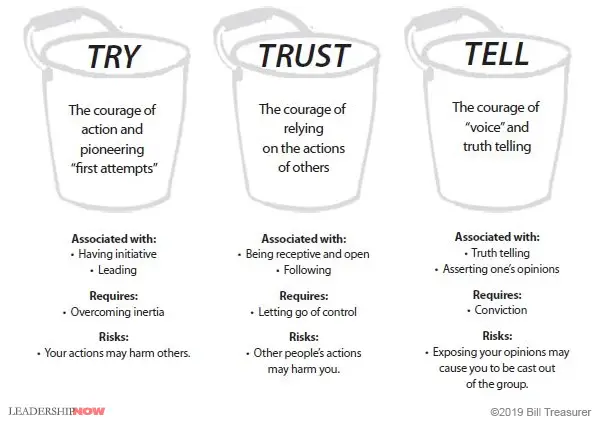
Like us on Instagram and Facebook for additional leadership and personal development ideas.
Posted by Michael McKinney at 11:37 AM
Permalink
| Comments (0)
| Personal Development
EVERYTHING YOU DO involves risk. The only questions are what and how much. Poor choices lead you into failure, and good choices take you out of failure.
“Success and failure both leave room for improvement. Inside every success, there are remnants of failure, and in every failure, there are pockets of success” writes Bill Wooditch in Fail More. He wrote the book not to encourage irresponsibility or to give license to “intentionally flunk life one mistake at a time,” but rather to continually improving through intentional practice, with the willingness to embrace the process, and the ability to learn from the result.
Nobody likes failure. We are lead to believe that failure means that there is something wrong with us. Failure simply represents a challenge; not something to avoid. “If you try to evade the things that are fundamentally important to your growth, you’ll pay the price of your neglect at a later date.”
Perfect isn’t part of the human condition. Many people wait for “perfect” before they begin, but perfect isn’t just going to show up out of nowhere. We all have to do the gritty and unglamorous work if we’re going to push the envelope. You have to put your toes on the edge of “comfortable” and step into the pain of change and the cloud of uncertainty to make a real difference in your life.
We crave certainty, and that feeds our fears. When it gets uncomfortable, when fear sets in, “you can’t get emotional; you have to stay centered in logic and break things down to small wins every day.” That’s how you overcome obstacles. “When you move from emotion (fear) to logic (obstacle management), you can then visualize an outcome by walking through the imaginary steps it takes to achieve it.”
The lesson of Fail More is to keep going. “Rejection will slap you in the face, not once, not twice, but so many times that you’ll lose count. But your purpose will compel you to keep going, adapt, and grow.”
There is a lot of material out there reminding us to embrace failure and clever memes that point you forward, but Wooditch makes one of the best presentations of the subject I’ve ever read. There are the stories of Jack Ma, Mark Cuban, Steve Harvey, Sara Blakely, J.K. Rowling, David Neeleman, and other well-known and not so well-known individuals, but he includes his own experiences that give it depth and credibility.
Fail More will help you to work past your fears, the obstacles, set realistic goals, and learn from every result. Success is a process, and failure is part of that process. Failure gives you the critical feedback you need to make the necessary adjustments to bring you closer to your goal.
Keep in mind:
Here are several more takeaways:
There is an expected range of failure that is the price of “good.” Learn to be okay with it.
Failing more is trying more.
The greatest point of growth occurs right below your limit.
Be one of those people that works right up to their edge of comfort.
We all start at a place where we need to improve if we are going to succeed on a more significant scale.
When you seek out uncertainty, you are opening your mind to possibility.
Procrastination, lack of prioritization, and the absence of goals all have their origins in fear.
In order to get what you want, you have to do those things that give you the confidence to do just a little bit more the next day.
Like us on Instagram and Facebook for additional leadership and personal development ideas.
Posted by Michael McKinney at 05:54 PM
Permalink
| Comments (0)
| Personal Development

THOMAS JEFFERSON was skilled in many fields. In December 1962, John F. Kennedy entertained a group of Nobel prize winners in the White House and welcomed them as the most distinguished gathering of intellects to dine in the Executive Mansion “with the possible exception of when Mr. Jefferson dined here alone.”
Jefferson cared for people and always offered advice when asked. A year before his death, he was asked by a father to give some counsel to his young son, Thomas Jefferson Smith. He responded with a letter that began:
Monticello Feb. 21. 1825.
Th: Jefferson to Th: Jefferson Smith.
This letter will, to you be as one from the dead, the writer will be in the grave before you can weigh it’s counsels. your affectionate and excellent father has requested that I would address to you something which might possibly have a favorable influence on the course of life you have to run, and I too, as a namesake, feel an interest in that course. few words will be necessary with good dispositions on your part. adore God. reverence and cherish your parents. love your neighbor as yourself, and your country more than yourself. be just. be true. murmur not at the ways of Providence. so shall the life into which you have entered be the Portal to one of eternal and ineffable bliss. and if to the dead it is permitted to care for the things of this world, every action of your life will be under my regard. farewell.
The letter concluded with ten rules to live by Jefferson titled A Decalogue of Canons for observation in practical life:
- Never put off till tomorrow what you can do to-day.
- Never trouble another for what you can do yourself.
- Never spend your money before you have it.
- Never buy a what you do not want, because it is cheap; it will be dear to you.
- Pride costs us more than hunger, thirst and cold.
- We never repent of having eaten too little.
- Nothing is troublesome that we do willingly.
- How much pain have cost us the evils which have never happened!
- Take things always by their smooth handle.
- When angry, count ten, before you speak; if very angry, an hundred.
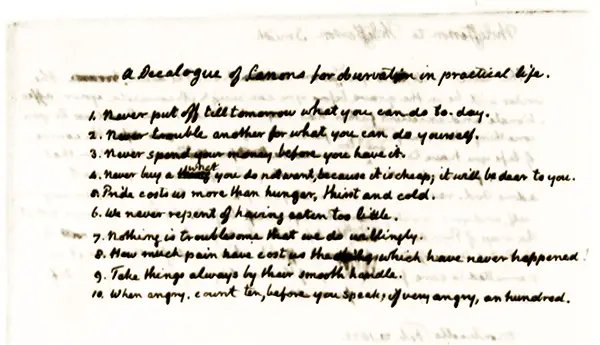
The complete letter can be found on the National Archives website.

Follow us on Instagram and Twitter for additional leadership and personal development ideas.
Posted by Michael McKinney at 04:40 PM
Permalink
| Comments (0)
| Leaders
, Personal Development
, Weekend Supplement
HOW DO YOU stand out in your chosen occupation to get the respect, recognition, and opportunities you want and deserve, to achieve the success you want?
Leadership and life are built on relationships. Despite any talent or education you may have, your ability to work with and influence others is what will set you apart. But that doesn’t just happen. You need a plan.
The 9 Dimensions of Conscious Success: It’s All About You! by David Nielson was written to give you a framework to consciously bring about your success.
The foundation of the Conscious Success Model contains three critical elements: Your Purpose, Self-Awareness, and Social Awareness.
Your Purpose
Why am I here? Your reason for being is built around “an anticipated outcome that is intended or that guides your planned actions.” Having a stated purpose for your life helps to give you inner strength—an internal sense of control. You are not a victim. A specific purpose helps you also to align your actions to the purpose of others and your organization.
Self-Awareness
Self-awareness allows you to separate yourself from what’s happening around you to identify your thoughts, feelings, physical state, and belief systems. “Awareness precedes meaningful choice. It is nearly impossible to make good life choices with no self-awareness.” When you are aware of your inner state—where you are at—it makes it easier to act on purpose. A good place to get self-awareness is to watch the behavior of others. Often the behaviors that irritate you are mirrors of your own life.
Social-Awareness
How do you impact others? Before you interact with others, begin by asking what is the desired result based on who I am, my purpose, and who I want to be? We have an impact on everyone we meet. How do others perceive us? Is that our intent? Does it align with our purpose?
The other part of the Conscious Success Model is how we differentiate ourselves. 3 Elements + 6 Differentiators = 9 Dimensions of Success. We cannot rely “on fate to be noticed. We have to be more proactive, more deliberate and consciously aware. This is conscious success.” Each of the differentiators is connected to and must be aligned with the three core elements.
As we move to the differentiators, Nielson begins by asking, “How am I really showing up? How am I presenting myself to others? Am I having the impact I really want to make?” What value do I bring? This, of course, speaks to having a healthy self-awareness.
Each of these differentiators as negative and a positive side. Either side will get you noticed. Avoid the side that will get you noticed for the wrong reasons.
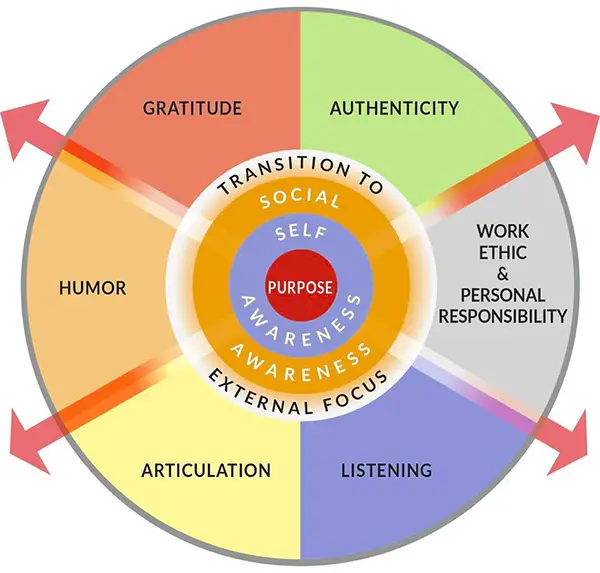
Differentiator 1: Authenticity
Authenticity is “never deceiving yourself or others in how you show up.” It might go without saying but to be true to yourself you need to know who you are and what you stand for. We mostly lack authenticity because we are trying to be what people want us to be in order to be accepted or popular. We are inauthentic to cover up for our insecurities. Authenticity leads to trust. Consistency matters.
Differentiator 2: Work Ethic and Personal Responsibility
“Work with conviction to produce the results you desire and take responsibility for the results produced—even when they fail to meet the desired result.” A good work ethic is based not on time put in but on results achieved. If you want to differentiate yourself, “show up early for work, do more than you’re asked to do, do everything to the best of your ability, and if you finish your work, offer to help others.”
Decide that you are 100 percent responsible for what happens in your life and everyone else is 0 percent responsible. It might seem unrealistic to do this but deciding to be 100 percent responsible forces you to move forward. “The reason the ratio must be 100 percent to 0 percent is that as long as the zero spot is occupied by any value, I can blame and justify the non-result. Blaming and justifying limits options and 100 percent to zero percent responsibility expands options.”
Differentiator 3: Listening for Results and Connections
“Concentrate intently on the words of others in such a way you could understand and repeat accurately what is said.” Listening shows respect for others and builds others trust in you. Ask questions with the intent of clarifying your understanding.
Differentiator 4: Articulate for Impact
Closely related to differentiator 3 on listening is articulation. “Provide information in a clear, concise way which produces the desired impact.” To be always talking doesn’t make you look smarter. Have a good vocabulary. Before you speak, consider your emotional state. Also, think about what your purpose is and what you are trying to convey.
Differentiator 5: Humor
Humor is “looking for and appreciating the humor all around us and even being able to laugh at one’s self.” Humor can provide perspective. Smile. “Facial expressions do not merely signal what someone feels but actually contribute to that feeling. If we smile even when we don’t feel like it, our mood will elevate despite ourselves.” Use humor appropriately. “Be sure the style and content of your humor is consistent with your purpose and brand. You can have a sense of humor, but it must be consistent with your image and what it is you want to accomplish.”
Differentiator 6: Gratitude
“Make the choice to be thankful for what you have and consciously demonstrate gratitude when others do something for you.” I believe that a lack of gratitude can undo all of the other differentiators. Gratitude is a choice we make each and every day. Having an attitude of gratitude gives you a positive outlook which makes you more attractive to others.
Conscious Success as the label implies doesn’t happen by accident. It takes commitment, focus, and a force of will. The Conscious Success Model provides a useful framework for not only differentiating yourself but creating a life that matters.
The 9 Dimensions of Conscious Success is a great tool to put into the hands of anyone starting out in life.
Like us on Instagram and Facebook for additional leadership and personal development ideas.

Posted by Michael McKinney at 11:06 PM
Permalink
| Comments (0)
| Personal Development
IN 1686, Sir Isaac Newton presented three laws of motion. The first law is often referred to as the Law of Inertia. The law states that every object will remain at rest or continue in a straight line unless compelled to change its state by the action of an external force. In other words, things stay the way they are unless something comes along to disrupt them. This law has the power to make us or break us. And it is at work in our lives all day, every day whether we are conscious of it or not.
When we kick a soccer ball, it heads in a specific direction until it is acted upon by a force greater than the force that is currently propelling it downfield. Like that soccer ball, our life is moving along a path that is taking us to a particular future intentionally or not. And we will continue along that path to its destination until we do something different. It’s not about what we want. It’s about what we are doing. Our intentions mean nothing. It’s a law, and as such, it is objective and indifferent to our intentions.
In other words, our 2019 will be just like our 2018 unless we exert a force to change our direction that is greater than comfort we enjoy by continuing to do what we have always done producing the same results again and again. No force, no change. 2019 will be 2018 all over again.
If you’re not where you want to be, change your direction. Get on a new path. New actions will produce different results.
We can use Newton’s law to our advantage. For every cause, there is an effect. Today is connected to tomorrow. Every action we take and everything we say is taking us somewhere. We just need to be sure we are on the path that is taking us where we want to go; a path that is taking us to the person we want to become.
If we work harder than we did last year, then we will do better.
If we sacrifice now, then we are investing in our future.
If we reflect, then we will grow.
If we improve our leadership, then people will follow us.
If we are courageous, then we will inspire.
If we are curious, then we will learn.
If we avoid the trappings of power, then we will stay connected with those we serve.
If we surround ourselves with the right people, then we will be enriched and will lift others up.
If we are authentic and humble, then we will build trust.
If we work this law to our advantage, then we will eradicate regret.
If we don't improve, then our circumstances won't improve either. We can’t tell ourselves that it’s not going to be alright if we are headed in the wrong direction. Life naturally pushes us off-course and takes us on tangents. Anything meaningful in life is produced by moving upstream – against the current. When we find ourselves where we don’t want to be, we must acknowledge the fact that we have drifted; we have gone with the flow. We need to make some course corrections. We all do from time to time.
Of course, this implies getting uncomfortable. It’s helpful to have a mentor, a coach, or a program that will keep us accountable, because we tend to say, “I pushed hard enough” when we’ve barely touched our potential.
As we look at our life, we all have directions that need to be changed. It helps to begin this process by asking ourselves questions and giving serious and honest thought to the answers.
The big general questions are: What worked for me last year and what didn’t? What habits are holding me back? What three things do I want to accomplish by 2020? What is that one thing I need to accomplish in 2019—your BHAG—my Big, Hairy, Audacious Goal? What does a good day look like? What routines keep me on track? Why do I do what I do?
And most importantly, what am I grateful for? Then drill down into specific areas of your life:
Do I make time to study and grow spiritually?
What habits are draining my time and attention?
What activities replenish me?
Am I taking time to relax and grow in other areas of interest?
Am I sleep deprived?
Am I eating healthy and avoiding processed foods?
What do I need to change in my diet in 2019?
Am I exercising regularly?
Am I drinking enough water? Is my morning and evening routine setting me up for my best day?
Am I living within my means?
How much do I want to make in 2019?
What do I have to do to reach that amount?
What weaknesses do I need to minimize?
Am I where I would like to be in my work or career?
How can I increase the value I bring to work?
What relationships are building me up?
Are any relationships taking me off-track?
Who do I take for granted?
Do I support those around me?
Do I support and encourage others?
Do I focus on building others up?
Do I make time for others?
Where do I need to grow?
What strengths do I need to improve on?
What do I need to learn?
What books do I need to read?
What seminars do I need to attend?
What can I learn from the mistakes I made in 2018?
The key to moving forward is the first step. Every destination needs to be broken down into incremental markers or indicators on the way to the destination. What is the first thing you need to do to get you moving in the right direction? As you begin, focus on the actions required and not the end result. A small step is easier than a leap. Once the first step is made, it is easier to continue down the right path to your desired destination.
Like us on Instagram and Facebook for additional leadership and personal development ideas.

Posted by Michael McKinney at 12:34 AM
Permalink
| Comments (0)
| Personal Development
A
Leading Matters is about the journey. The stories he tells here are revolve around the ten elements that shaped his journey and how he relied on these traits in pivotal moments. The elements are relevant to any leader at any level. As he observes, the higher up you go the crises just get bigger and come faster.
He begins by discussing the foundational elements: humility, authenticity, service, and empathy. He then links them together with courage. Finally, he shows how collaboration, innovation, intellectual curiosity, storytelling, and creating change that lasts, helped him reach his goals.
Here are some of his thoughts on each element extracted from his stories:
Humility
A true sense of one’s own skills and character—arises not from ego, but from humility. Arrogance sees only strengths, ignores our weaknesses, and overlooks the strengths of others, therefore leaving us vulnerable to catastrophic mistakes.
Leading with humility means letting others announce your accomplishments because you don’t need to, it means realizing and openly admitting that your understanding might not be right, it means taking the opportunity to learn from mistakes, and it means stepping up to the moments that challenge and grow you.
Authenticity and Trust
Authenticity is essential to building trust. Consider the wisdom popularly attributed to Socrates: “The way to a good reputation is to endeavor to be what you desire to appear.” It’s a start down the path to a deeper practice of authenticity—you must identify those good and true characteristics you admire, and then you must work to embody them.
So this is part of the practice: identify the virtue you admire, strive to embody them, and be humble about the journey—you probably aren’t there yet. In fact, just when you think you’ve arrived, life has a way of returning you back to the beginning.
Leadership as Service
The larger one’s leadership role becomes, the bigger the role of service in that leadership.
If you take a leadership role as a step toward a personal goal of gathering ever-greater titles, awards, and salaries, you will never see true success in that role.
Recognize the service of others. As a leader it is easy to get wrapped up in big projects and ambitious initiatives, and, in the process, to forget the smaller, but no less important, individual acts of service taking place all around you. Much of that service supports and enables the widely celebrated success of others.
Empathy
Empathy should always be a factor in making decisions and setting goals. Empathy represents a crucial check on action—placing a deep understanding of and concern for the human condition next to data can lead to decisions that support the wellbeing of all.
Empathy usually implies compassion and perhaps charity, but we are looking for more than that: we are looking for the kind of empathy that changes people as a result of their interactions with each other, the kind of empathy that arises when one sees the world anew through someone else’s eyes.
Courage
Humility, authenticity, empathy, service-mindedness—these characteristics shape a leader’s vision and chart a course toward right action. Courage, on the other hand, compels a leader to take that right action. While many people can discern what is right and true, acting on that discernment is more difficult.
Even if risk-taking is against your nature, for the good of your organization, you must find the courage to practice it.
Collaboration and Teamwork
Most significant endeavors will be accomplished by a team.
Certain ground rules circumvented interteam rivalries. First of all, I reminded everyone of our shared goal: we wanted to achieve something great. Further, to support innovative, cross-disciplinary thinking, I set a second ground rule: at the start, we don’t criticize ideas. To this, I added a third ground rule: tough questions aren’t only allowed, they are necessary. This led to my final ground rule: team members must be treated with the utmost respect.
Innovation
I can’t tell you how many times I’ve had this conversation with students: the student opens with, “I want to create a start-up.” I ask them to tell me about their technology, and they answer, “Well, I don’t have it yet, but I want to do a start-up.” I remind these students that great start-ups begin with great technology discoveries. Innovation presents great opportunities for smart entrepreneurs, not the other way around.
Intellectual Curiosity
Beyond personal enjoyment, though, this lifelong curiosity has served me well in my career. It has enabled me to engage in meaningful dialog about the world and its future.
Literature, biographies, and histories—they’re like laboratories in which we can examine and learn critical lessons without having to live the difficulties ourselves.
In challenging moments, great leaders show their true character. …Their stories taught me if you can’t take the blame for failure, you shouldn't take the job.
Storytelling
If you really want to inspire a team to action, best to engage them with a story. Once they become receptive—once they can imagine themselves as part of your vision—you can back your story up with facts and figures.
When you turn that dream into a vivid story, you make it so attractive and so real that people will want to share it with you by joining your team.
When it came time to respond to change, these companies moved quickly and efficiently, because every employee already understood the company identity and therefore knew how to respond without direct coaching.
In every profession and career, as we climb to higher leadership positions, the role of facts and data decreases.
Legacy
Instead of worrying about my legacy too much or too early, I’m choosing now—as I always have—to follow the path of making meaningful contributions.
Legacy means the institution serves people more effectively now than it did when you arrived.
Like us on Instagram and Facebook for additional leadership and personal development ideas.

Posted by Michael McKinney at 02:08 PM
Permalink
| Comments (0)
| Leadership Development
, Personal Development
, Teamwork

T
Carey Nieuwhof is the author of Didn’t See It Coming. He wrote this book because too often we don’t. And even though these seven challenges never really go away, we can create some life habits that keep them at bay.
Nieuwhof writes from a been-there-done-that Christian perspective about the issues as they manifest themselves in our lives and follows up each one with a chapter on how to combat it. It’s not really just for leaders. These issues affect everyone and some you'll find hit close to home.
The seven challenges are:
Cynicism
Disappointment and frustration often end in cynicism. “Most cynics are former optimists.” He reminds us that cynicism is a choice that benefits no one. “Cynics never change the world. They just tell us why you can’t change the world. Ask them and they know all about it.” The antidote is curiosity. “Curious people are never cynical, and cynical people are never curious.” Simple but profound.
Compromise
The little compromises we make every day—the half-truths, the rationalizations, the excuses— “create a gap between who we are and who we want to be.” We often look to competency to carry us to success. It may get us in the door, but character is what determines how far we go. “If you don’t nurture your character daily, you can be most admired by the people who you know the least, while the people who know you best struggle with you the most.” Our character gets challenged every day. The antidote to compromise is to “work twice as hard on your character as you do on your competency.”
Disconnection
Nieuwhof notes that technology doesn’t create disconnection, it just reveals what is already going on inside of us. “Disconnection is a human problem. Technology just makes it worse.” So the solution is to deal with what is going on inside of us. “When you search for an explanation as to why you have a hard time trusting or opening your heart to people, you can make progress. You’re using the past as a stepping stone into the future, not as a barricade against it.” Engage in life-giving conversation. Eliminate hurry from your life. And this comment could pull any of us up short:
For me, the sense that a conversation is going nowhere always carries with it an underpinning of judgment and even arrogance on my part. I just assume I’m better, smarter, or wiser or that I have greater emotional intelligence than others. Which, of course, should drive me right back to my knees in confession. After all, we’re encouraged to think of others as better than ourselves. That’s a cornerstone habit of the humble.
Irrelevance
Irrelevance happens when what you do no longer connects to the culture and the people around you. That gap is a factor of how fast things change relative to you. You defeat it by continuously “changing, learning, and evolving. Change staves off irrelevance.” A key idea here is you need to “love the mission more than the methods.” An easy trap to fall into. Get radical about change. Surround yourself with younger people. Seek change to transform you.
Pride
Pride manifests itself in many different and subtle ways so it’s hard to spot—in ourselves. “Pride will snuff out your empathy, stifle your compassion, create division, suffocate love, foster jealousy, deaden your soul, and make you think all this is normal.” The only way to deal with pride is to cultivate humility. “Learn the ways of the humble and make it your principal way of operating.” Nieuwhof offers practical ways to begin to make this happen in your life.
Burnout
Burnout saps the meaning and wonder out of life. Signs of burnout include among other things: your passion fades, you no longer feel your highs and lows, little things make you disproportionately emotional, everybody drains you, nothing satisfies you, and your productivity drops. Getting out of this state begins by admitting it and then figuring out how to live today so you will thrive tomorrow. What does that look like? “Maintaining health in all five major areas of life (spiritual, emotional, relational, physical, and financial)” must become a priority. Nieuwhof recommends some concrete steps you can take to bring you back from burnout. Go deep enough and take enough time to recover so that you begin to feel gratitude for the process.
Emptiness
Ironically, success often makes you feel empty. Once you have arrived, “you find there’s still something inside you that says there has to be more.” The antidote: “find a mission that’s bigger than you.” He continues, “Selfishness looks good only to the selfish in the same way that pride is attractive only to the proud. Humility will win you what pride never will: the affection of others. And that’s exactly what selflessness will do. Other people naturally gravitate toward people who live for a cause beyond themselves.”
Didn’t See It Coming is full of understanding and insight. The practical advice found here will benefit anyone on their leadership journey.
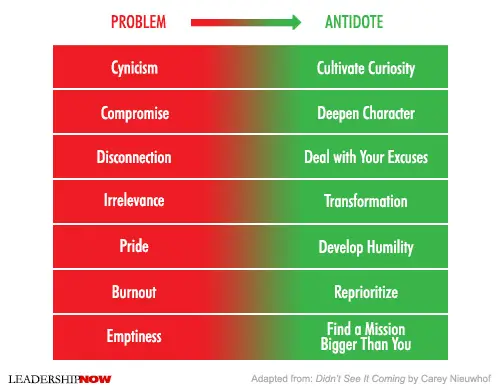
 Like us on Instagram and Facebook for additional leadership and personal development ideas.
Posted by Michael McKinney at 08:01 AM
Permalink
| Comments (0)
| Leadership Development
, Personal Development

T
Business Chemistry is a tool for self-understanding and empathy—a way to identify meaningful differences between people’s working styles and perspectives.
Kim Christfort and Suzanne Vickberg of Deloitte helped to develop Business Chemistry. It does not invalidate everything else of its type, rather it is designed to be simpler and thereby memorable and actionable on issues that really matter for people in the work environment. And it is quite straightforward for both accessing yourself and others you work with.
Using the key sticking points between people, they identify 4 Working Styles:
 Pioneers value possibilities and they spark energy and imagination. They’re outgoing, spontaneous, and adaptable. They’re creative thinkers who believe big risks can bring great things.
 Drivers value challenge and they generate momentum. They’re technical, quantitative, and logical. They’re direct in their approach to people and problems.
 Integrators value connection and they draw teams together. They’re empathic, diplomatic, and relationship oriented. They’re attuned to nuance, seeing shades of grey rather than black and white.
 Guardians value stability and they bring order and rigor. They’re practical, detail-oriented, and reserved. They’re deliberate decision-makers apt to stick with the status quo.
The authors naturally go into detail on each of these types and give an example of a well-known person that fits that type. They also delve into difference between the types as they relate to stress (Pioneers are the least stressed.), career aspirations, environments they thrive in, and where each type if found organizationally and generationally.
The trick of course, is to use this knowledge to modify you own behavior. Otherwise it’s just a game. “By learning about your own type and developing a hunch about the types of those you work with, you can see right away where some of your key differences and similarities are. Then you can determine how you might flex your own style to better match the preferences of those around you.”
For example, too many constraints can completely shut a Pioneer down, while a Guardian may withdraw in an environment that feels too chaotic. A Driver may become very frustrated in an organization that lacks decisiveness, while an Integrator may wither on a team that doesn’t value broad-based input. Knowing these trigger points can help you as a leader to give people more of what they need to excel and less of what will turn them off.
To understand your own style and develop your hunch about others you know, they’ve developed a test which you can take here.
If you’re going to try it out for yourself, you might think about what you are naturally inclined to do and what you have learned to do. I might want to be direct with others but I have learned that I am more productive when I am diplomatic. But being that that is my natural tendency, I probably prefer when people are direct and concise with me. That fact would affect my working style profile.
Interestingly, 32% of Millennials are most likely Guardians. They prefer having all of the answers and enjoy zooming into every detail. 29% of Baby Boomers are most likely to be Pioneers or Integrators. They grew up in a different time and may have adopted a more novelty-seeking and relationship–focused orientation.
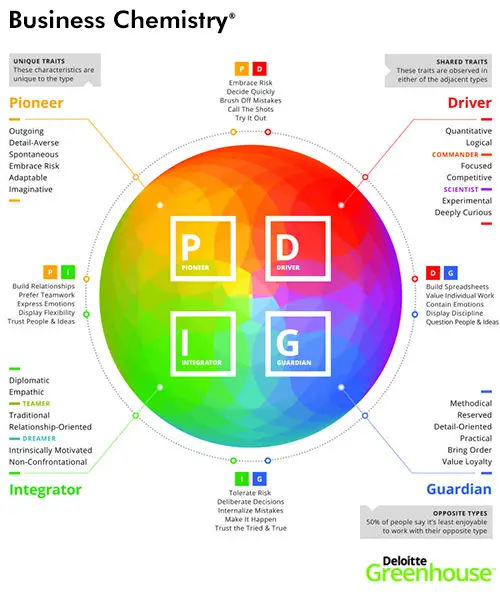 Like us on Instagram and Facebook for additional leadership and personal development ideas.
Posted by Michael McKinney at 08:21 AM
Permalink
| Comments (0)
| Personal Development
, Teamwork
A
Bob Rosen and Emma-Kate Swann wrote Conscious: The Power of Awareness in Business and Life, because they believe that becoming more conscious is critical in our increasingly disruptive and accelerating world. “Most of us believe they are self-aware, but research shows that only 10 to 15% of us truly have this capability.”
“The real power of awareness is found when we master action and introspection together” or what they refer to as conscious. “Lifting your gaze outside yourself while looking inward to remove the roots of resistance is how you become more conscious.” Being the smartest person in the room is not the advantage it might have been because it gets in the way of adapting to the change happening all around us. “Conscious is the new smart.”
Driven by the need to be right, those obsessed with being smart tend to hoard knowledge, externalize blame, and mismanage relationships and risks. This sabotages our ability to thrive in a constantly changing world.
There are four reasons why we are not aware as we need to be:
1. Too Shallow: “We spend little time self-reflecting and stay stuck in negative emotions, shackled by old baggage, resulting in little understanding of ourselves.” We just don’t dig deep enough.
2. Too Narrow: “We don’t challenge our outdated assumptions, which limits the power of our expansive minds.” With limited perspectives we miss opportunities and react irrationally.
3. Too Safe: “We are afraid of change and prefer to avoid the uncertainty around us. As a result, we stay stuck, biased, and reactive.”
4. Too Small: “If your view of yourself and the world is too small, you won’t see connections, possibilities, or solutions. Staying small and never stepping up is sure to lead to regrets and will undermine your highest potential.”
The antidote to our lack of self-awareness is:
Go Deep
Harness the power of introspection by getting to know who you are, where you come from, and why you act the way you do.
Think Big
Get curious and adaptive: deal with complexity and paradox by learning how to expand your mind, leverage your relationships and networks, and overcome unconscious biases.
Get Real
Become more honest and intentional in leadership and life, overcoming the pitfalls of being too safe and cautious while embracing reality.
Step Up
Act boldly and responsibly to reach your highest potential: how to champion your higher purpose, stretch people in constructive ways, and be generous in your relationships.
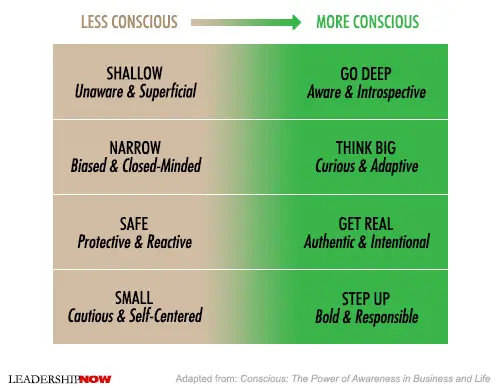
To address the realities of our time, we need people who will Go Deep, Think Big, Get Real, and Step Up. To lead change you need a conscious mindset. “Regardless of the context or the reason for change, leaders at all levels must lead people into the unknown and into the future.”
If we are going to create change, we have to begin with ourselves. That requires that we become more conscious of what pushes us forward—our Accelerators—and what holds us back—our Hijackers. Accelerators like courage, drive or determination, deliberate practice, resilience, and vulnerability, drive us forward. Hijackers like self-criticism, cynicism, controlling behavior, aloofness or disengagement, and hyper-competitiveness, hold us back. It is important to know how these things impact your performance and constructively use them or deal with them.
There are many things that conspire to throw us off-course. Knowing who you want to be in the world and remembering your purpose, will help you to manage these issues and keep you on course. The more conscious we are the less drama we will experience in our lives.
Another consequence of being conscious is to be civil. People and events will push our buttons, but the mature, conscious person will know when to “reprioritize personal needs and self-interests” for the good of all. “Conscious people realize there is a human being on the other end of every connection. Acts of civility are the small sacrifices we make for the good of all and the sake of harmoniously living and working together.” A good example of that kind of self-control and consciousness is John McCain’s comment to a woman at a town hall meeting that said she didn't trust then-Sen. Barack Obama because "he's an Arab." McCain responded, “No, ma'am. He's a decent, family man, citizen that I just happen to have disagreements with on fundamental issues.”
Conscious people see the big picture and know what is important. Consciousness is a choice.
Conscious unleashes our full potential as human beings. By expanding our minds, enriching our experiences, and shaping our destinies, we discover our purpose in life. Being conscious enables us to approach life as a journey. Equipped with everything we need—an open mind and heart, confidence and resilience, and our capacity for greater consciousness—we embrace the uncertainty of life. Conscious is the accelerator for effective change. The more conscious we are, the faster we adapt, and the higher performing we become.
Like us on Instagram and Facebook for additional leadership and personal development ideas.

Posted by Michael McKinney at 07:32 AM
Permalink
| Comments (0)
| Personal Development

I
Not only do you grow from the experience, but you’ll have a roomful of experts to learn from. At first, you may feel inadequate—feel like an imposter—but with enough grit, you’ll succeed and move forward.
When you feel like you don’t belong—like you are not up to par—know that it is a side effect of growth that everyone experiences at one time—or many times—throughout a career. If you are a high performer, it comes with the territory. You are doing the hard things. And that’s a good thing. You are, as Laura Otting puts it, “Standing on the edge of our incompetence.”
Think of imposter syndrome as valuable feedback that you are growing and are outside your comfort zone. Self-doubt comes before growth. Contrary to all appearances, imposter syndrome is experienced by very successful people. Barbara Corcoran, an entrepreneur and longtime investor on ABC’s Shark Tank, said at Fiverr’s Bridge the Gap webinar, “The more successful someone is, the more self-doubt they have because that’s what drives them. I’ve never met a secure person who was a stellar star. I look for a [competitor] who’s mostly insecure because I know I’ve got myself a winner. They have the ambition. They’re going to work twice as hard, which, I think, is the great upside to feeling like you’re an impostor.”
Graham offers 7 tips for overcoming Imposer Syndrome:
1. If You Aren’t Struggling a Bit, You Aren’t Growing Much
“When you’re taking on a new venture like a job switch, it’s normal to feel behind the curve. This doesn’t mean you’re a fraud or not cut out for the work. Don’t compare your start to someone else’s peak.”
2. Quite that Inner Voice
“We are often our own worst critic and hardest on ourselves. If you’re new at something, have realistic expectations and give yourself the latitude to learn.”
3. Perfection is Slow Death
“Perfectionists have an all-or-nothing view. Even as a seasoned expert, you’re human and not immune to bad days or learning curves. Mistakes can indicate that you need to prioritize, delegate, or take a break. Or they could just be mistakes. Don’t make them into more than they are.”
4. Honor Your Accomplishments
“Life isn’t about keeping a scorecard. Reminisce about past successes, and then engage strategies that worked before to tackle the problems you’re facing.”
5. Drop the “Yes, but….”
“Do you deflect or write off compliments? Perhaps you attribute your success to luck. We are masters at believing negative feedback while shrugging off the positive. Take time to listen to praise from others and own it.”
6. Plan for the Worst-Case Scenario
“The worst-case scenario rarely happens, but if you have an action plan should it become a reality, you can be confident you’ll handle the lesser obstacles that do arise.”
7. Fake It ‘til You Make It
“When you come across as self-assured, others sense that it creates a positive spiral. Self-assurance doesn’t mean you have all of the answers, rather that you’re confident you can use resources to find solutions as problems arise.”
And here’s a fact of life. The more you learn about something, the more you’ll realize how little you know about the topic in terms of all there is to know. Stay humble and curious. It will give you unprecedented depth in this day and age.
At the same time, imposter syndrome isn’t all that bad, thanks to the Dunning-Kruger effect that observes that the most incompetent are often the most confident because they don’t know enough to know that they are, in fact, incompetent. The sense that you don’t know everything can give you an edge because your imposter syndrome can motivate you to work hard and learn more.
Beyond what I'm sharing here, Switchers is an invaluable resource for those looking to make a career switch. “If you’re like most Americans, you’ll spend around five years of your life engaged in some type of job search activity.” Today though, people aren’t just changing jobs. They’re changing professions. And this requires a different approach than the typical job search.
Graham writes from a recruiter’s point of view, sharing not only what they think but also the psychological principles that underlie the Switcher’s journey. She covers the five job search killers, networking and the 2nd Level Contact Strategy, rebranding your social media profile, and crafting your professional identity.
Bias is a reality in the hiring process and can be an especially difficult hurdle for Switchers. Learn to identify it and engage strategies to overcome it, such as using your network to become an insider.
Your career story is what will convince the hiring manager to pull the trigger and make the offer. It should be logical, compelling, attention-getting, and genuine.
You need to network to make a career switch. Second- (and third) level connections are where the action is! Most people in your immediate circle have the same information you do, so the goal is to get their network because that is where your next opportunity lies.
Like us on Instagram and Facebook for additional leadership and personal development ideas.
Posted by Michael McKinney at 08:32 AM
Permalink
| Comments (0)
| Personal Development
“I actually felt as if I was going to perish,” said psychologist Stanley Milgram upon asking a subway rider for their seat.
Asking for help makes most of us uncomfortable and we often go to great lengths to avoid doing it. We fear rejection. We fear that people we think less of us. We believe people don’t really want to help. But the truth is we need the help and support of others to succeed. To be sure, leadership is fundamentally about asking people for help. “Reaching your fullest potential—professionally or personally—requires you to understand how to enlist reinforcements when you need them. For many of us, ‘when you need them’ is literally every day,” writes Heidi Grant in Reinforcements.
Yet our reluctance to ask for help means we often don’t get the support or the resource we need. Making matters worse, our intuitions about what should make others more likely to help are often dead wrong; our fumbling, apologetic ways of asking for assistance generally make people feel far less likely to want to help. We hate imposing on people and then inadvertently, we make them feel imposed upon.
We underestimate our chances of getting help, especially from those that have said “no” once already. We don’t like saying “no.” We don’t think less of people when they ask us for help. But for some reason, we forget that when it is our turn to ask for help.
Research shows that people actually like us more when they have been able to help us. It makes them feel good too—unless they feel compelled to help. Asking someone, “Can you do me a favor?” increase the likelihood that they’ll say yes, but usually because they now feel trapped.
So what are the subtle cues that motivate people to work for us?
Grant says, first of all, don’t make it weird by overdoing it on empathy (i.e., ASPCA commercials), apologizing profusely (just ask), using disclaimers (“I normally wouldn’t…”), emphasizing how much the other person will love helping (“This will be fun!”), and reminding people that they owe you one, among other tactics.
Instead try these three ways of asking others for help:
In-Group Reinforcement
Those members of our group are the most likely to help us. To create a sense of in-group among people, use the word “together,” create or highlight shared goals, identify a common enemy, share common emotions, experiences, and feelings.
The Positive Identity Reinforcement
Most people like to think of themselves as helpful because it is part of what it means to be a good person. We reinforce that with gratitude and appealing to the things that matter to them. “To maximize positive identity reinforcement, know your audience and emphasize what matters to them, not to you.”
Gratitude is a glue that binds you and your benefactor together, allowing you to hit the same well over and over again when you need support, know that it won’t run dry.
Also, “the more unique the help, the more closely tied it is to who they are.” If people feel that anyone could help you, it is more likely that they will pass thinking that someone else will help. They need not bother. “To activate the positive identity reinforcement, find ways to convey that the helper is in a unique position to help you.” “You’re my only hope.”
The Effectiveness Reinforcement
People want what they do to make an impact—to have meaning. If we feel we are not making an impact, we are likely to lose motivation. People need to clearly understand the impact of their helping.
Research shows that when people are unable to get any kind of feedback about how well they are doing on a task, they quickly become disengaged from it.
The question is, “How do I know what I am doing is important?” “How do I know that my time, money, or effort wouldn’t be better spent some other way?”
Be clear up-front about what you want done and the impact it will have. And be sure to follow-up. Let them know how things turned out. As a leader, “helping people see the impact of their work—their help—is one of the most important motivators you can wield.”
Reinforcements is written in an engaging way and is full of solid research to support the approach needed to get the help we need to succeed. It is practical advice for anyone asking for help in a way that will leave both parties feeling good about the relationship.
Like us on Instagram and Facebook for additional leadership and personal development ideas.
Posted by Michael McKinney at 07:41 AM
Permalink
| Comments (0)
| Motivation
, Personal Development

Y
This triangle was developed as a social model years ago by Stephen Karpman, a student of Dr. Eric Berne, the father of Transactional Analysis. It maps out a type of dysfunctional interaction that is common in the workplace and in our homes as well. The word “dysfunctional” is nothing to be afraid of – it just means “not working very well.” Effective leaders notice when their relationships are working and when they aren’t … and as a result, they learn to stay out of the Drama Triangle.
Karpman used this triangle to define three points that arise predictably in any dysfunctional real-life drama: the Persecutor, the Victim, and the Rescuer. Notice that all three of these are roles we can choose to play, or choose to step back from, at any time.
So for instance, let’s assume that one of your team members promised you an update about an important project by Tuesday afternoon. It’s Wednesday morning. You don’t have the report yet. Here are three ways you could choose to respond:
Every time you see one of these roles emerge, or find yourself tempted to play one of them, you can be certain that the Drama Triangle is beckoning … and you’re about to get sucked into it. One classic pattern is: boss attacks (Persecutor), people defend themselves (Victim), other people come to their aid (Rescuer). Be honest. How often do you really want to do that? Here’s what’s important to notice: The Drama Triangle is a game. If you choose to play, you’ll be asking for an exchange that’s high on conflict and denial, and low on resourcefulness, self-awareness, and win/win outcomes.
The problem is, it’s easy to play this game without even realizing that you’re playing and easy to become addicted to drama without realizing you’re addicted to it. A lot of the leaders we work with are shocked to learn that most of their workplace interactions fall within this dysfunctional triangle! The leader’s title typically means he or she is given the responsibility of judging or dictating … and that can be a slippery slope toward the Persecutor role. If you’re not careful, you can spend the majority of their working hours playing this game. It doesn’t have to be that way.
The very first step to overcoming a drama addiction is simply to learn to recognize what’s happening. Start noticing that the Drama Triangle game typically begins with one person – it could be you – taking up the Persecutor or Victim role. If you sense a piece of communication coming from your side that is some variation on “It’s all your fault” or “Poor me,” step back, take a deep breath, and ask yourself if that’s really the only way you can express yourself. It’s possible you’ll come up with a better way of approaching the situation – one that doesn’t simply invite the other person to intensify the drama. For instance:
No blame. No drama. Just good communication!
Your responsibility as a leader is to support your people, start good conversations, and make good outcomes possible. The Drama Triangle goes in the exact opposite direction of all three of those goals: it disempowers your team, starts lousy conversations, and makes terrible outcomes much more likely. If you spend even one minute a day in the Drama Triangle, that’s one minute too much.
The only way to win this particular game to resolve not to play – and then stick with that decision!
 Editor’s Note: The Road To Excellence asks the question, “What, exactly, stands between my company and organizational excellence—and what do I do about it?” David Mattson identifies 14 blind spots that have the potential to kill a business. The problem, of course, is seeing what you don’t know. The Excellence Process consists of six steps that when taken in order and made part of your culture will turn excellence into a process and help to get rid of your blind spots.
Like us on Instagram and Facebook for additional leadership and personal development ideas.
Editor’s Note: The Road To Excellence asks the question, “What, exactly, stands between my company and organizational excellence—and what do I do about it?” David Mattson identifies 14 blind spots that have the potential to kill a business. The problem, of course, is seeing what you don’t know. The Excellence Process consists of six steps that when taken in order and made part of your culture will turn excellence into a process and help to get rid of your blind spots.
Like us on Instagram and Facebook for additional leadership and personal development ideas.
Posted by Michael McKinney at 09:03 AM
Permalink
| Comments (0)
| Leading Forum
, Personal Development

J
You’ll find great insights here from the likes of Sonia Arrison, Edgar H. Schein, Henry Mintzberg, Tom Peters, Pascal Finette, Andreas Ehn, Murray Newlands, Brian Chesky, Hampus Jakobsson, Craig Newmark, Alf Rehn, Paul Nunes, Nathan Furr, Mette Lykke and others. But here are several that I found interesting my first time through the book:
Steve Blank: Startups Are Not a Smaller Version of a Large Company
We know that a startup is a temporary organization designed to search for a repeatable and scalable business model. The corollary for an enterprise is as follows:
A company is a permanent organization designed to execute a repeatable and scalable business model.
Once you understand that existing companies are designed to execute, then you can see why they have a hard time with continuous and disruptive innovation.
Danny Lange: Becoming Truly Data Driven
We’re seeing a development where you will be in trouble 24-36 months from now if you don’t start taking machine learning seriously. It will happen especially in industries such as transportation, shipping, finance, and retail, but all kinds of companies and leaders should look into this much deeper.
Of course, the big companies have an advantage due to the amount of data they often how. The startups lack this, and data is increasingly becoming king.
For example, you may be able to build a better app with a better backend than Uber, and pay a crew of drivers more money, but if you don’t have the data to deliver a consistently better pickup experience, all of that might not matter at all.
Christian Ørsted: Authentic Leadership is Narcissism
The leader’s most important task is not being authentic but focusing on serving. The leader’s own idea of the world or of him- or herself is completely without interest with regard to how he or she can serve the organization and the world in the best way possible.
That’s why there’s a risk that the whole concept of authentic leadership can easily give leaders an excuse for being narcissistic and focusing on themselves and their own values as leaders rather than how they create the best possible culture for their employees.
Daniel Burrus: How to Anticipate the Future
There are an amazing number of things we can accurately predict when we learn how to distinguish between what I call hard trends, trends that will happen, and soft trends, trends that might happen. Think of it as a two-sided coin. Agility is on one side, allowing you to react fast to unforeseen change, and the other side is anticipatory, allowing you to see what is coming and take action before the change occurs.
Agility is basically reacting quickly to change. Therefore, it’s important to understand that agile innovation is reactive innovation. Agile innovation will keep you reacting to disruptive innovation created by others.
Like us on Instagram and Facebook for additional leadership and personal development ideas.
Posted by Michael McKinney at 01:34 PM
Permalink
| Comments (0)
| Personal Development
T
Dodd has selected the 10 key practices that Apex Leaders have in common. While character, patience and empathy are important for a leader to sustain their leadership, they are not necessarily the behaviors and practices needed to get to the top of their chosen profession. To be sure, Dodd writes, “there are times when a leader’s talent can take them to places where their character cannot sustain them.” But that’s another story. Here, Dodd focuses on the achievement side of the equation. What is required to be the best at what you do?
Brian Dodd is the Director of New Ministry Relationships for Injoy Stewardship Solutions an organization founded by John Maxwell. While Timeless will resonate with Christian leaders, the principles apply across all organizations and contexts.
As readers of his blog have come to expect, Dodd draws on many examples from the world of sports. All of these principles are found in scripture and are being successfully applied by Apex Leaders in organizations of all types.
Here are 10 things Apex Leaders have done and will always do to achieve great success with Dodd’s insights:
Apex Leaders Build Great Teams
Apex Leaders are part of selfless, humble teams who are committed to each other’s success. Your team is your primary difference maker. Apex Leaders look for skill, work ethic and passion when building a team.
Apex Leaders Are Humble
Humble leaders do not deny their talents but are thankful for them. Humble leaders acknowledge that no matter how good they are, they are in constant need of support. All successful leaders must be servant-leaders first. They acknowledge they have been granted opportunities not for personal gain, but for the betterment of others. Humble leaders know they have not arrived. The mission and vision of what they are trying to accomplish is too important to remain the same.
Apex Leaders Continually Improve
Are you willing to be rebuilt? Pride and arrogance are enemies of continual improvement. An Apex Leader never asks, “Am I part of this organization’s past?” but, “Am I going to be a part of the future?” Continual improvement assures sustainability and continual options.
Apex Leaders Work Hard – Very Hard
Many leaders think their talent and competence alone will get them where they need to go, but hard work will always beat talent and competence when talent and competence don’t work hard. Proverbs 6:10-11: “A little sleep, a little slumber, a little folding of the hands to rest—and poverty will come on you like a thief.” No one is there to applaud the lonely work, but everyone applauds its results.
Apex Leaders Form Strong Relationships
One of the most impressive things about the leadership of Jesus was his continual focus on relationships. There is only one thing in your business which appreciates—your people. The most important relationship a leader needs to cultivate and protect is the relationship with their family. If you want to accomplish anything great as a leader, you must surround yourself with competent staff.
Worth thinking about: Almost all important decisions made about you and your career take place when you are not in the room. So, always leave a trail of kindness and respect behind you.
Apex Leaders Make Others Better
No matter how talented you are, you need someone who can make yourself better. Ralph Waldo Emerson said, “It is one of the most beautiful compensations of this life that no man can sincerely try to help another without helping himself.”
Apex Leaders Show Consistency
Organizations and their people suffer because of a lack of appreciation for consistent excellence. No athlete ever demonstrated consistent excellence better than the legendary Hank Aaron. We over-celebrate big results and under-appreciate consistent excellence. Aaron reminds us greatness is not always achieved through short-term spectacular results but sometimes through long-term consistency.
Apex Leaders Give Generously
The model of a generous life is investing in spiritual truth, intellectual capital, money, praise, encouragement, influence, and joy in other people’s lives.
Apex Leaders Lead by Example
You cannot lead by example if you do not effectively lead yourself first. Leading by example means putting the mission of your organization above your personal aspirations. Leaders who lead by example fight for unity.
Apex Leaders Deliver Results
Achieving results is one of the primary things separating Apex Leaders from all others. Delivering results requires preparation, decisiveness, talent, limiting unnecessary mistakes, energy, continual improvement, confidence, good health, and passion. Five-time Super Bowl champion Tom Brady said, “Every year has its challenges in different ways … you’ve always got to work on something.” They also deliver under pressure. Brady said, “To me, what separates really good players from great players—execute well under pressure. The biggest game. The biggest stage. That’s what playing quarterback is all about.”
A leaders character and people skills make someone want to follow them. The ability to deliver results determines if someone actually will follow them.
Like us on Instagram and Facebook for additional leadership and personal development ideas.
Posted by Michael McKinney at 11:18 AM
Permalink
| Comments (0)
| Personal Development
I
In The Book of Mistakes, Skip Prichard has created for us an absorbing fable of a young man and a young woman who are both part of a mysterious journey to learn the nine mistakes that tend to trip us up. While they make sense, they are not always intuitive. The truths presented here often stand between us and success.
The main story follows David whose life of promise has become ordinary. Through a life-altering event, he has a chance meeting with an Old Man who sets him on a journey that will take him to meet nine unique people who will share the nine mistakes and the impact these mistakes have had on their own lives.
The nine mistakes are framed by three universal laws that are found in an ancient book of wisdom. The parallel story is about Aria and how she comes to be the keeper of the book of wisdom and how she learns of the three laws.
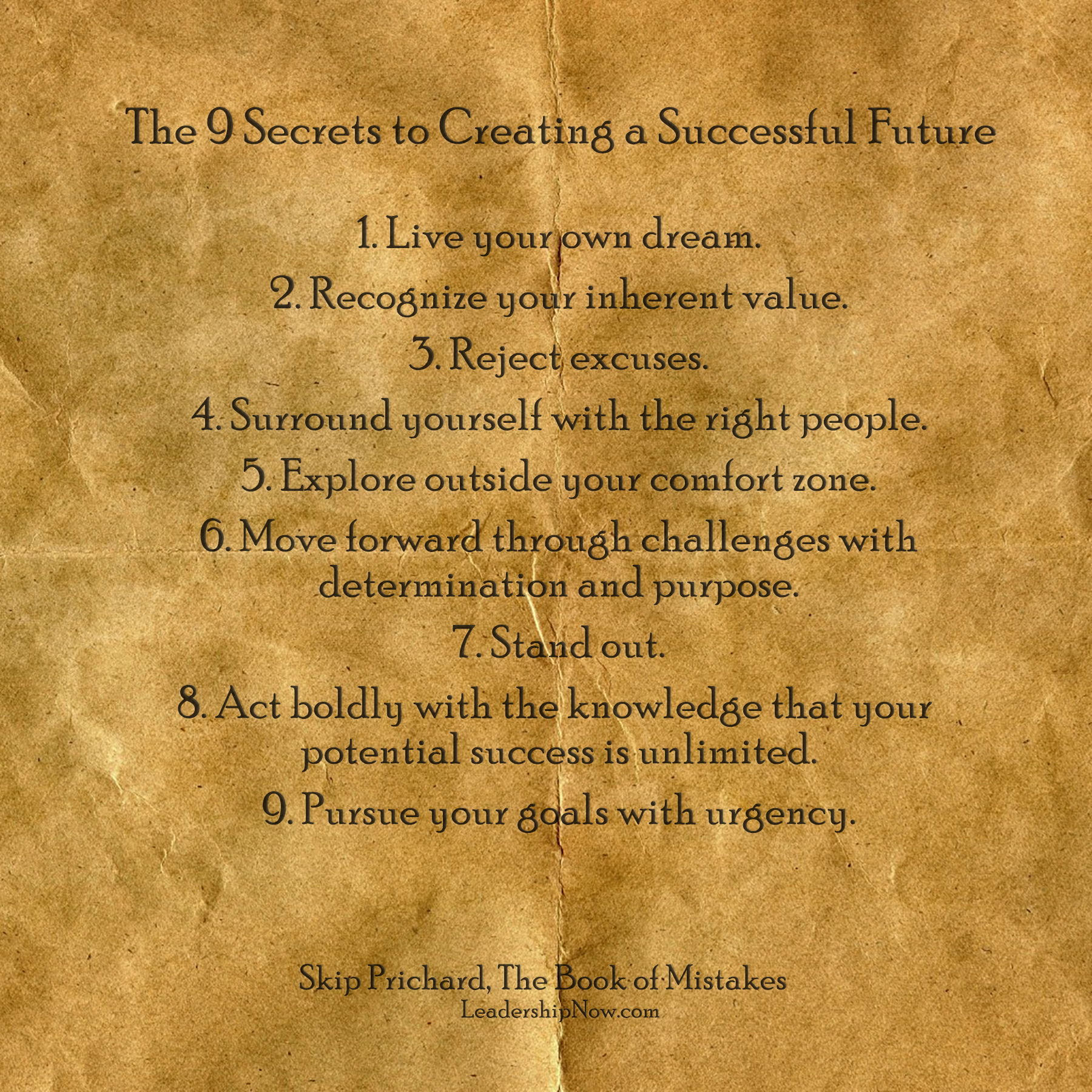
The three universal laws enable the nine secrets to creating a successful future. To avoid the nine mistakes, you need to:
1. Live your own dream. “A life choreographed by someone else is not our finest performance.”
2. Recognize your inherent value. “Don’t accept the limitations others put on you.” “Others are so quick to define us. They set expectations. They don’t realize when we’ve changed.”
3. Reject excuses. “Behind every excuse is a door to greatness.” “If you want to take your life back, take your thoughts back.”
4. Surround yourself with the right people. “Your friends determine your fate.” “Replace naysayers, doubters, and energy drainers with encouragers, winners, and motivators.”
5. Explore outside your comfort zone. “Mediocrity is the end result of too much comfort.”
6. More forward through challenges with determination and purpose. “Don’t let current circumstances define your destiny.” There will be setbacks but “It doesn’t mean you have to be good at everything or do everything, but if you think it’s a skill that you need to fulfill your purpose, you need to find a way through it.”
7. Stand out. “Standing out is as simple as consistently outperforming expectations.”
8. Act boldly with the knowledge that your potential success is unlimited. “The only limitations you need to worry about are the ones in your mind.” “Helping others magnetizes people to your cause and enhances your success.”
9. Pursue your goals with urgency. Live each day as if it’s your last and your first. “Your last keeps you focused on what really matters. You think about people, about loving those around you. Your first is important because you also must have a longer view, or you will never accomplish the goals that are hard and take longer.”
Each mentor David encounters has their own story that illuminates the mistake they share with us. Their experiences help to identify and relate to the mistake and help us to take action to avoid the mistake in the future. Prichard brings a lot of wisdom to each of these common life issues.
The story is engaging for young and old. Share this book widely because these are the kinds of mistakes that create regret down the road. At the end of your life these are the things that you look back on and wonder why no one ever told you about these pitfalls. We are never too old to learn them and some are more difficult to deal with because of the baggage that often accompanies them. Now is the time to set your course.
Like us on Instagram and Facebook for additional leadership and personal development ideas.

Posted by Michael McKinney at 10:45 AM
Permalink
| Comments (0)
| Personal Development
W
Morten Hansen thinks the way we work is broken. Not only that but how we manage and reward work, and how our culture recognizes hard work. What we call hard work may not be our best work.
In Great at Work, Hansen reports on a five-year survey of 5,000 managers and employees, including sales reps, lawyers, actuaries, brokers, medical doctors, software programmers, engineers, store managers, plant foremen, nurses and even a Las Vegas casino dealer. They discovered seven work smart practices. The first four involves mastering your own work, and the last three encompasses mastering working with others.
Do Less, Then Obsess
The common practice he found among the highest-ranked performers in the study was that they carefully selected which priorities, tasks, meetings, customers, ideas or steps to undertake and which to let go. They then applied intense, targeted effort on those few priorities in order to excel. He found that there were just a few key work practices related to this selectivity that accounted for two-thirds of the variation in performance among our subjects.
So working smarter boils down to “maximizing the value of your work by selecting a few activities and applying intense targeted effort.” If we wish to perform better, we should examine our own selectivity process. But that’s only half of it. Not only do we pick a few priorities, but then we must “obsess over your chosen area of focus to excel.” “As few as you can, as many as you must.”
Redesign Your Work
Redesigning work is about creating more value for the same amount of work done. That requires an outside-in view “because it directs attention to the benefits our work brings to others. The typical inside-out view, by contrast, measures work according to whether we have completed our tasks and goals, regardless of whether they produce any benefits.” Hunt for value. Opportunities exist at “pain points.” Ways to create value include: eliminating existing activities of little value, increasing existing activities of high value, creating new activities of high value, improving quality, and doing existing activities more efficiently.
Don’t Just Learn, Loop
The Learning Loop means you learn while you work. Doing great work requires that you are getting feedback every day. In his study, 74 percent of the top performers reviewed their work in an effort to learn and improve. On 17 percent in the underperforming category did.
Aim for Passion and Purpose
You can have one without the other, but we should aim for both. “Purpose and passion are not the same. Passion is ‘do what you love,’ while purpose is ‘do what contributes.’ Purpose asks, ‘What can I give the world?’ Passion asks, ‘What can the world give me?’” With passion and purpose working for you, you bring more energy per hour of work. Passion alone doesn’t guarantee success or happiness. You may need to take a wider view of what ignites you. “Passion can also come from: success, creativity, social interactions, learning, and competence. Expand your circle of passion by tapping into these dimensions.”
Become a Forceful Champion
Getting our work done often hinges on our ability to gain the support of others. Getting other people on board takes more than just explaining the merits of your project. You’ve got to inspire them. The best advocates in their study master two skills in this regard. “They inspired others by evoking emotions, and they circumvented resistance by deploying smart grit.” Beyond just appealing to people’s emotions, they persevere taking into the account the perspective of the people they’re trying to influence and devising tactics that will win them over. Not just grit, but smart grit. Enlist others to help move your project forward. “Too many people try to get others to change by doing all the convincing themselves. They become lone crusaders for their efforts—and they exhaust themselves in the process.”
Fight and Unite
The ability to lead teams is crucial to great work. As a matter of necessity, much of this work takes place in meetings. The trick is to encourage constructive fights in meetings with cognitive diversity. Team members need to “debate the issues, consider alternatives, challenge one another, listen to minority views, scrutinize assumptions, and enable every participant to speak up without fear of retribution.” But after that is done, the team needs to come to a decision quickly and commit to a decision. You must unite. “That means people on a team have to commit to a decision—to agree to it and exert effort to implement it.”
Adopt Disciplined Collaboration
Hansen has identified two sins of collaboration: undercollaboration and overcollaboration. Some people talk too little, and some people talk too much across teams and departments. The goal isn’t collaboration, but better performance. He recommends disciplined collaboration. That is, “they carefully select which collaboration activities to participate in (and reject others), and follow five specific rules to make the chosen activities a success: establish a compelling reason for the collaboration, craft a unifying goal that excites, reward people for results, commit full resources or kill it, and tailor trust boosters to solve any trust issues quickly.
Hansen’s research has statistically linked superior performance to the daily practice of the above seven principles. Fresh and compelling examples are used throughout to fully illustrate the seven smart work practices.
Like us on Instagram and Facebook for additional leadership and personal development ideas.

Posted by Michael McKinney at 09:06 PM
Permalink
| Comments (0)
| Personal Development
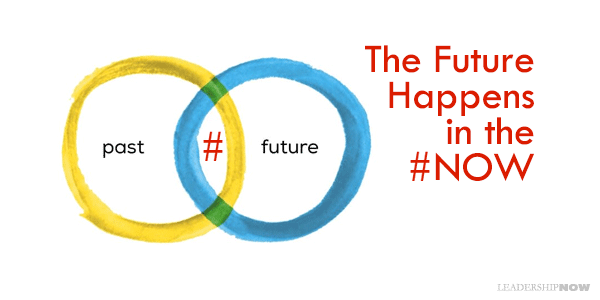
N
In #NOW, Max McKeown asks us the think about our now. He says that “for most people, most of the time, it is better to lean towards action than inaction.” People who grab opportunities that are available now, who don’t waste time looking back, and are regret-minimizers, are what McKeown calls Nowists. It is a flexible mindset so we can all learn to become a little more Nowist in our approach.
Using Your Past
Nowists don’t ignore the past, but they are good at bringing what they want or need from the past to serve them now for the future. They bring “lessons from their previous experiences and good memories” rather than living in the past. One of the reasons that Nowists can see opportunities is that they are not stuck trying to protect their past; spending time and energy on something that no longer makes sense.
Functional Impulsivity
Nowists don’t act without thinking. That’s dysfunctional. But they do possess a certain kind highly impulsive functional thinking. In a study performed at the University of Michigan on impulsivity, researchers found that there were two impulsive traits. There was the “kind that pushes people to decide quickly in a way that is likely to lead to bad consequences. And the kind that allows people to decide quickly with good results.” Successful Nowists benefit from functional impulsivity. They are good at deciding quickly under pressure and are willing to choose an option even at the cost of making a mistake that they can and are willing to correct as they go forward.
Procrastination
Nowists take control of their time. Nowists are good “at sequencing their own actions and the actions of others to get to the future on time.” Because they plan, seeing the future as a stream of connected sequences made up of actions and decisions, they can keep their momentum. And because each decision is connected to many actions, they don’t have to make as many decisions. “They can enjoy the pleasure of seeing progress in the past, present, and future, rather than discrete tasks that seem to add up to very little.”
You can avoid procrastination by changing your learning to see your future in your present. “Moving the priorities of your future-self into the present can become such a natural perspective that you are more likely to start something as early as possible than waiting too long.”
A Nowist leans towards the future from an “active, practical, let’s-make-this-work view of the world.” They only review the past for insights that will help them move forward. They understand cause and effect. “Not everyone sees clear connections between how actions in the past have created the situation in the present, or how actions in the present will shape, or create, the future.” I we can’t make these connections we are “isolated, disconnected and therefore cut off from the power of the #Now.”
We all exist in the #Now. It is only in the #Now that we can think, do, or change anything in the future. A Nowist is an active optimist. They believe they can make good things happen and take action to create a better future.
Now is a good time to think about your #Now. How will you use your #NOW?
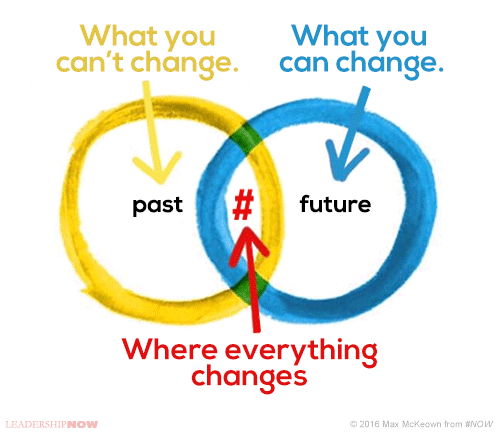 Like us on Instagram and Facebook for additional leadership and personal development ideas.
Posted by Michael McKinney at 02:19 PM
Permalink
| Comments (0)
| Personal Development
H
Steve Sims, the founder of Bluefish, has built a company that gets things done. Bluefish makes seemingly out-of-reach, change-your-life, experiences happen. Experiences like training with the Navy Seals, singing with your favorite band, watching Formula 1 in Monaco with royalty, having a private dinner at the feet of Michelangelo’s David while being sung to by Andrea Bocelli, and being James Bond for the weekend. He calls it bluefishing.
Bluefishing is about changing your mindset. It’s about looking at life differently. “You can’t cower your way through life and hope to succeed; you’re going to have to stick your neck out a little.” We usually sell ourselves short.
“Anything I wasn’t achieving in life, any doors that were closed to me, I could figure out the password for.” It’s about understanding what someone wants and finding the right key for each door. Bluefishers look for connections. What are people passionate about and how can I find a win-win for their passions?
Passion is something you have to discover—your own and others too. Bluefishers question everything. They don’t doubt, they question. Read between the lines; get behind the façade. Drill down for it. Ask why at least three times. “The first why is what they think they think, the second why is what they think you want to hear, the third why is why they feel.”
If you go in there with the idea that it’s going to fail, or that you’re asking too much, or you’re giving something the person doesn’t really want, you might as well not even go. You’ve gotta go in there knowing that this is really going to happen, but understanding that it’s not going to happen if it benefits only you.
It’s not about how much you know. “I don’t need to know how to do the whole event,” says Sims. “The first thing I need to know is which things I can’t do. The next thing is to find those people who can do what I can’t. I just find the ones who are good enough at doing what I can’t to make me look brilliant.”
Entrepreneurs should take note: You shouldn’t try to do everything, just “be able to magnificently orchestrate those who can.” You grow by giving others responsibility. “There’s a difference between being able to do everything and doing everything.”
Lead the orchestra. “All you want is to find a whole bunch of people with unique abilities, all with their own 5 percent traits or skill that no one else can do. That’s how you build up an irreplaceable team. A dream team.” Don’t spend time on things that slow you down.
Don’t overthink everything. Try something and fail at it over and over until you find out how to do it properly—to see if it is worth pursuing—while everyone else is still trying to work out the demographics. Sims Dad told him, “No one drowned from falling in the water. They drowned from staying there.” Don’t stand still.
When you don’t succeed, it isn’t a failure. It is discovery. Failure is final. Discovery is just the beginning. “You didn’t fail. You learned what to do on your next attempt.” It’s an education. “If you build up obstacles in your head, you’re looking for a reason to end it.” That’s failure.
To build your brand, first, do a self-audit. What do you stand for? How do you want people to feel when they are around you? Discover your strengths and manage your weaknesses. “Focus on the smallest element that can bring you down. Focus on your own weak links, the things that foul up your life or your work again and again and again.”
Forget about counting likes. If you tell people how good you are, that’s just selling. Get others to talk about you—recommend you. “What brands need to do—both personal and business brands—is ask other people to validate the truth.” Focus on the community you’re building around you.
Invest in your growth. Get better for your clients—your followers. And let them know. Sims told a friend, “Mate, the only difference between you and me is that I was willing to get into uncomfortable situations. I was willing to look dumb, to be among people that I knew were far more intelligent than me, so that I could learn. There’s no reason to get into a room with people stupider than you.” When you expose yourself to something new, you never go back. Be a sponge.
Sims shares techniques to support the thinking but the tactics change over time. The thinking never does. Bluefishing is a mentality first, then a stack of tools and behaviors. Learn the password and the doors will open.
Like us on Instagram and Facebook for additional leadership and personal development ideas.
Posted by Michael McKinney at 07:44 AM
Permalink
| Comments (0)
| Personal Development

W
The opposite of autonomy is gratitude. Gratitude isn’t dead, but it is in trouble. Society does not see gratitude as a moral or a character issue, which it certainly is. Although it is has been scientifically proven to be a key to happiness, it is something much more profound than that.
Most of our problems—especially relational issues—can be traced back to a lack of gratitude. In dealing with any of our problems, you will find that there is a lack of gratitude over something or someone.
The Roman statesman Cicero wrote, “Gratitude is not only the greatest of virtues, but the parent of all others.”
Even Adam Smith, the economist that believed that the market should be driven by self-interest, expressed in The Theory of Moral Sentiments, his belief that feelings of gratitude are crucial for maintaining a society that is based on goodwill. He considered gratitude to be a crucial source of social civility and stability.
Like all character traits, gratitude is expressed in action. It is returning a favor, giving thanks, showing appreciation or simply giving someone your time and attention. Cicero said, “There is no duty more indispensable than that of returning a kindness.”
Ingratitude has been called the “essence of vileness” and “the most horrible and unnatural crime that a person is capable of committing.” It is a moral issue that impacts our lives and thinking in significant ways. When we are full of pride, angry, frustrated, depressed, defensive, stressed, irritated or anxious, we would do well take a time-out and uncover our ungratefulness.
Gratitude is most often expressed by simply thanking others, but it is more than just giving thanks. It is a way of looking at life; a way of seeing other people. It is more than a strategy or a technique to influence others. It is a way of being.
We shouldn’t think of gratitude as something that happens at certain moments throughout our life. Real gratitude doesn’t appear at moments in our life, but it is a disposition we have towards life. Real gratitude is unconditional.
Gratitude endures through everything. It is not a fleeting response to our circumstances. You may remember Blanch Dubois’s classic statement in Tennessee Williams play A Streetcar Named Desire, where she said that she always depended on “the kindness of strangers”—people she didn’t know and may never see again. It was not about individual episodes in her life, but rather it speaks to a perspective on life. It’s not just gratefulness to a person but a gratefulness for your existence and how far you’ve come. It’s being aware of your whole life. An awareness of how much we owe to others throughout our life.
Gratitude creates perspective. Gratitude says, “I’m part of something bigger. I am not alone.” It connects us with each other. It strengthens our relationships while moderating our behavior.
The autonomous person rejects gratitude precisely because they must recognize and submit to others in this way. They think, “If I can find something wrong with that person I don’t have to recognize their kindness. I can invalidate them.” The autonomous don’t want to recognize others so that they can justify treating them any way they want. This kind of thinking is not based in reality. Eventually, it leads to self-destruction.
Gratefulness changes us. It strips away our indifference. It puts us in touch with reality because it acknowledges our connections—our networked existence.
It is this gratitude effect—the way it grounds us in reality—that benefits us and those around us the most. Gratitude moderates and even inhibits toxic emotions but more than that, it gives birth to positive emotions. It’s why Cicero said that it was the parent of all of the other virtues. Gratitude gives birth to and nurtures patience, a sense of humor, curiosity, creativity, insight, kindness, respect, courage, generosity, empathy, and positivity to name a few.
Gratitude creates the space for positive emotions to grow and flourish. Anger, irritation, defensiveness, worry, and impatience, are choices. These emotions don’t happen to us; we choose them. Have you ever been in the middle of an angry rant when the phone rings? When you answer the call you are all “sugar and spice and everything nice.” When it’s over you go right back into your angry rant. It’s a choice. The point is, we can choose gratitude to drive these toxic emotions out of our lives. Negative emotions cannot coexist with gratitude.
Gratitude has the power to pull teams together. When things don’t go our way, or when people don’t do what we think they should, we tend to pull away—withdraw. We want to take our ball and go home—disengage. If we can develop a mindset of gratitude, that will not happen. We will stay engaged. We will work together.
Gratitude has the power to slow us down and reflect and refocus our attention on what matters. Sometimes we have to step back to see our life in perspective; to be able to connect the dots. I like the way American writer Ursula Le Guin put it: “If you can see a thing whole—it seems that it’s always beautiful. Planets, lives. …But close up a world’s all dirt and rocks. And day to day, life’s a hard job, you get tired, you lose the pattern.”
It’s easy for any of us to lose the pattern, to lose the narrative, to forget what we are doing this all for if we never step back and see the bigger picture with gratitude.
How do we get to the point where gratitude defines who we are?
Humility, of course, makes all of this work. Humility is the ability to silence the self. Humility is valuing other people; appreciating them. Humility allows us to be open to recognizing the good in all of our circumstances.
Gratitude is humility in action.
Not surprisingly, the mechanism behind gratitude is remembering. Developing a mindset of gratitude is about remembering.
We don’t come by gratitude naturally. It’s not common sense. It’s something we have to cultivate. And remembering takes effort.
Of course, we can find the differences; we can find the negative. We can dwell on it. It’s the core trait of a toxic individual. But we can combat that by seeking out anything that is excellent or praiseworthy—seeking out the good in any situation. Drawing upon positive memories gives us hope for the future. Unconditional gratitude heals and creates understanding and builds relationships.
Gratitude acknowledges that we are connected. Allow unconditional gratitude to define you as a leader.
Like us on Instagram and Facebook for additional leadership and personal development ideas.


Posted by Michael McKinney at 07:40 AM
Permalink
| Comments (0)
| Personal Development
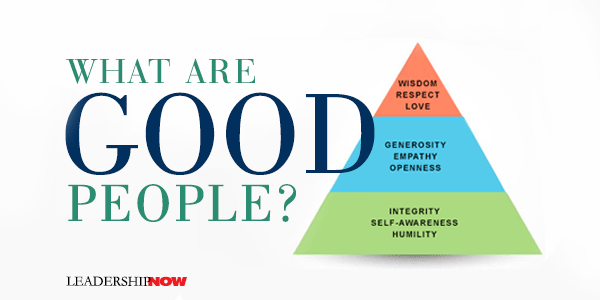
W
Anthony Tjan, author of Good People says, “Pursuing goodness in yourself while surrounding yourself with good people is the only leadership decision that really, truly, matters.”
Tjan begins a discussion by trying to define good and to build a framework and language to talk about what good is. He defines good people as “those committed to continuously cultivating the values that help them and others become the fullest possible versions of who they are.”
He discusses in detail a concept of goodness based on three cornerstone values:
Truth: A mindset of humility that makes you teachable. Self-awareness and integrity between your thoughts and actions based on that self-awareness
Compassion: An open mind that without bias allows you to understand the actions of others. To practice empathy and act on that empathy with a generous spirit that gives people what they need.
Wholeness: Involves gratitude for the people around you that leads to an outgoing concern for others. Caring and nurturing the growth of others. Having the respect to fulfil your obligations to yourself and others and acting with a degree of wisdom. Knowing what is important.
As leaders this is easier said than done. Daily we face tensions that have to managed as we try to implement our ideals real. Tjan lists five core tensions:
What can we do?
Good people do five things:
Good people put people first in their decision making. What does this do to my people?
Good people grow by continually seeking to improve themselves and help others to become fuller versions of themselves.
While good people value competency, they place a premium on character and values. They commit beyond competency to character and values of truth, compassion, and wholeness.
Good people are realists and find the balance between competing priorities and tensions. Learn to balance the tensions that exist in leadership.
Good people aren’t situational but seek to do good at all times. Don’t just practice goodness to avoid badness.
These five things are the Good People Mantra. They are five promises. As leaders we need to break from our role as leader to follower and relate to others human to human. Goodness come from building it in yourself and inspiring it in others.
Like us on Instagram and Facebook for additional leadership and personal development ideas.


Posted by Michael McKinney at 11:10 PM
Permalink
| Comments (0)
| Personal Development

I
Well you’re about to get a leadership lesson from a dog. This is not a typo. Dogs are naturals at exhibiting the leadership they need to be the leader of the pack. And they are the masters at shaking things off.
Ever watch a dripping wet dog as it gets out of a pool or a lake? Once it’s on dry land it just shakes it off. No towel or hairdryer needed, just a hypnotic back and forth motion that sprays unwanted water in every direction. And when it’s done the dog just moves on as if nothing ever happened.
At work, we need to learn how to do the same. Many of us make mountains out of molehills. Instead, we need to practice how to shake things off. After all, that little jab about your new mullet hairdo was meant as a good-natured joke. Heck, they’re probably jealous of your smokin’ hot new Billy Ray Cyrus look.
So how do you shake off these little things at work? Pivot from what you don’t want to what you do want.
Trust in others’ positive intentions. It is overwhelmingly more likely that your co-worker is not out to undermine you. So if they jab you for the way you did a project, take it as a learning experience. Pivot to how you can do better the next time.
If you’re on the receiving end of a mean-spirited joke, talk privately with the perpetrator. Pivot to what you want—a good relationship—and let them know how their comments made you feel. Leaders speak truth to power, but in a way that helps everyone come out a winner.
If you’re the leader of a team or office you also need to create an environment where everyone feels happy at work. If you see someone who is not able to shake things off, step in and make things right. Don’t allow the inmates to run the asylum.
Great leaders set the right tone. They show their team how they pivot from the negative—“we lost a good customer”—to the positive—“let’s redouble our efforts to learn from that and win a new customer.” Leaders don’t allow the little things to get under their skin.
There are, of course, some things that we should not shrug off. Constructive criticism, safety concerns and feedback on company policy can be critical to our success within the organization. These big issues are valid and require our buy-in.
It’s easy to wallow in misery. If you find the right compatriots you can wail and moan for weeks or years. But it won’t do you any good. Take a leadership lesson from a dog. Pivot from what you don’t want to what you do want. And shake it off.
Like us on Instagram and Facebook for additional leadership and personal development ideas.
Posted by Michael McKinney at 07:28 AM
Permalink
| Comments (0)
| Personal Development

Y
This is a case where it’s easy to think that good is good enough and get comfortable. Most of us live below our potential. As a result, we miss out on opportunities and therefore live below our true potential and hinder our ability to contribute to others.
The Potential Principle by Mark Sanborn is about how we can become better – even better than our best selves. It’s not about perfect. It’s about better.
So you might ask, “Better at what?” Sanborn presents a program to get you on the road to better. First, you need to figure out just what you want to improve.
What Do You Want to Improve?
Your journey toward better can be organized into four areas: Performing, Learning, Reflecting, and Thinking.
Improvement happens by not only things you initiate like interactive, collaborative activities but also by responding to what you hear, observe, learn as represented by the vertical line. Improvement also takes place in both our inner (things going on inside us) and our outer (things going with others) worlds as represented by the horizontal line. It’s about the inner world of being versus the outer world of performing.
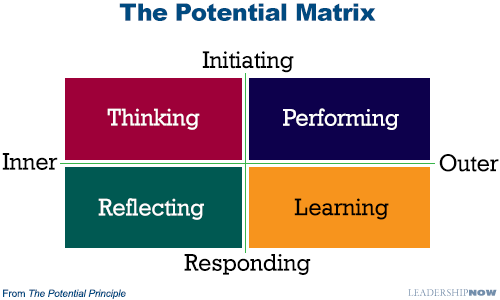
Performing
The top right quadrant is the most familiar to us. “It’s where most of us consciously spend each day doing things: the observable world of initiating, acting, and producing.” It’s what people expect of us when we show up – results. It takes deliberate practice. Performance improvement is not a straight line. There are plateaus. Also, keep in mind the FIT model: Frequency, Intensity, and Technique. How often you practice, the intensity you bring to it and the techniques you use, make all the difference.
Learning
Learning involves the acquisition of new ideas that we put into practice. If we approach life humbly, we will be enriched by what we do not know. Intentional curiosity keeps us growing. “Develop a learning agenda.” Identify what you must or need to learn and then make the time and find the resources to do it.
Reflecting
Reflecting is the inner world of responding. This is an underappreciated value in our instant, tech driven world. It’s about waiting and listening. “Epiphanies—that is, clarity and deeper understanding about yourself and how to improve your life—happen through introspection.” It’s easy to think that we have no time for this and focus on the outer world of doing, but, says Sanborn, “the inner world informs the outer world, and that for the majority of us, going within to understand motivations, hopes fears, and dreams offers some of the greatest leverage to improving every area of our lives.”
Thinking
Think about thinking. “Thinking is about proactively contemplating the world around you. It’s the source of vision, dreams, plans, and strategies. It uses external input and creates connections and directions.” Make the time to think about what you need to learn and unlearn. Focus your thinking and write it down. “Some of the biggest payoffs from thinking will occur when you review notes of previous thinking sessions and add to or modify what you came up with.”
Sanborn explains each of these areas in more detail to help you develop the right mindset. Improvement in these four areas are key to improving consistently.
To be sure, each of us is more comfortable on one or two of these areas. If you are not spending enough time in an area, that will signal an area where you could improve. “Each area complements the others. If you are headed toward better, you’ll want to use each of the four areas identified. Doing so will help you reach your destination sooner and, perhaps more important, enrich the trip.”
Four Tools for Breakthrough Improvement
These four tools will help you “prevent complacency, create improvement, and bust through barriers” on your improvement journey.
The ideas you will find in The Potential Principle are not all new, but they are organized in such a way as to make them actionable. Sanborn has done a great job of laying the foundation and providing a blueprint for continuous improvement. All you need to do now is to put it into practice.
 |
|
Like us on Instagram and Facebook for additional leadership and personal development ideas.
Posted by Michael McKinney at 06:28 PM
Permalink
| Comments (0)
| Leadership
, Personal Development

W
But once we accept the fact that moods aren’t something that happens to us, but are the result of our thinking, we can do something to control them—or at least manage them better.
Senn Delaney, Chairman and founder of Senn Delaney, wrote The Mood Elevator to help us take charge of our emotions and control our rides on the Mood Elevator.
Step one is understanding that the way we respond to outside events depends on what is happening inside our heads. “There may be events that stimulate our thoughts, but it is the thoughts that determine our moods.” Reality is reality; it’s what we make of it that makes a difference in our lives.
You will never let go of your moods completely, but knowing that your thoughts are the source of those moods can provide a little added distance and help you remain in control. It’s a powerful first step to learning to ride up the Mood Elevator rather than feeling like a helpless victim of emotional forces you can’t control.
Why Does It Matter?
When we are down the Mood Elevator our thinking is closed. When we travel up the Mood Elevator our thinking improves and opens up. We can reconnect with our best self.
We all come into this world with the potential for mental and emotional health. Our natural state is to be loving, creative, trusting, forgiving, curious, happy, and desirous of warm, close relationships with others. Unfortunately, as we grow up most of us develop thought habits or beliefs that can mask or obscure our innate health. At some point, we are hurt by someone, and we may become guarded and defensive. We are criticized for a mistake, and we may learn to make excuses and blame others, seeking to become less accountable so we don’t look bad.
 When we are up the Mood Elevator it is easier to maintain our sense of perspective and keep our cool in times of difficulty, stress, or conflict. Traveling up the Mood Elevator we are more ready to access the sources of original ideas.
Unfortunately, we can become stuck so long on the lower floors of the Mood Elevator that we can begin to think that it’s normal. Recognize when you are staying on the lower-floor emotions. Although it doesn’t make us happy, we can actually grow comfortable with self-destructive patterns of thought, negative thinking, and victimization. So we feed these thinking patterns and reinforce them with stories told to validate our perspective on life. Other people are often motivated by the same things we are. It’s just that their perspective is different than ours. It’s best for us if we let it go.
How to Move Up the Mood Elevator
The dividing line is curiosity because when something happens that threatens to pull you down to the lower floors, you can stop yourself and ask, “I wonder why they did that? It would be interesting to find out.” We tend to rush to the judgmental/blaming floor but with a curious perspective, you can begin to move up to the higher floors.
Learn to interrupt your own mood patterns and typical responses. A good night’s sleep, exercise, deep breathing, positive self-talk, and even listen to your favorite music can all help in this regard.
Adapt an attitude of mild preference. Senn explains:
Living in mild preference doesn’t mean adopting a Pollyanna attitude. It does mean looking for positive steps you can take to solve problems when they arise—and refusing to wallow in the emotions of frustration and anger that problems can so easily generate. Living in mild preference does not mean having no standards or principles. It does mean being selective about how and when to apply your standards and principles—choosing your battels carefully, as the saying goes.
Naturally a sense of humor and humility help here. But at the top of the Mood Elevator, you will find gratefulness. Senn calls it the overriding emotion. “It’s almost impossible to be grateful and at the same time be angry, depressed, irritated, or self-righteous.” Gratitude is a good way to maintain a healthy perspective on what’s happening in your life. “Focus on activities that will nourish your sense of gratitude and your appreciation for the blessings you’ve already been granted.”.
A few other important thoughts to help us manage our moods:
Recognize and honor separate realties we all live in. Be quick to understand other’s perspectives and slow to blame or criticize.
Remember that your thinking is unreliable in the lower mood states, so delay important conversations and decisions; don’t act on your unreliable thinking, and don’t take your lower mood state out on other people.
Have faith when you are down on the Mood Elevator, that this too shall pass.
Like us on Instagram and Facebook for additional leadership and personal development ideas.
Posted by Michael McKinney at 07:30 PM
Permalink
| Comments (0)
| Personal Development

W
I know none of us have any extra time, but there is overwhelming evidence that taking a time-out to simply think is foundational to your success.
Raymond Kethledge and Michael Erwin explore some solid reasons why you must make the time to think in Lead Yourself First.
When we say solitude we mean a “subjective state of mind, in which the mind, isolated from input from other minds, works through a problem on its own.” There is no particular structure to it—place, time, or length—but it must focus the mind. It’s scheduled white space—a commitment you make to yourself simply because your leadership begins with who you are—not what you do.
So let’s look at four things solitude will do for you.
Clarity
Clarity is about what is true. What is signal and what is noise? Solitude facilitates that distillation process. It helps you to eliminate or deliberately deemphasize all distractions. That alone will help you to make the time to think. Clarity and focus go hand-in-hand. That kind of focused attention is often best done alone.
Intuition complements analytical thought. When we get stuck, “intuition can provide clarity when analytical thinking cannot.” The challenge is accessing it. Accessing intuition requires “a deeper form of solitude: an absence of inputs not only from other minds, but also from one’s own.”
Clarity is important for decision-making but it is also critical for understanding who you are—strengths and weaknesses. It helps to connect you with your core values and understand your place from that perspective.
Creativity
Solitude opens the path to creativity. Solitude isn’t always the shortest distance to the goal. Joey Reiman, CEO of the consulting firm BrightHouse, credits their success to their “longer, incubation pace.” On one project he says, “If we had moved at a faster, business pace, we never would have excavated that original brand identity and then generalized it into a new ethos.”
Dena Braeger, mother of six in El Paso, offered this insight into information overload:
People make such an effort to copy what other people do, because we have so much access to information. I’m surrounded by people on Pinterest. I’ll be dammed if I make something on Pinterest. You’ll see things like these cupcakes that look amazing. And people copy them. But on the inside their phony, because the person didn’t create it themselves. We’re getting more of everything, but less of what is authentically ourselves. If we spent more time alone, creating something that might not look as amazing but is more authentic, we’d value ourselves more.
Creativity is doing something differently than the norm. Solitude allows us to get away from the inertia of our environment and connect to new possibilities.
Emotional Balance
Emotional balance requires you to respond rather than react. General James Mattis finds a lack of reflection the single biggest problem facing leaders. “The leader who neglects to step out of the sweep of events, to contemplate from whence they come and where they might go. Finds himself merely blown from one thing to another. But the leader who steps outside events is a leader who can change them.”
Solitude allows you to reflect on what is making you emotional and provide clarity on the issue. Often what you are emotional about is more of a distraction than an issue. Again Dena Braeger, the West Point graduate and mother of six in El Paso, said, “When I’m practicing solitude regularly, I self-correct so much better. I’m more focused on what’s important, and I let things go that aren’t important.”
Instead of allowing our emotions to adversely affect our leadership, it is wise to move away and deal with them in private. Our emotions will find an outlet somewhere. And that is best alone than in decisions made through unfiltered emotions that affect those around us.
Moral Courage
We’ve all seen them: leaders who take themselves too seriously—who believe their own press release. And it’s all too easy for any of us to fall prey to self-admiration. “Honest reflation can deflate these pretentions.” Reflection can pave the way to humility.
Solitude allows you to slow down and be clear and firmly convicted of your values and beliefs. “Leaders who are well anchored in what they believe are going to be more effective,” says Doug Conant, the former CEO and president of the Campbell Soup Company. When those criticisms come along that are design to enforce conformity, it is easier to weather the storm when you know that what you are doing is the right thing to do for the right reasons. It is the power to rise above.
Reclaiming Solitude
Brené Brown, author of Daring Greatly, says that “The biggest mistake I’ve made in my career to date is believing that solitude is a luxury. I could chart the ups and downs of my quality of life personally and professionally and the amount of time I spend in solitude.” As important as it is, it is easy to let it slip away without even realizing it. We are continuously bombarded by pressures—both personal and social—not to stop and reflect but if we lose our solitude, we will lose who we are.
You don’t have to go off to a mountaintop or sit at the seashore. It can be a closed room, the library, a park bench, and even a waiting room.
We have a responsibility to seek out periods of solitude. We owe it to ourselves and those we lead.
Of Related Interest:
 Taking Another Look: Leading Minds on Reflection Part 4
Taking Another Look: Leading Minds on Reflection Part 3
Taking Another Look: Leading Minds on Reflection Part 2
Taking Another Look: Leading Minds on Reflection Part 1
Does Your Leadership Have “White Space?”
Taking Another Look: Leading Minds on Reflection Part 4
Taking Another Look: Leading Minds on Reflection Part 3
Taking Another Look: Leading Minds on Reflection Part 2
Taking Another Look: Leading Minds on Reflection Part 1
Does Your Leadership Have “White Space?”
Like us on Instagram and Facebook for additional leadership and personal development ideas.
Posted by Michael McKinney at 04:05 PM
Permalink
| Comments (0)
| Leadership
, Personal Development

K
 Like us on Instagram and Facebook for additional leadership and personal development ideas.
Posted by Michael McKinney at 08:14 AM
Permalink
| Comments (0)
| Personal Development
S
Are you ready?
The Smart Machine Age (SMA) will revolutionize how most of us live and work. In Humility is the New Smart, the authors state that “smart technologies will become ubiquitous, invading and changing many aspects of our professional and personal lives and in many ways challenging our fundamental beliefs about success, opportunity, and the American Dream.” This means that the “number and types of available jobs and required skills will turn our lives and our children’s lives upside down.”
New skills will be needed. Uniquely human skills. Those skills, while uniquely human, are not what we are typically trained to do and require a deal of messy personal development. We will need to become better thinkers, listeners, relators, and collaborators while working to overcome our culture of obsessive individualism in order to thrive in the SMA. Humility is the mindset that will make all of this possible.
Most of today’s adults have had no formal training in how to think, how to listen, how to learn and experiment through inquiry, how to emotionally engage, how to manage emotions, how to collaborate, or how to embrace mistakes as learning opportunities.
In short, say the authors, we need to acquire and continually develop four fundamental NewSmart behaviors:
Quieting Ego
Quieting Ego has always been the challenge for us humans. As they observe, “Even if we don’t consider ourselves part of the ‘big me’ cultural phenomenon, for many of us to feel good about ourselves we have to constantly be ‘right,’ self-enhance, self-promote, and conceal our weaknesses, all of which drive ego defensiveness and failure intolerance that impedes higher-level thinking and relating.” This tendency negatively affects our behavior, thinking, and ability to relate to and engage with others.
Managing Self—Thinking and Emotions
We need to get above ourselves to see ourselves impartially. We all struggle “to self-regulate our basic humanity—our biases, fears, insecurities, and natural fight-flee-or-freeze response to stress and anxiety.” We need to be willing to treat all of our “beliefs (not values) as hypotheses subject to stress tests and modification by better data.”
Negative emotions cause narrow-mindedness. Positive emotions, on the other hand, have been scientifically linked to “broader attention, open-mindedness, deeper focus, and more flexible thinking, all of which underlie creativity and innovative thinking.”
Reflective Listening
Because we are limited by our own thinking, we need to listen to others to “open our minds and, push past our biases and mental models, and mitigate self-absorption in order to collaborate and build better relationships.” The problem is “we’re just too wired to confirm what we already believe, and we feel too comfortable having a cohesive simple story of how our world works.” Listening to others helps to quiet our ego.
Otherness
To create these new behaviors and mindsets, it should become obvious that we need to enlist the help of others. “We can’t think, innovate, or relate at our best alone.” As Barbara Fredrickson observed, “nobody reaches his or her full potential in isolation.” Jane Dutton out it this way: “It seems to be another fact that no man can come to know himself except as the outcome of disclosing himself to another.”
The NewSmart Organization
Optimal human performance in the SMA will require an emphasis on the emotional aspects of critical thinking, creativity, innovation and engaging with others. “The work environment must be designed to reduce fears, insecurities, and other negative emotions.”
To do this it means “providing people a feeling of being respected, held in positive regard, and listened to. It means creating opportunities for people to connect and build trust. “It means allocating time and designing work environments that bring people together to relate about nonwork matters.” Finally, it means getting to know employees and helping them to get the “right training or opportunities to develop and provide feedback.”
The NewSmart organization needs to be a safe place to learn. “Feeling safe means that you feel that your boss your employer, and your colleagues will do you no harm as you try to learn.”
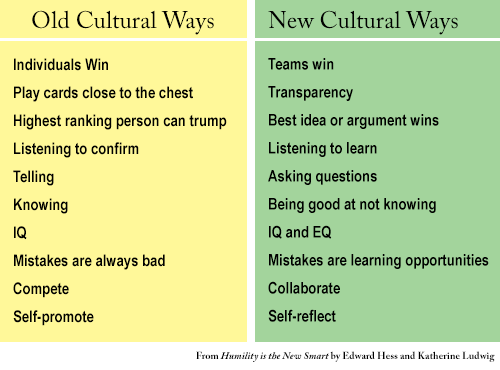 Like us on Instagram and Facebook for additional leadership and personal development ideas.
Posted by Michael McKinney at 05:28 PM
Permalink
| Comments (0)
| General Business
, Human Resources
, Leadership Development
, Personal Development
, Positive Leadership
T
In The Leadership Gap, Lolly Daskal addresses this gap—what it is, why it happens, and what we can do about it. The gap is always there but at some point, it comes the surface to sabotage us. What if we don’t know what we think we know?
The problem is that one day, suddenly, what once worked so well to propel their rise stops working. And the very same traits that had worked for them actually start working against them.
It is at this point that we need to begin asking ourselves some questions. “What is the gap between who I am and who I want to be, and do I know what it is I still need to learn?” In short, “Who am I being?” We need to rethink how our behaviors are perceived by those around us. And when there is that gap between how we want to be perceived and how we are actually being perceived, we need to take action. “Learning to recognize your leadership gap is the factor that determines your greatness as a leader.” Sometimes we overuse a strength and sometimes we drift into the shadow side of our strengths. Either way, an understanding of what drives can give us the insight we need to avoid our leadership gaps.
Daskal invites us to look at who we are being and the instincts that drive our behaviors. The “shadow” you. She has developed seven leadership archetypes to help us gain some clarity as to what drives our beliefs and therefore our behaviors. We aren’t necessarily one type as we tend to shift from one to another depending on the circumstances but “we tend to lean repeatedly toward the same archetype persona.”
The Seven Archetypes
 The Rebel who is driven by confidence. “How can I push the envelope?” The gap is self-doubt. The gap archetype is The Imposter who is so insecure they play havoc with their mind because they have self-doubt. The key to the Rebel’s success is confidence, but self-doubt that often accompanies great success, undermines their confidence and they act out of the imposter syndrome. They undermine their leadership thus keeping them from achieving greatness.
 The Explorer who is fueled by intuition. “What can I discover?” The gap is manipulation. The gap archetype is The Exploiter who manipulates every chance they get just so you will not know how powerless they really feel. The tendency for the Explorer is to use their intuition to manipulate others to gain control. Daskal notes, “Whereas intuition makes things better for others, manipulation is always about making things better for you.”
 The Truth Teller who embraces candor. “Where should I speak up?” The gap is suspicion. The gap archetype is The Deceiver who is suspicious about everyone because they cannot trust themselves to speak the truth. Discovering the truth and then speaking up for what is right is never easy but when we find we have been deceived, we can become paranoid and suspicious of others undermining our influence. We can become a kind of victim that will not speak up when we need to because of our paranoia.
 The Hero who embodies courage. “Where is courage needed?” The gap is fear. The gap archetype is The Bystander who is too fearful to be brave, too conservative to take a risk, and too cautious to take a stand. Once enabled by courage, they are now sidelined by fear. “Most of us not really afraid of being brave—we are afraid of what it takes to be brave. We are not really afraid of losing everything—we are afraid of what will happen when we have nothing.”
 The Inventor who is brimming with integrity. “How can we make this better?” No matter what you do you will be “held accountable and responsible as people. Everything in business, leadership, and success is founded on the virtue of integrity—it is the force that leads the way.” The gap is corruption. The gap archetype is The Destroyer who is morally corrupt. While an Inventor puts their personal values into practice, if those values become corrupted, usually by forces such as ego, personal gain, or anger, they destroy the organization from within. The Destroyer advocates cutting corners, quick fixes and compromising quality and standards. “The Inventor maintains his or her integrity while thinking outside the box.”
 The Navigator who trusts and is trusted as they guide people to where they need to go. “How can we get to where we need to go?” The gap is arrogance. The gap archetype is The Fixer who a chronic rescuer no one trusts They want to help too much, fix too much and rescue too much. “Navigators have a way of making the complicated simple, and the simple understandable. They inspire trust. But their ability and confidence to know where to go and become an arrogance that attempts to control others—to do for others what they need to be doing themselves.
 The Knight for whom loyalty is everything and will stand beside you and will serve you before they serve themselves. “How can I serve you?” The gap is self-serving. The gap archetype is The Mercenary who is self -serving and put their own needs before those of the team, the business or the organization. Often the transition from serving to self-serving is subtle. “Loyal employees become disloyal one infraction at a time. Only after unfaithfulness shapes itself does the self-serving attitude emerge in a way it can be detected and deciphered.”
Daskal reminds us that understanding our weaknesses is our greatest strength. From these seven archetypes, we can see how each has powerful abilities and hidden impediments. By knowing the gaps we can get into we can better use our strengths to achieve our own leadership greatness.
Daskal explains each of these archetypes in detail and importantly how we avoid these gaps. She describes what the positive looks like and what the negative looks like with examples for each.
The Leadership Gap provides the antidote for leading on autopilot. Daskal provides insight into our behaviors and beliefs that can if not managed properly can derail even the most talented and successful leaders. Confronting and avoiding our leadership gaps is the key to attaining long-term leadership success.
Like us on Instagram and Facebook for additional leadership and personal development ideas.

Posted by Michael McKinney at 03:03 PM
Permalink
| Comments (0)
| Leadership Development
, Personal Development
 Like us on Instagram and Facebook for additional leadership and personal development ideas.
Posted by Michael McKinney at 10:25 AM
Permalink
| Comments (0)
| Personal Development

H
When we haven’t conquered our pride putting on false humility might seem like the shortcut to the benefits of being a truly humble person. We’ve all met these kinds of people. False humility is nothing but arrogance.
In Humility: The Secret Ingredient of Success, Pat Williams, author and senior vice president of the NBA’s Orlando Magic, suggests four ways we can avoid the mask of false humility.
1. Take time to reflect on the person you are—and the person you want to be.
If we are genuinely humble, we are keenly aware of the disparity between who we are and who we aspire to be. We recognize that we have not already arrived, in terms of our character, integrity, and accomplishments. We are works in progress.
We need to remember that it’s easy over time to become someone we really don’t want to be. Williams cites Stanford professor Roderick Kramer:
When I ask respondents to explain why they think the process of experiencing great success will not change them in any fundamental way, they typically say something along the lines of, “Because I know what kind of person I am”….It is as if in finding success they will become merely bigger and better versions of what they are now. They can’t even imagine that they could ever fall from grace. And that, of course, guarantees that some of them will.
2. Ask a few trusted friends to be brutally honest with you.
We all need people in our lives who will hold up a mirror and show us who we truly are so we won’t be walking around with the moral equivalent of spinach in our teeth. Truth is a powerful antidote to self-deception and false humility. If you always have people in your life who will tell you the truth for your own good, and if you humbly need their wise counsel, they will save you from a multitude of self-inflicted wounds.
3. Immediately and humbly admit your faults and failures.
In other words, apologize without delay. Anyone who tries to achieve anything is bound to make mistakes. The greater your goals, the bigger your potential blunders. Our natural tendency is to deny our failings and shortcomings. We don’t like to admit that we’ve messed up. We prefer to protect our pride and our egos.
If you want to recover from a moral failure or a lapse in judgment, the key is o apologize fully, specifically, and humbly. Don’t try to get away with a non-apology apology. Be sincere. Take your lumps. Learn your lessons.
4. Be honestly humble and humbly honest.
Don’t inflate your resume—but don’t deflate it either. It’s perfectly wise and acceptable to own yur achievements and state your qualifications. Just don’t brag or take more credit than you’ve earned.
There’s never any need for false modesty. False modesty tends to break down authentic humility because it becomes hard to know where your real humility leaves off and your phony humility begins. Yu become so accustomed to devaluing your own talent, accomplishments, and self-worth that you actually lose confidence in yourself. Yu stop speaking up, stop advocating for what you believe, stop pursuing your own goals. In short, you start believing your own self-deprecating falsehoods.
Genuine humility is the best policy. False modesty comes from ego and pride. As Canadian humorist Eric Nicol observed, “I am keenly aware of the need to avoid false modesty. Which, like false teeth, can make you talk funny.”
Like us on Instagram and Facebook for additional leadership and personal development ideas.

Posted by Michael McKinney at 09:16 AM
Permalink
| Comments (0)
| Personal Development
I
We are under more pressure than ever to do more. The idea that we can stretch and do more with what we already have begins to remove us from the dehumanizing rat race for resources that is impossible to win. Chasing limits us. Stretch liberates.
Especially in uncertain times, “stretching equips us with the abilities to adapt and change when facing a less predictable set of circumstances.”
One of the reasons we chase instead of stretch is because fail to see how we might see a resource beyond its traditional use. It’s also easy to assume that if we just had more money we could spend our way out of our problems. It’s often easier to acquire things than to think about how to use those same resources in more productive ways. “The problem is that chasers become so fixated on acquiring resources that they lose sight of what those resources will do for them” so we end up squandering them.
We need to place more focus on what we already have. “Stretchers find beauty and richness in places where others struggle to see anything of value. Too often, we understand, interact with, and use things at face value, locking ourselves into conventions that limit possibilities.” Our creativity is sparked by constraints. Filmmaker Robert Rodrigues comments:
The creative person with limitless imagination and no money can make a better film than the talentless mogul with the limitless checkbook every time. Take advantage of your disadvantages, feature the few assets you may have, and work harder than anyone else around you.
Outsiders can often stretch by seeing possibilities that we can’t because we are the expert or just too close to the issue. “Breadth of experiences helps people stretch.” The well rounded often outperform those who are deeply focused on a single thing especially when trying to solve complex problems. It makes a case for a liberal arts education.
We need to repeatedly go outside ourselves. “Temporary departures from our small worlds can come from short bursts of new activities such as reading about another field, finding a hobby, or having conversations with people from different backgrounds.”
Stretching is not about being a cheapskate. There is a difference between frugal and cheap.
A Stretching Roadmap
In summary, here are a dozen ways Sonenshein suggests to help get us into the stretching habit.
Just Say No
Just say no to more resources. Ask: “If I only didn’t have these resources, I could…” “By saying no to more resources, we’re saying yes to an entirely new outlook on working and living.”
Find a Sleeping Beauty
It’s easy to miss what is right before us. Again an outsider can help here. “In the world beyond fairy tales, a lot of resources lie dormant. If we look hard enough, we’ll find resources all around us waiting to be activated. We just need to awaken them to benefit from more than we thought we had, allowing us to solve different problems and pursue promising opportunities that otherwise might be impossible.”
Go Explore
Dedicate time every week to reading something different, educate yourself outside of your industry, take lunch with someone new, or spend time with outsiders. Leave your comfort zone.
Take a Break (and Pay Less Attention)
Consider rotating between difficult work and mindless work. “Mindless work recharges our batteries, readies us to do more down the road, and lets our mind wander to find new connections among our resources.” Take a walk to find new connections. Consider putting yourself on the clock to provide a mandatory beginning and ending to your work.
Pick New Neighbors
“Whom we spend time with shapes a lot of our behavior.” You don’t need to change zip codes. “Instead, identify one stretcher you admire and already know. Commit to spending at least one hour with him or her once a month.”
Appreciate
“When people are grateful, they expand how they think about resources, often in ways that try to help others.” Also, by appreciating what we have, it makes it easier to say no to tempting things we lack but really don’t need.
Shop Your Closet
Use what you have. “Many of the best-known inventions came from existing products. Play-Doh started as a wallpaper cleaning compound that became obsolete with the rise of vinyl wallpaper in the 1950s; the corkscrew came from a military tool to remove bullets; and Pyrex came from material from train lantern glass the wife of a scientist at Corning Glass Work experimented with to bake a cake.”
Plan Backward
Think improvisation. Without a plan is often difficult to get started. But “jazz music replaces a plan with improvisation, teaching us to act and respond more spontaneously. Once we get moving, we free ourselves from worrying about plotting and following a plan and focus on observing and learning from our actions.”
Scramble the Back Row
To remove chess players from entrenched thinking, Bobby Fischer suggested randomly scrambling the back row. “If we find ourselves too regularly on autopilot, it might be time to scramble our back rows. There’s comfort in habits, but it’s critical to avoid being complacent with how things are, closing off the possibility of imagining how things might be better.”
Make Midyear Resolutions
“Why wait until the beginning of the year to make a pledge. The midyear resolutions also allow us to take stock of how we did with our New Year’s resolutions and set additional goals from a presumably clearer headspace.”
Break it Down
If we can break down our resources to their smallest components, then it becomes easier to see the hidden potential.
Turn Treasure into Trash
Keep a benefits diary to records unexpected benefits from you key events, activities, or experiences. “Once we find a hidden benefit in something, we can turn it into a treasure.
Stretch is a very well done book. Good and relevant examples give power to the points he is making. By chasing resources we really limit our potential. Stretching brings out our best.

|
|
Like us on Instagram and Facebook for additional leadership and personal development ideas.

Posted by Michael McKinney at 05:55 PM
Permalink
| Comments (0)
| Management
, Personal Development
, Problem Solving
Each of us has beliefs and fears about our value, and they cause defensive and/or self-promotional behaviors when under stress. Whether in a meeting, a presentation, or a relationship, part of our attention—sometimes all of it—is preoccupied by our view of our self. Are we competent? Respected? Intelligent? Liked? Attractive? Included? Each of us has a set of criteria we unconsciously judge ourselves against. When we measure up, we feel pride, even superiority. When we don’t, we feel uncomfortable, stressed, often afraid.Ego Free Leadership is co-written by executive coach Shayne Hughes, president of Learning as Leadership and Brandon Black the retired CEO of Encore Capital Group. The book tracks Black’s journey from acknowledging to changing the destructive elements of his ego. Once he committed to change, the transformation began in his team and throughout the culture of the Encore organization. Quite effectively, Hughes and Black go back and forth sharing their perspectives on the unfolding transformation. Naturally, it’s not a step-by-step prescription, but it is instructive to see the process because we all share similar issues and thinking.
Intellectually it’s easy to decide that learning, growing, or creating authentic relationships is more important than not appearing incompetent, failing, or being hurt. Unfortunately, this is not how we feel at a visceral level, or we wouldn’t be continuously repeating these dysfunctional behaviors. Transformation comes when we consciously connect with goals not tied to our self-worth and use this emotional clarity to inspire action in the present moment.
The theoretical importance of having authentic, transparent conversations isn’t in question: it’s rather the practical difficulty of doing so when there isn’t emotional safety in the relationship.
For our ego, the sensation of being right is like electricity to a lightbulb. It fuels us with energy and vigor. We sit straighter, our voice sharpens, and our language hardens. We face an issue or a conflict, and we see the answer clearly. With this certainty comes a feeling of power and righteousness, as captivating as a drug rush. This is the way it is. Being right sweeps us so automatically into an aggressive mental stance that any collateral damage seems just a necessary evil.
Our egosystem and brain can convince us of anything, regardless of its veracity. We can make—I myself have done it countless times—any number of important decisions with profound conviction, only to realize later it wasn’t really what we wanted or was based on incorrect perceptions. (“…clearly distinguishing between the facts I had collected and my conclusions about them.”)
In each case, people experienced their frustration as true, when in fact they were unconsciously focusing on the negative in others. Worse when we do this, our mindset and behaviors actually influence others to be less than their best selves, either because they don’t feel safe or because we simply don’t allow them to participate. We limit their potential.
Like us on Instagram and Facebook for additional leadership and personal development ideas.


Posted by Michael McKinney at 11:16 PM
Permalink
| Comments (0)
| Human Resources
, Personal Development
C
Conflict is energy, and can be used in positive or negative ways. Negative conflict becomes drama, and it is costly to companies, teams and relationships at all levels. In fact, according to a Gallup Poll, negative conflict drains the U.S. economy by about $350 billion a year in lost productivity and wasted energy.
In Conflict without Casualties, author Nate Regier believes that the misuse of conflict energy is the biggest crisis facing our world, and that we haven’t even begun to harness the creative potential of conflict. When people embrace the fullest meaning of compassion as a process of “struggling with” others in creative conflict, they can transform lives, companies, and the world.
It is understandable that we try to avoid conflict considering all of the drama and negative fallout that always seems to accompany it. But Regier says if we use conflict correctly, we can use it to create. “Eliminating the casualties of conflict cannot happen by repressing the conflict and just ‘being nice.’ It happens by stewarding the energy inherent in conflict to make something positive, even amazing.” That seems like a tall order, but it makes sense.
Compassionate Accountability
The way forward is to practice Compassionate Accountability. Compassionate Accountability is a method for resisting the negative pull of drama—“I gotta win.” Negative conflict becomes drama. “Drama is the mismanaging of the energy of conflict. It diverts energy towards the pursuit of self-justification, one of the strongest human urges and the one that almost always gets us into trouble.” (Chapter 2 on drama is one of the clearest discussions of drama I’ve read.)
To be compassionate is to struggle alongside with others; to struggle with instead of against. “Compassion is the result of people taking ownership of their feelings, thoughts and behaviors, and choosing to spend the energy of conflict pursuing effective solutions that preserve the dignity of all involved. Compassion is more than care and concern for others. It’s about the willingness to get in the trenches and struggle together as an equal with others.”
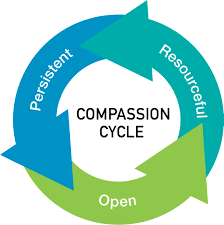 Compassionate Accountability is based on three skills:
Openness
Openness is a state of non-judgmental receptivity to your own and others’ experiences. Openness is the healthy alternative to the Victim response that is a part of most drama. It also involves transparency, courage with self and others, self-awareness, empathy, confidence in one’s own adequacy, and a willingness to own and disclose emotions. Openness involves empathy (understanding others), validation (affirming others), and disclosure (sharing with others).
Resourcefulness
If Openness reveals the real issues, motives, and emotions in our lives, then resourcefulness is the ability to problem-solve to satisfy those motives and address the issues. When there’s conflict, Openness is where we discover and affirm how the gap between what we want and what we’re experiencing is affecting us. Resourcefulness is the ability to understand the gap and figure out what to do about it. It requires the abandonment of the ego in order to gather ideas and opinions, analyze what has worked in the past, and leverage personal strengths.
Persistence
Persistence is all about seeing things through with integrity, humility, and respect. It’s accountability. It means setting boundaries, reinforcing non-negotiables, and accepting responsibility for your own behaviors. “Compassion without accountability gets you nowhere. Accountability without compassion gets you alienated. Blending the two is the essence of leadership.”
These three skills are a process that starts at Open, moves to Resourceful, and finally to Persistence. They are three interdependent ways of feeling, thinking, and acting that work productively together.
When Regier’s model is placed inside the Drama Triangle (developed by Steven Karpman), the author creates a useful visual for understanding where we often end up if we don’t intentionally stay the Compassionate Accountability course.
Regier writes: “Drama inevitably pushes us into corners, where we cling to distorted worldviews that compel us to do the same thing over and over, expecting different results. Compassion, on the other hand, keeps us moving, searching, nimble, effective, and capable of adapting to change.” It also keep us from being mired inside our own head and thus limiting our responses and our ability to reframe the conflict. We get stuck.
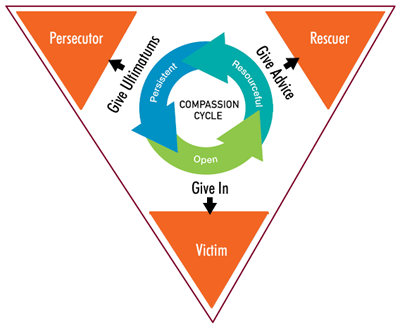
It would seem that if you stop at Persistence then you become stagnant and eventually irrelevant. A state of non-judgmental receptivity would seem to go hand-in-hand with progress, the inevitability of change, and the understanding of others. “As a species, human beings seem to have a very difficult time returning to Openness in order to keep the cycle going. We take up residence at Persistence, which inevitably morphs into Persecutor as we fight to protect what we’ve built and save ourselves from the consequences of our own creation.”
He adds, “Each point on the Compassion Cycle has a purpose. When that purpose is fulfilled, it’s time to move. Lingering after the purpose has been achieved is a recipe for stagnation and drama.”
If you want to end the drama in your life or organization then you have to replace it with something else. Compassionate Accountability is the cure. Regier concludes the book with a section devoted to implementing this concept into everything you do. A very useful user’s manual.
Like us on Instagram and Facebook for additional leadership and personal development ideas.


Posted by Michael McKinney at 06:01 PM
Permalink
| Comments (0)
| Change
, Communication
, Personal Development

I
This need for leaders to rethink who they are gets to the heart of what Rosamund Stone Zander describes in Pathways to Possibility. Often, our growth requires that we live a new story. We are not “trained to think of ourselves as governed by stories made up by younger iterations of ourselves, frozen in time.”
We need to rewrite the stories to reflect life as it is now. “I believe that when we become aware of patterns in our behavior, when we learn to identify and rewrite the stories that give us our identities, we will gain passage, at any age, into a new phase of adulthood. In this territory of maturity, where old fear-based pattern no longer hold us back, we will, I wager, do what we now think of as remarkable, even magical, things.”
We all have a point of view about how life should go and they are often illogical. But when they are we produce reasons for why we do and think like we do even if it has no basis on our current reality. They hold us back. What children’s stories have in common is survival anxiety. We are living a story made up by a child when we are frightened about the future, are ready to run, feel the need to control others, act out of insecurity, and are unable to take criticism of any kind.
The stores we tell ourselves are generally adopted unknowingly from the environment in which we grew up and are not under the control of the reasoning mind. To move forward, we have to uncover the story and tell a new one. Zander repeatedly states that new habits are formed in an environment of love.
How do you know if you are living in a story crafted by the mind of a child?
 You are being captured by the child in you if you are certain that your views are true, and you make no attempt to question them.
When you are frequently anxious that things will go wrong, or are living your life cautiously. Fear and anxiety are the underlying emotions in the child’s view of the world because for a child it is all about survival.
You are living in a child apart if you are regularly concerned with what others think of you.
When you assume that things will repeat. It makes you approach the future with resistance, be overly cautious, and close down to life.
You are expressing a child part when you are convinced that you have absolute needs and you are further convinced that your needs and desire will never change.
In short, a child’s stories are I-centered, concrete, fear-based, scarcity-minded, identity-bound, personal through and through, and indisputable—self-centered—my way.
When we are operating from the adult narrative:
We know we survived childhood and staying alive is no longer a present issue.
The mature mind is curious and devotes attention to what is not known.
The adult mind is open and flexible: willing to entertain new thoughts and feelings without the need to protect itself.
The adult mind is creative: on the lookout for opportunity and able to invent stories and move into contexts that will further our alignment with one another.
The adult mind is loving and compassionate. Defined by love, joy, appreciation, gratitude and wonder. Nothing appears as personal.
Zander relates three rules that coach Pete Carroll gave his players. Zander says that these three rule will help support the adoption of an adult story. “These three rules,” she writes, “almost guarantee that the person who follows them is saved from the distraction of survival instincts, such as possessiveness, entitlement, and winning over others, and feelings of helplessness, fear and rage when things don’t turn out the way he planned. Here are the three rules with Zander’s comments:
Rule 1: Protect the Team: A perfect instruction to remind a player that he is not, in fact, the center of the universe, and to encourage him in all matters related to the game to adopt and live into a story of collaboration.
Rule 2: No Negative Talk. No Whining and Complaining: This rule establishes that the game is played in a mode of possibility and not one of survival where players are out for themselves and can be weakened by a victim story. It requires that people be responsible for the effect of their words and their moods, which ensures that the team maintains energy.
Rule 3: Be Early: What powerful little words! What an amazing third rule! The player who lives by “be early” puts himself in charge of his life. If you decide to be early, you are always in charge; you will show up as a considerate person as well as a paragon of responsibility.
Like us on Instagram and Facebook for additional leadership and personal development ideas.
Posted by Michael McKinney at 10:11 PM
Permalink
| Comments (0)
| Personal Development
A
An outward mindset doesn’t come naturally. We have to consciously change how we think about others.
In The Outward Mindset, the Arbinger Institute reports that “the biggest lever for change is not a change in self-belief but a fundamental change in the way one sees and regards one’s connections with and obligations to others.”
People and organizations get stuck when they have an inward mindset because when we are focused on ourselves and our needs, our reality becomes distorted. An inward mindset limits our possibilities and negatively affects our behavior and thus our relationships.
Arbinger reminds us that an inward mindset and introspection are not the same thing. “One can introspect in a self-centered way, which would indicate an inward mindset. However, a person also can introspect about one’s connections with others, which is the very essence of what we are calling outwardness. Sometimes it is helpful to look inside to see how one is connected with what is outside.”
Moving from an inward mindset to an outward mindset is more than a surface adjustment or behavioral change alone. It requires a change in how we see and think about others. How we see and respond to others is not so much about them as it is a reflection of what is going on inside of us. We often fixate on other’s shortcomings so we don’t have to deal with our own.
Inward-mindset people and organizations do things. Outward-mindset people and organizations help others to be able to do things.” It is possible to be an inward-mindset person or organization masquerading as an outward-mindset person or organization if you aren’t paying attention to the needs, objectives, and challenges of those you are supposedly doing the work for. Whose needs are your primary focus?
Arbinger has discovered that those who consistently work with an outward mindset follow a pattern. They:
An outward-mindset begins with you. “While the goal in shifting mindsets is to get everyone turned toward each other, accomplishing this goal is possible only if people are prepared to turn their mindsets toward others with no expectation that others will change their mindsets in return. This capability—to change the way I see and work with others regardless of whether they change—overcomes the biggest impediment to mindset change: the natural, inward-mindset inclination to wait for others to change before doing anything different oneself.” This, of course, is true leadership.
To begin:
Take the Mindset Audit online.
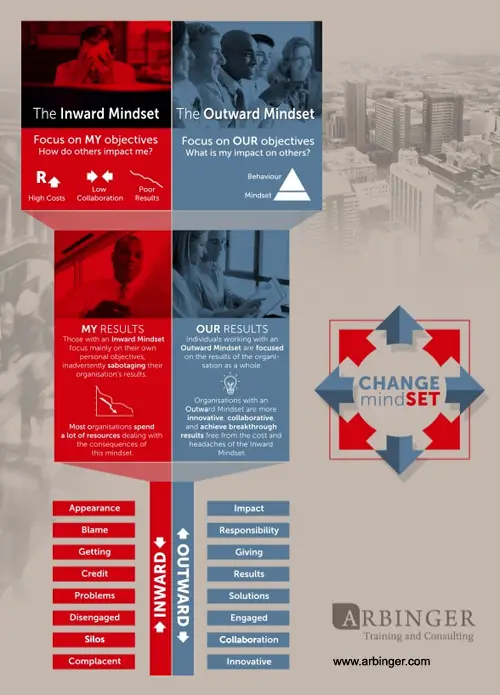 Like us on Instagram and Facebook for additional leadership and personal development ideas.
Posted by Michael McKinney at 03:21 PM
Permalink
| Comments (0)
| Personal Development

J
There is Life After College is a book that every student should read—twice. Frankly, it would hurt those already in the workplace to read it as the ground is shifting under our feet as well.
Employers are looking for T-shaped individuals. The vertical bar represents depth of knowledge and the horizontal bar represents the ability to work across a variety of complex subject areas with ease and confidence. Something a liberal arts education is designed to do.
Selingo notes that too many undergraduates want to be spoon-fed. “They sit back and wait for professors to deliver lessons in the classroom. They participate in campus life but too often from the sidelines, so they lack and deep engagement in activities that provide much-needed skills for the job market. They fail to cultivate relationships with professors or staff on campus who might lend advice or act as mentors. And they are reluctant to chase after experiences—whether undergraduate research, study abroad, or internships—that help them discover their passions and arm them with the interpersonal skills so in demand by employers today.”
Selingo has distilled a lot of wisdom into five often overlapping skills needed to succeed in your career and life. (You see these concepts are appearing more and more in leadership development studies as well.) I’ve listed them here with brief outtakes for each from the chapter. The book provides much more detail and practical career and life advice that is well worth taking the time to consider.
1. Be Curious, Ask Questions, and Be a Learner for Life
The recent graduates who succeed in their careers are flexible about how they learn. “They have ideas and act on them,” said Tim Brown, CEO of IDEO. “Being able to get stuff done is a capacity that is rather important.” Most of all he’s looking for a mind-set with creativity, passion, and empathy at its root. “I want diversity of experiences in college that have exercised their brain,” Brown said.On executive said, “Our industry is changing so fast that we can’t depend on what students already know. We need people who are creative, curious, whose brains are wired to constantly ask what’s next. What we need are learning animals.”
2. Build an Expertise, Take Risks, and Learn the Meaning of Grit
“We see a lot of transferable skills in athletes,” Marie Artim, vice president of talent acquisition at Enterprise, told me. Enterprise is not alone. As employers search for signals that someone is ready for a job beyond achieving the baseline bachelor’s degree, participation in collegiate athletics is seen by many as one clear indicator of commitment and drive in a generation of college graduates often lacking both.The qualities prized in athletes obviously apply to other college activities. Employers told me they value musicians, game designers, and writers in much the same way.
“We want to see that they have a passion, and they show proficiency and go deep in it.” The more time students spend trying to master a skill or a job, the more likely they are to encounter failure. “Our best employees are problem solvers and are able to weave everything they know together—customer service, empathy, persuasive skills, leadership skills, flexibility, and work ethic,” Marie Artim of Enterprise told me. “They can think on their feet.”
Selingo adds, “What is unfortunate is that our desire to protect our kids and fill every waking moment of their schedules with organized activities seems to only worsen as they get older.” So they never find opportunities to take risks and perhaps fail.
Recruiters are looking for applicants who have overcome challenges and learned from their disappointments.
3. Every Job is a Tech Job
Understanding the programming language behind the apps on your iPhone or the basics of artificial intelligence is now seen as basic foundational skills by many employers. Learning to program is much like learning a second language was in the twentieth century: You might not become proficient enough to move overseas, but you could get by if you traveled to a particular country.“It’s more about giving people the skills and tools they learn in the act of coding,” Carol Smith, who oversees Google’s Summer of Code program, told Wired magazine. “It gives them the critical thinking skills that are important whether or not they go into computer science as a profession.”
The generation entering college and the workforce now are often referred to as “digital natives” because they were raised on technology from a very young age. But their relationship has been largely passive: switch on the device and use it. Being digitally aware isn’t about turning more people into computer geeks. It’s about moving from a passive relationship with technology to a more active one—especially in understanding the how and why behind machines, not just the what.
4. Learn to Deal with Ambiguity
“Excelling at any job is about doing the things you weren’t asked to do,” said Mary Egan, founder of Gatheredtable, a Seattle-based start-up, and former senior vice president for strategy and corporate development at Starbucks. “This generation is not as comfortable with figuring out what to do.”The ability to negotiate ambiguity on the job requires people to think contextually, to provide what I call the “connective tissue” that occupies the space in between ideas. It is the “killer app” of today’ workplaces. People who make these connections do so by following their curiosity and exploring and learning from peers. Knowledge is not only what is in our brains, but also what is distributed through our networks. Learning happens by building and navigating those networks.
5. Be Humble and Learn from Your Peers and Mentors
People who manage recent college graduates all had the same complaint about their new hires: they’re too impatient about their careers and unrealistic about their roles within a company. A friend who is my age and a manager at a major media company told me about new graduates who applied for senior roles after less than a year on the job and who were flabbergasted when they didn’t get the promotion, which went to someone with ten or twenty years more experience.
Being socially aware goes beyond knowing your role within the organization. It includes important skill sets like written and verbal communication as well as the ability to deal with negative feedback, speak in public, and, most of all, interact on a basic human level with coworkers and clients that doesn’t involve texting them.
eBay offers classes on managing your personal brand (because graduates usually can’t set goals for themselves), giving an elevator pitch (they often can’t get to their point fast enough), managing your calendar (once again, time management), and performance reviews.
Selingo emphasizes that what you do in college (and therefore what you become—who you are) is typically more important than where you go.
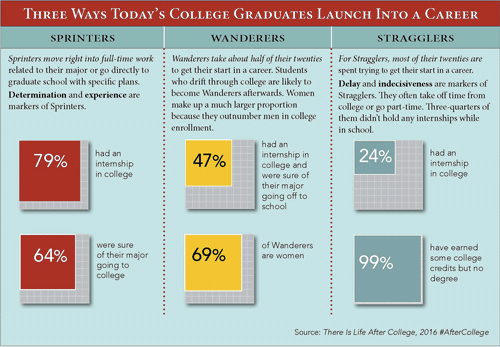 Like us on Instagram and Facebook for additional leadership and personal development ideas.
Posted by Michael McKinney at 12:27 AM
Permalink
| Comments (0)
| Personal Development

HUMILITY casts a wide net and makes possible the work of leadership. Nothing facilitates community, collaboration, and innovation like humility.
In Humility is the New Smart, Ed Hess and Katherine Ludwig define humility as “a mindset about oneself that is open-minded, self-accurate, and not all about me, and that enables one to embrace the world as it is in the pursuit of human excellence.”
Their definition encompasses the mind of a leader that will be able to lead in a changing and uncertain world. Humility is inclusive. It is inclusive of others ideas, others needs, others strengths, other contributions, and the realities that exist outside of our own head. A humble leader asks more questions and is open to more answers thus deepening the pool of resources they have to draw upon. But it requires a strength of character. As senior vice president of the NBA’s Orlando Magic, Pat Williams writes in Humility: The Secret Ingredient of Success:
Additionally,
Humility is the antidote to insecurity that often plagues us. A lack of humility actually drives insecurity. Humility makes your strengths productive and multiplies the strengths of others. Humility acknowledges a world beyond our own thinking and minimizes our own limitations. A good leader knows this and acts accordingly to produce the best results.
Do you have the strength to be humble?
Like us on Instagram and Facebook for additional leadership and personal development ideas.
Posted by Michael McKinney at 10:50 PM
Permalink
| Comments (0)
| Leadership
, Personal Development

YOU'VE NO DOUBT HEARD that it is outside our comfort zone where the magic happens. But how do we get outside our comfort zone? It’s not always easy in some cases too stressful to consider.
Andy Molinsky gives us some practical first steps in Reach: A New Strategy to Help You Step Outside Your Comfort Zone, Rise to the Challenge and Build Confidence.
We often fail to get outside our comfort zone because of the feeling that it’s too big a reach (which is why they’re outside your comfort zone): “It’s not me,” “People won’t like this version of me,” “It’s embarrassing because I’m clearly not good at this,” “Why should I have to do this,” and/or “Maybe this isn’t something I should be doing.” So commonly, we do nothing. We avoid it altogether. Or we only do it half-heartedly. All of these things sabotage our efforts.
So the question to ask yourself is, "If I could erase the anxiety and distress, is it something I’d like to be able to do?"
Molinsky has interviewed and also observed people in many different professions and walks of life. And the stories he includes from managers, executives, priests, baristas, stay-at-home-moms, singers, actors and performers, are helpful and relatable. And although these people are very different, there is a common theme. He has found that those most successful at getting outside of their comfort zones have three things going for them:
Conviction—Making Sure the Gain is Worth the Discomfort
It’s a deep sense of purpose that it’s actually worth it to endure the strain or stress entailed in stepping outside your comfort zone. This is the “why am I doing this?” And that can come from anywhere.
Customization—Designing a Personalized Baby-Step Plan
This is the ability to tweak or adjust in often very slight ways how you perform a task to make it feel more comfortable and natural. When facing difficult situations we often feel powerless, but we can alter situations to play to our strengths. For example, we can change the words we use or the topics we talk about, change our body language, or change the timing or location.
Clarity—Getting Some Perspective on Your Fears
Clarity is the ability to develop an even-handed, reasonable perspective on the challenges you face. “It is an attempt to be as true as possible with ourselves about the situations we’re currently working on, taking a careful inventory of our true feelings—even if we’re embarrassed by them—as well as an inventory of our avoidance strategies.” In other words, to not succumb to the distorted and exaggerated thinking so many of us do in very stressful situations. It may not really be as far outside of our comfort zones as we imagine.
Here are Five Comfort Zone Myths to consider:
Myth #1: All it takes to step outside your comfort zone is taking a leap.
Reality: Very few people spontaneously “leap” outside their comfort zones; rather, that leap is the result of considerable thinking and deliberation.
Myth #2: The “magic” only happens outside your comfort zone.
Reality: The “magic” can happen both inside and outside your comfort zone.
Myth #3: I’m the only one who struggles with situations outside my comfort zone.
Reality: Nearly everyone struggles with situations outside their comfort zones.
Myth #4: Getting out of your comfort zone is just about “sucking it up.”
Reality: “Sucking it up” is important, but so too are other strategies which, in fact, can ultimately make ‘sucking it up’ less necessary.
Myth #5: With enough inspiration, anyone can stretch outside their comfort zone.
Reality: Anyone can do it, but it takes more than inspiration; it takes effort, persistence, strategy, and a keen understanding of the challenges.
Like us on Instagram and Facebook for additional leadership and personal development ideas.
Posted by Michael McKinney at 08:06 AM
Permalink
| Comments (0)
| Personal Development
 IN Thank You for Being Late, journalist Thomas Friedman affirms that we are living in one of the greatest inflection points in history. “The three largest forces on the planet—technology, globalization, and climate change—are all accelerating at once. As a result, so many aspects of our societies, workplaces, and geopolitics are being reshaped and need to be remained.”
As he notes, it more than just change it is reshaping that is taking place. It’s hard for any of us to keep up. “In such a time, opting to pause and reflect, rather than panic or withdraw, is a necessity. It is not a luxury or a distraction—it is a way to increase the odds that you’ll better understand, and engage productively with, the world around you.”
Friedman’s title, Thank You for Being Late, comes from realizing that a guest’s tardiness to a meeting gave him time to just sit and think. And he was better for it. So, “Thank you for being late.”
Thank You for Being Late succeeds in presenting a better understanding of why the world is the way it is. What follows is a small selection of thoughts and analysis of and prescriptions for the world we live in:
☙ As the world becomes more interdependent and complex, it becomes more vital than ever to widen your aperture and to synthesize more perspectives.
☙ Creativity becomes, in part, about asking the best questions.
☙ You can’t just show up. You need a plan to succeed. You have to know more, you have to update what you know more often, and you have to do more creative things with it. Self-motivation is now so much more important.
☙ It is so easy to forget that many, many people in America don’t have a professional network, an alumni network, two parents, or in some cases anyone around them with a job, to consult about how to get one.
☙ In a world of so many choices, it’s hard to know what to do.
☙ Social media is good for collective sharing, but not always so great for collective building; good for collective destruction, but maybe not so good for collective construction; fantastic for generating a flash mob, but not so good at generating a flash consensus on a party platform or a constitution.
☙ Quoting Jeffrey Garten, the former dean of the Yale School of Management: Maybe this is overly romantic, but I think leadership is going to require the ability to come to grips with values and ethics. The more technological we get, the more we need people who have a much broader framework. You’ll be able to hire the technologist to make systems work, but in terms of the goals, that takes a different kind of leader.
☙ A number of technological forces came together to create an exponential step in change in the power of men and machines—much faster than we have been able to reshape our institutions, our laws, and our modes of leadership. Quoting Dov Seidman: Technology creates possibilities for new behaviors and experiences and connection, but it takes human beings to make the behaviors principled, the experiences meaningful and the connections deeper and rooted in shared values and aspirations.
☙ No better source of restraint then a strong community.
☙ It is only when people relax their hearts and their minds that they are open to hear and engage with others, and healthy communities create a context for that.
Like us on Instagram and Facebook for additional leadership and personal development ideas.
Posted by Michael McKinney at 11:07 AM
Permalink
| Comments (0)
| Personal Development
Civility costs nothing, and buys everything.— M. W. Montagu
CIVILITY has a way of winning people over and garnering influence.
Civility isn’t just the absence of incivility. In Mastering Civility, Christine Porath explains that “Civility in the fullest sense requires something more: positive gestures of respect, dignity, courtesy, or kindness that lift people up.”
Incivility impacts our health and performance. It depletes our “immune system, causing cardiovascular disease, cancer, diabetes, and ulcers.” It also robs us of our “cognitive resources, hijacks our performance and creativity, and sidelines us from our work. Even if we want to perform at our best, we can’t, because we’re bothered and preoccupied by the rudeness.”
Incivility is contagious. “When you’re exposed to hostility or aggression, you behave differently. Incivility sneaks into your subconscious. It’s easy to see how plagues of incivility can take shape and spread.” But you don’t have to succumb to incivility. “When you follow a rude experience with a polite one, the polite one ‘overwrites’ the rude one, loosening the hold it has on your mind.”
Civility starts with a few basic behaviors and it grows from there. Simple things like saying please and thank you make a difference in how we are perceived by others and the influence we have on them. “Most of us are in a hurry to prove our competence, but warmth contributes significantly more to others’ evaluations. Warmth is the pathway to influence.”
Other basic behaviors include acknowledging people and listening. They signal caring, commitment and connection. Show respect for others by sharing resources, the limelight, and positive feedback. “The highest performers offer more positive feedback with their peers; in fact, high-performing teams share six times more positive feedback than average teams. Meanwhile, low-performing teams share twice as much negative feedback than average teams.”
What if you are the victim of incivility?
When someone is being uncivil to you it’s easy to let your emotions take over. It’s easy to get sucked in to their incivility. Porath advises you to avoid the temptation to get even. It’s not a win for you.
The best advice has nothing to do with them and everything to do with you. How will you choose to interpret it? Here are a few of her thoughts:
When you experience incivility, your sense of thriving comes into play in a particular way: by making it easier for you to reframe the negativity of the event so that it isn’t nearly as destructive.
What are you going to make this mean? How you interpret the situation is crucial. How much are you going to let someone pull you down? What useful lessons might there be for you in the situation?
Science reveals that about 50m percent of our happiness is based on brain wiring; 40 percent is owed to how we interpret and respond to what happens to us, and 10 percent is driven by our circumstances.
In large part, you really do get to decide how you interpret incivility, the meaning you assign to it, and the stories you tell yourself. You also get to control whether it makes you feel bad or not. It may not be realistic for you to “toughen up,” but you can choose not to worry about what was said or done to you.”
Everyone would agree that we should be civil and we recoil when we see others engaged in it, yet incivility has become more commonplace. Somehow we feel justified being uncivil when things don’t go our way. And it costs us all.
Uncivil behavior does not generate greater influence no matter how loud you are. Most leadership failures can be attributed to abrasive or arrogant approaches to others. Uncivil leaders eventually undermine their own potential.
Are you civil? Porath offers a quick civility assessment online.
Like us on Instagram and Facebook for additional leadership and personal development ideas.

Posted by Michael McKinney at 08:44 AM
Permalink
| Comments (0)
| Human Resources
, Personal Development

TOM ASACKER always makes you think.
Life is not scripted but we live it as though it were. In doing so, we create boxes that we operate within without ever really seeing the possibilities. “We’re confined in mental prisons of our own creation.”
We make these scripts up or others make them up for us and eventually we come to believe them. And the problem is we think that is reality. It’s that story inside our head that keeps us from flourishing as we should—a life that moves us. We are sabotaging ourselves.
We act more like Coleridge and less like Keats. In I Am Keats, Asacker develops a metaphor for two worldviews as expressed through the poetry of two 19th century poets: Coleridge and Keats.
Keats was passionate. He was moved by his senses and imagination. Capable of being in uncertainties, mysteries and doubts, he was uninhibited, open, and without judgment.
We are conditioned – perhaps predisposed – to live in Coleridge’s worldview. Coleridge wants to predict an unknowable future. He is logic, order, control and progress. Coleridge wants you to live a productive and mistake-free life. “He is an expert craftsman, skilled in the rights and wrongs of the world, and turned on by the desire for risk aversion, accumulation and conformity.”
Neither is right or wrong but we need to be aware of the dynamic between the two or we never really live. We never see the possibilities. Knowing is safe. Being is frightening – “a dynamic dance with reality.”
But we are held captive by our beliefs—what we believe to be reality. “Here’s the thing about our beliefs. We don’t want them pointed out to us. We don’t want to have our soothing stories interrupted. We don’t want to be woken up from our script, from our reassuring routines. Otherwise, we’ll have to think. And then, heaven forbid, we may have to change.
Asacker writes, “Let go of your incessant desire to know, to predict and influence, and instead be willing to experience the mystery of the present without corrupting it with questions.”
When you allow yourself to become more like Keats, “you find yourself being pulled deeper and deeper into a process that creates serendipitous connections and refines your perceptions. Your old eyes adjust to a new world, and you become more creative and discerning.”
Experience the moment. “Your present creates the meaning of your past.”
I Am Keats is a book for our times. It is a philosophy says Asacker. “Magic, then logic. Heart, then head.” Try it.
More at: IAmKeats.com
Like us on Instagram and Facebook for additional leadership and personal development ideas.
Posted by Michael McKinney at 08:33 AM
Permalink
| Comments (0)
| Personal Development

 Like us on Instagram and Facebook for additional leadership and personal development ideas.

Posted by Michael McKinney at 09:24 AM
Permalink
| Comments (0)
| Personal Development

WE KNOW GRATITUDE makes relationships thrive and makes trust possible. Gratitude encourages, clarifies, motivates, includes, and unifies.
When we show gratitude, people feel valued, they know what’s important, they want to do more, and they feel part of something bigger than themselves.
But gratitude is good for you too.
Gratitude puts you in the right mindset to lead. Gratitude and humility are interconnected. They reinforce each other. Gratitude says, “I didn’t do this alone.” French philosopher Andre Comte-Sponville wrote, The narcissistic leader or “the egoist is ungrateful because he doesn’t like to acknowledge his debt to others and gratitude is this acknowledgement.” A lack of gratitude is at the core of narcissism. We alone are not responsible for who we are and what we do and that is the essence of leadership. We are never truly self-sufficient.
In a practical way, gratitude provides guardrails in our life. Gratitude helps us to protect from ourselves. It is amazing how much gratitude plays into avoiding poor behavior and wrong thinking. Gratitude sets a boundary on our thoughts by making us mindful of others. It helps us to avoid going where we should not go because we are more self-aware.
Gratitude requires that we slow down and reflect. Gratitude is the basis of emotional intelligence. It puts other people first. It says you know and you care. While empathy has been found to be essential to leadership, empathy is not empathy if it is silent. It must be expressed.
Gratefulness helps to curb unproductive emotions such as frustration, resentment, and revenge. Studies have shown that it is an antidote to depression. It has the power to heal and move us forward.
It improves relationships and is a remedy to envy and greed. Instead of trying to strive with others we are thankful for what they do. It eliminates a leader’s tendency towards entitlement. Grateful people find more meaning in life and feel more connected to others.
In these changing and uncertain times, gratitude is a leaders ally. Gratitude looks at the long term and doesn’t focus on the present situation. Life is a continuum. Gratitude allows a leader to appreciate where they are and the resources they have at their disposal to face what life throws at them. A habit of gratitude gives us perspective. It doesn’t blind us to the negative but it facilitates a solution.
Gratitude can’t just be something we do is has to be who we are as a leader. More than a behavior it must come from the heart. It must be the mindset we lead from, manage from, and make decisions from. Gratefulness is grounded in reality because ultimately we must realize that everything good in our life is a gift.
Leadership begins and ends with gratefulness.
Like us on Instagram and Facebook for additional leadership and personal development ideas.
Posted by Michael McKinney at 11:34 AM
Permalink
| Comments (0)
| Leadership Development
, Personal Development
Great leaders appreciate every job that is done well; it doesn’t matter whether it’s in the C-suite or the mailroom. Great leaders also understand that respect isn’t an entitlement linked to a particular job title. They need to respect others before others will respect them.
So, how do you earn respect in business? Here are 10 ways:
Like us on Instagram and Facebook for additional leadership and personal development ideas.

Posted by Michael McKinney at 02:51 PM
Permalink
| Comments (0)
| Personal Development
TO THRIVE IN the new economy—the current information economy—you need to master these two core abilities:
These two abilities depend on your ability to perform deep work.
Cal Newport bases his book Deep Work on the Deep Work Hypothesis: The ability to perform deep work is becoming increasingly rare at exactly the same time it is becoming increasingly valuable in our economy. As a consequence, the few who cultivate this skill, and then make it the core of their working life, will thrive.
Learning is an act of deep work. An act of intense focus. “To produce at a peak level you need to work for extended periods with full concentration on a single task free from distraction.”
The reason deep work is rare is that we encourage distractions by the way we design our life. “An interruption, even if short, delays the total time required to complete a task by a significant fraction.” Deep work is not a priority. We are what we focus on and that is increasingly, the superficial.
Shallow work adds to our sense of meaninglessness. Science writer Winifred Gallagher observed that “when you lose focus, your mind tends to fix on what could be wrong with your life instead of what’s right.” Newport adds: “A workday driven by the shallow, from a neurological perspective, is likely to be a draining and upsetting day, even if most of the shallow things that capture your attention seem harmless or fun.”
To fight the drift into the superficial we need to cultivate some strategies to develop a deep work habit. Here are a few Newport suggests:
Find Your Deep Work Philosophy
Newport describes four approaches to making time for deep work. There is the Monastic approach that eliminates or radically minimizes shallow obligations. The Bimodal approach that suggests binging on deep work for various lengths of time. The Rhythmic approach makes deep work a habit by scheduling a regular chain of deep work in your day. The last approach and the one Newport prefers, is called the Journalistic approach. Using this approach you fit deep work wherever you can into your schedule. This last approach, however, requires a great deal of willpower and practice. The Rhythmic approach may work best to get you started.
Take Breaks from Focus
Make deep work a priority by taking breaks from focus, not from distraction. “The idea motivating this strategy is that use of a distracting service does not, by itself, reduce your brain’s ability to focus. It’s instead, the constant switching from low-stimuli/high-value activities to high-stimuli/low-value activities, at the slightest hint of boredom or cognitive challenge, that teaches your mind to never tolerate an absence of novelty.”
Quit Social Media
Network tools such as Facebook, Twitter, Instagram and infotainment sites like Business Insider and Buzzfeed, “fragment our time and reduce our ability to concentrate.” The overuse of social media unwittingly cripples our ability to succeed in the world of knowledge work. “To master the art of deep work, therefore, you must take back control of your time and attention from the many diversions that attempt to steal them.” Newport recommends that we only use a tool if its positive impact on the core factors that determine our success and happiness, substantially outweigh it negative impacts.
If you give your mind something meaningful to do throughout all your waking hours, you’ll end the day more fulfilled, and begin the next one more relaxed, than if you instead allow your mind to bathe for hours in semiconscious and unstructured Web surfing.
Be Intentional with Your Time
Have a plan for your day. Confine the shallow work you must do, don’t eliminate it. If you start your day with blocks of deep work scheduled in, you stand a much better chance of actually getting some deep work done. “Your goal is not to stick to a given schedule at all costs; it’s instead to maintain, at all times, a thoughtful say in what you’re doing with your time going forward—even if those decisions are reworked again and again as the day unfolds.”
“To succeed,” writes Newport, “you have to produce the absolute best stuff you’re capable of producing—a task that requires depth. A deep life is a good life.”
Like us on Instagram and Facebook for additional leadership and personal development ideas.
Posted by Michael McKinney at 08:54 AM
Permalink
| Comments (0)
| Personal Development

AS A TWENTY-SOMETHING, Paul Sohn said his life looked so good on paper. But a growing feeling of disappointment overwhelmed him. He wondered, “Is this all there is?”
He was experiencing a quarter-life crisis.

Fear and Anxiety: Instead of enjoying where you are at you allow the uncertainty of the world around you to overwhelm you with stress and a sense of trepidation.
The Choice Overload: We allow the choice we have to paralyze us. This is brought on “by a recent phenomenon called FOMO (Fear of Missing Out). Twentysomethings live in a 24/7 plugged-in culture. We live in an era where we are accosted by the incessant meals, vacations, parties, and sheer awesomeness people are experiencing—thanks to Facebook, Twitter, and Instagram. According to a new study by Eventbrite, 69 percent of millennials experience FOMO when they can’t attend something that their family or friends are going to.”
Too Busy to Slow Down: Are we doing the things we really should be doing? We are overscheduled, overworked and overcommitted.
The Obsessive Comparison Disorder: We can always find people who are doing better than us and we want what everyone else has. ‘Millennial expert Paul Angone calls this Obsessive Comparison Disorder (OCD). He says, “OCD is the smallpox of our generation.” This is an epidemic that is producing unwanted thoughts and feelings, driving us into depression, consumption, anxiety, and all-around discontent. The grass is not always greener on the other side.
The YOLO/FOMO Generation: You only live once. It’s easy to get stuck in the moment. Social media encourages this thinking and the resulting drift into instant gratification and self-absorption.
Paul Sohn is talking to twenty-somethings but we all can learn from his experience. The context changes but the principles are the same.
The answer is to find your sweet spot—that place where you are living out your calling. Sohn says it is found at the intersection of your personality (who you are wired to be), gifts (that which you are naturally gifted in), passions (that which ignites a fire in your soul), and life story (what doors have opened and closed in your life). It is here that you will find your purpose that will lead you to a meaningful life.
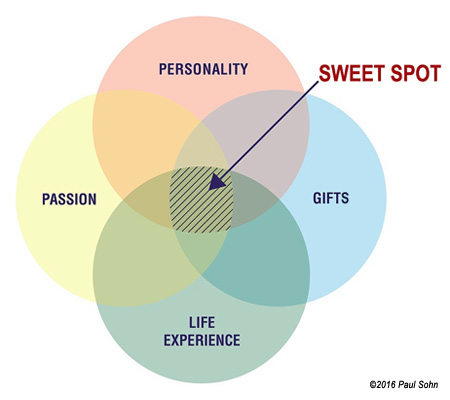
In a noisy world it is hard to slow down enough to know yourself. Finding your sweet-spot begins with getting outside of yourself—seeing yourself from another perspective. A meaningful life comes from something outside yourself. Sohn found that in the Bible. It allowed him to integrate his life around a concept outside of his present. It makes all the difference.
For twenty-somethings, Sohn says the key is to start well. Start early.
As a clinical psychologist who specializes in twentysomethings, Meg Jay [author of Defining Decade] has observed how twentysomethings have considered this time as a throwaway decade, paying the price, professionally, personally, spiritually, and economically later in life. This is the biggest myth out there. No more procrastination. No more wasting away your time, talent, and treasure believing you can make it up later in life.
Keep learning. Find mentors. Life isn’t meant to be a rat-race. You were meant to flourish. Begin today.
Like us on Instagram and Facebook for additional leadership and personal development ideas.
Posted by Michael McKinney at 10:33 PM
Permalink
| Comments (0)
| Personal Development
 Like us on Instagram and Facebook for additional leadership and personal development ideas.
Posted by Michael McKinney at 05:22 PM
Permalink
| Comments (0)
| Personal Development

The majority of people are not aware of their social awkwardness and give little time to thinking about what gear the other person is in while they are talking.What I like most about the 5 Gears model is first, it gives you language to communicate which gear you are in to yourself and others, and to understand where others are at so that you can be more fully present. Second, it helps you plan what gear you need to be in as you move through your day. And third, it helps to be more self-aware and other-aware.
When a person’s agenda is the driving force of their life, then they are going to run over people most of the time unless they learn to use their brakes and downshift.
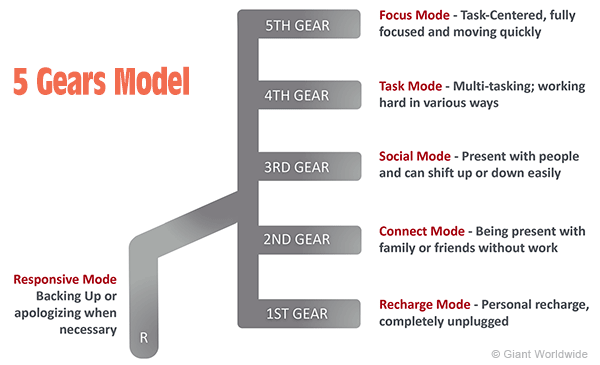
 5th Gear: Learn to Get "In the Zone"
 4th Gear: Leading in a Task World
The personal story for me was realizing that as a woman I have “work” 4th and 5th gear and “domestic” 4th and 5th gear. I thought that because I was being disciplined about putting my devices away during the golden family window of 5 to 8 P.M. I wasn’t in 4th or 5th gear, when in reality I was just putting on a different task hat. When my eyes were opened to that, I realized that I actually have little to no 3rd or 1st gear in my life at all. That was shocking.In other words, the other gears are not just another 4th Gear task. Each Gear requires a different mindset or approach to your time. If we learn to implement the other gears in our life we will find that our everyday, multitasking 4th gear will become more productive.
 3rd Gear: Why Being Social Matters
 2nd Gear: Connecting Deeply
 1st Gear: Learn How To Recharge
 Reverse: Learn How to Apologize
There are two types of people—responsive and resistant. You hire responsive ones and fire the resistant. Responsive people are self-aware and have a consciousness that is not steeped in victim mentality, but rather responsibility. They understand that they are responsible for their actions and will make amends when they have clearly overstepped their bounds. Responsive people are the best employees, and spouses, and children.Are there any relationships you need to restore?
Resistant people, on the other hand, are exhausting. Resistance is basically pride. Resistance will fight rather than resolve, blame rather than admit, and run away rather than run toward reconciliation.
6A.M.—Wake Time: 1st Gear
7A.M.—Drive Time: 1st or 4th Gear
8A.M.—Work Time: 4th or 5th Gear
12 Noon—Lunchtime: 3rd or 1st Gear
1P.M.—Work Time: 4th or 5th Gear
5P.M.—Drive Time: 4th or 1st Gear
6P.M.—Dinner Time: 2nd or 3rd Gear
8P.M.—Social Time: 3rd or 2nd or 1st Gear
10P.M.—Bedtime: 1st Gear
Like us on Instagram and Facebook for additional leadership and personal development ideas.
Posted by Michael McKinney at 11:28 AM
Permalink
| Comments (0)
| Human Resources
, Personal Development
NO MATTER HOW HARD WE TRY, our environment affects us in powerful, insidious, and mysterious ways. Our environment triggers behaviors or responses in us.

We can’t control our environment, but we can control our responses. We always have a choice.
When it comes to interpersonal behavior we can’t rely on habits to help us. “We must be adaptable, not habitual—because the stakes are so much higher.” We need something more to help us deal with the uncertainty of our day.
When it comes to triggers, it’s not the big triggers that usually do us in, it is the little moments in life that trigger our most outsized and unproductive responses. They trigger some of our basest impulses. Especially with the people we know and love the most. “We can say and do anything with these folks. They know us. They’ll forgive us. We don’t have to edit ourselves. We can be true to our impulses. That’s how our closes relationships often become trigger festivals with consequences that we rarely see in any other part of our lives—the fuming and shouting, the fights and slammed doors, the angry departures and refusals to talk to each other for months, years, decades.”
So where the problem is most vivid is in the small, minor moments of the day, when we are not thinking about our environment or our behavior. That’s when we need to be most vigilant.
Sometimes the best strategy is to avoid the trigger altogether. Stop flirting with those things that tempt you. Goldsmith says that one of the most common behavioral issues among leaders is “succumbing to the temptation to exercise power when they would be better off showing restraint.” And that behavior is very hard to eliminate because those who engage in it because they no doubt enjoy doing it.
But we can’t always walk away.
SOLUTION
The solution then isn’t trying to fix the environment or the behavior of others, the solution is to change our behavior. When we are triggered we need to adjust.
Goldsmith has found that asking yourself some active questions works magic. Active questions get to personal responsibility—something you have control over. Goldsmith suggests six engaging questions anyone should be asking themselves each day to build engagement:
Did I do my best to set clear goals today?
Did I do my best to make progress toward my goals today?
Did I do my best to find meaning today?
Did I do my best to be happy today?
Did I do my best to build positive relationships today?
Did I do my best to be fully engaged today?
In addition, Goldsmith has a number of other Daily Questions he asks himself to gauge whether he had taken responsibility for his own life. Our own questions would reflect those things that we want to work on—will success on these items help me become the person I want to be?
Did I do my best to have a healthy diet?
Did I do my best to be a good spouse?
Did I do my best to add value to ______?
Did I do my best to learn something new?
Did I do my best to get a good night’s sleep?
Did I do my best to not prove how right I am when it’s not really worth it?
You score yourself on a scale from 1 to 10 to track your progress or the lack of it. “One of the underappreciated benefits of the Daily Questions is that they force us to quantify an unfamiliar data point: Our level of trying. We rarely do that.”
Daily Questions remind us that success is the result of small efforts repeated consistently over time. Daily Questions can be a game changer because they reinforce our commitment, they ignite our motivation where we need it and not where we don’t, and they shrink our goals into manageable increments.
OUR NEED FOR STRUCTURE
The Daily Questions provide structure in our lives. Simply put, Goldsmith says: “We do not get better without structure.” Like rules, structure pushes us in the right direction when our first impulse is to go the other way.
Goldsmith has work with Alan Mulally and finds that “no idea looms bigger in Alan’s mind than the importance of structure in turning around and organization and its people.” Goldsmith explains how Mulally integrated the Daily Questions process in his weekly Business Plan Review meetings with his sixteen top executives. And repetition was key. “In the same way that Daily Questions drive us to measure our effort every day and then face the reality of our own behavior, the executives would be announcing how they graded themselves every Thursday—without deviation.” And in the group setting the idea was: How can we help one another more?
Structure “limits our options so that we’re not thrown off course by externalities….Imposing structure on parts of our day is how we seize control of our otherwise unruly environment.”
Goldsmith points out that after a hard, decision-filled day we become depleted. Our discipline and decisiveness fade at the end of the day to the point where we want to do nothing or fill our time with mindless activities.
Deletion isn’t something that we are always aware of but we should anticipate it and create structure where we can. “If we provide ourselves with enough structure, we don’t need discipline. The structure provides it for us. We can’t structure everything obviously—no environment is that cooperative.” But the more structure we have the less we have to worry about.
ANTICIPATE
When you know you are headed into a pointless meeting, imagine that you are going to be tested on your behavior:
Did I do my best to be happy?
Did I do my best to find meaning?
Did I do my best to build positive relationships?
Did I do my best to be fully engaged?
Sometimes we think we have to show everyone how we feel but that’s ego talking. “Why waste that hour being disengaged and cynical?” asks Goldsmith.
It’s in the moment that we shape ourselves into a better person. Sometimes hourly questions might help. When we face an event were not up for or a person that usually throws us off our game, why not try setting our Smartphone to ask us a question like, “Am I doing my best to…?”
THE BEST PART
What I like best about Triggers is that by creating an awareness of our environment and identifying our own triggers we can be a force for adding value in other people’s lives by triggering something good in others. It requires our imagination and clarity about what we want to become.
When we dive all the way into adult behavioral change—with 100 percent focus and energy—we become an irresistible force rather than the proverbial immovable object. We begin to change our environment rather than be hanged by it. The people around us sense this. We have become the trigger.
Follow us on Instagram and Twitter for additional leadership and personal development ideas.


Posted by Michael McKinney at 12:19 AM
Permalink
| Comments (0)
| Personal Development
AS WE navigate through life, we must be able to cooperate and compete. Knowing what to do when is very important to getting where you want to go and to where you want to go next time.
In Friend and Foe, authors Adam Galinsky and Maurice Schweitzer state that all of our relationships are both cooperative and competitive and we get more out of life when we learn to find the right balance between acting as a friend and acting as a foe.
Drawing on interdisciplinary studies, they show how to manage social comparisons (We crave comparisons because we like to know how we’re doing compared to the people around us.), get and keep power, how to get others to put their trust in you and what to do when you lose it, the art of seeking another perspective, negotiating, when it’s best to go last and when it’s best to go first, and finishing every interaction well.
When it comes to power, it’s not so much how powerful we are, but how powerful we feel that determines how we think and act. Whether you have it or feel it, power makes us more focused on our own vantage point and oblivious to the perspective of others. The key to keeping our power is being able to see the world through the perspectives of others.
There is an acceptable range of power that you can display relative to your actual power. Exceed it, and you will be ostracized. You also need to find the right balance between being confident and deferential. It’s usually a lack of deference rather than an excess of confidence that gets powerful people into trouble.
Interestingly, they say we crave hierarchy because it helps to manage the tension between cooperation and in competition.
Hierarchy provides a means for solving the question of how we distribute scarce resources. It also facilitates coordination. Studies demonstrate that co-leadership usually doesn’t work. “Co-leadership can kill both ideas and people, because it creates uncertainty over who is really in charge. Of course, co-led teams are not always ineffective and dangerous. But when there is not clear division of labor among these leaders, coordination becomes difficult, patterns of deference can disappear, and conflict can erupt.”
Hierarchy is less useful the more human the task or the more cognitively complex—more thought than any one person can attend to. Why? “Because to make the best complex decisions, we need to tap ideas from all the rungs of the hierarchical ladder and learn from everyone who has relevant knowledge to share.” Steve Jobs said, “You have to run by ideas, not hierarchy.”
But here is an interesting find. When over 30,000 Himalayan mountain climbers were analyzed, they found that members of expeditions from more hierarchical countries were more likely to die on the expedition because in countries and cultures that are hierarchical, decision-making tends to be a top-down process. These expedition members are less likely to speak up and less likely to alert leaders to changing conditions and impending problems.
They say that asking for advice does more than turn adversaries into advocates. “It can also help you supercharge your advocates and lead them to help you climb up the corporate ladder.” And when you don’t take their advice, you need to explain that even though you didn’t take their advice, it gave you a unique perspective and insight that led to your success. Always follow up with your advice-givers.
Friend and Foe is a very interesting read and full of useful advice and insights to help you get along and get ahead. It will go a long way to developing the awareness that is essential to leadership.
No matter what happens, if your interaction ends well, people will tend to remember it well. More importantly, it sets the stage for anything that comes next.
Follow us on Instagram and Twitter for additional leadership and personal development ideas.
Posted by Michael McKinney at 07:42 AM
Permalink
| Comments (0)
| Personal Development
 Like us on Facebook for additional leadership and personal development ideas.
Posted by Michael McKinney at 10:54 PM
Permalink
| Comments (0)
| Personal Development
 Like us on Facebook for additional leadership and personal development ideas.
Posted by Michael McKinney at 01:57 AM
Permalink
| Comments (0)
| Personal Development
We market and sell ourselves in the ways we present ourselves to the world, which are based on what we see as our personal strengths or limitations. We distribute ourselves in the ways we choose to spend our time and where we focus our energies. When viewed from this framework, the process of self-transformation becomes approachable: you need only analyze each link in your internal value chain and find the single link that’s holding you back. Then make changes to that link to disrupt yourself.Finally, distribution is how we spend your time and where we direct our focus. Do I devote my time and energy to achieving my dreams, or am I surfing the Internet every evening? Our time and energy is a valuable resource, we must distribute it wisely.
Like us on Instagram and Facebook for additional leadership and personal development ideas.
Posted by Michael McKinney at 06:17 AM
Permalink
| Comments (0)
| Personal Development

BERNARD ROTH, one of the founders of the multi-disciplinary d.school at Stanford University, has written a book titled, The Achievement Habit. However, it is much more than the title might let on.
It’s about how you can achieve your goals more fully and faster by expanding your limited view of reality. It’s about design thinking applied to every aspect of your life. It’s about assisting us to break through the walls that are mostly of our own making.
You Give Everything Its Meaning
Roth begins by reminding us that nothing has any meaning except for the meaning that we give it. “Stop labeling things in their usual way. Make the familiar into the unfamiliar, and the result can be amazing and delightful, as opposed to dull, nonfunctional, and ordinary.” Along these same lines, this applies to our need to be right. “Next time you find yourself playing right and wrong, remember: You give everything in your life its meaning, so you can choose to end the game. It does not matter how right you are or how wrong they are; you lose just by playing.” You have the power to change your attitude and therefore, how you will play the game.
Reasons Are Excuses
And then there are all the reasons we have for why something is or isn’t happening. They’re really just excuses prettied up says Roth. He was chronically late until he decided to stop coming up with reasons and deal with the real issue. Here’s the key point: We use reasons “to hide shortcomings from ourselves. When we stop using reasons to justify ourselves, we increase our chances of changing behavior, gaining a realistic self-image, and living a more satisfying and productive life.” In other words, we take responsibility for our life.
We often get stuck because we are working on the wrong issue. We have some faulty assumptions. “Experience has shown me that one of the main causes of losing sleep over a problem is that we think we are dealing with a question when in fact we are dealing with an answer (a solution) that turns out not to be a good fit to our actual problem.” Letting go of the problem is often the best solution. Roth shows you how to rework your question to find the actual issue.
At the d.school there is a bias toward action. Failure is part of the expected result. In reaching our goals we also need to watch our language because it influences the way we see things (and the way others see us too). The word but creates conflict. Using the word and opens up the conversation. Change “I have to” to “I want to.” It clarifies the fact that we have a choice in the matter.
Don’t Interrupt
Here’s a ego taxing communication tip: Don’t interrupt. “Many people interrupt because they have something that they are afraid they might forget or that it will not be relevant later. The best thing to do is to let it go. If it is still appropriate at the end, say it then. If it gets lost and remains unspoken—no matter how brilliant it would have been—the world will not notice.”
Flat Organization
Roth describes the flat organization of the d.school over the last forty years. Why and how it works. With a common goal and purpose, I think what Roth describes is possible: “We operated by consensus and negotiation, almost never voting on anything. There was almost no acrimony, and people treated each other with respect, collegiality, and a spirit of shared purpose and commitment.” “We were all in charge, and we wanted to make it work.” If you can overcome your biases, “you might find a management structure that strongly supports what you want to accomplish.”
Many more topics from designing workspaces to self-image are discussed. All of it valuable. Each concept is followed by a “Your Turn” section to give you tools and techniques to apply these ideas to your own situation.
When you hold yourself in high esteem and keep a positive outlook on your future, others will usually follow suit. By choosing the meaning we give to people and things in our environment, ultimately we control our own experiences, no matter what work we are doing.
|
|
Like us on Instagram and Facebook for additional leadership and personal development ideas.
Posted by Michael McKinney at 09:44 PM
Permalink
| Comments (0)
| Creativity & Innovation
, Personal Development
Posted by Michael McKinney at 01:41 PM
Permalink
| Comments (0)
| Personal Development

WE LIVE in an age where wisdom is only wisdom if it is supported by numbers.
There are two obvious problems with this. First, we miss a lot because we are looking for immediate return. And so it puts our focus on the wrong things. And secondly, as a result, we tend to assign value to things in terms of numbers. It is assumed that if it gives us the best numbers, it must be the best choice or behavior. Nevertheless, it is satisfying when the numbers do add up.
In Return on Character, Fred Kiel has put numbers to the notion that good leadership aimed at promoting the common good, not just individual, winner-take-all acquisition can be good business.
In a seven-year study of 121 CEOs, they found that highly principled CEOs—Virtuoso CEOs—achieved nearly five times the return on assets that leaders whose character scores were the lowest—Self-Focused CEOs—in the study. Also encouraging is the fact that people demonstrate character through habitual behaviors and therefore, anyone can learn habits of good character an unlearn habits of poor character.
Character is defined in this study as “an individual’s unique combination of internalized beliefs and moral habits that motivate and shape how that individual relates to others.” Our character is what we believe. Despite what we say. Our leadership is what we do for (or to) others as a result of what we believe.
To assess character traits Kiel defined four keystone character traits that supported that definition: integrity (telling the truth, acting consistently), responsibility (admitting mistakes, concern for common good), forgiveness (letting go of mistakes of others and ourselves, focusing on what’s right) and compassion (empathizing with and empowering others, caring for others, committed to others’ development).
Not surprisingly, self-awareness is a key issue in character development. The Virtuoso leaders rated themselves quite accurately. However, the Self-Focused leaders rated themselves as high as the Virtuoso leaders. Clearly, we have issues seeing ourselves as we are.
Perhaps the most important fact revealed by these interviews was whether the leaders knew their life story. Could they provide a coherent narrative about their past, touching on a number of major events, both positive and negative, and including a reasonable description of the effect those events had on their personal development?
The Self-focused leaders seem to have had very little opportunity to construct a meaningful platform of beliefs or principles.
As a result, they lack the foundation of supportive relationships, character habits, self-awareness, and mental complexity upon which to build the kind of character-driven leadership that reliably contributes to sound decision-making and strong, sustainable business results.
Virtuoso leaders also had the disciplined decision-making skills that resulted in clearer organizational vision, more focused strategies, a higher-performing executive team, and a stronger culture of accountability.
The good news is we can all improve our character—even Virtuoso leaders. Kiel outlines six steps in the personal change process. Step one is probably the most difficult and the key to the whole process.
Step 1: Acknowledge Invitations to Change. “Being confronted with an undeniable truth about the way others perceive our behavior and character is a gift.”And that usually doesn’t come in the form we would want it. (If there is such a way!) “No matter what their source, all invitations to change share one thing in common: they make you aware that your current understanding of the world is inadequate, that you have encountered the limits of your level of personal integration. Your existing worldview, your level of mental complexity, or your ability to act in a way that reflects your core values and principles is no longer working, and you have to find a new way forward.”
Step 2: Discover What You Want to Change. Understanding exactly what habit you need to change is not always apparent. It requires some self-examination and, quite possibly, some outside help for some additional feedback.
Step 3: Find the Fuel for Change. The resolve to make changes is made easier if you connect it to a visionary goal. “I want to be thought of as…” What result do you desire?
Step 4: Identify the Keystone Change. What change will contribute the most to your character development? Often a single new habit will bring about other positive character adjustments.
Step 5: Disarm Your Security System. Any change will make you uncomfortable. You have to be okay with that. Disarming your brain’s instinctive resistance to change “requires that you face the assumptions that rigger your unwanted responses and behaviors and the true outcomes they produce for you.” Create an action plan. “I will do this when…” This helps you to avoid your automatic responses you are trying to change.
Step 6: Rewire Your Brain. As your new patterns of behavior seem secure, celebrate your progress.
It is not easy to become a Virtuoso leader in a world looking for loopholes. But Return on Character demonstrates that the payoff is there.
Follow us on Instagram and Twitter for additional leadership and personal development ideas.
Posted by Michael McKinney at 01:00 PM
Permalink
| Comments (0)
| Personal Development

SELF-MADE billionaires think differently than most of us do.
Most of us think like what authors John Sviokla and Mitch Cohen call Performers because their success is tracked through performance. They excel at optimizing within known systems. They strive to excel in well-defined areas, and are important to any organization – in fact, they are important to the self-made billionaire.
Self-made billionaires have what the authors call the Producer mind-set. They thrive in uncertainty. Producers are critical to any company looking to create massive value because they redefine what’s possible, rather than simply meeting preexisting goals and standards. Combining sound judgment with imaginative vision, Producers think up entirely new products, services, strategies, and business models.

Self-made billionaires are able to integrate ideas and actions that most individuals and organizations keep separate or even hold in direct tension to one another. Self-made billionaires effectively operate in a world of dualities—they seamlessly hold on to multiple ideas, multiple perspectives, and multiple scales. Here are the five critical dualities that they observed with additional thoughts on each:
Empathetic Imagination
Producers billion-dollar ideas come through the marriage of extreme empathy for the customer’s needs and wants, and an imaginative mind-set that allows him or her to come up with and explore new, untested ideas.
Focusing on the competencies of today is exactly what causes companies to get stuck in the markets they serve and the products they deliver now, with little eye for the shifts and innovation they will need for tomorrow. Sometimes it takes a slight twist in perspective to see opportunities through a different lens.
Steve Case said that his experience at Williams College—a top liberal arts college—was a kind of laboratory for imaginative thinking. “Liberal arts education is important particularly in a world that’s changing rapidly, because there is a lot of fluidity. There’s the melding of different perspectives, having a sense of things and having a sense of how to learn about things and to look for connections.”
Patient Urgency
Producers urgently prepare to seize an opportunity but patiently wait for that opportunity to fully emerge.
Producers are willing to operate simultaneously at multiple speeds and time frames.
Patient time spent waiting for an idea to mature is not the same as idle time. They’ll wait for the time to be right, but they will prepare relentlessly so that they are ready to jump on the opportunity when it arrives.
They don’t go off track planning for the next stage before they have capitalized on the present.
Inventive Execution
Producers approach execution of their ideas with the same integrative, inventive mind-set they applied to come up with a billion-dollar idea in the first place. Inventive freedom allows them to design aspects of the customer experience that outsiders consider fixed, thus unlocking new value.
Producers frequently operate in markets that require them to rethink the fundamentals of product or business design in order to deliver at scale.
Taking a Relative View of Risk
Self-made billionaires are not huge risk-takers. Their perceptions of risks are relative: they are far less concerned about losing what they have than of not being part of a bigger future.
What Producers are not willing to risk is the chance to capture an opportunity. This dynamic creates a critical duality between the right kind of risk and the resilience needed to do it all over again when the original plan doesn’t work out.
They invest bog, but they often have a parallel spring of income or safe source of cash they can count on to keep them solvent while they work the more exciting high-stakes opportunities.
Leadership Partnership
Producer overwhelmingly do not go it alone. Creating billions in value requires both a master Producer, who can bring together divergent ideas and resources into a blockbuster product design, and a virtuoso Performer, who can apply his or her creative acumen to optimizing the potential of that design.
Creating billions in value requires both: the Producer’s ability to bring together divergent ideas and resources into a blockbuster concept and inventive design, and the Performer’s ability to follow through on details needed to make the business work.
Why don’t organizations hold on to extraordinarily talented people? These Producers?
Here’s the thing: while we can all get behind these attitudes of mind, organizationally we don’t generally reward these traits. We recognize and reward Performers. They get the raises and promotions largely because they're easy to recognize. They fit in; they can hit the ground running. Producers on the other hand don’t always fit because they think differently from those around them. “The ideas they propose move against the standard approach you are following, and that friction is what you need to achieve breakthrough value.” That makes us uncomfortable. As a result, we tend to drive Producers away or cause them to just give up.
We need both types, but when looking for new employees we need to look for more people whose background hints at looking at things differently. People who have started something new. People with the raw imagination to see something new and the fortitude necessary to work through the difficulty of execution.
“The key imperative for management is to differentiate between opportunities that need a Performer and those that need a Producer. Look at areas of achievement for the business and at who did the work. When it is a Producer, recognize that and give that Producer her next Producer-appropriate challenge.”
As leaders we need to accept both Producers and Performers and reject neither. We need to find and support positive deviance while promoting for systematic improvement.
Like us on Instagram and Facebook for additional leadership and personal development ideas.
Posted by Michael McKinney at 11:30 PM
Permalink
| Comments (0)
| Human Resources
, Management
, Personal Development
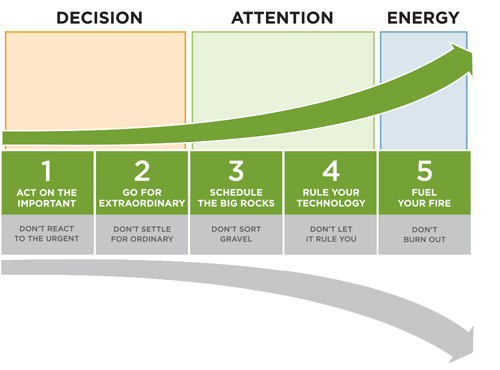 Choice 1: Act on the Important, Don’t React to the Urgent
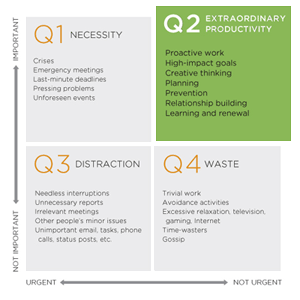 Q1: The Quadrant of Necessity. “These are things that need to be done now and, if not done, could have serious consequences.
Choice 2: Go for Extraordinary, Don’t Settle for Ordinary
Choice 3: Schedule the Big Rocks, Don’t Sort Gravel
Choice 4: Rule Your Technology, Don’t let it Rule You
Choice 5: Fuel Your Fire, Don’t Burn Out
Like us on Instagram and Facebook for additional leadership and personal development ideas.
Q1: The Quadrant of Necessity. “These are things that need to be done now and, if not done, could have serious consequences.
Choice 2: Go for Extraordinary, Don’t Settle for Ordinary
Choice 3: Schedule the Big Rocks, Don’t Sort Gravel
Choice 4: Rule Your Technology, Don’t let it Rule You
Choice 5: Fuel Your Fire, Don’t Burn Out
Like us on Instagram and Facebook for additional leadership and personal development ideas.
Posted by Michael McKinney at 04:37 PM
Permalink
| Comments (0)
| Personal Development
 Like us on Facebook for additional leadership and personal development ideas.
Posted by Michael McKinney at 12:01 AM
Permalink
| Comments (0)
| Personal Development
MICHAEL SOUPIOS and Panos Mourdoukoutas have reviewed the writings of the Classical philosophers and selected ten ideas that will positively impact our leadership effectiveness in The Ten Golden Rules of Leadership. Not surprisingly, the philosophies of classic figures remain relevant in today's workplace.
Early on, the authors suggest that the raw material of leadership is not latent in just about everyone and rightly discredit the idea that it “just takes a nudge to trigger its unfolding.” Further, they say that the “special qualities of genuine leadership are remarkably complex and rare.” It is true that good leaders are not as common as they need to be and that we do confuse administration with actual leadership as they suggest, but the potential is there in each one of us. The problem is that it remains latent in many of us. We choose not to do the work necessary and instead assume reading “Leadership Lessons I Learned from My Cat” is enough to unlock our potential.
The authors do expose the real culprit at the end of the book: “Achieving the rank of genuine leader is a daunting task that most will find prohibitively challenging.” In short, “leadership requires a special form of courage: the courage to fashion a code of conduct governed by principled conviction.”
Genuine leadership is not complex, but it is difficult because it requires that we do the inner work on a continual basis. And that is a lot to commit to. It’s lifelong. And what we want to do is to check it off and mark it as good enough. Sustainable leadership requires a radical life-long commitment to rule one of leadership: Know Thyself.
Rule 1: “Know Thyself.” –Thales
This is an intimidating task and one that many leaders never really get around to. It never seems as important as the task at hand. The larger issue though is that we all possess a “powerful tendency to obscure, distort, and fictionalize on behalf of a fabricated reality.” The authors note that “Knowing Thyself means bringing a fresh transparency to our hidden motives and identities.” They suggest that a would-be leader commit to “an agenda of spirited self-indictment.”
Rule 2: “Office Shows the Person.” –Pittacus
Giving a person power reveals their inner qualities. “Specifically, power discloses whether or not a person has disposed of the psychological deficiencies that negate the possibility of real leadership.”
Rule 3: “Nurture Community at the Workplace.” –Plato
Plato insisted that “there is no greater evil than discord and faction and no greater good than the bonds of communal sentiment.” The idea is that if one part of the body suffers, we all suffer. “Foster a culture of cooperation and collaboration by defying the myth of the exceptional individual and by explaining the corporate gains of working together.”
Rule 4: “Do Not Waste Energy on Things You Cannot Change.” –Aristophanes
The Athenian playwright Aristophanes wrote in his play titled Peace, “Never will you make the crab walk straight.” Some things we cannot change. “Leaders must assume a posture of flexible response.”
Rule 5: “Always Embrace the Truth.” –Antisthenes
Antisthenes wrote, “There are only two people who will tell you the truth about yourself—an enemy who has lost his temper and a friend who loves you dearly.” “Honest assessment is an essential requirement of effective leadership.” The problem is that the higher up the ladder you go, the less likely you will receive complete and accurate information.” Seek the truth. Hire a heretic.
Rule 6: “Let Competition Reveal Talent.” –Hesiod
Hesiod suggested that competition that releases selfishness is destructive, but competition that releases ingenuity and creativity is a constructive use of competition. Strife, then, is not the byproduct but inner excellence and personal development.
Rule 7: “Live Life by a Higher Code.” –Aristotle
Aristotle wrote of the “magnanimous man” or the “great-souled” person. He is referring to a person that lives by a higher or more rigorous code than the average person, but not in a vain way. “When it comes to the great-souled individual, personal honor, not ego, is the ultimate priority and concern.”
Rule 8: “Always Evaluate Information with a Critical Eye.” –The Skeptics
“Leaders should never assume that the information they receive is unsoiled by hidden agendas or political agendas.” The problem, though, is even more personal than that. Socrates reminded us that “we must be vigilant against the conceits of wisdom [and] that we are all strongly inclined to assume we understand things that in truth we fail to genuinely comprehend.”
Rule 9: “Never Underestimate the Power of Personal Integrity.” –Sophocles
In the play Philoctetes by Sophocles, one of the two central characters believes that the ends justify the means; “one should not allow moral concerns to impede the necessities of practical achievement.” In the face of this seductive idea, the other main character, Neoptolemus, responds, “I would prefer even to fail with honor than win by cheating.” It’s easy to rationalize wrong behavior.
Rule 10: “Character Is Destiny.” –Heraclitus
Our character or our moral essence determines the course of our lives. While we can’t control the world around us, “Heraclitus was correct to insist that we are, to a very great extent, the authors of both our own blessings and our own burdens.” “A well-formed character,” write the authors, “is the priceless reward paid to those who have done the hard work of coming to know themselves.”
Follow us on Instagram and Twitter for additional leadership and personal development ideas.
Posted by Michael McKinney at 04:24 PM
Permalink
| Comments (0)
| Leadership Development
, Personal Development

 Second is Opportunity. “An opportunistic leader looks for ways to make things better. She is motivated by a desire to make a positive difference.” That means a willingness to see beyond the immediate problem and see the possibilities over the horizon.
 The Leader’s Pocket Guide
Lead With Purpose
Lead Your Boss
Lead By Example
Like us on Instagram and Facebook for additional leadership and personal development ideas.
The Leader’s Pocket Guide
Lead With Purpose
Lead Your Boss
Lead By Example
Like us on Instagram and Facebook for additional leadership and personal development ideas.
Posted by Michael McKinney at 06:50 PM
Permalink
| Comments (0)
| Personal Development
 Like us on Facebook for additional leadership and personal development ideas.
Posted by Michael McKinney at 01:37 PM
Permalink
| Comments (0)
| Personal Development
GOOD LEADERS are healthy leaders.

Faced with the speed of change today, staying aligned with who we are is very difficult making us feel stressed and defeated. We can deal with the winds of change in one of three ways: ignore the change, deal with it head on with uninformed short-term fixes, or get ahead of it. Those ignoring the situation often “adapt a rigid attitude toward personal change, avoiding introspection or soul-searching that might threaten long-held values or unexamined results.” Those who get ahead of it are not only flexible but are personally grounded.
Rosen says that great leaders are grounded in six areas:
Physical Health / How You Live: Not just the absence of disease but the presence of health. “Strong personal health begins with body-mind awareness, which gives you the personal insights and knowledge to develop a healthy lifestyle specially tailored for you.”
Emotional Health / How You Feel: Having good self-awareness. “Emotionally healthy leaders have a nimbleness, evident in their reactions, thinking and behavior.”
Intellectual Health / How You Think: Having a good curiosity so that you can break out of your mental comfort zone. “By expanding your mental range, you can broaden your thinking, solve complex problems, and focus on what is truly important.”
Social Health / How You Interact: The ability to build mutually rewarding relationships while being true to yourself – transparent and connected. “Leadership follows an inside-outside progression. Social health starts with authenticity, advances to mutually rewarding relationships, and culminates in nourishing teams and communities.”
Vocational Health / How You Perform: Meaningful work that reflects who you are. “A company led by an ill-equipped leader soon falls behind in the race for talent and productivity. Now more than ever, people are yearning for leaders to create the conditions that enable others to excel and to reach their full potential.”
Spiritual Health / How You View the World: The ability to recognize a higher purpose and something more meaningful than your personal needs. It’s connecting at the macro level. “On a personal level, individuals become alienated, rootless, and self-destructive. A business devoid of spiritual health promotes elfish, parochial, and narrow financial interests above humanity and social responsibility.”
Rosen says that these six areas are part of a system of health and if one of these subsystems is out of line, the entire system can come undone. “Poor leadership is a failure or breakdown of the whole or of part of the system.”
Rosen deals with each of these areas addressing the key issues of each, identifying where you need work, and how to develop and master each of them. The process requires self-awareness, disciple and the conscious choice to take the steps to achieve desired outcomes.
Like us on Instagram and Facebook for additional leadership and personal development ideas.


Posted by Michael McKinney at 10:56 PM
Permalink
| Comments (0)
| Personal Development
Accountability is being responsible to some other person or organization for the activities and actions we take. it is critical to an individuals performance and an organization’s integrity and credibility.They stay at their own peril too.
A good organization where high-performing people want to work is a place where people have responsibilities and accountabilities for their actions and how they perform in their jobs. High performing organizations do a great job of defining accountability and then measuring it and holding people accountable for results on a real time basis.
Some of the best organizations that I have seen are very clear and very specific about those accountabilities. If people join an organization and don’t recognize its culture of accountability, they join at their own peril.
Like us on Facebook for additional leadership and personal development ideas.
Posted by Michael McKinney at 08:11 PM
Permalink
| Comments (0)
| Personal Development
BLINDSPOTS. Those problems that are right in front of us that we fail to see. We all have them not because we can’t find them but because we don’t look very hard.
In Leadership Blindspots, author Robert Shaw makes this important observation: “Leadership strengths are often found in close proximity to blindspots. An overpowering strength, in particular, usually has an associated blindspot.”
Shaw suggests that not all blindspots are bad. Some may actually protect a leader from doubt. For instance, a certain confidence may “push him or her forward in the face of uncertainty and adversity” to “see what is possible beyond what a realistic assessment would suggest is sensible.” Yes, but…. I would talk about it differently but eventually arrive at the same place.
To me, a blindspot is a blindspot and needs to be uncovered. Once uncovered, it can be managed in some way. An uncommon confidence in your approach to uncertainty may serve you well, and if recognized and understood, it is no longer a blindspot but an approach to life that is managed. Any blindspot puts distance between you and reality. A small deviation may never become an issue, but large deviations will eventually trip you up.
An optimal margin of illusion occurs when individuals have a small, positive distortion about themselves. This results in an advantage over those who are more realistic. A positive bias is useful because it increases an individual’s motivation to move forward in risky situations and persevere in difficult situations.
“Leaders get into trouble when they don’t know what they don’t know in areas that matter.” There are degrees of blindness:
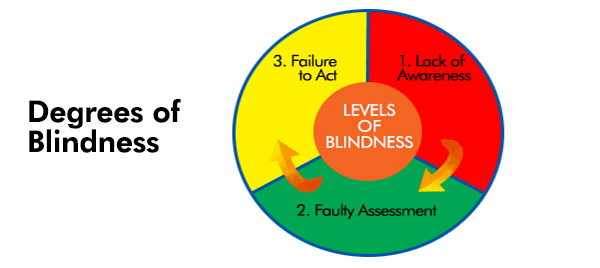
First is a complete lack of awareness. Leaders are said to be blindsided by these weaknesses or threats.
Second is denial. “In this case, a leader may be aware of a weakness or threat but doesn’t analyze it in sufficient depth to understand its causes and potential impact. The vulnerability is seen by the leader as ‘not being a big deal’ or ‘not my problem.’”
And third is the failure to act on a known weakness or threat. “There are cases when a leader knows that trouble lies ahead but fails to take action due to a range of factors, including a lack of skill. I refer to this as a type of blindness because the leader fails to fully appreciate the risk he or she is facing and the consequences of not taking action.”
Not all blindspots are created equal. “Leaders need to question the relative importance of a weakness or threat once they become aware of it.”
Not surprisingly, “the more power and status people have, the less likely they are to pay attention to those below them and the less empathic they will be.” So we just don’t bother searching for blindspots.
Leadership Blindspots has a Leadership Blindspot Survey in the appendix of the book. It contains self-assessment questions in each of the four potential blindspot areas: self, team, company and markets.
Follow us on Instagram and X for additional leadership and personal development ideas.
Posted by Michael McKinney at 10:34 PM
Permalink
| Comments (0)
| Personal Development
Educational software can help kids master new skills by pinpointing where they’re going wrong, and letting them practice just that task over and over until they get it. And yet, we don’t seem to be carrying that lesson outside the computer lab. Perhaps this is because even as our electronics have become a better and better environment for learning from failure, our educational system has become much worse.Of course, learning from failure means asking the right questions after a failure and taking responsibility for the answers. “Learning to fail well means overcoming our natural instincts to blame someone—maybe ourselves—whenever something goes wrong.” Perhaps we deflect responsibility not just to make ourselves look better, but also to create a sense of control and structure in the world.
Like us on Facebook for additional leadership and personal development ideas.
Posted by Michael McKinney at 06:42 PM
Permalink
| Comments (0)
| Personal Development

1. Be Aware of Your Nonverbal and Extra-verbal Cues.
What we say is important but how we say it can make or break the communication. “Extra-verbal cues include the speed with which we speak, our volume relative to background noise, our inflection, and our willingness to pause to make space for others to speak.”
2. Develop Curiosity About the Perspectives of Others.
“Empathy is demonstrated when it becomes evident to others around us that we are interested in what they think, why they think it, and how they feel about it. When this happens, it becomes easier to communicate respect to others, even if we disagree with them.”
3. Assume that Everyone is Smart About Something.
“Because I like to think I’m smart, it is reasonable to assume that other people like to think they are also smart. The only difference is that we are all smart through different histories and life experiences.”
4. Become a Better Listener by Shaking Your “But.” The word “but” can be used in a way that hinders our ability to show respect. The word “but” negates what came before it. Replacing it with “and” and other words that validate and convey consideration, the entire tone is changed.
5. Look for Opportunities to Connect with and Support Others.
“Even in the heat of conflict, there are ways to connect with people if we want to. When we demonstrate a willingness to move away from our immediate agenda and search for positions of agreement first, it makes working through the actual differences a bit easier.”
6. When You Disagree, Explain Why.
“It is disrespectful when we fail to share our observations and opinions in order to avoid conflict. We have an obligation to others to be truthful with our perspectives and points of view. When done with civility, tact, and room for counterarguments, sharing our perspectives leads to the best decisions and optimal results. It also prevents the accumulation of ‘baggage’ that builds up when we keep things bottled up.” And remember, it works both ways.
7. Look for Opportunities to Grow, Stretch, and Change.
“As we develop the desire and the willingness to hold ourselves up to the proverbial ‘bright light’ for an occasional reality check, two things happen. First, we become infinitely easier to be around because we are less critical of others. Second, we grow in wisdom and perspective. That’s because we start considering that, in situations where we might initially view others critically, the problems may be ours to deal with and not theirs.
8. Learn to Be Wrong on Occasion.
“From a neurological perspective, there is absolutely no correlation between our degree of certainty about a subject and the likelihood that we are actually correct in our beliefs. This means that our feeling of certainty about something is nothing more than a strong emotion. The stronger the emotion, the more likely we are to develop blind spots around it.” An open mind is a demonstration of respect.
9. Never Hesitate to Say You Are Sorry.
“Unfortunately, it is often when we’re at our worst that our actions are most memorable to others. While we don’t expect everybody to be perfect, “we do expect people to make it right when their words, actions, or decisions cause damage.”
10. Intentionally Engage Others in Ways that Build Their Self-Esteem.
“Building esteem in people we work with or for requires a shift in agendas. It takes a shift in focus away from what we need to what others need.” Meshanko colleague Teresa Welborne said, “If you are in a leadership position and you are not a people person, you become a liability to your organization. And if you’re not willing to make the effort to become a people person, you should not be in a position of leadership.”
11. Be Respectful of Time When Making Comments.
“If we don’t become curious or have value for what other people have to say, it is difficult to consistently fake the behaviors that demonstrate interest.”
12. Smile!
“Sometimes the most effective strategies are also the simplest. With rare exceptions, when we meet people who greet us with a smile, they are sending us important information about their intentions.”
Meshanko concludes with 3 key ingredients to improving your ability to demonstrate respect for others:
Respect is about you and me, not “them,” and our commitment to it influences everyone around us. Once we understand the value proposition respect offers, that insight can provide us with patience, courage, and creativity.
Patience permits us to maintain our composure and respectful demeanor when others are not acting at their best.
Courage enables us to candidly challenge disrespectful behavior and actions directed toward others.
Creativity allows us to see points of connection, even in the midst of conflict.
When we bring these qualities online and into our work interactions, everyone benefits, including our peers, customers, vendors, and ultimately, our shareholders.
Like us on Instagram and Facebook for additional leadership and personal development ideas.

Posted by Michael McKinney at 11:13 PM
Permalink
| Comments (0)
| Personal Development
 Like us on Facebook for additional leadership and personal development ideas.
Posted by Michael McKinney at 09:56 PM
Permalink
| Comments (0)
| Human Resources
, Personal Development
MALCOM GLADWELL wants us to rethink how we think about the giants in our lives whether they be outsized opponents, disabilities, misfortunes, or oppression. We all face or have faced odds that seemed to be stacked against us. Odds that we are forced to deal with.

Second, giants are not always what we think they are. The powerful and strong are not always what they seem. Often their strength can expose their greatest vulnerability. Their size can be their undoing. What we see as their overwhelming advantages can also be the thing that limits their options.
We know but easily forget, that there is a point where more doesn’t make a difference and more still becomes a disadvantage. “We all assume,” writes Gladwell, “that being bigger and stronger and richer is always in our best interest.” A wealthy man told Gladwell about the relationship between wealth and parenting:
My own instinct is that it’s much harder than anybody believes to bring kinds up in a wealthy environment. People are ruined by challenged economic lives. But they’re ruined by wealth as well because they lose their ambition and they lose their pride and they lose their sense of self-worth. It’s difficult at both ends of the spectrum. There’s some place in the middle which probably works best of all.
Gladwell is a master storyteller. The stories are compelling and at times provocative. But they all make you think.
Gladwell makes the point that certainly some people triumph over their disabilities in spite of them. They simply won’t let them stand in their way. But there are those that succeed because of their disability. “They learned something in their struggle that proved to be of enormous advantage.” Challenges can cause us to develop skills we might not otherwise have developed if we choose to respond that way.
Although Gladwell makes the point that there are “desirable disadvantages,” in that it is the difficulty that eventually led to a person’s success and made them a better person, it is not to suggest that we should wish for more disadvantages or wish them on other people. We all have disadvantages, some are huge and some are not, but the lesson is in how we see them. How we react.
Some of what we perceive as advantages—opportunities or resources that we wish we had—have actually ruined people or diminished their full potential in some way.
The thread that runs through all of Gladwell’s examples is how individuals or organizations turned their disadvantages to their advantage—how they defeated giants by reframing their perceived advantage. There is no formula here as to what will work and what won’t. The question is as it has always been, how will you respond to what you have been given?
The key lesson is that for the most part, difficulties are what you make of them.
Like us on Instagram and Facebook for additional leadership and personal development ideas.
Posted by Michael McKinney at 09:16 PM
Permalink
| Comments (0)
| Personal Development
 Like us on Facebook for additional leadership and personal development ideas.
Posted by Michael McKinney at 10:56 PM
Permalink
| Comments (0)
| Personal Development

CY WAKEMAN does an excellent job of helping us to peel away the layers of rationalizations and excuses we create to avoid facing reality. First she did it with Reality-Based Leadership and now with Reality-Based Rules of the Workplace.

Wakeman has put this book together to help you do just that. If you have been playing the victim for a substantial period of time, her ideas will seem impossible, but they are the only thing that will work.
I am here to tell you: You are not a cog in a machine — far from it. You have more control than you think. That’s the good news. The bad news is, you and you alone are causing your own suffering. What most of you have lost touch with is that it isn’t your reality that is causing your pain and frustration. It’s the worn-out methods, techniques, and mindsets with which you are approaching your reality. I’m here to tell you that your suffering is optional. I can help you get back on track so you can find bliss in your work again while becoming more valuable to your organization than ever before.
She has created some pretty straightforward, brief assessments to determine your current performance and your future potential. Your value, plain and simple is based on "the value you bring to your organization, the market value of your work, and the return on investment that you deliver, both economically and emotionally, now and into the future." You must be clear about the value you bring to your organization. The three factors that make up your value:
YOUR VALUE = Current Performance + Future Potential - (3 x Emotional Expensiveness)
The chapter on Your Emotional Expensiveness is worth reading twice. It's your drama factor. "It is the single most important factor in the New Value Equation, the one that determines whether our Performance and Potential and anything meaningful to the bottom line, and whether others feel that working with us is worth the effort." Wakeman lists 15 clues to your emotional expensiveness factor. Among them are:
You may be Emotionally Expensive if …
Wakeman presents the Five Reality-Based Rules of the Workplace:
1. Your level of accountability determines your level of happiness. Personally accountable people bring their own motivation and engagement to everything they do. Be one of those people, and you will ensure your job security—or that your résumé goes to the top of the stack.
2. Suffering is optional … so ditch the drama. (Wakeman estimates that the average person spends two hours each day in drama—complaining, creating stories, and arguing with reality.) Your circumstances are what they are, but your reaction to them is up to you.
Even if you don't share your drama with others, there is no such thing as a throwaway thought. Most thoughts lead in some way to an action—or lack of action….Your thinking manifests itself in a way that affects everyone around you and the way they see you.
If you remain in your lane, tending to your own responsibilities in the present, you will seldom be stressed. You'll be clear, capable, and effective. Stress enters the picture when you leave your lane to meddle in other people's business, judging or trying to control them.
Learn to see stress as a sign—not that the world is going to hell in a handbasket, but that you are not currently living in reality and need to inquire on your thinking.
3. Buy-in is not optional. To succeed, your buy-in is not optional, and action, not opinion, adds value. The most valuable people say "yes" the most often. If a decision has been made, opinions are no longer welcome.
4. Say “yes” to what’s next. Your success will not be dependent on everything staying the same, but on your readiness for what's next.
5. You will always have extenuating circumstances. Succeed anyway. That which is missing from this situation is something I am not giving. When you find something missing (especially—but not limited to—intangibles, like honesty, generosity, humor, sensitivity, or gratitude) don't dwell on what other people "should" be doing or giving.
|
|
Like us on Instagram and Facebook for additional leadership and personal development ideas.

Posted by Michael McKinney at 11:22 PM
Permalink
| Comments (0)
| Human Resources
, Personal Development
 Like us on Facebook for additional leadership and personal development ideas.
Posted by Michael McKinney at 11:30 PM
Permalink
| Comments (0)
| Personal Development
HUMAN BEINGS—and that includes most leaders—are relational.
Self-leadership is fundamental to good leadership, but it is not the end-game.
Self-awareness for self-awareness sake has limited value.
Through introspection and reflection we can get to know a great deal about ourselves—as far as we know. The problem is that we don't know what we don't know. Only when we are able to test our assumptions about ourselves, can we know if we are getting it right. It is when we see ourselves in relation to others and in relation to a higher purpose that we really begin to clarify (and many times even identify) our core values, beliefs and intentions. We can all know who we think we are, but it isn't until we get out and interact with others that we can begin to see where we are right and where we have been fooling ourselves.
Who we are takes on meaning when it is in the context of our relationship with others. Superman's stance on "truth, justice, and the American Way" is pointless if he remains isolated in his Fortress of Solitude. His values only have meaning in relationship to other people. All the self-knowledge in the world counts for very little if it is not put to work in the service of others.
Self-awareness that points to your unique contribution in the world is leadership. Who you are is leveraged when it is placed in the service of other people. Surely we must lead with integrity—in a manner consistent with who we are. However, the only way to know if we are really doing that is by looking at how we impact the lives of others—how our leadership is experienced by others.
Self-awareness provides the opportunity for us to close the gap between who we think we are or want to be and who we actually are at a particular point in time. But that can only be achieved with feedback of some kind. I want to share a lengthy story provided by Scott Weiss in his great book DARE, to illustrate this point. It's a book about trust in leadership and the trust that is generated by knowing who you are and leading as that person.
At thirty-five, I was already an executive vice president with Turner Broadcasting, overseeing two divisions and reporting directly to the second most senior executive who soon would be named the company's CEO. I believed that I was very much at the top of my game, already delivering a lot of high-level presentations, and getting consistently positive feedback. I was more than a little offended by the suggestion that I needed any help at all with my communication skills. But I went.
In Atlanta, I participated in Speakeasy's exclusive, invitation-only workshop for C-suite executives. Called "The Leader's Edge," this intense three-day workshop focused on communication style and delivery with respect to leadership. In spite of my initial resistance, I did my best to participate without revealing my conviction that I felt superior to this target audience that needed help with communication and presentation skills. I wasn't the least bit nervous when it came time to watch the video recordings of our individual presentations. I was sure I'd done just fine.
With the others in our group, I watched as the executive persona of Scott Weiss delivered his speech from the screen. The guy up there looked pretty good. Very sure of himself. Very corporate. Very buttoned up. I expected to be told, as I always had been before, that I was a very effective presenter. But after a moment, Sandy Linver, the faculty leader who had directed our session turned to ask me a question.
"So," she said, "as you look at yourself, objectively, how do you perceive this person?"
"Fine," I said. "He seems knowledgeable. Experienced. Very confident."
"Hmm," she said. "That's interesting. If you could separate yourself from this person and experience him objectively, would you want to hang out with a person like that on the weekend?"
It was a strange question. But I looked at that person frozen on the TV monitor and thought about it. Reluctantly, I had to tell the truth.
"No," I said. "Probably not."
"Really?" she asked. "And why not?"
"Well," I said, "because I don't hang out with people like that."
I'm not sure whether there was a collective gasp from the audience or just a stunned silence, but what she said next definitely stunned me.
"You know, don't you, that you're talking about yourself?"
Yes. I was. I had just admitted that the person I was projecting was not someone to whom I could relate. He wasn't even someone I really liked!
And apparently, I wasn't the only one to be put off by Scott Weiss's executive persona. In our remaining time together, other members of the audience began to offer more specific impressions of how they had experienced me as a communicator, and as a person.
Arrogant.
Cocky.
Superior.
Disconnected.
Not real.
Those were just some of the terms they used. I had never heard myself described this way before. I felt like the emperor with no clothes.
I had not gone to Speakeasy for a consciousness-raising experience. But I sure had one. In the weeks following that close and uncomfortable encounter with my own executive persona, I did a lot of thinking. I examined what I had learned about how others actually did experience me, and thought about how I wanted people to experience me. There was a gaping abyss between those two extremes, and I realized that I had a lot of work to do to bring them closer together—to become more congruent as an individual and as a leader. I needed to find my authentic self and learn how to bring more of my real personality to my vocation.
I appreciate Scott Weiss sharing this story, for it's not just a process all growth-oriented leaders must go through, but a process we must seek out continuously.
Feedback is a process that, if we allow it, will keep us honest with ourselves. We see things as we are, and we see ourselves through our intentions. Feedback gives us a reality check that we are free to accept or reject, but without it we have no way to combat our own self-deception.
We must be able to experience ourselves in relation to other people if we are to have a genuine understanding of who we are and why we do what we do.
So the place to begin if we truly want to know ourselves is to reflect on the impact that we have on others. Only then can we lead authentically knowing that our inner being is congruent with our outer behavior.
Like us on Instagram and Facebook for additional leadership and personal development ideas.

Posted by Michael McKinney at 12:09 AM
Permalink
| Comments (0)
| Personal Development

IRONICALLY, the more self absorbed we are, the less self-aware we are.
Self-awareness is vital to the development of a leader. But it's not navel-gazing. It is not an inward focus. It is an outward focus. Its ultimate goal is to improve our connection and effectiveness with others.
The self-absorbed leader struggles with self-awareness and emotional intelligence because self-awareness is about how we are perceived by others. It's about understanding how our behaviors are affecting other people. And we just can't do that by focusing on ourselves.
It is easy for us to focus on ourselves—to think people just don't understand us. And when we do, we tend to rationalize rather than grow. Explain rather than listen. Disconnect rather than lead.
Self-important leaders can't see how they are sabotaging themselves because they focus on their needs and feelings and not those of their followers. Consequently, they don't encourage feedback because it never seems relevant to them. An inward focus dooms us to operate from a place of weakness—never able to see what is holding us back.
It is in the character of great leaders to have a great appetite for feedback. It's a gift and still the best way to gain an awareness of ourselves. You might think of it as a personal scorecard.
To see where we need to grow, we need to see how we affect other people. Only then can we begin the introspection that will lead us to a deeper understanding of ourselves and learn to move past unproductive thinking and develop new behaviors.
Like us on Instagram and Facebook for additional leadership and personal development ideas.
Posted by Michael McKinney at 06:52 PM
Permalink
| Comments (0)
| TrackBacks (1) | Personal Development

"Why do we have such a hard time making good choices?" ask Chip and Dan Heath in Decisive.
"A remarkable aspect of your mental life," says Daniel Kahneman, "is that you are rarely stumped." We have opinions about nearly everything and are quick to jump to conclusions based only on the information that is right in front of us. We often just go with our gut. And that hasn't always served us well.
• An estimated 61,535 tattoos were reversed in the United States in 2009.
• Forty-one percent of first marriages end in divorce.
• Forty-four percent of lawyers would not recommend a career in law to young people.
• Eighty-three percent of corporate mergers and acquisitions fail to create any value for shareholders.
The Heath brothers have identified “four villains” when it comes to making decisions:
What can we do? We can counteract our tendencies with these four strategies the authors call the WRAP Process from the first letter of each step:
Making better decisions is a choice. This process will help us to make better choices.
|
|
Like us on Instagram and Facebook for additional leadership and personal development ideas.
Posted by Michael McKinney at 12:09 AM
Permalink
| Comments (0)
| Management
, Personal Development
, Thinking
RESEARCH shows that givers sink to the bottom of the success ladder. Givers may make others better off, but they do so at their own expense.
Grant notes that in "purely zero-sum situations and win-lose interactions, giving rarely pays off…. But most of life isn't zero-sum."
The giver advantage is often hard to see in the short term because the "giver advantage grows over time." Chip Conley, founder of Joie de Vivre Hotels, explains, "Being a giver is not good for a 100-yard dash, but it's valuable in a marathon."
The Strength of Weak Ties
Givers connect with the people they know casually--their acquaintances. Although it is harder to ask them for help, they are the faster route to new leads and ideas. "The dormant ties provided more novel information than the current contacts. Over the past few years, while they were out of touch, they had been exposed to new ideas and perspectives."
The Five-Minute Favor: "You should be willing to do something that will take you five minutes or less for anybody."
Givers create a ripple effect around themselves. "Giving, especially when it's distinctive and consistent, establishes a pattern that shifts other people's reciprocity styles within a group." Givers take on the tasks that are in the best interests of the group.
Developing Others
As leaders, givers don't look for talent first, they focus on motivation. "Because they tend to be trusting and optimistic about other people's intentions, in their roles as leaders, managers, and mentors, givers are inclined to see the potential in everyone."
Takers have a general distrust of others. "Even when takers are impressed by another person's capabilities or motivation, they're more likely to see this person as a threat, which means they're less willing to support and develop him or her." Takers desire to be the smartest person in the room.
"The matcher's mistake lies in waiting for signs of high potential. Since matchers tend to play it safe, they often wait to offer support until they've seen evidence of promise."
Otherish Givers
Givers that end up on top are otherish. "Being otherish means being willing to give more than you receive, but still keeping your own interests in sight, using them as a guide for choosing when, where, how, and to whom you give." Giving energizes and is meaningful when it is done out of choice rather than duty or obligation—and otherish givers give more than totally selfless givers.
To avoid being taken, it is important to distinguish between givers and takers and those that pretend to be givers. Givers become matchers when they are dealing with takers.
Grant provides a lot of fresh examples—people from all walks of life. What he finds most magnetic about successful givers: "they get to the top without cutting others down, finding ways of expanding the pie that benefits themselves and the people around them. Whereas success is zero-sum in a group of takers, in groups of givers, it may be true that the whole is greater than the sum of the parts."
|
|
Like us on Instagram and Facebook for additional leadership and personal development ideas.
Posted by Michael McKinney at 09:10 PM
Permalink
| Comments (0)
| General Business
, Management
, Personal Development
INJUSTICES HAPPEN.
Bad things happen to good people.
And when they do, we need to be sure we are taking away the right lesson. When something bad happens we naturally prefer to process the injustice in a way that makes us come out as the victim; we are right, they are wrong. Sympathy is in our corner.
But, if we are honest with ourselves, rarely do we find ourselves in a situation where we played no part. And if we have the courage to step back, we can see where we contributed to the perceived injustice.
In What You're Really Meant to Do, Robert Kaplan tells the story of a television producer that got passed over for a promotion. Initially, he took the easy way out. He chose to frame it as a "political" issue. "The people who get the jobs are the ones with the connections. All this talk about being a team player and helping others sounds nice, but it's not how people get ahead." This is the wrong lesson. Worse still is the fact that this thinking taints all of your thinking and behavior from this point forward and contributes to further "injustices" down the road. You undermine your "ability to exhibit character and leadership traits" that could help your career, says Kaplan. With this narrative in your head, you fail to do the things you should and when things don't go well for you, you create a self-fulfilling prophecy that further degrades your attitude and performance. At that point, everything you do is operating from a place of weakness and not your strengths.
He adds, the producer "found it easier to stew about the unfairness of it rather than take the more uncomfortable path of figuring out how he needed to improve." We all typically do this but we can't leave it there. Kaplan wisely counsels:
I urge people who have suffered a trauma that they experience as an injustice to take time out to process it. You need to reflect on what just happened, seek advice from others who witnessed it, and figure out whether you played a role in what happened…. Learning the wrong lesson, or failing to learn at all, may doom you to repeat some version of the same experience.
When you have been wronged, slow down long enough to learn the right lesson.
Like us on Instagram and Facebook for additional leadership and personal development ideas.
Posted by Michael McKinney at 01:19 PM
Permalink
| Comments (0)
| Personal Development
IT’S not uncommon to think of personal reinvention as being somewhat contrived or manipulative. But reinventing you isn’t about becoming what you are not, but more of who you are. In Reinventing You, Dorie Clark says “it’s about taking control of your life and living strategically. Who do you want to be? And what do you need to get there?” It’s about making sure that our personal brands reflect the reality of our lives (Facebook notwithstanding).
KNOW YOURSELF
Clark takes you through the whole process, beginning with, of course, starting where you are. This is a vital step and not to be glossed over because many of us don’t know where we are starting. We need you to understand our reputation and why it is what it is. She offers ways to do this, questions to ask, and how to conduct your own 360 interview—determining what those around you think about you. Very valuable material.
Next you need to research your next move or future destination and test drive it. (Did you know that there is a company that allows you to test-drive over 125 new careers to see if they are a fit?)
Once you have determined where you need to be, it is important to develop the skills you need. Clark explains how to do this and when to go back to school and when not to, and finding a mentor (someone who embodies what you’d like to develop and the person you’d like to become).
LEVERAGE YOUR POINTS OF DIFFERENCE
Rebranding yourself publicly means understanding first, what is unique about you. It may not be what you think. Often it's the mindsets and thinking that proved valuable in your current situation may differentiate you in a completely unrelated field. The examples of people that Clark provides, who have done just that, are very helpful in getting you to see your unique contribution.
From that you can build your narrative that pulls together the underlying themes that connect your professional experiences in a way that is obvious to others.
THE GAP
There is a time lag–a gap–between fully inhabiting the “old you” and the “new you.” Clark writes that the “hardest part of making a transition can be bridging the gap between how others used to perceive you (and how you perceive yourself) and how you’d like to be seen moving forward.” She says the only solution is to fake it till you make it.
I’m sure that we have all experienced this dynamic when making any personal change. When no one readily accepts the nice person you have finally become, it’s easy to give it up and resort to the old habits of behavior. The answer is to keep projecting the new behavior until you’re comfortable with it and others begin to accept it as the new “normal.” Your commitment to the new you will eventually win people over.
Clark adds, “You need to be hyperaware of what you’re doing and make sure you’re signaling explicitly to the outside world what you’re trying to build.” This is where doing the homework in step one—know yourself—will help you to have the fortitude to press on.

|
|
Like us on Instagram and Facebook for additional leadership and personal development ideas.
Posted by Michael McKinney at 04:28 PM
Permalink
| Comments (0)
| Human Resources
, Personal Development

Julian Fletcher shouldn’t stop being efficient—he needs to start being more sophisticated. He needs to raise his game so he understands how efficiency can harmonize with other complementary leadership traits he needs to nourish.Breeden tackles seven sacred cows:
When leaders embrace beliefs without understanding and managing the potential side effects, the beliefs become sacred cows and get in the way. When leaders shut off their brains and blindly follow the bromides of conventional wisdom they set off a string of unintended consequences.
 |
|
Like us on Facebook for additional leadership and personal development ideas.
Posted by Michael McKinney at 07:54 PM
Permalink
| Comments (0)
| Management
, Personal Development
The first job of leadership is to help people see their significance. Leaders recognize that those who feel insignificant rarely make significant contributions. An effective leader is able to show people that they are significant in ways they may not realize.The Fred philosophy means:
|
|
Like us on Facebook for additional leadership and personal development ideas.
Posted by Michael McKinney at 05:17 PM
Permalink
| Comments (0)
| General Business
, Human Resources
, Leadership Development
, Personal Development
STRUGGLE is a part of any human endeavor and leadership is no different. The problem is we view struggle as a negative. But struggle is how we grow. Without them we can’t reach our full potential as leaders.
It may sound counterintuitive, but considering the benefits illuminated by Stephen Snyder in Leadership and the Art of Struggle, we should welcome it as an important element of the leadership process and our own personal development. Snyder writes that we should face struggle “head on—not hiding from it or feeling shame—because struggle is the gateway to learning and growth.” It can also help us to discover our purpose and meaning and develop the adaptive energy necessary to sustain our leadership for a lifetime.
Struggles have three defining characteristics:
Change: Every struggle is triggered by some type of change.
Tensions: Change creates a natural set of tensions.
Being out of Balance: Change and its ensuing tensions throw a leader off balance. This may happen without us even being aware of it, but acknowledgement of it is central to regaining control.
In the world we live in today, this is a common occurrence often leading to burnout unless we learn to see struggle through a different lens. Snyder recommends:
Adopt a growth mindset. The first step in accomplishing this is through reflection—being aware of what is going on around you. Snyder’s former colleague at Microsoft, Frank Gaudette, used to say: “I reserve the right to wake up smarter every day.” A good mantra to make our own.
Center your mind, body and spirit. We all need some way to anchor ourselves and gain perspective that we practice daily like exercise and diet, prayer, connecting with nature, meditation, and/or journaling.
Build your support community. “Create a community of people whom you can connect and bond with and from whom you can seek advice and feedback.”
Overcome your blind spots. Blind spots by their very nature are hard to recognize. And they are frustrating because they blind us from seeing why people may be responding to us in counterproductive ways—leading us to finger pointing rather than personal responsibility. “Blind spots,” writes Snyder, “are the product of an overactive automatic mind and an underactive reflective mind.”
A fairly common blind spot Snyder calls the Conflict Blind Spot. This blind spot can cause someone to interpret every interaction through a distorted lens. It reinforces the perception that the other person is wrong and we are right.
Recommit, pivot, or leap. When we struggle we have essentially three options. The first is to recommit and stay the course. The second is to pivot and make a course correction. And third is to leap into uncharted territory far beyond our comfort zone. Choosing the right option requires that we examine ourselves and determine which choice is most consistent with our personal values or mission statement.
Every struggle is a chance to learn and to confront who we are and what we are becoming. Seen in that light, they are a gift. And our ability to deal with our own struggles effectively has an impact on those around us. Not only does it create a more positive environment to function in, but it provides a constructive example for others to follow.
Snyder has written an outstanding and practical book to help us to rethink the challenges and problems we face along the way. One of the best you’ll ever read on the topic.
(The Adaptive Leader Profile is available from Snyder Leadership Group.)
|
|
Like us on Instagram and Facebook for additional leadership and personal development ideas.
Posted by Michael McKinney at 10:27 PM
Permalink
| Comments (0)
| Leadership
, Leadership Development
, Personal Development
, Problem Solving
 Webb presents us with four ways of looking at work. We may move from frame to frame but we tend to operate in one. They are Company Man or Woman, CEO of Your Own Destiny, Disenchanted Employee, and Aspiring Entrepreneur. Where we should all be headed, states Webb, is to the mindset of the CEO of Your Own Destiny. We are living in the age of the entrepreneur.
Prior to the Civil War, most Americans worked in agriculture or as small merchants or tradesmen. Success was the result of self-direction, self-motivation, and self determination. In a way, everyone was self-made.Today personal and professional development is on the employee. It “requires you to be relevant every day and to be voted on to the team you want to play with.” But with this freedom come accountability. In an entrepreneurial age it is more important than ever that you think like a leader—no matter where or at what level you work.
The Industrial Revolution brought opportunities to work outside the home, reversing the entrepreneurial spirit and giving rise to the paternalistic company, but now the Age of Entrepreneurship is bringing it back.
Dear Founder
Like us on Instagram and Facebook for additional leadership and personal development ideas.
Posted by Michael McKinney at 01:55 PM
Permalink
| Comments (0)
| General Business
, Human Resources
, Marketing
, Personal Development

Winners live in a mindset of 100 percent accountability. Accountability, say the authors is taking responsibility for the “success and failure of everything you do—for your choices, behaviors, and actions—before you know how it will turn out” (even if you’re working with someone else).
If you’re not living the personal responsibility mindset where winners live then you might be displaying what the authors call loser characteristics:
The Victim: If you live in a world where circumstances beyond your control dictate your success, you have no power.
The Finger-Pointer “owns” only the good. If it is good, I did it; if it is bad, you did it.
The Robbery Victim always blames someone else for undermining him, for getting something he deserved instead, or for scoring a win at her expense.
The Coulda-Woulda tries to take credit for what she didn’t earn by saying she easily could have, if only … (take your pick of excuses).
The Guess Man knows that there is no accountability without clarity. The more vague he is with his instructions, the easier it will be to blame someone else when the job doesn’t go well.
Where do you live?
Like us on Instagram and Facebook for additional leadership and personal development ideas.
Posted by Michael McKinney at 10:06 PM
Permalink
| Comments (0)
| Personal Development
A HUGE difference between the leaders who make things happen and those who do not is how they prioritize their time.
Leaders who make things happen schedule their lives around what needs to get done. Leaders who don’t make things happen do the exact opposite, scheduling what needs to get done around their lives.
The difference is priorities.
If meeting your deadline isn’t more important than going to the football game or getting eight hours of sleep, then you probably don’t have what it takes.
I’m not saying that football is bad. I’m just saying that I simply cannot go. I just can’t get it all done in time and still catch a four-hour game. If you want to lead a team of people who are so invested in your vision that they are willing to sacrifice certain things to help you accomplish it, then the sacrifices must first start with you.
Ask yourself this question: What are most people spending time on that I could probably live without?
You must be intense about finishing on a deadline, and that might mean sacrificing a lot of recreational things.
The key is to know thyself.
You know what you need to get done, and you ought to know how long it will take you to finish it. If you’re serious about making it happen, you must design days around completing what you know needs to be completed in order to make things MOVE.
Here’s another hint: 40 hours a week won’t cut it.
If you’re spending half the “workday” cleaning out your inbox, maybe it's time to start waking up at five. Leadership is not exclusive to eight-hour windows. You have to set the tone. If you possess a 9-5 mentality, so will the people you are leading.
Every leader I’ve met who is really killing it puts in an average of around 80 HOURS PER WEEK!
Leaders have to think like entrepreneurs. It’s funny to me that I’ve never seen an entrepreneur just standing around the water cooler with a cup of coffee. The doers don’t have time for that; they’re too busy grinding away.
The bottom line is that success is built by chunks of time. And a successful leader has that time built in.
If you’re truly serious about making it happen, put your minutes where your mouth is.
Of course, if you are that serious, you probably already do. Keep it up!
What techniques do you have for blocking out distractions and getting things done?
Like us on Instagram and Facebook for additional leadership and personal development ideas.

Posted by Michael McKinney at 10:46 PM
Permalink
| Comments (0)
| Personal Development
 Like us on Instagram and Facebook for additional leadership and personal development ideas.

Posted by Michael McKinney at 11:09 PM
Permalink
| Comments (0)
| Ethics
, Motivation
, Personal Development
WE KNOW every behavior begins with a thought. So if we want to have lasting change, the beginning point has to be our thinking.
Behavioral change is only surface change if we don’t first change the thinking behind those behaviors. And it won’t stick. It will keep coming out in so many ways we won’t be able to keep up with it because we haven’t changed the thinking behind it.
When we look at our behavior we have to understand that there is a thought going on in our heads that is tripping us up. And we have to change that first. Or we’re working on the wrong thing.
The question becomes, “What thoughts do I need to change to make my behavior change?” New behavior will automatically follow a change in thinking. One right thought can correct a lot of bad behavior.
What am I thinking that isn’t allowing me to see things as I should? As human beings, we latch on to certain ideas and assumptions and they blind us from seeing other options and responses to what life throws at us. We get ideas in our head that can literally block us from seeing other perspectives.
Change doesn’t happen in a moment. We’ve had these patterns of thinking and behavior for a lot of years. We have to unlearn some behaviors and then learn and put into practice the new thinking and resulting behaviors. And it just takes time.
It’s right thinking over time that brings about lasting change. It’s a process. It’s a long history of repeated behaviors in the same direction that builds character.
We have to wake up every day and know that we have a tendency—not just because of our life experiences, but also because of the way that we have chosen to respond to them—to repeat a certain set of behaviors over and over again. We’ve got to remember that and change the thinking that supports these behaviors.
We’ve got a lot of set patterns in our heads that we want to return to, that we have become comfortable with, that we can justify, that we can blame on something someone else did.
That’s why we have to make a point of reflecting on our behaviors and on the impact we have on the people around us. And learn from it. And then go to work on the thinking behind the behaviors we want to change.
It’s not what you do that needs to change, it’s what you think that needs to change.
First change your thinking. The behavior will follow. It all starts with a thought.
Like us on Instagram and Facebook for additional leadership and personal development ideas.
Posted by Michael McKinney at 06:13 PM
Permalink
| Comments (0)
| Change
, Personal Development
, Thinking

Today, because information is so prevalent, our kids assume they have [experiential knowledge] when they only have [informational knowledge]. With an abundance of knowledge, their confidence can soar, but it’s based on a virtual foundation. Without experience, it’s easier for knowledge to produce judgmental attitudes, bullying, and arrogance.
With all of this information kids think they are mature. And unfortunately, we do too. That’s part of the problem. How often have we seen a “smart” child and thought, “They are sure mature for their age.” Intelligence and maturity are not the same thing. (Of course, we see this same issue in “adults” too.) Elmore writes, “Except in rare cases, their knowledge has only entertained them. It has not produced anything real.”

Emotional Intelligence. Mature, healthy people manage their emotions. This means developing self-awareness, self-management, social awareness, and relationship management.
Character and a Sense of Ethics. Mature, healthy people live by a set of values and principles. They don’t merely react to what is going on around them. They have self-discipline, emotional security, core values, and a clear sense of identity.
Strength Discovery. Mature, healthy people who become the best versions of themselves are one’s who’ve stopped trying to do everything and focused on what they do very well. This means developing their natural talents and gifts, knowledge base, heartfelt passions, and acquired skills.
Leadership Perspective. Mature, healthy people live lives that don’t just revolve around themselves. They invest their lives in something beyond themselves. A leadership perspective involves a personal vision, responsibility, compassion, and initiative.
Developing maturity is centered on four key areas:
In addition, Elmore believes there are four debts we owe our kids: clarity (fosters focused direction), transparency (fosters validation and vulnerability), consistency (fosters trust and assurance), and boundaries (fosters security).
There is far too much information in this book to cover it here, but here are a few more ideas from Elmore:
• Start inserting age-appropriate responsibility into your children’s lives right away. Avoid indulging and overprotecting them and creating hyperinflated egos. We are doing a disservice to young people if we remove their chance to fail.
• Enable them to take control of their lives; to boss their calendars. Hold them accountable and responsible for the choices they’ve made and don’t bail them out. Let them see that failure isn’t final and poor judgment is not necessarily poor character.
• Connect them to people (adults) outside their peer group. This generation doesn’t need you for information (they can get that without you), but they do need you for interpretation. They need mentors to help them make sense of the information and the world around them.
• Communicate that there is meaning even in the small, mundane tasks. Give them a sense of the big picture and how all the little things they do fit into the big picture of history, or of the organization, or of their community.
Authentic maturity is a leadership issue. Elmore concludes, “Our kids have what it takes inside of them, if we’ll just take them seriously and equip them for the future. As they enter adolescence, we must begin to treat them as young adults and train them to be both autonomous and responsible. Then, I dare you to stand back and watch them amaze you.”
|
|
Follow us on Instagram and Twitter for additional leadership and personal development ideas.

Posted by Michael McKinney at 08:10 AM
Permalink
| Comments (0)
| Personal Development
 Like us on Facebook for additional leadership and personal development ideas.
Posted by Michael McKinney at 10:55 PM
Permalink
| Comments (0)
| Leadership Development
, Personal Development
Instead, when we get stuck we need to rely on Stillpower, not willpower says Garret Kramer. Stillpower is the ability to return to a clear mindset after we get into a muddled mental state—a low state of mind. It’s knowing that “all sentiments are temporary since they originate from your own thoughts and moods. Stillpower comes from knowing that self-worth has nothing to do with winning, losing, parental approval, money, fame, or anything external to you.”
When we get into a low state of mind we need to do nothing. It’s when we operate from a low state of mind that we usually make mistakes, poor judgments, miss opportunities and dig ourselves deeper into whatever hole we are digging. “Once you understand,” says Kramer, “that as human beings we form our perceptions from the inside out, that the quality of our thinking and level of awareness move up and down independent of our circumstances, you will see that it makes little sense to work yourself through a temporarily low state of mind.” But that’s often exactly what we do.
When we run into trouble that’s a sign to step back—not a call to action. Negativity is a sign to slow down. We can't perform at an elevated level when we are in a low state of mind.
A seemingly unresolved issue of today has nothing to do with erroneous thinking of today. And until an individual comes to this realization, he or she will always fall prey to the conditions of life itself.
Here’s what many of us ought to consider: All human beings exist, from moment to moment, at varying levels of psychological functioning. When this level of functioning is low, most often for no tangible reason, we view life through a dirty lens and are prone to deviant behavior—if we act. Once this principle is grasped, we see that navigating smoothly through life doesn’t have to be so complicated, and unlike the belief of many counselors and coaches in the self-help world, it has nothing to do with personal history.
Awareness is key. When you are aware of your thoughts and feelings in the moment and when necessary, allow your thinking to clear, then you will have the clarity to act; “insights will flow and answers will become obvious.” He adds, “Insight is infinitely more powerful than willpower. Actually, insight, or having a new idea and/or a change of heart, erases the need for strength or force of will of any kind.”
COACHING
Kramer notes that when you are coaching or counseling, you need to be operating from a higher level of thinking than the person you are talking to. “What comes out of your mouth is much less significant than the level of mental functioning from which the words are spoken.” We need to interact with people from a state of mind “brimming with love, compassion, and selflessness….External how-to resources are not all that necessary; love will provide all the direction you seek.”
Leadership is an all-in proposition. Done right, it’s a lot of hard work. To cut ourselves some slack, we too often rely on external gimmicks and techniques rather than the messy work of a real relationship.
IDEAS TO CONSIDER
• “We perform better when we get caught up in the experience, rather than when we make the experience about us….When we focus on a personal prize, our options narrow; when we relish the process, our options expand.”
• “When we act from clarity, it is impossible to get weighed down by judgmental outcomes.”
• “When we succumb to our errant thoughts or closed-off moods, judge another person, and then act from this egotistical perspective of insecurity, it is practically impossible to find long-term success.”
• “Every failure, every mistake, every loss—occurs to clarify our path, not to obscure it.”
• “You will never wrestle with a choice when your level of consciousness is high.”
Leaders will find a lot to consider here. Stillpower is one of those books that makes you reconsider your approach on many things. While Kramer might seem to be throwing the baby out with the bathwater at times, he doesn’t overturn conventional wisdom as much as he calls us on it when we misapply it. It is the perfect prescription for those that have a need to control their world and the people around them.
It is important to note too, that looking within for answers is fine if you have consciously put something there to draw-on in the first place. Good flashes of insight are only produced when there is something good to draw upon. Choose your sources wisely.
Like us on Instagram and Facebook for additional leadership and personal development ideas.
Posted by Michael McKinney at 03:57 PM
Permalink
| Comments (0)
| Human Resources
, Personal Development
, Thinking
WHY DO PEOPLE all over the world enjoy participating in games and sports? Why have games and sports been going on for not just centuries, but millennia?
One of the theories is that they provide immediate feedback.
The batter in a neighborhood game of softball knows immediately if he hits or misses the ball. If it is hit, it is clear whether it is in bounds or a foul ball. It’s clear if it bobbles into the infield or sails over the fence for a home run. The tennis player learns immediately how the angle of the racket and the strength of the swing can cause the ball to be returned too low and hit the net or if it is hit too high and too hard it goes out of bounds. Indeed, a good part of the joy and appeal of every sport is this immediate feedback. It also enables the player to make an infinite number of adjustments necessary to improve performance.
It’s important for organizations to become feedback-rich environments in which information flows freely and is accepted and acted upon. It is obviously not enough to simply have feedback given if it is angrily rejected or dismissed because of the source. There is a Swedish proverb that says, “With the eating comes the appetite.” We have found that the more that feedback is shared in organizations, the more easily it is digested and acted upon.
Attitudes about feedback in companies that have been doing 360-degree feedback for 25 years are extremely different from those doing it for the first time. Within organizations that routinely provide feedback, there is a much higher degree of eagerness to get data. At the same time, there is a calm and ease about being able to dismiss the occasional outlier number or comment.
Good things come from asking for feedback. Seeking the opinions of others has a host of benefits. It conveys respect. It reduces barriers between the levels. Managers learn valuable information that comes in no other way. Empirically it reduces by 10 percent the number of employees who intend to leave.
Clearly the ideal is for managers to both give and get, but if you had to choose one or the other, our data suggests that it is better to receive than to give.
Like us on Instagram and Facebook for additional leadership and personal development ideas.
Posted by Michael McKinney at 11:01 PM
Permalink
| Comments (0)
| Personal Development

How we are perceived matters more to our leadership effectiveness than our intentions. We must not only seek out how we are perceived by others but we must do something with the feedback we get. Canaday calls this applied self-awareness. In other words, using that information to adjust our behavior and close the gaps between our intentions and how others perceive us.
Typically, our blind spots, our perception gaps exist in those areas where we have overemphasized our strengths. “For instance,” writes Canaday, “do your colleagues think of you as assertive? Or overbearing? Collaborative or manipulative? Gregarious or obnoxious? There’s a fine line between these perceptions, but you can see why the subtle differences can have a huge impact on your career and your future.”
Canaday discusses in detail nine common perception gaps and how to begin to deal with them:
Self-awareness flourishes in a person that accepts personal responsibility. Without it, we only seek to justify what we do. We never quite get to dealing with those areas where we mean well but are coming across badly.
Whether we like how we are coming across to others or not, it is our reality. It is crucial that we seek out our perception gaps and deal with them if we are to be effective and grow as leaders. “No one is so amazingly self-aware that he or she can clearly see and eliminate every potential perception disconnect before it occurs. Those who are the most successful have just learned how to read the diverse people and situations they encounter and respond appropriately.”
You According to Them is a great place to start. Canaday places an emphasis throughout this book on “actively working to understand our reputations and artfully managing the perceptions that directly impact our careers.”
Like us on Instagram and Facebook for additional leadership and personal development ideas.
Posted by Michael McKinney at 06:04 PM
Permalink
| Comments (0)
| Personal Development
There is an alternative to this pressure we all feel. Throughout the story—an exercise in itself to create space, slow down and become more aware—the author’s stress three qualities to strengthen your leadership: Awareness (slowing down), Acceptance (embracing reality), and Abundance (considering multiple options).
The Leader’s Climb is well written and nearly everyone will recognize patterns of behavior found in the story’s main character Adam, in themselves. The authors provide a lot to think over. Here are some excerpts:
It’s not hard to see the impact on organizations of leadership that focuses primarily on speed, efficiency, results, and financial return. The same issues come up over and over again. The tyranny of the urgent becomes a substitute for planning and prioritization. Snap decisions with hidden costs replace careful consideration with obvious time requirements. Mindless compliance replaces community and commitment. Activity that looks like momentum disguises chaos. Purpose is sacrificed to performance at any cost.
Removing what does not matter is the first step in figuring out what does.
I’m afraid we often find it easier to fight an obstacle or pretend it’s not there, rather than accept it for what it is and use it to accomplish something worthwhile.
Acceptance does not mean quitting.
Activity is not the only sign of progress.
[Personal responsibility and self awareness.] I’d be a little more careful about seeing who is on the way before you throw your words around. Someone might get hurt.
[The challenge.] You’re becoming more consciously aware of what’s going on around you and what’s going on within you. We just need to find where they fit together.
Most of the time, when people think they are at cross-purposes, it is simply that they don’t know each other well enough. So they speculate or assume, which almost always goes to the wrong place.
Nothing’s authentic when you try too hard and others see right through it.
Follow us on Instagram and Twitter for additional leadership and personal development ideas.
Posted by Michael McKinney at 10:34 PM
Permalink
| Comments (0)
| Personal Development
MAX MCKEOWN accurately argues in Unshrink that our beliefs have shrunk us. They have limited our responses. And it profoundly affects our ability to adapt.
Of course, to begin, you have to recognize the need to adapt. That’s not always as easy as it sounds mainly because we have to admit that something isn’t right. You have to understand what’s going on. Enthusiastic ignorance often rules the day. And so as, McKeown points out, “stupid survives until smart succeeds.” Knowing the rules and when to break them is essential to successful adaptability.
If you find a system failing, then you have also found a system that is failing to adapt. You need to discover, first, what adaptations are needed for the system to succeed. Second, you should understand what has stopped the system from adapting successfully. And third, you should find out how to free the people in the system to make the necessary adaptations.
Once you recognize the need to adapt, you need to understand what adaptation is required. In times of great uncertainty, we need the knowledge creators, the radical and the rebels. “When times are easy, almost anyone can look effective….When choices seem obvious, unimaginative leaders may be rewarded for making the obvious choices even when they know they’re the wrong choices.”
Leaders too, need to release its stranglehold on what is considered acceptable and unacceptable thought. Effective adaptation will not happen when there is a dominance of a couple of people over the way everyone else is allowed to think and act.
It is important to not only identify what needs to be done, but to keep on learning until you get it right. Something to think about:
Most people lock on to a particular course of action, they make their minds up early and fail to adapt to evidence that their choices are wrong. As a result, only a small portion of most people’s experiences lead to new learning.
Finally, you need to actually make the changes necessary to adapt. “The most successfully adaptive companies are those that never grow up.” It is rare to find leaders that are comfortable with “learning what is necessary from the people who do the work and know the answers.” McKeown rightly observes that being all knowing is not a human quality.
When attempting to adapt, “it is very tempting to try to remake a new situation to match an old situation.” We tend to continue to do what we already know.
“In adaptive terms, if you are still in the game, then it’s always the beginning.” This is a critical mindset for successful adaptation. “You can imaginatively rethink your actions so that wherever you are becomes the best place to start.”
|
|
Like us on Instagram and Facebook for additional leadership and personal development ideas.
Posted by Michael McKinney at 09:29 AM
Permalink
| Comments (0)
| Change
, General Business
, Management
, Personal Development
 5 Leadership Lessons: Inside Welch's Communication Revolution at GE
Like us on Facebook for additional leadership and personal development ideas.
5 Leadership Lessons: Inside Welch's Communication Revolution at GE
Like us on Facebook for additional leadership and personal development ideas.
Posted by Michael McKinney at 11:59 AM
Permalink
| Comments (0)
| Personal Development
Communication — How well do you listen, ask questions, and speak with influence? How many of our problems are caused by a lack of listening?
We listen better to people we like, but we can learn to listen with liking to anyone. What prevents us from doing so is preconceived ideas and ideas that we have about someone. “Sometimes while listening to someone, thoughts flood your mind – “can this person do anything for me?” “I probably won’t like this person,” or “Who likes them anyway?” – influencing how you listen.” Listen with liking.
Leading Teams – How well do you establish trust, healthy conflict, and achieve results with others?
A culture of blame teaches people that they can avert their own responsibility by blaming others. “When you breed and teach a culture of no accountability, it’s very hard to reach anything above mediocrity.” Without accountability you can’t lead. Papp suggests five ways to hold yourself accountable: 1. Don’t overextend yourself; 2. Take action before you speak. Actions speak louder than words; 3. Have an accountability partner; 4. Chart your progress. Write down daily or weekly actions that chart your continual growth; 5. Aim for consistency, not perfection.
Productivity – How well do you spend your time and how focused are you?
You are responsible for being productive. Know where your time is going, plan the day before, focus on high-payoff items, and delegate for results and not the process. (Forcing someone to do things your way is not delegating for results. It makes for a very stressful environment and is also counterproductive.)
Personal Development – What are you doing to develop yourself?
Where do leaders find their inspiration? “When we retreat to silence, we tap into the inner calm that allows us to search for answers.” Lead with silence.
We must learn to deal with stress. Papp suggests that we enjoy silence, create a gratitude list, get your sleep and take naps, allow for mistakes, help someone (giving is a great stress reducer), and make a decision to enjoy life.
Like us on Instagram and Facebook for additional leadership and personal development ideas.
Posted by Michael McKinney at 08:25 AM
Permalink
| Comments (0)
| Communication
, Personal Development
, Teamwork

IF you’re trying to make a significant contribution you will have to influence people you can’t control. In other words, you will need to influence up.
Often we get in our own way when trying to influence. In Influencing Up, authors Allan Cohen and David Bradford we have to overcome these barriers:
Cohn and Bradford deal with all of these issues. Beside any self-examination you will need to do, you will need courage to deal with two influencing up issues:
First, the impact of large power differentials. Obviously, the greater the power differential between you and the powerful person, the more difficult influence becomes.
Unfortunately, this kind of large power gap tends to produce dysfunctional behavior for people on both sides of the equation. Relatively high-power people tend to overvalue their own contributions and undervalue others’, whereas those with less authority tend to overestimate higher-level individuals’ power and underestimate their own.
Second, becoming a partner with high-powered people. Partner does not necessarily mean equals. It’s a matter of “joining with” not just “reporting to” and taking responsibility for developing the partnership. To do that you need a clear understanding of your boss’s world.
Characteristics of this partnership are:
Just as leaders should ask themselves, “Why am I doing that?” so should junior partners ask themselves, “Why aren’t I doing that?” Not all bosses of course, are interested in the idea of influencing up and this is one area where the partnering mind-set really helps.
You need to carefully examine the interests, power, knowledge, and agendas of every relevant individual, group, or organizational stakeholder—and determine who influences others. Although you might not be able to sway a powerful person, he or she might respond to someone else’s argument. Who has those connections? This complete analysis is critical for selling ideas or proposals, gaining backing for projects, neutralizing resistance, or otherwise making a difference.
Building on the model they first presented in their book Influence Without Authority, Cohen and Bradford deal with challenges of power differentials and partnering and how to overcome them in a step-by-step, straightforward way.
|
|
Like us on Instagram and Facebook for additional leadership and personal development ideas.
Posted by Michael McKinney at 10:42 AM
Permalink
| Comments (0)
| Followership
, Leadership
, Personal Development
Everything isn’t alright in our workplaces. People are frustrated, angry, disillusioned, tired, and afraid. Not to mention skeptical, cynical, and distrustful. And those plaques touting people as the most important asset should be taken down. They’re a hypocritical reminder of last century’s failed promise. Not everywhere, of course, but in far too many organizations.But we have a choice.
We can continue the de-motivating spiral of self-indulgent, unaligned leaders, or we can decide to create tomorrow’s workplaces through a new kind of leadership. It’s the kind that doesn’t come with a title. It’s not determined by rank, responsibilities, or position. No one needs to appoint you, promote you, or nominate you. You decide.What Russell is talking about here is a different kind of leadership that starts with what all good leadership begins with: self-discipline. It is taking responsibility for the outcomes in your area. It’s setting an example of behaviors that are aligned with values.
 Like us on Facebook for additional leadership and personal development ideas.
Posted by Michael McKinney at 06:58 PM
Permalink
| Comments (0)
| Human Resources
, Leadership Development
, Personal Development
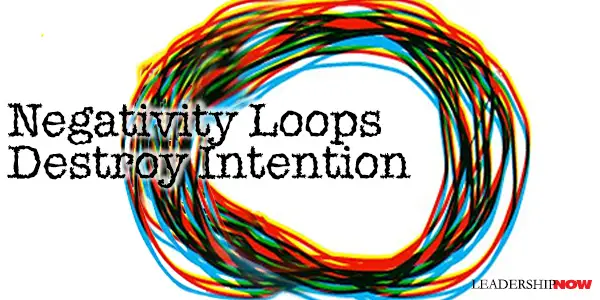
WHEN the stakes are high, negative thinking is a no-brainer; it comes naturally to any of us. Living intentionally is the path to success, but what happens when our intentions are derailed? When things aren’t going as planned?
Kristi Hedges is an expert in executive presence. In The Power of Presence she describes presence as “how people move through the world.” It is how people perceive you over time. Negativity dramatically affects your ability to lead.
Negativity pulls us down and inward. Positivity pulls us up and outward.
Negative thoughts have two characteristics: they are permanent and universal. As in, “They are…” “It is…” and “I’m not.” Hedges says, “People who maintain optimistic thoughts gain resilience. When they have setbacks, they see the issue as temporary and specific, not permanent and pervasive.”
You have to learn to dispute your own negativity and turn it into optimism. Most of our pessimistic thoughts are just catastrophizing with little or no root in reality. Negative thoughts “Support inaction, excuse complacency, and take away our options for solutions. They destroy our game.”
When you find yourself in a stressful situation and caught in a downward negative spiral, Hedges recommends that you:
Like us on Instagram and Facebook for additional leadership and personal development ideas.
Posted by Michael McKinney at 10:25 AM
Permalink
| Comments (0)
| Personal Development

THE Enneagram is a method for identifying your personality type and is a valuable system for learning about yourself and others. The Enneagram system defines nine basic personality types of human nature and their complex interrelationships.
Wendy Appel has tackled the Enneagram’s subtleties and complexities in InsideOut Enneagram. Her book makes practical the Enneagram system by use of clear explanations of each Type, case studies, and a structured journaling process. There is a section on Type and team interactions that examines predictable points of tension, reactive patterns, and synergies between all of the possible Enneagram Type pairs. Her goal is to help you to see and think differently about your strengths, your weaknesses, and mostly the subterranean habits of mind and motivations that drive you and others. It’s a journey of self-mastery.
Appel observes that “most of us focus our attention outward and neglect our inner life. We think that change is out there. Instead of tuning in to the language of our head, heart, and gut, we are busy looking outside, ahead, and down.”
Understanding who we are, uncovering our blind spots, and creating a game plan to master our thinking and behavior, is vital to developing our leadership potential and to better understand those we lead.
The subconscious mind, where our habits, patterns, and beliefs reside, directs the course of our lives, and most of us are unaware that this is happening. To transform as leaders and to transform our organizations require that we examine our core beliefs—both individual and collective. If not, we simply make iterative changes, and that won’t be enough to succeed in today’s globalized economy.
The Enneagram gives you the possibility to transform the way you show up as a leader. Inner change leads to outer change—when your inner world transforms, an opening is created for extraordinary shifts to occur in your outer world. When you lead from the InsideOut, you have the ability to be responsive and flexible enough to act in the moment. Your words and actions are aligned. You take responsibility for creating your life and for leading with integrity and passion.
Appel says she often gets asked “about the difference between the MBTI and the Enneagram, or whether MBTI Type preferences neatly fit into the Enneagram Types. The most simplistic way to understand how the systems complement each other is that the MBTI describes preferences for how we do things (get our energy, make decisions, gather information, and so on); the Enneagram describes why and how we behave as we do (beliefs, fears, desires, focus of attention), and how we go about getting our perceived needs met.”
InsideOut Enneagram is an opportunity to discover what is working for you, what is not working for you, why, and what you can do about it. You will find descriptions of each type on her website.
Like us on Instagram and Facebook for additional leadership and personal development ideas.
Posted by Michael McKinney at 07:08 PM
Permalink
| Comments (0)
| Human Resources
, Personal Development

THE premise of Flip the Script is approaching everything in your life with a new mindset: you can’t control circumstances but you can manage them.
Author Bill Wackermann says that the first step is to “embrace the notion that turning a situation around and creating new opportunities takes the desire to face yourself as you really are and a willingness to see the potential that could be hiding right in front of you.”
Wackermann believes that anything can be flipped—any expectation can be turned upside down. It is a skill that can be learned and developed through practice. The book is divided into three sections: understanding yourself, navigating how to build your flip, and winning, overcoming obstacles and putting it all together. All three steps are important, but the first section is the meat of the book and the one that requires the most attention because this is where we get in our own way most of the time.
Understanding yourself and your situation requires honesty. It doesn’t do any good to make excuses here; that only clouds the issues. “Designing your way around obstacles starts with a proper mind-set.” Begin by asking, “So what if …?” So what if there isn’t enough money? We are short on people? So what if they don’t come through? “So what if?” is a “mental tactic that allows you to force yourself to consider alternative viewpoints and plan for the worst.”
Taking responsibility for where you are in this moment, is crucial and once done can actually provide us with a great deal of freedom. Blaming others imprisons us. Wackermann suggests asking yourself:
In conjunction with those questions, you might also ask yourself:
Wackerman says blame is like candy; too much is unhealthful and will make you sick. “What’s standing between you and success right now is you. Not your folks, not your history, just you. I’m not suggesting that you deny your past, but I am advising that you refuse to live there because it just might kill your future.”
He covers common areas of self-sabotage like Know-It-All-Ism, My Boss Hates Me, Taking Things Personally, Perception is Reality, and Excusing Yourself. Wackermann leaves you with much to think about. Here are a few more ideas to keep in mind:
Flipping means managing all aspects of a situation, including the internal and external…A successful flip requires that we not confuse our motives with what the world sees. To move our goals forward, we have to be mature enough to recognize that perception, unfortunately, is reality. That is business, and our actions and behavior shape how others see us and see our potential for growth. The good news is that we can control in way both big and small how the world sees us.
You can borrow the best of what you like in others rather than fixating on their worst traits.
The behaviors you do robotically are the ones that are keeping you stuck in your current situation.
Actions must follow words. If you feel like other people are catching all the breaks, come in early, stay late, and volunteer for assignments that take you out of your job function. It’s called taking the initiative: you need to show your boss that side of you.
Flipping the script isn’t based on intelligence, rather it’s based on our ability to manage ourselves and control our urges.
Doing the right thing is so hard because it usually takes much more work, determination, willpower, and self-control than you’d expect.
To win at politics, don’t complain, and take five minutes a day to build alliances and stay focused on your end goals. Use the ROPE method: Have a good Role Model, Open yourself to change, Project confidence, and Express humility.
In the end, you can’t make people behave differently; all you can do is manage yourself.
|
|
Like us on Instagram and Facebook for additional leadership and personal development ideas.
Posted by Michael McKinney at 09:41 AM
Permalink
| Comments (0)
| Personal Development
HABITS will always be with us. Some good. Some bad. But how do you replace bad habits with good habits? More importantly, how often do we ask ourselves if what we are doing is really just a habit? We are less intentional than we think we are.
As a newspaper reporter in Baghdad, Duhigg heard about an officer conducting an impromptu habit modification program in Kufa, a small city ninety miles south of the capital.
He was an army major who had analyzed videotapes of recent riots and had identified a pattern: Violence was usually preceded by a crowd of Iraqis gathering in a plaza or other open space and, over the course of several hours, growing in size. Food vendors would show up, as well as spectators. Then, someone would throw a rock or bottle, and all hell would break loose.
When the major met with Kufa’s mayor, he made an odd request: Could they keep the food vendors out of the plazas? Sure, the mayor said. A few weeks later, a small crowd gathered near the Masjid al-Kufa, or Great Mosque of Kufa. Throughout the afternoon, it grew in size. Some people started chanting angry slogans….At dusk, the crowd started getting restless and hungry. People looked for the kebab sellers normally filling the plaza, but there were none to be found. The spectators left. The chanters became dispirited. By 8 PM, everyone was gone.
In a sense, a community—your organization—is a giant collection of habits. Later, when Duhigg talked to the major, he said, “Understanding habits is the most important thing I’ve learned in the army.” “Once you see everything as a bunch of habits,” says Duhigg, “it’s like someone gave you a flashlight and a crowbar and you can get to work.”
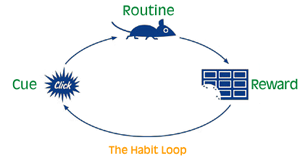 A habit is the brain’s way of saving effort. Duhigg has broken the formation of habits into a three-step loop: the cue (“a trigger that tells your brain to go into automatic mode and which habit to use), the routine (“which can be physical, or mental or emotional”), and finally there is the reward (which helps your brain figure out if this particular loop is worth remembering for the future).
The key to remember here, says Duhigg, is that “When a habit emerges, the brain stops fully participating in decision making. It stops working so hard or diverts focus to other tasks. So unless you deliberately fight a habit—unless you find new routines—the pattern will unfold automatically.”
Breaking habits down in this way makes them easier to deal with. If we can learn to identify the cues and rewards, we can change the routines. We can live life a bit more intentionally.
Duhigg shows how habits played a part in the success of Olympic swimmer Michael Phelps, Starbucks CEO Howard Schultz, and civil-rights hero Martin Luther King, Jr. He goes behind the scenes at Procter & Gamble, Target superstores, Rick Warren’s Saddleback Church, and NFL locker rooms. He explains how improving a single habit rippled out to improve an entire organization—Alcoa. Fascinating material to think about on many levels.
How much of what you do is on autopilot?
How much of what your organization does is on autopilot?
Follow us on Instagram and X for additional leadership and personal development ideas.

Posted by Michael McKinney at 07:08 PM
Permalink
| Comments (0)
| General Business
, Human Resources
, Management
, Personal Development
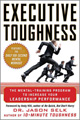 Like us on Facebook for additional leadership and personal development ideas.
Posted by Michael McKinney at 11:01 PM
Permalink
| Comments (0)
| Personal Development
Our understanding of leadership does not come to us all at once. It takes time. In our instant-oriented culture we often want to short-circuit the thinking, reflecting and acting that mark our progressive development as leaders. Understanding how leaders develop and why they matter requires discernment, wisdom and insight.Leadership development is a process. Seeking instant results and ladder-climbing can leave us little to show for our efforts. Some leaders “penchant for moving on has allowed them to avoid facing the consequences of their decisions” thereby restricting their development. “They have changed responsibility so often that they have failed to undergo the development that comes from facing mistakes.” Then too, some leaders are so busy “fixing problems” with personnel changes that they never really face the core issue—themselves.
Like us on Facebook for additional leadership and personal development ideas.
Posted by Michael McKinney at 10:36 PM
Permalink
| Comments (0)
| Leadership Development
, Personal Development


 Justification: You defend your negativity and your right to be angry. Negative emotions cannot exist unless you can justify your right to experience them to yourself and others. The more you justify yourself and convince yourself that the other person involved is bad in some way, that you are pure and innocent and are therefore entitled to feel the way you do, the angrier and more upset you become.
 Identification: This means that you take things personally. You interpret what has happened as a personal attack on you. Having healthy emotional boundaries is essential, especially in a work environment. You can be compassionate without identifying with someone else’s emotions.
 Hypersensitivity: To be extremely sensitive to the thoughts, opinions, or attitudes of others toward you. Peter Ouspensky called it “inward considering.” In extreme cases, hypersensitive people become paralyzed in that they cannot make a decision without getting the approval of other people.
 Judgmentalism: The tendency of people to make negative assessments about others. When you judge another, you become emotional. And emotions distort evaluations. People often judge others because they want to control their behavior.
 Rationalization: What happens when you put a socially acceptable explanation on an otherwise socially unacceptable act. Because of low self-esteem and weak egos, most people cannot admit that they have done or said something that was not thoroughly reasonable and justified.
You have a wonderful mind. But it is a two-edged sword. You can use it to make yourself happy, or you can use it to make yourself angry. Your goal should be to use your intelligence to keep yourself calm, in control, and at peace, no matter what is happening around you or to you.
Like us on Facebook for additional leadership and personal development ideas.
Posted by Michael McKinney at 10:14 PM
Permalink
| Comments (0)
| Five Lessons
, Personal Development
THERE IS NO quick fix—no hack. But the right habits consistently applied in your life will bring you success. It’s the compound effect.
The Compound Effect is a reminder of the law of cause and effect. Darren Hardy shares the impact it has had on his life and how you can make yourself accountable for your choices.
The Compound Effect is the ripple effect you get from the choices you make. In life, you not only reap what you sow, you reap more than you sow. The seemingly insignificant choices we make daily, will create major changes in your life for good or bad. These are the things we don’t think about because they have no immediate effect. They don’t seem to matter. But over time, they can take you places you never intended. Hardy encourages us to make conscious choices—daily.
Given the fact that we have a limited lifespan, the earlier we start consciously making small changes in our behavior, the more powerfully the Compound Effect works in our favor.
Since your outcomes are all a result of your moment-to-moment choices, you have incredible power to change your life by changing your choices. Step-by-step, day by day, your choices will shape you actions until they become habits, where practice makes them permanent.
Creating habits isn’t easy. Hardy says you have to begin by thinking your way out of the instant gratification trap. “The problem is that the payoff or instant gratification derived from bad habits often far outweighs what’s going on in your rational mind concerning long-term consequences. Indulging in our bad habits doesn’t seem to have any negative effects at all in the moment. But it doesn’t mean you haven’t activated the Compound Effect.
Hardy also recommends that when we try to change a habit we should focus on what we are adding-in rather than what we are taking-out. Instead of thinking about all of the TV you will miss in the evening, think about the experience and fulfillment you will gain by adding-in a hobby instead. Instead of focusing on what you have to sacrifice, focus on what you get to add-in.
It harder to get started than it is to keep going, so you must be consistent to keep your momentum going. “When you start thinking about slacking off on your routines and rhythms, consider the massive cost of inconsistency. It is not the loss of the single action and tiny results it creates; it is the utter collapse and loss of momentum your entire progress will suffer.”
In this regard, it is important to look at what is influencing you—what you feed your mind, the people you spend time with, and your environment will all conspire to bring you closer or further from your goals. Stand guard.
Finally, Hardy says to multiply your results by going beyond the expectations; doing the unexpected. Uncommon things deliver uncommon results.
|
|
Like us on Instagram and Facebook for additional leadership and personal development ideas.

Posted by Michael McKinney at 11:47 PM
Permalink
| Comments (0)
| Personal Development
“There are thousands of books on success. But very few on failure,” begins Siimon Reynolds in Why People Fail. “Yet mastering failure is surely a vital step in achieving your aims, hopes, and dreams.”
He is passionately driven to take the "taboo" out of failure. As Reynolds suggests, it is a "forbidden subject. We're not supposed to fail, and if we do, we're supposed to hide it from everybody. It gives people the wrong impression about what it takes to be successful."
Failure leads to success—if you see it as a process. “If someone has achieved more than you, it’s not usually because they are better than you or smarter than you. It’s because they have discovered a better strategy for success.”
Reynolds has identified 16 reasons for failure. They are:
1. Unclear purpose
Reynolds claims that the reason average people are average is because they have no clear purpose. “It is not unusual to see people working 12 hours a day and still not getting anything substantial done. Why? At the heart of it, their lack of clarity about the best use of their time leads them to work on what’s urgent, not what’s important.” Foggy purpose leads to mediocre results, says Reynolds. Zig Ziglar remarked, “Most people are a wandering generality rather than a meaningful specific.”
2. Destructive thinking
Not surprisingly, destructive thinking has a dramatic impact on both our health and our behavior. Reynolds recommends the SCORE technique created by Jim Fannin. Before you begin a new task, ask yourself: Are you working toward your goals? (Self-Discipline), Are you focused? (Concentration), Are you positive? (Optimism), Are you calm? (Relaxation), and Are you choosing to have fun? (Enjoyment).
3. Low productivity
Getting productive begins with planning before you start. Make a list. Break your work down into blocks of time. Reynolds says that when he’s feeling down or lazy, he likes to separate his day into 10-minute blocks. Working in short bursts boosts his momentum and increased his concentration. This technique he learned from Ingvar Kamprad, founder of IKEA. Kamprad says, “Divide your life into 10-minute units and sacrifice as few of them as possible in meaningless activity.”
4. Fixed mindset
People with a fixed mindset believe that their capabilities are set in stone. They tend not to try hard, give up early, and don’t try new things. In contrast, people with a growth mindset believe that with dedication and effort, you can get better. They tend to forgive more, see problems as temporary, learn from their mistakes, and have faith in the future. What would happen if you worked a little harder at something you feel you’re not good at?
5. Weak energy
Success takes energy. Success requires good sleep, a proper diet, exercise, and a balanced lifestyle.
6. Not asking the right questions
The questions you ask create the things you think about and the direction of your life. You should be asking yourself the following questions frequently: What are my values? What would I do if I knew I couldn’t fail? What could go wrong? How could I make ten times more money? What would X do? Should I even be involved with this? How would my competition defeat me? What’s the best use of my time right now? When I die, what kind of life would I like to have lived? How could I improve that performance?
7. Poor presentation skills
“Presenting well will increase your confidence and your salary faster than almost any other skill. Your boss will want you to lead more, and your clients will trust you more. You’ll feel in command and in control, and others will sense that they’re dealing with someone highly capable and dynamic.”
8. Mistaking IQ for EQ
A priceless ability for leaders, those with a strong EQ (emotional intelligence) are able to perceive emotions, use emotions, understand emotions, and manage emotions. “When it comes to everyday practical living, EQ beats IQ every time.”
9. Poor self-image
Self-image is important because it determines what actions you will take and how you will feel each and every day. It’s like your “mental operating software…a mental blueprint of what’s possible for you.” Mostly, you are not your conscious thought. According to Deepak Chopra, about 70% of your thoughts are not new. They are the same thoughts you had yesterday. “The truth is, because of their low self-image, most people are selling themselves short.” Think about your self-image and focus on building it up. Act-as-if. Consider the people you socialize with. Are they building you up? Visualize who you could be.
10. Not enough thinking
We are obsessed with doing and don’t spend enough time thinking. Brainstorm regularly.
11. No daily rituals
Daily rituals enable even average people to become champions of life and ultimately outperform others who seemingly have more talent. “If you can add a structure to your goals, a ritual you do daily, you will increase the chances of achieving them by 1000%.” If you’re not getting the results you want in any area of your life, Reynolds attributes it to a lack of ritual.
12. Stress
Stress can kill. Relieve stress with deep breathing and the practice of releasing. You might try list making, dividing your stress into things you can do something about and things you can’t, cleaning and simplifying your environment, getting outside, eating properly, and creating order in your life.
13. Few relationships
You can’t get there alone. You must enlist the help of many others along the way. Develop your ability to develop strong personal relationships.
14. Lack of persistence
Giving up too soon is at the heart of many failures for two reasons. The first is a poor self-image. “Deep down they don’t have the faith that they are capable of pulling off a great victory, so when they try, they do so in a tentative, half-hearted manner and are ready to give up at the first sign of difficulty.” And second, they think there is something wrong with failure. Champions know they are going to fail numerous times, so they get on with it.
15. Money obsession
Professor Tim Kasser remarked, “The more materialistic values are at the center of our lives, the more our quality of life is diminished.” Research shows that people who focus on the material things are less satisfied with their lives. There is nothing wrong with money, but we shouldn’t build our life around it. Better to focus on relationships, community, serving others, and appreciation.
16. Not focusing on strengths
Know your strengths to maximize your natural strengths. Not everything you need to do can be centered around your strengths, but the more you do, the more successful and enjoyable your life will be.
|
|
Follow us on Instagram and Twitter for additional leadership and personal development ideas.
Posted by Michael McKinney at 06:31 PM
Permalink
| Comments (0)
| Personal Development

We can only be said to be alive in those moments when our hearts are conscious of our treasures.—Thornton Wilder
Sometimes we have big and uncommon things to be thankful for, but mostly what we have to be thankful for is daily, common and mundane. It’s these daily blessings that we take for granted. It’s these that we need to be most thankful for and learn to find ways to express our gratitude for—daily.
Gratefulness is a state of mind. Gratitude puts us more in the moment rather than being shackled to the past. Without an attitude of gratitude, we tend to focus on the wrong things. It makes us do things we shouldn’t do.
Gratitude assigns meaning to that which we find common, but is, in fact, a gift. At the same time, it gives us meaning.
Often it is not until we are deprived of something that we begin to appreciate that which we take for granted. It is easy to be oblivious to that which we have until we lose it or face the prospect of losing it.
Do we have to suffer a loss to appreciate that which we have?
Like us on Instagram and Facebook for additional leadership and personal development ideas.
Posted by Michael McKinney at 12:01 AM
Permalink
| Comments (0)
| Personal Development
Many people view “character” as an immutable trait formed during childhood and adolescence. I believe character development is similar to the development of knowledge or wisdom—it’s a lifelong process. The world isn’t neatly divided into good people and bad people. Most will behave well or poorly, depending on the context….Business leaders need to remember that most of us have too much confidence in our strength of character.Nohria is exactly correct. Good leadership is humble leadership. Humility is living in truth. The truth about our limitations and an understanding of our proper relationship with others. And do we share with each other a moral overconfidence—a certain naiveté about ourselves that carries with it the seeds of our own destruction.
Like us on Facebook for additional leadership and personal development ideas.
Posted by Michael McKinney at 04:07 PM
Permalink
| Comments (0)
| Human Resources
, Leadership Development
, Personal Development

AMBIGUITY is not only certain; it is a necessary state for advancing. Jonathan Fields writes, in Uncertainty: “The more you’re able to tolerate ambiguity and lean into the unknown, the more likely you’ll be to dance with it long enough to come up with better solutions, ideas, and creations.”
The problem is that most of us, to one degree or another, react so strongly to ambiguity or uncertainty, that it becomes a limiting factor in our lives and stops us from acting in the face of it. The issue is not so much failure as it is not wanting to “be judged for taking the less-mainstream path and coming up empty.”
But taking the risk in the face of uncertainty is “not about tempting fate, it’s about going to that place where magic happens.” Living in the question. So how do we push forward when everything seems to be spinning out of control?
Fields suggests we first find our certainty anchors. Certainty anchors are rituals and routines that we build into our lives that help to counter the resistance. On those occasions when you find that it is “Twitter-Time,” rituals and routines will help move the process along. “Ritual helps train you to sit down when you most want to stand when you’re forced to work on the part of the process that leaves you anywhere from bored to riddled with anxiety.”
Get feedback along the way. Build a hive of heroes, mentors, and champions. Consider ways to bring into the process the very people you are creating for.
Train your brain in the art of focused awareness through meditation, mindfulness, visualization, and exercise to stay focused and grounded. Randy Komisar, author of The Monk and the Riddle, told Fields:
It’s a process of stripping myself bare of all the pressures, all of the barnacles that accumulate around you every day as you interact in the world—the pressures, the expectations, the ego, the things that ultimately make your vision unclear.
Exercise in the list above wasn’t an afterthought. Most of us feel we don’t have time to work out. But we really can't afford not to. Fields writes:
Studies now prove that aerobic exercise both increases the size of the prefrontal cortex and facilitates interaction between it and the amygdala. This is vitally important to creators because the prefrontal cortex, as we discussed earlier, is the part of the brain that helps tamp down the amygdala’s fear and anxiety signals.For artists, entrepreneurs, and any other driven creators, exercise is a powerful tool in the quest to help transform the persistent uncertainty, fear, and anxiety that accompany the quest to create from a source of suffering into something less toxic, then potentially even into fuel.
I emphasize this a lot on the Leading Blog, but I think it’s something we really have to work at. Randy Nelson, Pixar’s former head of education said, “The core skill of innovators is not failure avoidance, it’s error recovery.” Fields adds, “When that’s baked into your creative culture on all levels, people become more empowered to lean into the creative abyss—and magic tends to happen.”
|
|
Like us on Instagram and Facebook for additional leadership and personal development ideas.
Posted by Michael McKinney at 06:39 PM
Permalink
| Comments (0)
| Creativity & Innovation
, Personal Development
, Problem Solving
THE workplace has enough challenges and obstacles without us getting in our own way. But too often, we sabotage ourselves. Whether it’s internal forces that cause us to sell ourselves short or it’s a matter of having been conditioned not to “toot our own horn,” people have a marked tendency to avoid the limelight when in truth, they belong in it. What’s more, if you’ve always been the ‘unsung hero,’ management wants to know who you are.
In my executive coaching business, I’ve worked with scores of clients over the years to help them overcome self-limiting mindsets that were holding them back in the workplace. Here are some of the most common issues:
Remember, if you don’t take credit for your own success, someone else will. That doesn’t serve your own interests. And if you think about it, it doesn’t serve the long-term interests of the company. You have a professional duty to yourself as well as your company to make sure your accomplishments are recognized and credited to you.
Follow us on Instagram and Twitter for additional leadership and personal development ideas.

Posted by Michael McKinney at 10:11 AM
Permalink
| Comments (0)
| Human Resources
, Leadership Development
, Leading Forum
, Personal Development
Ben begins with an agenda. His job is to convince or if necessary, to steamroll a manufacturer of high-quality chairs to accepting a merger. Ben’s company believes it to be a good thing, but the target company is not so sure. Ben’s mindset as he starts out is: “how do I get them to do what I want them to do.”
Somewhere between getting people to understand him and slowing-down long enough to understand them, he found his answer.
Through a series of encounters with a mentor—Aunt Elle—and a lot of reflection Ben comes to understand that it is not about him. His journey causes him to reflect on five lessons:
Lesson #1: Hold the Vision. The hard part isn’t coming up with the vision, it’s holding on to the vision. “As a leader, your job is to hold fast to the big picture, to keep seeing it in your mind’s eye, with crystal clarity, where it is you are going—that place that right at this moment exists only in your mind's eye. And to keep seeing that, even when nobody else does.”
Lesson #2: Build Your People. “People have all sorts of amazing qualities and natural abilities trapped inside them. With the wood, it’s knowing how to apply the heat. With people, it’s applying your belief.” If you give people something great to live up to, they usually will. “How influential you are, comes down to your intention. What are you focused on? Your benefit, or theirs?” The more you yield, the more power you have.
Lesson #3: Do the Work. Be humble and stay grounded. Aunt Elle said, “People who achieve great things that the world will never forget, start out by accomplishing small things the world will never see.”
Lesson #4: Stand for Something. Lead from who you are. People will figure it out anyway. People need to trust your competence, but they need to trust your character more. “Competence is simply the baseline, the thing that puts you in the game. It matters, but honestly, it’s a dime a dozen.” The authors remind us that you can only lead as far as you grow. Aunt Elle says, “What you have to give, you offer least of all through what you say; in greater part through what you do; but in greatest part through who you are.”
Lesson #5: Share the Mantle. It’s not about you. “You are not their dreams, you are only the steward of those dreams. And leaders often get it backwards and start thinking they not only hold the best of others but they are the best….The moment you start thinking it’s all about you, that you’re the deal, is the moment you begin losing your capacity to positively influence others’ lives.”
Whatever great parenting looks like, it is not about the parent.
The Go-Giver Leader is a great presentation of solid life lessons. A book to be read and passed around. Unfortunately, “it’s not about you,” is not the kind of lesson that once learned, is always remembered. If it was, fewer great leaders would finish poorly after so many years of outstanding service. This is an issue that we face over and over again, but hopefully in ever diminishing frequency and intensity as our leadership matures. This book is a great reminder of the power of the right kind of leadership; leadership that comes from an inner strength of understanding, service and outgoing concern for others.
|
|
Like us on Instagram and Facebook for additional leadership and personal development ideas.
Posted by Michael McKinney at 09:29 PM
Permalink
| Comments (0)
| Followership
, Human Resources
, Leadership Development
, Personal Development
Everyone is born a genius, but the process of living de-geniuses you.Gina Rudan’s Practical Genius is designed to re-genius you. Gina says we all have the capacity for what she terms, practical genius. It is the “kind of practical, street-level, everyday genius that can change the game for you, your business, and every aspect of your life.” Practical genius is a choice.—Buckminster Fuller
So many of us are unconsciously compromising some of our greatest natural assets because of external factors, past hurts, or current fears. Or, even worse, we have sacrificed our skills, strengths, and passion to the expectations and influence of others. Or we’re consciously hitting the snooze button, rolling over and going back to slept every time we’re reminded how far from feeling happy and fulfilled we are in our work and personal lives.In order to identify and leverage both the hard and soft unique personal assets we all possess, Gina has created a 5-step plan:
|
|
Like us on Facebook for additional leadership and personal development ideas.
Posted by Michael McKinney at 05:48 PM
Permalink
| Comments (0)
| Personal Development
THE TERM work-life balance is fatally flawed says Matthew Kelly in Off Balance. Meant to deal with the pressures surrounding both personal and professional life, the term has unwittingly created a false dichotomy. You can’t separate the two. In fact, says Kelly, “the term itself diminishes our ability to make the case that work can be a richly rewarding part of a person’s life and should in many ways be personal.”
What people really want (and need) is not work-life balance, but to “live deeply satisfying lives both personally and professionally.” The trick is to get in touch with your dissatisfaction and then strategically create the life you want. But it will take some work. It’s not going to happen accidentally. Kelly writes, “The life you desire is there for the taking, but it comes at a cost. Life, like business, hinges on the successful allocation of scarce resources.”
Kelly provides some key thinking to support this discussion:
We seem more interested in how we want to live than we are in discovering the best way to live. Likewise, we are much more interested in developing self-expression than we are in developing selves that are worth expressing. Personal preference has triumphed over the pursuit of excellence. We want what we want, and we feel entitled to get what we want.
The problem with all this is that getting what we want is certainly not work-life balance, and getting what we want almost never leads to personal and professional satisfaction. The reason is that very few people have the requisite self-knowledge to want the right things. As we grow and gain this self-knowledge we begin to want what we need because we discover that the fulfillment of our legitimate needs is more likely to lead to lasting happiness in a changing world than the reckless pursuit of whimsical happiness.
So we need to begin with self-knowledge. “Satisfaction does not arise from simply having experiences and things, but rather from having the experiences and things that you deem important.” Kelly has developed a system to increase the level of personal and professional satisfaction in your life that involves five steps, beginning of course with assessment:
Assessment. What brings you satisfaction? (There is an Off-Balance Assessment in the book and online at FloydConsulting.com) This process says Kelly, allows us to pinpoint an element of our dissatisfaction and create a prescription to overcome it.
Priorities. What matters most to you? While these may change over time, it is essential that we clearly define them or we become victims of the tyranny of the urgent.
Core Habits. What are the daily habits that keep you healthy, focused, and energized? For example, workout, meditation, proper diet, maintaining relationships. “What one thing, if done every day, would change your life markedly?”
Weekly Strategy Session. What is the key project that should have your attention and be your starting point for each day of the week? Our lives are destined for underachievement and dissatisfaction if we don’t learn to plan and strategize personally.
Quarterly Review. Every three months review what is working well in your life, review what you said you would do in the last ninety days; outline the key objectives in your life at this time; share your plan to accomplish these objectives.
Kelly says that knowing how to balance various activities in our life to produce the maximum flow of energy is perhaps the most important skill any of us can learn and develop. “Each day has a focus, and holding to this focus plays a significant role in creating and sustaining high levels of satisfaction.” He concludes, “To lay your head on your pillow at night, knowing that who you are and what you do makes sense … now, that is satisfaction.”
|
|
Follow us on Instagram and Twitter for additional leadership and personal development ideas.
Posted by Michael McKinney at 03:00 PM
Permalink
| Comments (0)
| Human Resources
, Personal Development
THERE are no guarantees in life. We can be proactive, but there are some things that are completely outside of our control. So if we can’t be proactive on everything, we can, Mark Sanborn suggests, be interactive. We must learn how to interact with the forces in our life that are bigger than we are to create the outcomes we desire. No matter where we are—up, down, or sideways—there are things we can do to mitigate the downs, take advantage of the ups and maximize the sideways times in our life.

To be interactive, you first need to define your scorecard for success. Most people don’t live the life they imagined because “they are stuck using a scoring system that doesn’t fit the game they want to play.” Sanborn guides you in developing a scoring system that is meaningful, long-term, and personal.
Besides a clear scoring system, your success also depends on your attitude. You must develop an optimistic attitude. “The way you look at yourself and the world around you affects your success regardless of the circumstances.” We can choose what we focus on.
Another important mindset is that of the lifelong learner. “The more you learn, the more prepared you are for whatever comes your way. And the more you learn, the more you develop behavioral flexibility that provides a distinct advantage over your competition.”
Sanborn offer six methods to succeed when times are Up, Down, or Sideways.
Sanborn gives some final reminders: When you’re Up, you need humility and perspective. So surround yourself with people who keep you grounded. When you’re Sideways, you need a boost. So surround yourself with people who challenge you to keep moving in the right direction. And finally, when you’re Down, you need hope. So surround yourself with people who lift your spirits.
Certainly this is an important book for these times, but this book is meant to help your thrive no matter what life throws your way. You need this book—young people need this book—to prepare for the rest of your life, whether you are Up, Down, or Sideways. Read, reread, and refer.

|
|
Like us on Instagram and Facebook for additional leadership and personal development ideas.

Posted by Michael McKinney at 07:08 AM
Permalink
| Comments (0)
| TrackBacks (1) | General Business
, Personal Development
CHARACTER is built choice by choice, decision by decision. And it is eroded the same way. We often don’t stop to think about how each choice builds on the last until it’s too late. It is a worthwhile practice to think about your choices and where they are leading you on a daily basis. Ralph Waldo Emerson put it well: “The force of character is cumulative.”
In a October 2002 Fast Company article—The Secret Life of the CEO: Is the Economy Just Built to Flip?—Jim Collins, explains how character erodes:
These were the people who, in the presence of an opportunity to behave differently, got drawn into it, one step after another. If you told them 10 years ahead of time, "Hey, let's cook the books and all get rich," they would never go along with it. But that's rarely how most people get drawn into activities that they later regret. When you are at step A, it feels inconceivable to jump all the way to step Z, if step Z involves something that is a total breach of your values. But if you go from step A to step B, then step B to step C, then step C to step D ... then someday, you wake up and discover that you are at step Y, and the move to step Z comes about that much easier.”
Like us on Instagram and Facebook for additional leadership and personal development ideas.

Posted by Michael McKinney at 10:14 PM
Permalink
| Comments (0)
| Personal Development
WHILE we might like to think otherwise, here is a fact about successful leaders:
Successful leaders go through significant periods of time in which they feel confused, discouraged, and unsure of themselves and their decisions. They feel as if they should be somewhere else, doing something else.
And unsuccessful leaders go through the same thing. The difference, says Harvard professor Robert Kaplan, is “how they deal with these periods of confusion and uncertainty. The trick lies not in avoiding these difficult periods; it lies in knowing how to step back, diagnose, regroup, and move forward.”
Vision and Priorities. In this foundational area we need to be very clear and communicate it in a way that helps others to be able to determine where to focus their own efforts. Have you developed a clear vision and have you identified three to five clear priorities to achieve that vision?
Managing Your Time. Your vision and priorities are reflected in the way you use your time. Track your time for two weeks. How does this compare to your key priorities?
Giving and Getting Feedback. Most leaders do not effectively coach their subordinates, and also fail to get the critical coaching that they themselves need in order to excel. Do you cultivate advisors who are able to confront you with criticisms that you may not want to hear?
Succession Planning and Delegation. When leaders fail to actively plan for succession, they do not delegate sufficiently and may become decision-making bottlenecks. Have you identified potential successors for your job? Why not?
Evaluation and Alignment. It is often extremely difficult as an insider to see where you and the organization have drifted out of alignment. If you had to start again, how would you do it? Would you be doing the same things? Does the design of your organization, your incentive systems, your culture, and even your approach to leading still fit the needs of the organization?
The Leader as Role Model. Many leaders fail to appreciate that their actions speak louder than their words. Self-awareness is critically important. Write down two or three key messages you believe you send with your behavior. Seek advice from key subordinates and advisors who directly observe your behavior, in order to answer this question: is there a “disconnect” between the messages you wish to send and those you are in fact sending?
Reaching Your Potential. Know and learn to manage your strengths, weaknesses, and passions, not only to bring out your best, but also to create this same environment and aspiration among your staff.
It’s not uncommon to find leaders that just stick to what they know best and not address those areas where they feel uncomfortable or insecure. All of these areas need to be reflected on as they each have an impact on the other. Taking the time to reflect is not easy and “doesn’t sound like fun, and may not sound as important as the fifty other things you have to fit into your day—but it works.” And be sure to take the time to reflect on these issues with your team as well.
With many down-to-earth examples, Kaplan will expand the range of questions you should be asking yourself. What to Ask the Person in the Mirror will help you to rethink unsustainable behaviors that are damaging to both you and your organization and help you to mature and grow in your leadership role.
Like us on Instagram and Facebook for additional leadership and personal development ideas.
Posted by Michael McKinney at 03:57 PM
Permalink
| Comments (0)
| Human Resources
, Leadership Development
, Personal Development
READING Have a Nice Conflict was like listening to my Dad again. He first met “Doc” Porter in the early seventies and they clicked almost immediately. Elias Porter’s Relationship Awareness Theory, on which the book is based, resonated with my Dad.
Behaviors are the tools we choose and use to support our self-worth.
You can look at personal strengths like behaviors. They represent the different ways a person can interact with others to achieve self-worth. When a person tries one of these strengths and has success with it, they use it more often. Other strengths might have rendered poor results, and so they might tend to use those less and less. Over time, we develop a set of “go-to” strengths. They become our modus operandi.
But it’s important to remember that you have a whole tool chest of other options that may get you better results from time to time.
It is possible that some of your conflict at work happens because other people don’t see your strengths the way you intend them to be seen. … So when you find another person’s behavior annoying, look for the strength behind it. What are they overdoing? What are they really trying to accomplish? Most likely, their intent is not to annoy you. If you can find the strength lurking behind the perceived weakness, you’ve discovered insight into that person that may help you understand them better.
Conflict can happen when other people misinterpret your strengths.

Dr. Mac explains to John that there are many ways of interacting with others. We have default ways of behaving and when in conflict we often shift into other behaviors to maintain our self-worth. While we are trying to do the “right thing” to maintain our self-worth, conflict can happen when our “right thing” appears to be the “wrong thing” to another person. Conflict can be prevented by seeing contentious behavior as merely a different style instead of a direct challenge or threat aimed at annoying you or derailing you.
He introduces him to the Strengths Deployment Inventory (SDI) which is a tool to help you understand the motivations behind your own behaviors and to better discern the motivations of others. By giving you a framework it helps you to understand what you and others are feeling and then helps you be better able to respond.
Having a nice conflict is about taking personal responsibility for the interaction. To create movement toward resolution, we need to show the other person the path back to self-worth—where they feel good about themselves. That path may be different than yours.  The SDI helps you understand those paths. “When we’re stuck in a place of protecting our self-worth, it’s much harder to help others protect or restore what’s important to them. And that’s the primary mission of managing conflict. Managing conflict is about creating the conditions that empower others to manage themselves out of their emotional state of conflict. To effectively manage conflict, we have to begin with ourselves. If we’re pulled into conflict ourselves, we’re usually not in a great position to help others.”
The concept should be taught in schools, however, the thought process is essential for leaders. The book alone offers valuable insights into the process and methodology, but coupled with the SDI you’ll have greater success. The authors offer a discount on the SDI to readers of the book.
Like us on Instagram and Facebook for additional leadership and personal development ideas.
Posted by Michael McKinney at 05:08 PM
Permalink
| Comments (0)
| Communication
, Human Resources
, Management
, Personal Development
, Problem Solving
, Teamwork
I’m a strong opponent of imitation. I always tell them that they have to be themselves. That’s hard, because they don’t believe in themselves, they believe in their heroes. And I will tell them: that’s perfectly alright, but your hero is the only one who can play that way. If you want to try and do the same thing, it will only be an imitation, however perfectly you will do it. I keep on trying to convince them that they have to play what they feel themselves. But that’s not easy.Your hero is the only one that can play it that way. Be yourself.
Like us on Facebook
Posted by Michael McKinney at 04:43 PM
Permalink
| Comments (0)
| Personal Development
“Humbition is one part humility and one part ambition. We notice that by far the lion’s share of world-changing luminaries are humble people. They focus on the work, not themselves. They seek success—they are ambitious—but they are humbled when it arrives. They know that much of that success was luck, timing, and a thousand factors out of their personal control. They feel lucky, not all-powerful. Oddly, the ones operating under a delusion that they are all-powerful are the ones who have yet to reach their potential. . . . [So] be ambitious. Be a leader. But do not belittle others in your pursuit of your ambitions. Raise them up instead. The biggest leader is the one washing the feet of the others.Success most often doesn’t come from our efforts alone but in our ability to include and organize the contributions of others; to coax the fragments of a good idea from the hearts and minds of others; from a practiced watchfulness that comes from knowing that a good idea can come from anyone or anywhere. The result, when it comes together—the execution of a great idea—should be humbling to any leader.
Like us on Instagram and Facebook for additional leadership and personal development ideas.
Posted by Michael McKinney at 11:04 PM
Permalink
| Comments (0)
| Personal Development
GALLUP scientists have determined that there are five universal and interdependent elements of wellbeing that differentiate a thriving life from one spent suffering:
Statistically, while 66% are doing well in at least one area, only 7% are thriving in all five. If we are struggling in any one of these areas, as most of us are, it damages our wellbeing and wears on our daily life.
Ways to measure and improve in each of these areas is provided in Wellbeing by Tom Rath and Jim Harter. (The Wellbeing Finder can be taken online by using the code provided in the book.)
Our wellbeing will not improve if we don’t make a conscious decision to do so. Small changes can have a huge impact. To get started they recommend setting positive defaults.
One of the best ways to create more good days is by setting positive defaults. Any time you help your-short-term self work with your long-term self, you have an opportunity.
You can intentionally choose to spend more time with the people you enjoy most and engage your strengths as much as possible.
You can structure your finances to minimize the worry caused by debt.
You can make exercise a standard part of your routine. You can make healthier decisions in the supermarket so you don’t have to trust yourself when you have a craving a few days later.
And you can make commitments to community, religious, or volunteer groups, knowing that you will follow through once you’ve signed up in advance.
Through these daily choices, you create stronger friendships, families, workplaces, and communities.
Like us on Instagram and Facebook for additional leadership and personal development ideas.

Posted by Michael McKinney at 06:12 PM
Permalink
| Comments (0)
| Personal Development
YOU can’t stop The Drama. There will always be drama.

Chism defines drama as “any obstacle to your peace and prosperity.” Drama is the result of not recognizing or taking care of the little signs of bigger problems when they first presented themselves. At the core of drama, you will find one of three common elements (if not all three): a lack of clarity, a relationship issue, and/or resistance. So, says Chism, when you experience drama you need to ask yourself three questions:
1. Where am I unclear?
2. What is my relationship issue?
3. What am I resisting?
Chism presents eight principles for dealing with drama, but “lack of clarity” struck me as the most common and excuse-laden trap there is. Too often this is where we get stuck.
When we first set a goal we’re clear. In her terms, “we see the island.” But between here and there the process becomes difficult and someone on your team becomes unhappy, and, “instead of focusing on the island we are trying to reach, we’re now concentrating on pleasing the one person who is upset. Our focus has shifted because we became confused about our number one priority.” And the fog rolls in.
“Any type of discord, abuse, confusion, or game-playing always boils down to a lack of clarity.” A loss of focus.
Sometimes we create drama because we want something on our terms. We imagine that we can’t do something because we can’t do it the way we think it should be done—our way. Chism relates a clarifying example of this with the recently divorced Joe who is having visitation issues with his ex-wife Patty. She’s not letting him do what he wants in the way that he wants.
Many people get stuck in the drama of what should or shouldn’t be. Yes, you can fight that battle, if winning a battle is what you want. But again, in order to clear the fog and help Joe get clarity, I asked, “If there are two islands you can go to, and one means winning a battle with your wife and the other island is getting to see your kids and be a father to them—then which island would you choose?”
He said, “Seeing my kids, but…”
I said, “No buts. Are you willing to drive to Illinois several times a year and spend quality time with your kids, even if Patty does nothing more than cooperate?”
Joe said, “Yes.”
It’s never as difficult as we make it when we get clear on what we can control and what we are committed to.. The point here is that clarity may or not change Joe’s ex-wife. Joe will struggle if that is his motive or intention. However, Joe’s clarity will give him the essence of what he really wants. If he is able to let go of distractions and not get stuck on the rocks that lie between him and his final goal.
Do you see that while this kind of clarity may not change all the drama, it will give you peace and free up your energy for more productive endeavors?
This kind of dynamic plays out every day in our business and personal lives. When we are not clear about what we want, what our values are, what we are committed to, it is easy to lose our focus, to drift off course
Solution: Clear the fog.
Chism has written a good-natured and practical book that will change your thinking and in the process help you to control the drama in both your personal and professional life. As leaders, we have the responsibility to be very clear with ourselves and our team so that we don’t get pulled into negativity, gossip, power plays, resistance and … drama. Chism suggests asking the following questions:
What are my top 10 principle-based values?
What areas of my life or business are in the fog?
What are some of the distractions that take me off course?
Where do I get stuck?
Where can I improve as a leader?
What drama do I see on a daily basis in the workplace?
What drama do I see in my personal life?
Where am I avoiding or procrastinating?
Like us on Instagram and Facebook for additional leadership and personal development ideas.
Posted by Michael McKinney at 10:00 PM
Permalink
| Comments (0)
| TrackBacks (1) | Change
, Communication
, General Business
, Human Resources
, Management
, Personal Development
, Teamwork
, Vision
JUSTIN MENKES says that there are no longer periods of calm seas for leaders in any industry. So it’s not a matter of gritting your teeth and riding out the crisis. Leaders must get comfortable in an environment of ongoing stress. They must be Better Under Pressure.
To do this a leader must possess a “highly unusual set of attributes that often run counter to natural human behavior.” This means leaders must “foster specific attributes to achieve maximum success in themselves and their people. No longer can leaders think of leadership as unidirectional. Instead, leadership “becomes a fluid, virtuous cycle of exchange and growth between leaders and the people they lead.”
Menkes writes, “Almost every human being alive today has an underutilized thirst for bettering himself or herself. It is up to leaders to discover how to trigger this thirst—in fact, it is a leader’s most critical responsibility.” Recognizing and developing that thirst is something that must be and can be learned.
He identifies three catalysts that will help a leader to realize his or her own potential and the potential of others:
Realistic Optimism. Striking a balance between the known and unknown. Kevin Sharer, CEO of Amgen, said, “With all the things that are going on in today’s workplace, if you’re not a little bit self-reflective and self-aware, you’re not going to make it.” And you won’t get the best from your team.
Awareness requires humility. Humility allows you to see yourself as you are. It also allows you to see your role in any problem.
Realistic optimism creates a sense of agency—the degree to which you believe your circumstances are within your control. “People must recognize how—and that—their own approach to the problem can either exacerbate these obstacles or bridge the space between two parties.”
You must learn says Menkes, “to minimize the ways your mind distorts reality.”
Subservience to Purpose. While realistic optimism allows leaders to see and address deficiencies in themselves and the world around them, subservience to purpose gives them the drive to do so. In this framework, “people’s level of dedication toward the mission of the enterprise is paramount, rather than their dedication to each other….Hierarchical distinctions are secondary to the overarching value system that considers the company’s noble missions its most important function.”
Subservience to purpose means developing affect tolerance or “the ability to channel intense reactions to recurring setbacks in a way that not only avoids hampering you, but also constructively keeps you and your organization moving forward toward maximum potential.”
It is vital that a leader understand the outsized effect that their emotional behaviors have on their people. Not managing your emotions and reactions—especially in a stressful environment—will hinder other people’s progress. You must temper the intensity of your responses “with the awareness of the unequal power dynamics you share with your team.” This also means keeping in check your sense of self-importance. Menkes writes:
Grandiosity is particularly costly to you as a leader, because its expression unintelligently telegraphs to your subordinates that you believe the group’s accomplishments are largely due to your involvement. This why expressing humility is so important because when you are humble, you clearly communicate to others that you recognize the critical role each team member plays in contributing to the organization’s progress.Fred Smith, founder, chairman, and CEO of FedEx told Menkes:
As a founder, you must be able to resist any temptation to let the organization become a cult of personality built around you. FedEx isn’t about me. When I walk out the door here, this organization won’t miss a beat.”
How many can (want to) say that?
Finding Order in Chaos. This attribute is about maintaining clarity of thought and a drive to solve the puzzle. Maintaining clarity of thought is developed by learning how to manage your stress in such a way that it fuels your focus and increases your clarity. To do this, one must seek out experiences that support your sense of competence under duress—“managing adrenaline without panic and gaining confidence that the sensations that stress induces will not lead to collapse.”
The drive to solve the puzzle “manifests itself as an intense intellectual curiosity…and a pleasure in finding solutions to them.” Menkes adds, “The positive feedback we get from maintaining clarity under pressure gives us a thirst for more situations that involve pressure, and we are thus driven to solve the puzzle.”
 All of these attributes work to develop the other. Understanding things as they are gives you the confidence to face the issues with the mission in mind. Success in this area drives you to remain calm and find solutions to the problems with those around you. “Once you experience the gratification of triumph in the pursuit of meaningful goals, the virtuous cycle of realizing potential becomes a regenerating flywheel that is transmitted to others.”
Importantly, Menkes reminds us, “people do not act as isolated entities, but are reflections of an essential interaction between themselves and the context in which they are placed….A person’s potential can only emerge as an active process, consciously cultivated through a fluid, ongoing exchange between leaders and their people.” It serves to remind us of the privilege and huge responsibility leadership truly is. To see leadership primarily as a function of authority, is to totally miss the mark.
I’ve only offered an overview of the ideas Menkes presents here. There are so many more insights in this book than can be provided here. But reading the examples of those who exemplify theses attributes and those who haven’t, coupled with the interviews of 25 leaders, you will come away with a sense of where you stand and a confidence that you can improve in any area you identify.
Like us on Instagram and Facebook for additional leadership and personal development ideas.

Posted by Michael McKinney at 05:13 PM
Permalink
| Comments (0)
| Personal Development
FORMER chairman and chief executive officer of Baxter International, Harry Kraemer, has written a genuine, back-to-basics book on value-based leadership: From Values to Action. He presents four interconnected principles that build on and contribute to each other:
Self-Reflection is the most important and is central to your leadership. “If you are not self-reflective, how can you truly know yourself?” writes Kraemer. “If you do not know yourself, how can you lead yourself? If you cannot lead yourself, how can you possibly lead others?”
Self-reflection allows you to transform activity into productivity for all the right reasons. It means “you are surprised less frequently.” It is essential in setting priorities. You can’t do everything. So reflection makes it possible to answer key questions like What is most important? and What should we be doing? in a way that is in line with your strengths and values and organizational goals.
Engaging in self-reflection on a regular, ongoing basis (preferably daily) keeps you from becoming so caught up in the momentum of the situation that you get carried away and consider actions and decisions that are not aligned with who you are and what you want to do with your life.
Balance and Perspective is the ability to understand all sides of an issue. Pursuing balance means you will have to grasp the fact that leaders don’t have all the answers. Kraemer says, “My task was to recognize when a particular perspective offered by one of my team members was the best answer….Leadership is not a democracy. My job as the leader is to seek input, not consensus.”
Because he believes we are more effective if we balance all areas of our life, he prefers the term “life balance” over “work-life balance.” It’s not an either-or proposition. “When you identify too closely with your work, you can easily lose perspective and become unable to look at all angles in a situation.” He recommends implementing a “life-grid” to keep track of where you are spending your time and to hold yourself accountable.
True Self-Confidence is know what you know and you don’t know; to be comfortable with who you are while acknowledging that you still need to develop in certain areas. (Comfortable not complacent.) Why TRUE self-confidence?
There are people who adopt a persona that might make others think that they have self-confidence, but they are not the real deal. Instead, they possess false self-confidence, which is really just an act without any substance. These individuals are full of bravado and are dominating. They believe they have all the answers and are quick to cut off any discussion that veers in a direction that runs contrary to their opinions. They dismiss debate as being a complete waste of time. They always need to be right—which means proving everyone else wrong.
Genuine Humility is born of self-knowledge. Never forget where you started. “Genuine humility helps you recognize that you are neither better nor worse than anyone else, that you ought to respect everyone equally and not treat anyone differently just because of a job title.”
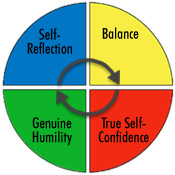 After describing each of these principles, Kraemer explains how these four elements play in everyday situations such as talent management and leadership development (“The values based leader is looking for people who exhibit the values that are most important to her.”), setting a clear direction (You’ve been tasked with creating a quick strategy, the first step is to listen. “This is precisely the time that you need to draw upon the capabilities of the excellent team you’ve put together.”), communication (“Never assume you have communicated enough.”), motivation (“What you must do is relate to others by letting them know who you are and the values you stand for.”), and execution (“As you become a leader, you will shift from knowing the right answers to asking the right questions.”).
Kraemer describes a values-based leader well: “Self-reflection increases his self-awareness. Balance encourages him to seek out different perspectives from all team members and to change his mind when appropriate in order to make the best possible decisions. With true self-confidence, he does not have to be right, and he easily shares credit with his team. Genuine humility allows him to connect with everyone because no one is more important than anyone else.”
From Values to Action is an outstanding book and filled with important concepts that any would-be leader would benefit from.
Like us on Instagram and Facebook for additional leadership and personal development ideas.
Posted by Michael McKinney at 04:13 PM
Permalink
| Comments (0)
| Communication
, Human Resources
, Leaders
, Leadership Development
, Management
, Personal Development
, Positive Leadership


Posted by Michael McKinney at 11:32 AM
Permalink
| Comments (0)
| Personal Development

Look for the fear. That’s almost always the source of your doubt.Godin notes, “I’ve had a lot of practice in poking the box, figuring out which ideas resonate, and then shipping them. The more you do it, the more it gets done and the less crazy you feel.” He also cautions, “Poke. But be smart about it.” Poke the Box is an effective and convincing book, but more importantly, if applied, is transformational.
Reject the tyranny of picked. Pick yourself.
Sooner or later, many idealists transform themselves into disheartened realists who mistakenly believe that giving up is the same thing as being realistic.
Poking doesn’t mean right. It means action. Once we learn how to take initiative we see opportunities all around us.

Posted by Michael McKinney at 12:30 AM
Permalink
| Comments (0)
| Personal Development
Posted by Michael McKinney at 12:24 AM
Permalink
| Comments (0)
| Personal Development
In the final part of this series, Marshall Goldsmith explains the relevancy of reflection in today’s world. It has always been a vital ingredient to success, but it becomes critical in the age of the knowledge worker. Jeremy Hunter teaches courses on The Practice of Self-Management at The Peter F. Drucker and Masatoshi Ito Graduate School of Management. He emphasizes a focus on reflecting in real-time—in the present—in order to align both our intentions and behaviors so that we might bring about the results we seek.
Marshall Goldsmith, executive educator and coach:
I believe that the process of reflection is more important today than ever before. I also believe that it is more challenging.
We live in the age of the knowledge worker. Peter Drucker defined knowledge workers as 'people who know more about what they are doing than their boss'. Knowledge workers need to think and reflect. They have to listen and learn. They cannot just 'do what they are told', since their managers know less than they do about what they are doing.
On the other hand, we live in a world of constant stimulus. Our minds are barraged by media of all forms. Cell phones, emails, text messages, and personal computers have reduced our already-limited attention spans.
One of the great challenges for the knowledge worker of the future is finding the time to think - in a world that is screaming at you to act.
Jeremy Hunter, Adjunct Professor, The Peter F. Drucker and Masatoshi Ito Graduate School of Management:
When we think of “reflection” it tends to be retrospective. Where I think my work is a bit different is that I focus on what a leader is doing right now as it is happening––reflection and awareness in the moment. Most people's immediate action will very likely be an automatic non-conscious process that they're not aware of. Throw in a little stress and emotional reactivity and people find themselves doing and saying things that are destructive to themselves, others, and their goals without understanding why nor knowing what to do about it.
The big issue is that the retrospective analysis alone can’t necessarily change a person's immediate habits. Science tells us that 90% or more of the brain’s activity is automatic and non-conscious. However, we have a worldview that focuses largely on conscious processing, we think that having the answer makes change automatically happen. A friend might say, “You know, Ruth, when you’re confronted with a challenge from a superior, you react too strongly.” OK, now Ruth knows that. We assume that just because Ruth knows what she does, she will change it. But there’s a whole other process that has to happen to change the wired-in, non-conscious, automatic pattern. Ruth may be 100% aware of what she does but then the trigger happens and it plays out in the same way. And then it’s, “Oh no, I did it again.”
Change happens in the choices we make right now. So my interest is in, how you actually retrain the brain by interrupting that automatic habit and doing something differently. You may have to do it over and over again but at some point, the rewiring function will happen. And that’s a function of interrupting that immediate non-conscious habit and doing something different.
I give people a model of this process from the triggering moment of contact to the final result. All along there are intervention points. Of course, the earlier you can intervene, the better. Not everyone can interrupt the process early on, but what I emphasize is that you just need to interrupt it somewhere. And the more practiced one gets at it, the earlier you can see what is happening. It’s really about becoming more conscious about what you are doing, why you are doing it, what result do you want and do these behaviors get you there, and if they don’t, what do you need to be doing instead?
You always start with the repeated unwanted result. What’s the thing that keeps happening that you don’t want? For example, Ruth might say, “I notice that whenever I’m confronted, I fight back too aggressively or I get too hostile.” So now she knows that about herself and that’s the reflective piece. Now, let’s tie that reflection to action.
The next step is to build awareness of when and how that habit plays out. For example, “I have this meeting with my boss and I know he’s upset about something. What is it I do that might push back too hard, that gets me in trouble?" And so in that moment, she's bringing attention to all the things that happen automatically--what is she doing? What is she feeling in the body? Tension? Pressure? What emotions are arising? What are the stories in her head? Directing her attention to her internal experience creates the awareness of the non-conscious habit. She now has the opportunity to step outside all those automatic reactions and make a different, more conscious choice. We’re tying the process of reflection to immediate behavior. Again, change happens in the choices we make right now.
As people are increasingly “burned out” from the stress and uncertainty of the economic reset, it’s too simplistic to just return to basic vacation policies, doing little to introduce meaningful distinctions between home and work. When the workday rarely ends, given technology’s ability to engage employees any time and anywhere, sabbaticals offer a refreshing moment to simply pause. Sabbaticals lead to people stepping back to see their work and creativity through a different lens.
More in this Series:
Taking Another Look: Leading Minds on Reflection Part 3
Taking Another Look: Leading Minds on Reflection Part 2
Taking Another Look: Leading Minds on Reflection Part 1
Consider: Harnessing the Power of Reflective Thinking in Your Organization
Like us on Instagram and Facebook for additional leadership and personal development ideas.
Posted by Michael McKinney at 11:14 AM
Permalink
| Comments (0)
| TrackBacks (2) | Elements of Leadership
, Human Resources
, Personal Development
In part three of this series, James Strock talks about the importance of taking time “off” from one’s customary activities. He also gives insight into gaining perspective through reflection.
Mark Sanborn talks about the essential nature of making time to think so that we might learn and gain insight from our experiences. He lists some areas we should be thinking about so that we might get the most out of our time reflecting.
James Strock, speaker, consultant and entrepreneur:
There is nothing more important—or more easily overlooked—than making time for disciplined reflection. Indeed, it should be scheduled—and protected and enforced—with the utmost seriousness.
Religious traditions include notions of a Sabbath, a day of rest and reflection. It’s a recognition that taking time “off” from one’s customary activities is necessary to fulfill one’s obligations, to perform effectively over time. It’s also an act of humility, pulling people away from a prideful presumption of the significance of their personal contribution and control when it tends toward isolating, habitual overwork.
It’s surely not a coincidence that so many of the greatest leaders have been noted for multiple interests. Winston Churchill was active as a painter, speaker, historian, and commentator on current events. Theodore Roosevelt was, in the memorable description of Brander Matthews, “polygonal.” George Washington and Abraham Lincoln maintained perspective through theatre. Though it would be an error to say that effective leaders have “balanced” lives at any given moment, they tend to bring a number of interests to bear—thereby increasing their capacity to see things from various perspectives and to discern and appreciate the contributions of others.
In business, one thinks of Bill Gates’ semi-annual, week-long sabbaticals for study and reflection. Many enterprises—from Google and GE to sports teams—encourage regular meditation or related mental exercises. To the extent each day can be seen as a sort of lifetime in itself, meditation or prayer can also be viewed as a sabbatical of sorts.
In my personal experience, travel can be invaluable. Simply being pulled out of one’s daily routines and habits, and being inspired by new surroundings, can be mentally and spiritually invigorating. You may see familiar notions with new eyes.
Though disciplined reflection has always been important for leadership, it’s arguably more important now than ever before. In the 21st century, information and data are often ubiquitous. The value added by leaders—either in high positions or not—increasingly arises from those invaluable intangibles: judgment and insight. Both of those are more likely to be found with disciplined reflection. And there’s no better place to start than from history and the observations and experiences of others, such as is offered so notably by LeadershipNow.
Mark Sanborn, author and speaker:
Someone once said if we don't slow down occasionally nothing good can ever catch us. I think that sentiment applies to the good that can come out of reflection.
One of the reasons we don't learn—truly internalize lessons—and keep making similar mistakes is that we don't pause long enough to gain any insights.
Most of the busy and successful professionals I work with—and myself included—can go for long periods of time without actively thinking. We reactively think—response to questions, problems, opportunities, etc.—but don't make time to proactively think.
I frequently say that nobody has time for anything; we make time for what is important. So often we live life by default and let circumstance and the demands of others determine how we spend our time. I believe we need to make time for reflection. We make time when we priorities, eliminate and adjust our schedules.
Specifically, I think leaders should reflect on:
Reflection usually requires "getting away" whether that requires a physical relocation to a peaceful thinking spot or simply blocking time to avoid interruptions.
And finally, I think those leaders who value reflection and benefit most from it make it a regular part of their schedules.
There is a hierarchy of communication we all practice, in which electronic and immediate data responses reign far above in-person and more time-intensive, dialogue-driven interaction. The trade-off is easy to make: we gain speed, immediate connection, and reactions while giving up richer contexts that emerge only when we take time to think. There are times when the arrival of each new electronic message or data-driven distraction has become a digital proxy for the sound of a bell once used by a doctor named Pavlov.
More in this Series:
Taking Another Look: Leading Minds on Reflection Part 4
Taking Another Look: Leading Minds on Reflection Part 2
Taking Another Look: Leading Minds on Reflection Part 1
Consider: Harnessing the Power of Reflective Thinking in Your Organization
Like us on Instagram and Facebook for additional leadership and personal development ideas.
Posted by Michael McKinney at 10:58 AM
Permalink
| Comments (0)
| TrackBacks (3) | Elements of Leadership
, Human Resources
, Personal Development
In part two of this series, Tom Asacker philosophizes about the nature of reflection. His insights help us to understand that until we start to see our connection to reality, core changes rarely happen. Have we given the proper consideration to the impact of what we do? Then, Brian Orchard emphasizes the need to slow down enough to absorb what we are experiencing. He talks about the need to take a second look to gain understanding and the importance of getting counsel in decision making.
Tom Asacker, author, speaker and professional catalyst:
I’ve noticed something interesting of late. I’ve been spending more time reflecting on my work than passionately involved in the doing of it. To an outsider, it may look like idleness. In fact, history informs me that it’s a necessary prelude to meaningful change, to boldness and growth.
Our work should be designed to move us forward, toward a worthy ideal, meaning, and a better life. But in order to get there, we must occasionally pause from its narcotic effect and critically evaluate its impact on our happiness and well-being, and its resulting influence on our community and environment. We must sit quietly and reflect.
Reflection is not daydreaming. Reflection is imaginative inquiry; it’s an internal dialogue that asks, Am I making a difference? Is this the best that I can do? Will people be advanced by my efforts? Will my children be proud of my actions? Yes, there is boldness in action. But we must follow action with quiet reflection for that boldness to remain relevant and vibrant.
Elbert Hubbard wrote, “The reason men oppose progress is not that they hate progress, but that they love inertia.” Reflection is the path to progress. Imaginative reflection breaks the powerful grasp of inertia—the desire to stay the course regardless of the impact on our lives—and moves us courageously towards our higher potential.
Brian Orchard, pastor:
This quote from the Guardian summarizes for me, where we are at: “Although, because of the Internet, we have become very good at collecting a wide range of factual tidbits, we are also gradually forgetting how to sit back, contemplate, and relate all these facts to each other.” And so, as Carr writes, "we're losing our ability to strike a balance between those two very different states of mind. Mentally, we're in perpetual locomotion."
From my experience as a minister, I have found that an issue is rarely understood well by the first exposure to it. Our first response is usually weighted by whoever presented the issue. It takes time and thought to slowly come to a more complete understanding. The value of reflection in this case allows for a deeper understanding to be obtained by thinking about the issue and allowing it to be seen from a number of angles.
There are two biblical principles that to me, support reflection. First, Proverbs 18:17 states, “The one who states his case first seems right, until the other comes and examines him.” We all have the tendency to accept the first version of what we hear, but the concept of “searching” carries the idea of talking and asking questions, but also thinking about the situation and the reconsidering of fundamental assumptions.
The second is simply the whole idea of seeking counsel. This must mean a certain amount of reflection and counsel has a strong bearing on decision making.
Devaluing reflection while expecting constant growth and innovation is nonsensical. It’s only when we step away from the onslaught of the day that a new direction arises (good or bad). By never stepping away and, instead, insisting on constant connectivity, you can’t be sure if what you are working on will prove you to be relevant in the future.
More in this Series:
Taking Another Look: Leading Minds on Reflection Part 4
Taking Another Look: Leading Minds on Reflection Part 3
Taking Another Look: Leading Minds on Reflection Part 1
Consider: Harnessing the Power of Reflective Thinking in Your Organization
Like us on Instagram and Facebook for additional leadership and personal development ideas.
Posted by Michael McKinney at 10:43 AM
Permalink
| Comments (0)
| TrackBacks (3) | Elements of Leadership
, Human Resources
, Interviews
, Personal Development
John Kotter begins this series on reflection by talking about the need to develop a reflective habit and why we don’t. Are we spending our time on the right issues? Are we delegating issues we should not be working on that could be better dealt with more locally in the organization? Kotter also stresses its importance as a continual learning tool. John Baldoni urges us to make the time to reflect to gain perspective. He reframes reflection as an action step, not a passive process.
John Kotter, Harvard professor, author and consultant:
In a world that is moving faster and faster, and changing more and in larger leaps, learning becomes a gigantic issue. Doing what you know is not enough. And learning cannot come in a classroom once every 2 years. That’s too little too late. Learning has to be an ongoing process, literally all the time.
People learn in many ways. Reading really good books can help. Talking to really good people can help. Nothing wrong with going to a Harvard executive education program, but there is no better teacher than reflection on the world, and especially one’s own actions. I did X. It produced Z. But is Z what we really need? And why did X create Z? And what were the other alternatives? And can I find others (in books, discussions, HBS) that tried those other alternatives?
Obviously, self awareness makes this easier. If I pay no attention to what I am really doing, what it is really producing, it’s hard to reflect on that.
One can be both action oriented and reflective. Action oriented means when you know what to do and you do it. Now. Not next quarter. Let’s go. Reflection means using the time on airplanes, when you’re not on the slopes or with family at the ski lodge, Zenning-out on the beach—whatever—to think.
People don’t reflect because they have no time, but usually because they don’t delegate enough, let others delegate up to them, or don’t have the staff they can delegate to—all correctable problems. People don’t reflect because they haven’t—so they have no reflective habit, so to speak. Correctable too.
Since the end game is life, not one’s job, all this is not only applicable to life in general but is arguably more important for life in general.
And since leaders have the capacity to help or hurt us all a great deal, everything I have said here is very important in their case.
John Baldoni, leadership consultant, coach, author and speaker:
Reflection is a powerful tool for leaders, and one that is much underused. The chief reason is perceived lack of time. I remember asking the late Skip LeFauvre, the man who ran Saturn, how he found time for it. He said, "Put it on your schedule."
Reflection is a means of gaining perspective. It challenges you to think where you are now and where you might want to go. How to get there is a good thing to consider during reflection.
Reflection may be perceived as a passive process, i.e. sit and ponder. In reality, reflection is an action step. You are thinking. That can be rigorous in its methodology. Reflection can also come through the writing process, i.e. organizing and expressing thoughts on a problem and its solution. Thinking of reflection as an active process makes it more palatable to leaders who by nature are doers; they like to be engaged in activities. Reflection can be one of them.
Constant change doesn’t lend itself to instantaneous insights through simple phrases like “too big to fail,” and “liquidity crisis.” The question we must ask ourselves is this: In the midst of dramatic and extreme change, has decision making devolved into merely informed chaos, or can we imbed reflection and think time into our habits and routines to arrive at better outcomes and understanding?
More in this Series:
Taking Another Look: Leading Minds on Reflection Part 4
Taking Another Look: Leading Minds on Reflection Part 3
Taking Another Look: Leading Minds on Reflection Part 2
Consider: Harnessing the Power of Reflective Thinking in Your Organization
Like us on Instagram and Facebook for additional leadership and personal development ideas.
Posted by Michael McKinney at 01:47 PM
Permalink
| Comments (0)
| TrackBacks (3) | Elements of Leadership
, Human Resources
, Interviews
, Personal Development
PETER SENGE, founder of the Society of Organizational Learning and senior lecturer at the MIT Sloan School of Management, once observed, “Most managers do not reflect carefully on their actions.” Most managers are too busy “running” to reflect.
While reflection seems to have no place in a competitive business environment, it is where meaning is created, behaviors are regulated, values are refined, assumptions are challenged, intuition is accessed, and where we learn about who we are.
Some of the greatest barriers to getting the results we want lie within us. Growth happens when we stop repeating our habitual patterns and behaviors and begin to see things in a new way and in the process, discover the power to create the results we want. That makes Consider: Harnessing the Power of Reflective Thinking in Your Organization, one of the most important books you’ll read this year.
He defines think time as “the purposeful elevation of chunks of our work time, forged within densely packed schedules. It forces the consideration of core significant and pending decisions, outside of cursory overviews and immediate response…. Reflection is the deliberate act of stepping back from daily habits and routines (without looming and immediate deadline pressures), either alone or within small and sequestered groups. It’s where meaning is derived through reconsideration of fundamental assumptions, the efficacy of past decisions and the consequences including the downside of future actions. It’s where space is given for the ‘totally unexpected’ to emerge.”
Even if we can agree on the value of think time, we still regard it as a luxury. There’s just no time. But what emerges from Forrester’s research is the fact that we can’t afford not to. It is at the core of what allows a business to thrive. It’s what we don’t know that has a disproportionate impact on us personally and organizationally. We don’t really see the reality we face. Reflection in effect expands our perspectives and thus reveals to us more options and that gets to the heart of what leadership is all about. The point is to make the unseen seen so we can act on it.
Forrester interviewed Sarah Sewall who worked with General Petraeus and others to rewrite the military’s counterinsurgency doctrine. Sewall noted, “We are now in a world of increasing specialization, where people get narrower and narrower in their viewpoints in order to become more expert and ‘useful.’ My view is that people become more myopic in how they can think about problems and solutions. We wind up shuttered in our ability to think about possibilities.” This tendency is best counteracted by think time and reflection; being able to back away and incorporate more and varied thinking.
Forrester asks, “What is the last document or strategy you can point to as a ‘product of reflection’ built with all parts of the organization and senior-level involvement? If you can’t cite one, it may indicate a culture that values immediacy and the short term over reflection and scalable problem-solving.”
Recognizing the need for reflection and actually doing it are two different things. Reflection is a discipline. General Petraeus told Forrester that “he forces bursts of reflection into his day, where he pauses to read, think, and then moves to the next iteration—recognizing that thoughtful insights are not born through real-time analysis.”
Forrester suggests that we set time aside for a meeting with oneself. “It isn’t hard to book a meeting with yourself, when you are off-limits to everything but your thoughts.” He notes too, “The power of reflection lies not in how much time we allocate to it. The power of reflection lies in how we choose to use that time and what structure we bring to the fleeting disjointed moments we are afforded.”
While some situations required his immediate action, Forrester describes how Lincoln “developed ways to force time to think (if even only for a few minutes) before acting. Even Lincoln had to resist the “instantaneous nature of the telegraph.”
Some organizations he has studied have adopted a no internal e-mail Friday policy and other ways to temporarily disconnect from technology. Although these ideas may not work for you, the point is made so that you might consider the impact these technologies are having on the productivity and well-being of your staff. There is always one more e-mail and it will control you if you let it.
“When overworked people declare that they ‘just don’t have time to think,’ leaders have a choice: They settle for the status quo and declare that it’s the best way the world works today, or they can insist that reflection is a strategic business enabler,” says Forrester. As an organization, you can either educate for it, make it an expectation—a cultural norm—or treat it as a “do it on your own time” activity and pay the price. Leaders need to understand and demonstrate by example that reflection—taking time to consider—is not wasted time.
Reflection is the first step in coming to understand how we are connected to our outcomes. Until we see the relationship between the two, we cannot make deep, lasting change and bring thoughtful behaviors to bear on the situations we find ourselves in. Our thinking creates our reality. If we do not reflect on our thinking we stand to miss our connection to the whole.
Consider offers a way to break the pattern of continuous partial attention that seems to be our default position in this technological age. It helps to disrupt the habitual thinking that drowns out the reflective, critical thinking we need to become fully present and effective. Consider isn’t a fad. It is the bedrock of successful leadership and living.
Upcoming: I asked some leading minds about the discipline of reflection. So, for the rest of the week, I’ll share their thoughts on this important topic. Look for valuable insights from John Kotter, Mark Sanborn, Brian Orchard, Marshall Goldsmith, John Baldoni, Tom Asacker, James Strock, and Jeremy Hunter.
More in this Series:
Taking Another Look: Leading Minds on Reflection Part 4
Taking Another Look: Leading Minds on Reflection Part 3
Taking Another Look: Leading Minds on Reflection Part 2
Taking Another Look: Leading Minds on Reflection Part 1
Like us on Instagram and Facebook for additional leadership and personal development ideas.
Posted by Michael McKinney at 01:57 PM
Permalink
| Comments (0)
| TrackBacks (6) | Human Resources
, Leadership
, Learning
, Personal Development
, Thinking
 Like us on Instagram and Facebook for additional leadership and personal development ideas.


Posted by Michael McKinney at 11:24 AM
Permalink
| Comments (0)
| Personal Development
Posted by Michael McKinney at 06:18 PM
Permalink
| Comments (0)
| Government
, Personal Development
MAKE sure that the first person you are managing every day is yourself. Take good care of yourself outside of work so that you can bring your best self to work every day. Arrive a little early to work and stay a little late. Focus on playing the role assigned to you before trying to reach beyond that role. Focus on doing your tasks, responsibilities, and projects very well, very fast, all day long. If you want to carry weight with your boss, that should be your primary focus. Be a problem-solver, not a complainer. Commit to continuous improvement through rigorous self-evaluation.
Think about context and figure out where you fit in every situation. Continually ask yourself, “Where do I fit in this picture? Why am I here? What is at stake for me? What is my appropriate role in relation to the other people in the group? What is my appropriate role in relation to the mission?” Concentrate on playing these roles 110 percent. Contribute your very best thoughts, words, and actions. No matter how lowly or mundane or repetitive or minor your tasks and responsibilities might seem in relation to the overall mission, play your role to the max. Attitude matters—a lot. Effort matters—a lot.
Start mastering the art of human relations. Approach every relationship by focusing on what you have to offer the other person rather than on what you might want or need. Be a model of trust. Remove your ego. Listen carefully. Empathize. Exhibit respect and kindness. Speak up and make yourself understood. Be a motivator. Celebrate the success of others.
Make yourself a great workplace citizen. Under-promise and over-deliver. Don’t bad mouth others, and try not to speak about others unless they are present. Keep your word. Keep your confidences. Be an accurate source of information. Don’t keep other people waiting. Instead of under-dressing, overdress. Practice old-fashioned good manners.
Adapted from It’s Okay to Manage Your Boss by Bruce Tulgan.
Like us on Instagram and Facebook for additional leadership and personal development ideas.
Posted by Michael McKinney at 08:13 AM
Permalink
| Comments (0)
| Leadership Development
, Personal Development


For some, power is a bad word. But, without a doubt, power does open doors and provides opportunity. Powerlessness creates its own problems—pettiness, blame, irresponsibility, hopelessness and depression.
Pfeffer takes a candid look at power. He has found that those that have obtained power possess not only the will—the drive to take on big challenges—but also the skill—the capabilities required to turn ambition into accomplishment. As part of these two fundamental personal attributes, they also possess seven essential personal qualities that help them amass organizational power and influence:
Will: The drive to take on big challenges
1. Ambition “Organizational life can be irritating and frustrating and can divert people’s effort and attention. Ambition—a focus on achieving influence—can help people overcome the temptation to give up or to give in to the organization.”
2. Energy Energy does three things: inspires more effort on the part of others, the long hours it permits provide an advantage in getting things accomplished, and people with energy often get promoted because hard work equates with organizational commitment and loyalty.
3. Focus “Focus turns out to be surprisingly rare. People are often unwilling or unable to commit themselves to a specific company, industry, or job function. Particularly talented people often have many interests and many opportunities and can’t choose among them.”
4. Self-Knowledge When he asked one executive what leadership habits made him effective, he answered, “Making notes about decisions, meetings, and other interactions and reflecting on what he had done well or poorly so that he could improve his skills.”
5. Confidence “Observers will associate confident behavior with actually having power. Coming across as confident and knowledgeable helps you build confidence.”
6. Empathy with Others “Putting yourself in the other’s place is one of the best ways to advance your own agenda.”
7. Capacity to Tolerate Conflict “Because most people are conflict-adverse, they avoid difficult situations and difficult people, frequently acceding to requests or changing their positions rather than paying the emotional price of standing up for themselves and their views. If you handle difficult conflict- and stress-filled situations effectively, you have an advantage over most people.”
Power has a right use and a wrong use. The time to think about power is before you get it. Seneca’s caution that those with great power should use it lightly goes in one ear and out the other if you haven’t first established your personal view of and relationship with power.
Nearly everything Pfeffer writes in Power can be taken the wrong way and applied in ways that will eventually cost you power or even derail you. Then, too, it can be applied in constructive and other-focused ways as well. If you execute these power strategies at the expense of others, you’re sowing the seeds of your own destruction. If wisdom isn’t part of your agenda, you will end up where you never intended. Unfortunately, there is very little in modern life that will serve to guide you in meaningful ways.
History is littered with lessons from those who have used power to advance selfish agendas. However, if you use it with humility, if you use it to free others to lead, you can build a lasting legacy. Humility resolves the problems posed by power. How you build it is as important as why you are building it.
Follow us on Instagram and Twitter for additional leadership and personal development ideas.
Posted by Michael McKinney at 11:25 PM
Permalink
| Comments (0)
| Personal Development
I am certain that after the dust of centuries has passed over our cities, we, too, will be remembered not for victories or defeats in battle or politics, but for our contribution to the human spirit.—John F. Kennedy
Posted by Michael McKinney at 12:07 AM
Permalink
| Comments (0)
| Personal Development
Even though charisma is thought of as something intrinsic to the individual, a person cannot reveal this quality in isolation. It is only evident in interaction with those who are affected by it. Charisma is, above all, a relationship, a mutual mingling of the inner selves of leader and follower.—Charles Lindholm, Charisma
Charisma is about connecting with others. Mortensen defines it as “the ability to easily build rapport, effectively influence others to your way of thinking, inspire them to achieve more, and in the process make an ally for life.” Like leadership, it can be used positively or negatively. It depends on where the emphasis is: self or others. For example, he lists some of the differences between ethical and unethical uses of charisma:
| Serves others | Uses others |
| Creates win-win | Uses for selfish interests |
| Has high morals | Has low morals |
| Empowers people | Forces people |
| Open up communications | Closes down communication |
| Follows the heart | Follows the money, power, or greed |
| Defines a vision and purpose | Makes it up along the way |
| Helps people grow | Bank account or ego grows |
| Works for the good of others | Works for own good |
| Helps society | Helps themselves |
Ultimately, charisma will only take you so far. Without character and competence, it is fleeting.
Our greatest roadblock to developing charisma, Mortensen points out, is that we lie to ourselves. We think we are better than we are. We think our weaknesses aren’t that noticeable, and it gives us a false sense of security and no starting place from which to begin to make the improvements we need to make.
Mortensen has created a self-assessment for 30 attributes that define a charismatic individual. Chapter by chapter, he takes you through each of these, describing them, showing how they are applied with real-world examples and what the counterfeit version of each looks like. For instance, passion is not hype or bouncing off the walls. It’s more like conviction that radiates from within. You may think you’re coming across as confident, but you could be perceived as either arrogant, cocky, or condescending. Arrogance is about self, and confidence is about others. Control is not power. It creates short-term compliance even as it drains the life out of people and creates long-term resentment.
The attributes are organized into four areas:
The elements of presence—how to radiate charisma through passion, confidence, congruence, optimism, positive power, energy and balance, and humor and happiness.
Tapping into and developing the core inner qualities of charisma: self-discipline, competence, intuition, purpose, integrity, courage, creativity, and focus.
Delivery and communication—how to use presentation skills, people skills, influence, storytelling, eye contact, listening, and rapport to speak with conviction and get heard.
Empowering others through inspiration, esteem, credibility, motivation, goodwill, vision, empathy, and respect—the components of contagious cooperation.
Other things to consider are how you communicate (both verbally and non-verbally), how you look, and your feelings and moods.
Each chapter is well thought out as he looks at each attribute from different angles. Each attribute is just a piece of the total charisma picture. The more you develop, the better you will be able to connect with others. While some of these attributes will come naturally to you, some will take a concerted effort. Taken as a whole, these thirty attributes are overwhelming. Take them one at a time. It’s a lifelong process.
Follow us on Instagram and Twitter for additional leadership and personal development ideas.
Posted by Michael McKinney at 12:31 AM
Permalink
| Comments (0)
| Communication
, Personal Development
Posted by Michael McKinney at 12:24 AM
Permalink
| Comments (0)
| Communication
, Personal Development
Posted by Michael McKinney at 11:14 PM
Permalink
| Comments (0)
| Personal Development
 , “The explorer … is looking, not for thrills, but for facts about the unknown… . To him, an adventure is merely a bit of bad planning, brought to light by the test of a trial… . Serious work in exploration calls for as definite and rigorous professional preparation as does success in any other serious work in life.”
 , “During challenging times, it’s more important than ever to dedicate yourself to training, practicing, and improving everything you do. Being well trained will help you be one of those people who thrives not just now but when things turn back around, as they always do. Don’t rely on your company to train you, either.”
Posted by Michael McKinney at 10:36 PM
Permalink
| Comments (0)
| Personal Development
| Personal Presence | Confidence in your presence | Doubt in how you contribute |
| Regular renewal of your energy and perspective | Running flat out until you crash | |
| Custom-fit communications | One-size-fits-all communications | |
| Team Presence | Team Reliance | Self-reliance |
| Defining what to do | Telling how to do it | |
| Accountability for many results | Responsibility for a few results | |
| Organizational Presence | Looking left, right, and diagonally as you lead | Primarily looking up and down as you lead |
| An outside-in view of the entire organization | An inside-out view of your function | |
| A big-footprint view of your role | A small-footprint view of you role |
Posted by Michael McKinney at 07:40 AM
Permalink
| Comments (0)
| Human Resources
, Leadership Development
, Personal Development

 Your Job Survival Guide: A Manual for Thriving in Change
Where the Jobs Are Now: The Fastest-Growing Industries and How to Break Into Them
New Job, New You: A Guide to Reinventing Yourself in a Bright New Career
Rebound: A Proven Plan for Starting Over After Job Loss
Your Job Survival Guide: A Manual for Thriving in Change
Where the Jobs Are Now: The Fastest-Growing Industries and How to Break Into Them
New Job, New You: A Guide to Reinventing Yourself in a Bright New Career
Rebound: A Proven Plan for Starting Over After Job Loss
In an environment filled with noise, actions speak louder than words, Instead of staking out a fixed position on the organizational chart, you need skills in designing and participating on ad hoc teams. And you need a certain kind of leadership and followership, to succeed. You live and work in a different world. You need new thinking and skills to succeed.—Gregory Shea and Robert Gunther, Your Job Survival Guide
Posted by Michael McKinney at 11:41 PM
Permalink
| Comments (0)
| General Business
, Personal Development

Adapting Jonathan Haidt’s metaphor of the rider and the elephant, Richard Daft presents the executive (the voice of reason) and the elephant (impulsive and emotional) metaphor to help us to learn how to help our inner executive manage our inner elephant as needed to behave according to our best intentions—to better manage oneself.
One of the biggest problems we face as a result of our inner elephant’s tendency to distort reality. It’s one of the reasons we are so surprised when someone disagrees with us. Our internal elephant judges (our self and others), creates illusions (self-justification) and acts as our attorney (defends us and making us immune to reality).
In The Executive and the Elephant, Daft points out that our inner judge “sees things from a selfish point of view and has little empathy and consideration toward others. It is hard to be optimistic and motivate people when your mind is critical of them.” The judge will also become our own worst critic—“the automatic voice of blame and criticism inside your head that points out how inadequate you are.” Daft poignantly asks: “Can you be an effective leader when your mind is constantly finding fault with you?”
Daft illuminates some perceptual habits of the inner elephant that can get in the way of seeing the world accurately. Without a conscious effort to do otherwise, it is easy to fall prey to any or all of these six mental mistakes:
Reacting Too Quickly. As quickly as things are thrown at us, it’s a lot easier being reactive than being proactive. It’s easy to instantly judge, conclude and react based on small scraps of data rather than slowing down and remaining calm says Daft. Serious intention is required to slow things down. How we see things always appears so clear to us and it seems we can’t act on it soon enough. It’s what the elephant does. We have to engage our inner executive to avoid acting on wrong-headed conclusions.
Inflexible Thinking. The inner elephant doesn’t like to change its mind. After all, we believe what we think for obvious (to us) reasons. We don’t intentionally think the wrong thing. And we interpret the world around us according to our beliefs. “It is very hard to let go of your own gut feelings and mental preferences” says Daft. “It’s all you know. The mind-set, habits, and skills that made you successful tell you to stick to your guns. However, things change, and if the mind does not accept the current reality, it can create problems for everyone.”
Wanting Control. Your inner elephant is more comfortable when you’re in control. Of course, we only take control because if we didn’t things wouldn’t get done the way we think they should be done. But our satisfaction is at their expense. The desire for control can lead us to illusions—attempts to gain control (and think we have it) over the uncontrollable. A leader’s inner executive needs to learn to give control to others. Our job is to “engage a bigger picture of mission and purpose (inner executive) and let people be in control of their own work.”
Emotional Avoidance and Attraction. Even when we know we need to do something, our inner elephant can find reasons to avoid it. We procrastinate. We delay an intended course of action despite expecting to be worse off for the delay. Our inner elephant feels anxiety and creates an invisible barrier in our mind that prevents us from moving forward. Attraction can cause us problems by enslaving us to our desires. Desire for acceptance can cause to make decisions we wouldn’t otherwise make under the influence of our inner executive. About the desire for perfection, Daft writes:
A few of my MBA students are perfectionists who can’t restrain their desire to redo a group project to make it look the way they want, even after I explain that this behavior is fatal for leaders who have to accomplish work through others. Managers may also feel the need to act on their unthinking desire to be right rather than let other people shine, to perpetually find fault with other people’s ideas, to win every disagreement, to blame others when something goes wrong despite being culpable, or to speak harshly when upset.
Exaggerating the Future. Related to the emotional avoidance and attraction issues is our tendency to exaggerate outcomes. When our inner elephant wants to do something we tend to be overly optimistic about the future and underestimate the potential difficulties. When we don’t, we tend to overstate the potential problems. The problems are obvious. Objectivity is needed if we are to anticipate the future realistically. “The inner elephant tends toward positive or negative exaggerations about the future depending on its emotional orientation toward an object or event."
Chasing the Wrong Gratification. The inner elephant is child-like and selfish. “Finding happiness is a challenge because the inner elephant often seeks things that do not provide lasting satisfaction.” We can be easily seduced into chasing after the wrongs things—things that don’t bring us lasting satisfaction.
Daft offers sensible techniques to get some mastery over your inner elephant. He writes, “Let’s face it: Your inner elephant has been running your life. For better or worse, everyone is on automatic pilot more than they realize.” Your best defense is to get to know your inner elephant. Slow down and reflect. While there are negatives, there are strengths that can be harnessed.
Like us on Instagram and Facebook for additional leadership and personal development ideas.
Posted by Michael McKinney at 11:33 PM
Permalink
| Comments (0)
| TrackBacks (1) | Personal Development
, Thinking
Posted by Michael McKinney at 05:25 PM
Permalink
| Comments (0)
| Leadership Development
, Personal Development

CHRIS THURMAN wrote in The Lies We Believe, “The number one cause of our unhappiness are the lies we believe in life.” Too often, we operate apart from reality. Given a choice between reality and our version of it, we are inclined to choose the latter. It is a central tendency of human beings. The result is drama, not peace.
“Instead of getting the results we want,” says Cy Wakeman, “we end up with reasons, stories, and excuses for why things didn’t work out—leading to more drama, disengagement, judgment, and ineffective leadership.”
“I shouldn’t have to do this—it’s not part of my job description.
“Our department is always having to clean up after others’ mistakes.”
“The boss just doesn’t get it.”
“Management only care about the bottom line.”
“You are arguing with reality whenever you judge your situation in terms of right and wrong instead of fearlessly confronting what is.” You need to respond to the facts, not the story you create about the facts. This is easier said than done. Interwoven in our stories are our egos, insecurities, and identities. (At one point Wakeman suggests we ask, “Who am I as a manager or as an employee when I believe this story?”) We like our stories. They make us look better. They place the blame somewhere south of us. If other people are always coming up short in our stories, then it’s all about us. But letting go of our stories is not always easy as we have a lot invested in them.
Too often our criticism is about setting us apart from others and not about helping them. It says a lot more about us than it does those it is directed towards.
Wakeman says, “When you are judging you are not leading.” In her analysis of the case study about Steve and a team he dreaded working with, she concludes, “his biggest obstacle is his belief that they are a negative group. What if he just dropped that whole story and simply responded to reality directly? The phone rings? Answer it. The team ask a question? Answer it, or teach them where to find the answer. The team share what worked in the past? Listen and lead them into the future. The team requests some time with the leader? Engage with them—lead! When Steve began to lead the team rather than judge and criticize, the team began to change for the better.” She adds, “When you focus your energy on what you are able to give And create rather than what you receive, you are truly serving.”
Do you see any applications in what you and involved in? Wakeman insightfully writes: “What is missing from a situation is that which you are not giving.”
Operating out of a judging mindset of “I know” or “I am right” effectively shuts down the potential to learn or accomplish anything. Moving on based in reality requires setting the story aside and asking, “If I set the story aside, what would I do to help?”
The minute you start judging is the very minute you quit leading, serving and adding value. When you’re in judgment, you are dealing with your story—not with reality. Wakeman suggests that when you get off-track:
What stories are you telling yourself that cause you to operate in your own world? While it may be cognitively economical, it is costing you far more in every other area.
Like us on Instagram and Facebook for additional leadership and personal development ideas.

Posted by Michael McKinney at 03:54 PM
Permalink
| Comments (0)
| Human Resources
, Leadership
, Learning
, Management
, Personal Development
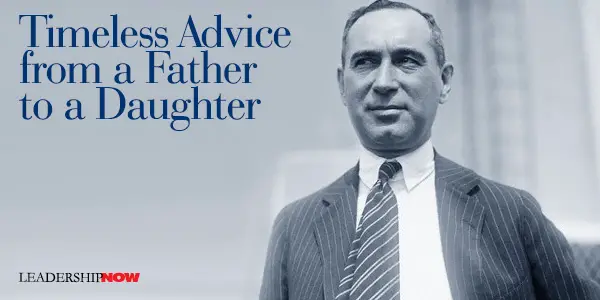

My darling Mary,Just One More: In 1938, Lord & Thomas hired the obscure comedian Bob Hope to pitch Pepsodent on the radio.
Welcome to Lord & Thomas. I hope we have a long business association together—if we do, we will both get much joy from it.
Both as father and employer I give you this advice—try to learn from everyone (high and low), try to be of service to everyone (high and low). He finally leads who first learns to serve. And remember—we spend our lives learning. Above all, be yourself—your best self. Always think of the other fellow’s viewpoint and try to get him to think of yours. Learn to walk before you run. Believe in yourself—and believing, strive to learn every day and grow creatively every minute so that you will justify your belief.
All my love,
Father
Although Lasker enjoyed making and consorting with the stars—and in one case, marrying them—he remained largely unimpressed with them. One day, the head of Lord & Thomas’ broadcast department reported to Lasker that Hope was grumbling about his contract with the agency. “Mr. Lasker,” the subordinate said, “Bob is very unhappy. He says he just can’t put the show together for $4000 a week. He must have $6,000.” “Just between us,” Lasker replied dryly, “I’d rather have Mr. Hope unhappy at $4000 than unhappy at $6,000.”
Like us on Instagram and Facebook for additional leadership and personal development ideas.
Posted by Michael McKinney at 09:16 AM
Permalink
| Comments (0)
| Human Resources
, Learning
, Personal Development
BUILDING relationships is about others. It’s more than networking says Tommy Spaulding. “When a heart centered on others drives your actions, networking is replaced by something far, far more powerful—Netgiving. Networking is all about you. Netgiving is all about others.” It's from this sound perspective that Tommy Spaulding writes It’s Not Just Who You Know.

Spaulding thinks of relationships in terms of a five story building. Level 1 is purely transactional—meet and greet. Level 2 you share basic personal information. Level 3 relationships, while superficial, relationships have developed an emotional comfort level that goes beyond sharing facts, news weather and sports and involves sharing opinions and feelings with others.
Level 4 relationships are marked openness and candidness. We respond in ways that show that we value the relationship for its own sake. The relationship reflects an ability to work through and a willingness to at times, put others interests above your own.
Level 5 relationships are our closest and most intimate relationships. They are based more on giving than on getting. “They are relationships based on a shared empathy—an intuitive understanding of each other's needs, even those that aren't necessarily expressed…. In Fifth Floor relationships, we become confidants, advisers, and partners in helping the other person achieve their greatest potential.”
Spaulding says the goal is to be able to develop the ability to build relationships at all five levels and he offers practical advice for expanding our relationships. It’s not done though through manipulation. Motives matter. Relationships built on getting what you can from others have no lasting value and will more than likely collapse when you need them the most. You can judge your motives by filtering them through the following traits: authenticity, humility, empathy, confidentiality, vulnerability, generosity, humor and gratitude. In building genuine relationships, says Spaulding, who you are is far more important than what you do.
Some of his advice:
As important, Spaulding offers five relationship warnings such as choose wisely and the relationship cancer you must avoid at all costs. He says that Dale Carnegie’s How to Win Friends and Influence People taught him how to get people to fall in love with him. But there is more. We can fall in love with others if we remember it’s not about us. It’s not just who you know—it’s who you are.
Like us on Instagram and Facebook for additional leadership and personal development ideas.

Posted by Michael McKinney at 01:08 AM
Permalink
| Comments (0)
| Human Resources
, Personal Development
WARREN BENNIS wrote in Leader to Leader that “every exemplary leader that I have met has what seems to be an unwarranted degree of optimism—and that helps generate the energy and commitment necessary to achieve results.”
Optimism says Bennis, “the sense that things generally work out well, creates tremendous confidence in oneself and in those around one.” Optimism helps leaders to be more resilient as they tend to believe in their capacity for self-control and the ability to overcome obstacles that come their way. In short, I would say, optimism is finding perspective.

One important place to begin is with our negative thoughts and feelings. Optimists dispute catastrophic thoughts, those “feelings that everything is wrong and that nothing is going to change.” Paulson says that “means you have to be ready to argue with some of your negative beliefs.” Optimism is “about facing and taking advantage of reality—even unsettling reality. Expecting unrealistic results may actually increase your dissatisfaction….To an optimist, it’s all about resilience and maximizing your results.”
Start with understanding what it is you’re saying to yourself that is causing a bigger problem in your thinking. Clarify it and then take a critical look at your beliefs and dispute them. Are they valid? Is there another way to look at this? Seek alternate explanations. Optimists ask, “Is there any less destructive way to look at this or explain what happened?” Look for causes that you can overcome and focus on what can be changed and then take action.
Like us on Instagram and Facebook for additional leadership and personal development ideas.

Posted by Michael McKinney at 12:36 AM
Permalink
| Comments (0)
| Personal Development
, Positive Leadership
, Thinking

Silverstein’s book is built around The Five Accountabilities he has developed to help you—in a practical way—to move beyond the excuse; to make accountability a way of life for you personally and part of your organization’s culture. The five accountabilities are:
Doing the Right Things. Begin by identifying your strategic intent. What are you trying to accomplish and by when? We are accountable for understanding and identifying our strategic intent—and the activities that support it.
Mt. Everest climber Ronnie Muhl, told Sam: “You get into the habit of asking yourself, ‘If my life depended on the next action I took, how differently would I perform that action?’ —because doing the wrong thing can have massive consequences.”
Managing Your Space. We are accountable to create the new space we need to grow and innovate in our own lives, which sometimes means taking space from something else that we’re doing. “Force of habit prevents us from giving ourselves the physical, mental, financial, or emotional space necessary to shake things up a little bit and put something new in our lives—something that could provide growth and improvement.”
David Silverstein, CEO of the Breakthrough Management Group International, told Sam, “You have to be willing to cannibalize your own business in order to grow.”
Managing the Process. We are accountable for creatively making progress toward whatever it is we are trying to make happen even when we hit an obstacle. It means not throwing up our hands and saying, “If it’s not meant to be, it’s not meant to be.”
Kenneth Evans, Dean of Price College of Business at the University of Oklahoma told Sam, “The real problem with the way that some people look at accountability is that oftentimes it’s layered into a notion of a rigid set of expectations and performance parameters, and frankly, you can get into very deep trouble if that’s your mantra. How you react to changing events is important as well.”
Establishing the Right Expectations. We are accountable for establishing the right expectations, that reflect our values, that are properly benchmarked, and are a bit of a stretch.
Clothier Elim Chew, spoke to Sam about the leading from where you are at his company 77th Street, “The people who accept responsibility for, say, 10 things that are part of their job description and then accept personal accountability for five more things all on their own are the ones who are more likely to get the bigger bonuses and bigger raises in this company. They’re the ones who may end up running a business of their own someday.”
Contributing to Your Relationships. The success or failure of our relationships depends entirely on the contributions we make. We are accountable for giving to our relationships—without keeping track. “In fact, the quickest way to kill a relationship is to start keeping track of all the reasons it’s not your turn to give to it and support it.” Sam adds, “We should constantly be looking for ways to invest in the relationship and enhance the value of the relationship over time.”
Sam says, “Building relationships is about choices, and the choices should always be based on your values. To get a fix on your values, ask yourself: How can I best serve this relationship in the short term and the long term?”
Brian Martin, CEO and founder of Brand Connections, talked to Sam about managing emotions. He said, “I have asked every single person I’ve hired two questions: ‘First, what is most important for you to feel professionally, every day? And second, what’s most important for you to avoid feeling? What would you really rather not go through, not have to replay with your spouse at the end of the day, when that person asks how your day went?’ I keep the answers on file, and I look at those answers every week when I do my own planning.”
More information can be found at SamSilverstein.com to help you implement the Five Accountabilities. “If you want to build an organization that achieves its goals and beats the competition, it’s time for No More Excuses.”
Like us on Instagram and Facebook for additional leadership and personal development ideas.
Posted by Michael McKinney at 06:56 PM
Permalink
| Comments (0)
| TrackBacks (1) | Change
, Ethics
, Personal Development
“I don't know anyone who could get through the day without two or three juicy rationalizations.”We like (need) to rationalize. We often feel compelled to create acceptable reasons for otherwise unacceptable behavior. You know … excuses. We all have made excuses and can easily get into the habit of making excuses.—Michael Gold (played by Jeff Goldblum) in The Big Chill (1983)
There are a thousand excuses for failure but never a good reason.—Mark Twain
Hold yourself responsible for a higher standard than anyone else expects of you. Never excuse yourself. Never pity yourself. Be a hard master to yourself and be lenient to everyone else.—Henry Ward Beecher
Never Complain. Never Explain.
Crunch Point: Test Your Excuses
Posted by Michael McKinney at 01:46 PM
Permalink
| Comments (0)
| Personal Development

Understand that you are only to change yourself, and that is exactly what you are setting off to do: change the way you value this person, regardless of your past experiences together and without a set agenda of how you expect them to contribute to the cause. The more you let go of preconceived notions of what the other must do, the more effective your quest for collaboration and mutual learning.Through examples and the lessons learned from them, Diaz demonstrates how otheresteem is possible in not only the workplace, but anywhere you find people in your life. It is not unusual for people to wonder, “Yeah, but if it am busy valuing others—especially in the workplace—then what about me? Don’t I get left behind?” As odd as it seems, otheresteem—esteeming others—is the antidote to the question, “What about me?” By esteeming others you are building your self-esteem—and we greatly improve the world we live in.
Take the Greater Than Yourself Challenge
Posted by Michael McKinney at 10:31 PM
Permalink
| Comments (0)
| Personal Development
Everyone can be great because everyone can serve. You don’t have to have a college degree to serve. You don’t have to make your subject and your verb agree to serve…. You only need a heart full of grace, a soul generated by love.–Martin Luther King. Jr.
“Ultimately, management is a key to extraordinary service. Individual performance has the limitations of an individual. You may be a virtuoso. Yet, if you are determined to express your individuality in a more expansive way, you must develop management skills and engage others in a larger enterprise.Filled with examples and quotes, Serve to Lead 2.0 is well thought out and one of the best books you’ll read on how to think about service and how to get your leadership to be one of service.
To achieve ever deeper relationships with greater numbers of customers and other stakeholders, you must master management. Day in and day out, that means you must serve those with whom you work, enabling them to serve ever more effectively.
How many people are trapped in their everyday habits: part numb, part frightened, part indifferent? To have a better life we must keep choosing how we’re living.–Albert Einstein
Like us on Instagram and Facebook for additional leadership and personal development ideas.


Posted by Michael McKinney at 01:42 PM
Permalink
| Comments (0)
| TrackBacks (1) | Leadership
, Leadership Development
, Management
, Personal Development
Posted by Michael McKinney at 07:07 AM
Permalink
| Comments (0)
| Leaders
, Leadership
, Personal Development
Posted by Michael McKinney at 07:03 AM
Permalink
| Comments (0)
| Personal Development
IN many ways leadership is about taking an oath of excellence. To a leader, excellence matters. Excellence requires “re-imagining” (to borrow a Peters’ term) your world done excellent. Leaders see things differently and this difference can be taught. Teaching excellence—one behavior at a time—is what The Little Big Things by Tom Peters, is all about.
Some of what you will read in TLBT has been presented on the Tom Peters blog over the years. But for this book, the posts have been edited, revised, organized and conveniently packaged. It’s a compilation of 163 behaviors you can put into practice to achieve excellence in any endeavor. As such, it is not meant to be read straight through. Jump in anywhere it looks interesting. The process here is: read—consider—implement—repeat.
Tom, as we’ve said here before, is good at boiling things down to basics. You’ll find opportunities to pursue excellence in basic insights that produce big results.
Courtesies of a small and trivial character are the ones which strike deepest in the grateful and appreciating heart.—Henry Clay, American statesman (1777-1852)
Sometimes the little-big-things can seem too “soft” or beneath the demands of business. Tom explains: “Ideas like conscientiously showing appreciation are matchless signs of humanity—and the practice thereof, in my opinion, doubtless makes you a better person, a person behaving decently in a hurried and harried world….Acts of appreciation, to stick with my theme of the moment, are masterful, even peerless, ways of enthusing staff and partner and client alike, and, hence, greasing the way to rapid implementation of damn near anything. That is, ‘Soft is hard’ is wholly pragmatic—and more often than not, effectively implemented, makes the bottom line blossom!”
Excellence has to be challenged into existence. The Little Big Things does just that.
Like us on Instagram and Facebook for additional leadership and personal development ideas.
Posted by Michael McKinney at 08:00 AM
Permalink
| Comments (0)
| General Business
, Leadership Development
, Management
, Personal Development
 Mojo is that positive spirit toward what we are doing now that starts from the inside and radiates to the outside, writes Marshall Goldsmith. It’s that sense others get about us that comes from the harmony between what we feel about what we are doing and what we show on the outside. It’s about two simple goals: loving what you do and showing it.
 Goldsmith's Gold: You Are Under the Microscope
Goldsmith's Gold: Stop Trying to Help People Who Don’t Want to Change
Goldsmith's Gold: Feedforward
Goldsmith's Gold: "You asked for my opinion and now you're arguing with me?"
Goldsmith's Gold: You Are Under the Microscope
Goldsmith's Gold: Stop Trying to Help People Who Don’t Want to Change
Goldsmith's Gold: Feedforward
Goldsmith's Gold: "You asked for my opinion and now you're arguing with me?"
Posted by Michael McKinney at 07:59 AM
Permalink
| Comments (0)
| Personal Development
Posted by Michael McKinney at 01:30 AM
Permalink
| Comments (0)
| Personal Development
LOYALTY is a critical subject for leaders. As builders of community, we can’t function without it. Successful organizations are built on relationships. Leadership is all about relationships. But how important is modeling loyalty in everything you do?

Loyalty has become a commodity that we hold or withhold—a tool to vote with—a means to express our discontent on a whim. Abiding commitments are seen as old-fashioned. Impatience, irritability and selfishness all drive the need to look for greener pastures. “In a strange way,” said Jack Valenti, “loyalty is now seen as some kind of character flaw.” In Why Loyalty Matters, authors Timothy Keiningham and Lerzan Aksoy write:
The possibility of leaving applies to some degree to our relationships with everyone. Weak friendships, dysfunctional families, bad marriages, intolerant religious institutions, and inept governments all face the prospect of abandonment. And there are indeed times when leaving is the best option.
But society cannot function, and relationships cannot last if leaving is the readily selected, probable outcome to every perceived grievance. And while few would admit to cutting and running when times get tough, many, if not most of us, have a general sense that leaving has become too easy for many.
Loyalty is about making commitments to causes, people, and ideas through thick and thin, for better or for worse. It is about service to something greater than ourselves.
Keiningham and Aksoy define loyalty as “accepting the bonds that our relationships with others entail, and acting in a way that defends and reinforces the attachment inherent in those relationships.” Loyalty is implicit in all relationships, and the lack of it is eroding our sense of well-being and happiness. Our priorities are often misplaced. They write, “The problem isn’t that we are exchanging our time for commodities, but instead we are exchanging our family’s time, our friends’ time, our ideals’ time to get something.”
Of course, we like to see ourselves as more loyal than we are and everyone else as less loyal than they really are. But, “it is our unwillingness to see our own role in the general decline of loyalty that is a major cause of relationship disintegration. And this disintegration ultimately leads to our unhappiness.”
Long-term thinking helps to develop loyalty. Professor Richard Sennett observed, “‘No long term’ is a principle which corrodes trust, loyalty, and mutual commitment … social bonds take time to develop, slowly rooting into the cracks and crevices of institutions.” Leaders are hard-pressed to function without it.
We develop and model loyalty in the seemingly small choices we make every day. “If loyalty is to be an important part of our lives, then we must become aware of the ramifications of our decisions. Living a loyal life requires that we recognize the formal and implicit commitments we have made to others. We must then make deliberate choices to strengthen our bonds by honoring our commitments.” The authors suggest a process they call P2R2. It stands for:
Pinpoint Where You Are: Where do you stand? We believe we are far more loyal than the recipients of our loyalty believe us to be.
Prioritize Those Things That Matter: If we want to make loyalty a meaningful part of our everyday existence, then we need to understand where we are actually spending our time and then prioritize.
Reinforce Your Connections: Actively schedule time to connect with those to whom we owe loyalty. “It will mean that there will be times we must sacrifice doing things that would be more fun to help a friend in need.”
Reach Out To Others: Engage beyond your friends and family. “It says, this relationship, this institution, this cause is mine, and I will not abandon it.”
Why Loyalty Matters delves deeply into the issue of loyalty. They discuss the economics of loyalty, the problem of misplaced loyalty, faith and loyalty, and an important chapter on teaching loyalty. President Theodore Roosevelt warned, “To educate a man in mind and not in morals is to educate a menace to society.”
Oprah Winfrey sums up the need well: “Lots of people want to ride with you in the limo, but what you want is someone who will take the bus with you when the limo breaks down.”
Follow us on Instagram and Twitter for additional leadership and personal development ideas.
Posted by Michael McKinney at 03:12 PM
Permalink
| Comments (0)
| Personal Development
 Like us on Instagram and Facebook for additional leadership and personal development ideas.
Posted by Michael McKinney at 12:12 AM
Permalink
| Comments (0)
| Personal Development
, Thinking
 Derailed: Five Lessons Learned from Catastrophic Failures of Leadership
Posted by Michael McKinney at 08:13 AM
Permalink
| Comments (0)
| Ethics
, Personal Development
TO OVERCOME the force of gravity—that which pulls us down—we have to generate an opposing force greater than gravity. That force is lift. Any opposition to lift is called drag.
In the same way that we use the laws of physical science to lift a plane off the ground, we can use social science to lift “ourselves and others up to greater heights of achievement, integrity, learning, and love,” thereby becoming a positive force in any situation. It’s the pressures of daily living that drag us down. Instead of experiencing lift we fall back into our comfort zones, become reactive, self-centered and fatalistic.
To intentionally experience lift and to be a positive influence for others, we have to make a conscious choice.
In Lift: Becoming a Positive Force in Any Situation, authors Ryan and Robert Quinn present this fitting metaphor, to explain how we can intentionally experience lift, to rise above the constraints of everyday life and lift the people around us. “All of us have a choice: we can choose to be the kind of people who drag others down or to be the kind of people who lift…. We are relational beings. Who we are at any time depends on who the people around us are, and who they are depends on who we are.” That last sentence can’t be overemphasized. It carries with it a great deal of responsibility, especially for us as leaders.
The authors describe lift as “a psychological state in which a person is purpose-centered, internally directed, other-focused, and externally open.” What exactly are these four characteristics of lift? In a very relatable and revealing example—the parenting of a young son, Mason—the authors show how this plays out in real life. I can’t reproduce the example here, but I think from the inferences you will get the idea the authors are trying to convey. The following is paraphrased from their work:
Purpose-centered is the opposite of being comfort-centered. The desire to stay comfortable is a characteristic of a normal psychological state. My son Mason’s behaviors were comfortable for me. In my desire for comfort, what had not occurred to me was the possibility that perhaps Mason was behaving differently because of the changes that had happened recently in his life. We need to ask, “Are the results I am trying to create about me and what I am comfortable with or are they about what is best for the other person?”
Internally directed is when people experience the dignity and integrity that comes with exercising the self-control necessary to live up to the values that they expect of others. External direction, on the other hand, is a characteristic of a normal psychological state.
If Mason was building with his Legos or playing a game when I asked him to do something, I expected him to put those things aside and do it. Yet, if I was involved in an activity and Mason interrupted me, I would expect him to wait until I was done with my activity before I did what he asked. I expected him to show respect to me, but I was not doing the same for him...When people are externally directed, they let circumstances (such as the need to get Mason to clean up or go to bed) drive their behavior instead of their values (such as respect for others’ time and activities).
Other-focused is to be open to other people’s feelings and needs. We then empathize with them and feel impulses to be compassionate. When we are self-focused, we are concerned only with our own needs, feelings, and wants. We see other people as objects that either helps us or impede us in our goals. In my case, Mason was an object that was preventing me from my goal of showing that I was a good father.
Externally open is openness to external cues. When we are open we learn, grow and adapt ourselves to the situation unfolding before us. When we are internally closed, we ignore and deny feedback. We ignore or deny feedback out of fear that the feedback says something about our worth as human beings. So as a result, we tend to get angry. Again with Mason, I was not showing him the respect that I wanted him to show me. As I opened myself to the possibility that I might be wrong, I also opened myself up to what Mason was feeling, and to what his needs might be and became other-focused.
Using scientific research to provide “insight into why lift is important, what the characteristics of lift are, and how our psychological states influence others,” they formulated four questions that capture the nuances required to intentionally move ourselves from a normal state into lift.
This post is getting long, but I would like to share several more thoughts for you to contemplate:
When a new situation disrupts our previous expectations, though, it is more productive to change our expectations than to try to make the world conform to our old expectations.
A purpose-centered state involves more than having a goal. When people are purpose-centered, they envision and pursue extraordinary results that are not constrained by previous expectations or by the expectations they receive from others.
Self-regulation is the process of using one’s conscious mind to inhibit one’s automatic response to the situation and to replace it with a controlled response.
Since he was not focused on himself, he was not worried about people taking advantage of him.
The book is full of great examples and scientific evidence to back their perspective. The scientific evidence is really just icing on the cake. The relational principles at work here are sound, but they require much thought and self-examination. This is a book that needs to be read and re-read. Inertia is our biggest enemy. Inertia will keep us from benefiting from this book and becoming a positive force; the kind of leaders that provide lift in our own lives and those we influence.
Like us on Instagram and Facebook for additional leadership and personal development ideas.
Posted by Michael McKinney at 11:10 PM
Permalink
| Comments (0)
| Communication
, Leadership Development
, Personal Development
, Positive Leadership

AIR FORCE fighter pilot Rob “Waldo” Waldman learned how to overcome fear, anxiety, and self-doubt to fly combat missions that pushed him to his limits by disciplined training and the help of his wingmen. Wingmen are people with different backgrounds, skills, and experiences unified under one agreement—to never think or act alone.
A wingman watches your back. In Never Fly Solo, Waldo threads real-world experiences to encourage the development of a check-six culture. Check-six refers to the six o’clock position where the jet is most vulnerable—the pilot’s blind spot.
Waldo says, “There is a limit to how much you can learn on your own. A good wingman will give you mission-critical feedback, catch your errors, ask questions, and propose challenging scenarios to push you to grow in your skills and mental discipline.” Encouraging others to look out for our blind spots requires a great deal of mutual trust. “These trusted partners, male or female, are your wingmen.”
Of course, this means first, not being afraid to acknowledge that you need help and then being able to ask for it. This is all the more difficult if you haven’t built trust in yourself and invested the time to build trusting relationships with others. You’ve got to “walk the flight line.” Get out and build relationships with those people you work with—treating each other as people first and coworkers second. “It’s the relationships we build and the people whom we trust that give us the courage to take risks and make ourselves better.”

Additionally, we have to keep our “radar sweeping for a wingman, coworker, or peer who may be experiencing a challenging time in her life. Don’t let her get isolated.” Be supportive and find her some help if necessary.” It is the worker that keeps to themselves—trying to fly solo—that check out, become unmotivated, complacent and careless. “Never feeling invested in the company’s mission, they do the minimum, and everyone suffers.”
In today’s environment, communication, feedback, and mutual support are critical Waldo says because:
“An effective check-six environment frees up communication and removes barriers to growth so that all members of the team feel empowered to speak up and ask questions.” It also builds team confidence.
We all need wingmen and the best way to find a wingman is to be one!
Like us on Instagram and Facebook for additional leadership and personal development ideas.
Posted by Michael McKinney at 07:29 AM
Permalink
| Comments (0)
| Personal Development
, Teamwork

GRATITUDE is a way of investing ourselves in others. A particularly overlooked aspect of the art of gratitude is the habit of noticing. When we notice others and show our appreciation, it pays huge dividends. Additionally, by noticing others we become more attuned to life’s vitality, intensity, and diversity.
I related the following story from the book Growing the Distance, a few years ago, but it bears repeating:
Arden Barker had planted a 50-acre field of wheat that was now golden-brown, very full, and ready for harvest. It was a sight to touch the heart of any farmer. When his Uncle Harry came to visit, Arden proudly took him out to look at the field of wheat. Harry looked around, put his hand over his eyes to peer into the distance, and fixed his gaze on a boulder that had been too large to move in the middle of the field. “Is that a stone on the hill?” he asked. He said nothing about the field of wheat. Arden was crushed by his lack of enthusiasm.
The Uncle Harry incident became the subject of discussion at many Barker family dinners thereafter. A few years later, their daughter, Brenda, had just finished cutting and trimming the family’s huge lawn. Arden came home and surveyed her work from the kitchen window. “You missed a patch under the trees,” he pointed out. Brenda came over to him, put one arm around his waist, and her other hand over her eyes to peer off into the distance and asked, “Is that a stone on the hill?”
Too often, leaders, managers, and parents think that it is crucial to their role to point out where people could improve—to be critical. Certainly, there is a time for that, but it happens all too often. Effective leaders will look for the positive and show gratitude and appreciation for it. People often look to others for direction and support and if it is not forthcoming it can kill the spirit and impede growth.
Like us on Instagram and Facebook for additional leadership and personal development ideas.
Posted by Michael McKinney at 12:19 AM
Permalink
| Comments (0)
| TrackBacks (1) | Communication
, Personal Development
| "We are all put to the test, but it never comes in the form or the point we would prefer, does it?" ~Anthony Hopkins, The Edge |
Free Online Assessment: Tim Irwin has developed an online assessment This exercise will help you to identify your risk for derailment in four key areas. There are 48 questions within this assessment. It should take you 5-10 minutes to complete.
12 Keys to Greater Self-Awareness
Follow us on Instagram and Twitter for additional leadership and personal development ideas.
Posted by Michael McKinney at 12:30 PM
Permalink
| Comments (0)
| Leaders
, Personal Development
THERE IS NO evidence to suggest that any species of animals other than humans come pre-packaged with a set of mechanisms for any kind of meaningful self-awareness—to ask what and why. The degree to which we develop and use that capacity, in a constructive way, will largely determine our success in life.
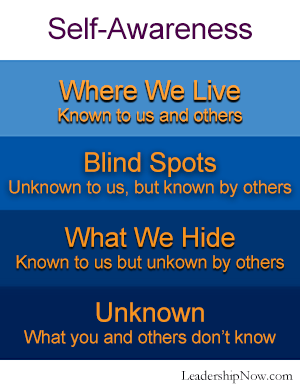
Self-awareness is where leadership development begins. Self-management and authenticity flow from self-awareness. Self-awareness can be divided into four parts: what is known to us and others, what is known to others but not by us, what we know and others don’t and what we don’t know and others don’t either. Plumbing the depths of self-awareness takes time and more intensive tactics. However, our biggest gain in self-improvement can be had by finding out what others know that we don’t. And they know more than we think.
Here are twelve keys to greater self-awareness:
Your thinking and the behavior that flows from that has brought you to where you are now. You are in control of developing the thinking and behavior that will take you where you want to go. Self–awareness is difficult. We don’t always like to admit things about ourselves because we don’t like the guilt associated with not doing what we know we should. But admit we must if we are to grow. Ask yourself, “In light of where I come from, what do I need to know about myself?”
Warren Bennis wrote, “It is one of the paradoxes of life that good leaders rise to the top in spite of their weaknesses, while bad leaders rise because of their weakness….We are our own raw material. Only when we know what we are made of and what we want to make of it can we begin our lives—and we must do it despite an unwitting conspiracy of people and events against us.” It is a lifelong and rewarding journey.
Like us on Instagram and Facebook for additional leadership and personal development ideas.
Posted by Michael McKinney at 12:09 AM
Permalink
| Comments (0)
| Personal Development



Posted by Michael McKinney at 10:40 PM
Permalink
| Comments (0)
| Personal Development

WITHOUT self-awareness leadership becomes just another exercise in ego gratification. Self-awareness allows for self-discipline and control of the ego. Without it the ego runs amok looking after itself and only incidentally in the service of others if the needs of both happen to align.
Self-awareness is the ability to see when an emotion or a perception is influencing your thinking and behavior and, if necessary, do something about it. Gaining control over the state of your mind will pay big dividends in terms of your leadership effectiveness. What is going on beneath the surface? It is the blind spot of leadership. Being able to step back and see both the positive and negative aspects about yourself, to see how you affect others, and to see how you are behaving in real-time, is critical to your success as a leader.
Emotional Intelligence 2.0 offers some good strategies to develop your self-awareness as part of an overall EQ skill development program. Self-awareness is a bigger problem than one might think. The book reports that “only 36 percent of the people tested were able to accurately identify their emotions as they happen. This means that two-thirds of us are typically controlled by our emotions and are not yet skilled at spotting them and using them to our benefit.”
A proper and healthy self-awareness facilitates an essential other-awareness that is vital to good leadership. You can not manage the behaviors of others without first getting a handle on your own.
Follow us on Instagram and Twitter for additional leadership and personal development ideas.
Posted by Michael McKinney at 11:33 PM
Permalink
| Comments (0)
| Leadership Development
, Personal Development

We choose to go to the moon in this decade and do the other things, not because they are easy, but because they are hard, because that goal will serve to organize and measure the best of our energies and skills, because that challenge is one that we are willing to accept, one we are unwilling to postpone, and one which we intend to win, and the others, too.True accomplishments come from doing the hard thing and not resting on the easy things. Raise your expectations. Don’t rob yourself of your potential future. Strive to do the hard things.
Posted by Michael McKinney at 12:59 PM
Permalink
| Comments (0)
| Personal Development
Once you find a mentor, it’s essential that you show respect and never become a “Yeah, but.” If your mentor tells you your hair is too long and needs to be cut, do it. Don’t ever say, “Yeah, but I had it short and that didn’t help.” Whatever your mentor suggests, do it and do it immediately if you want him or her to continue to help you. It’s one thing to do what your mentor suggests and report back how it went and quite another to question the advice without trying it. You won’t last long if you resist suggestions.A mentor or a book like this can help you to gain vicariously what many people end up learning the hard way. Here are several maxims found in Parrish's book that are good to think on:
Generally speaking, if you’re contradicting, you’re losing.
Your success or failure will be determined first and foremost by how effectively you deal with others.
When you lose, don’t lose the lesson.
Don’t ask a no question if you want a yes answer.
Most anger distills to blame. When you eliminate blame, you eliminate anger.
Men and women differ in numerous ways and sometimes make the mistake of treating the other the way they want to be treated.
If you always do what you say you are going to do, I can build an empire around you; if you sometimes do what you say you’re going to do, you’re just another headache for me.
What we aren’t taught early in life is the pain and agony that follow selfishness.
Never say anything about yourself that you don’t want to be true. Every facet of life is determined by our thinking, yet we’re not taught how to think.
Posted by Michael McKinney at 10:32 AM
Permalink
| Comments (0)
| Personal Development
Posted by Michael McKinney at 11:01 PM
Permalink
| Comments (0)
| Personal Development
 WHILE I DON'T BELIEVE the core of the strengths-based movement ever intended as its agenda the idea that you only need to "focus on your strengths and ignore your weaknesses," it doesn’t change the fact that that is all most people seem to hear and those that have jumped on the bandwagon, promote. All too often the mantra, “focus on your strengths and ignore your weaknesses” sounds like a Get-Out-of-Jail-Free card. An extreme focus on your strengths (do what you like doing) and delegate your weaknesses (stop doing what you don’t like) plays well, but in reality, it can get to be a bit self-indulgent. While there is some truth to it, it’s more nuanced than that.
There is no arguing the fact that we all have various combinations of strengths in varying degrees. Maximizing the use of those strengths as we can, in the context we find ourselves in is advantageous to all involved. If you can carve out a place in the world that leverages your strengths that’s great, but the reality is that the world keeps changing and what is required of you to stay relevant – valuable – keeps changing too. You may need to develop a new strength and turn some of your weaknesses around. Then there is the question of whether or not your particular brand of strength is marketable. I may derive pleasure, feel actualized, and be in my zone by utilizing one of my strengths, but if it isn’t competitive with what others are doing with that same strength, well then, I’ll be out of work. Great hobby, but not a career (at least not at my current level of competence).
Robert Kaiser has assembled fifteen authors in The Perils of Accentuating the Positive to help you get some perspective on the strengths movement. Kaiser writes that the point of the book “is not to dismiss strengths-based development.” It’s really a guide to make you a “savvier user of the strengths-based approach” and based on an understanding that “recognizes that both strengths and weaknesses have an appropriate place in learning and development.”
In an interesting analysis by Korn/Ferry of 360 assessments of almost 2000 individuals, they found that most managers don’t have the leadership strengths that their companies need for them to have in order to be effective. The reality is, most people need to develop strengths that don’t come naturally to them. That means if you want to stay competitive – stand out from the crowd – you need to begin now to develop the strengths you don’t have now that are required for your long-term success.
They bring out four ways to look at strengths:
Your Personal Best: What comes naturally to you
Competitive Strengths: Skills that are stronger than most of your competitors
Distinctively Competitive Strengths: Strengths that distinguish you from others
Competitive and Aligned Strengths: Strengths you need for long-term career success
If you plan to succeed by focusing on your strengths, make sure you do more than just discover and build on your strengths (your personal best). You will also need your strengths to stand out compared to your peers (competitive strengths). If you want to stand out among your peers and have a better chance for promotions, make sure your strengths set you apart from other also competitive peers (distinctively competitive strengths). Finally, you better hope that your five distinctive and competitive strengths include the ones that make a difference when it comes to long-term career success (competitive and aligned strengths).
We regularly tell the up-and-coming youngies to first discover their strengths, then gauge how those strengths compare to those of the people they are and will be, competing with, and finally, find out which strengths they need to fulfill their career dreams and to start working on the ones that are not up to par.
As we have stated here before, the overuse of a strength can be a weakness. In addition, USC professor Morgan McCall writes, “Strengths that have led to success, the very ones that advocates claim should be played to, can become weaknesses over time or in a new situation.” As our reality changes, we must also change. When we rely too much on our strengths we usually end up emphasizing them to the point where they become weaknesses and derail our career and relationships.

The bottom line is self awareness and adaptability. There are no shortcuts. Play to your strengths as you can but don’t be over-reliant on them. Develop new strengths as required. Manage your liabilities.
Of Related Interest:
You Can Change
Changing Your Nature
I Don’t Like My Strengths. Now What?
Like us on Instagram and Facebook for additional leadership and personal development ideas.
Posted by Michael McKinney at 01:35 PM
Permalink
| Comments (0)
| Personal Development

It begins with being able to and understanding the need to engage others in continuous strategic conversations as part of the normal way of doing things—a process Karr has termed Integrated Dialogue. Integrated dialogue is a conversation of shared purpose that draws people out “to create a powerful relationship, one that identifies whole new zones of mutual opportunity, addresses far-ranging issues, and positions you as an invaluable resource: a leader.”
As with all leaders, salespeople too will succeed when they fully appreciate the many relationships inherent in their success. Sales leaders lead a whole cast of people in their own organizations from the customer service, tech people to accounting and senior management. In addition, they lead not only their customer or end-user but also many points of contact in their customer’s organization that are likely to have some input on the buying decision like operations, accounting, purchasing, and senior management. Gone are the days where everything filters through the salesperson. “Your success as a salesperson depends on your ability to build and sustain coalitions both inside and outside your organization. You must create and lead the coalition, no matter what you are selling.” This will resonate with any leader:
Your job is to manage multiple constituencies and alliances and to use those alliances to identify new and better ways of generating the desired results. Your job is to do what most salespeople don’t do: lead the conversation with your prospects and customers about the results they need, the problems they have, and the obstacles they face.
To make this happen you must possess and develop the belief that you have everything you need and can build on that, the belief that you can improve any area of your life, everything is possible, preparation maximizes your potential, and your customers—the people you need to influence—come first.
After laying the groundwork, Karr defines and explains the seven traits that great sales leaders share:
Karr demonstrates how to move from task-oriented selling (which is what most salespeople do) to purpose-oriented selling. These principles are worth bearing in mind on a personal development level as well. Karr encourages, “The bottom line is that you have the ability to increase your sphere of influence and sales just by the way you act toward those you are trying to influence.” Change your conversations, change your outcomes. Leaders in any field will find much here to assimilate into their daily activities. Read it and grow.
Like us on Instagram and Facebook for additional leadership and personal development ideas.


Posted by Michael McKinney at 11:15 AM
Permalink
| Comments (0)
| Communication
, General Business
, Marketing
, Personal Development
, Teamwork
Posted by Michael McKinney at 09:37 AM
Permalink
| Comments (0)
| Personal Development
, Teamwork
The principles in Good to Great were derived primarily from studying specific periods in history when the good-to-great companies showed a substantial transformation into an era of superior performance that lasted fifteen years. The research did not attempt to predict which companies would remain great after their fifteen-year run. Indeed, as this work shows, even the mightiest of companies can self-destruct.Of course, the same is true of the classic by Tom Peters and Bob Waterman, In Search of Excellence. The failure or declining performance of some people and organizations does not negate the basic message. It is part of being human to get ourselves off-course—even when we know better. The failure of the exemplary companies to maintain their hold on greatness or excellence does, however, hold an important lesson for us. It’s all too easy to move away from our core values. They are always under fire and it takes courage to hold the course. Everything we do has to be continually reviewed and realigned to our core values.
Like us on Instagram and Facebook for additional leadership and personal development ideas.

Posted by Michael McKinney at 09:02 AM
Permalink
| Comments (0)
| TrackBacks (3) | Personal Development
, Thinking
Posted by Michael McKinney at 09:49 AM
Permalink
| Comments (0)
| Personal Development

Posted by Michael McKinney at 11:26 PM
Permalink
| Comments (0)
| Personal Development

Posted by Michael McKinney at 04:03 PM
Permalink
| Comments (0)
| Personal Development
BEING happy or being perfect. You can have one, but you can’t have the other. The happy life is attainable, but the perfect life isn’t. In fact, trying to be perfect gets in the way of being happy (and productive). Imperfection is a by-product of being human.
Perfectionism – the maladaptive and neurotic belief that you and/or your environment must be perfect and that work or output that is anything less than perfect is unacceptable – is not something that you are born with. It is developed. Contrary to the goal they seek, perfectionists are focused on failure.
The key difference between the Perfectionist and the Optimalist is that the former essentially rejects reality while the latter accepts it.
While the Perfectionist rejects failure, the Optimalist accepts it as a natural part of life and as an experience that is inextricably linked to success.
The Perfectionist believes that a happy life comprises an uninterrupted stream of positive emotions. And because he, of course, aspires to be happy, he rejects painful emotions…. The Optimalist, on the other hand, accepts that painful emotions are an inevitable part of being alive.
The perfectionist is never satisfied. She consistently sets goals and standards that are for all intents and purposes impossible to meet, thereby from the outset rejecting the possibility of success…. The Optimalist also sets extremely high standards, but her standards are attainable because they are grounded in reality. When she meets her goals, she appreciates her successes and takes time to experience gratitude for her accomplishments.
Perfectionist reject reality and replace it with a fantasy world – a world in which there is no failure and no painful emotions and in which their standards for success, no matter how unrealistic, can actually be met. Optimalists accept reality – they accept that in the real world some failure and sorrow is inevitable and that success has to be measured against standards that are actually attainable.

Ben-Shahar discusses these ideas in detail and then shows how they apply to and play out in education, the workplace, and in relationships. He offers exercise and meditation to help you reorient your thinking and move from perfectionist thinking to optimalist thinking.
It’s easy to see from his approach and the advice given in this book, why his Harvard course in “Positive Psychology,” is the most popular class in the university’s history. Read it. I’m certain you’ll benefit.
How do you know if you're a perfectionist? Psychology Today offers a self-test on their web site.
Like us on Instagram and Facebook for additional leadership and personal development ideas.
Posted by Michael McKinney at 09:33 AM
Permalink
| Comments (0)
| Personal Development
, Positive Leadership

WHAT'S happened to the economy has been likened to a tsunami as well as an implosion. When the undersea earthquake and subsequent tsunami hit in Indonesia in 2004, the world was stunned by the devastation that took place. It triggered earthquakes around the globe, as far away as Alaska. It happened in a very short amount of time.
This kind of event takes shape over a period of time and then erupts with incredible force. What happened this past year is similar in that respect—it'd been brewing for some time. When it hit, it was like a tsunami which caused other economies to start crumbling as well. We are all familiar with that scenario. What we need to do now is deal with it.
The aftermath of a tsunami requires surveying the damage, picking up the pieces, and moving on. Some people have bigger losses than others, but everyone has to keep going.
When it comes to implosion, it's more of a cave-in than a wipe-out, but equally potent. We saw the effects of an implosion watching the towers fall on 9/11. It's a domino effect. We won't sink because we can swim, but let's not go the way of dominos. Let's be smart and learn to think for ourselves in positioning ourselves for what comes next. Here are a few survival tips:
Follow us on Instagram and Twitter for additional leadership and personal development ideas.
Posted by Michael McKinney at 01:12 AM
Permalink
| Comments (0)
| General Business
, Personal Development
, Problem Solving

We don’t really create, but we assemble what has been created for us. Be a great assembler—no matter what your interests may be—and you’ll be on your way to inventiveness.
Considering the availability of news, blind spots can’t really be rationalized anymore, no matter where you might be living. Information is available to everyone, and if you aren’t plugging into it, it will eventually work against you—maybe on your first interview. Don’t learn this the hard way.
Do not allow fear to settle into place in any part of your life. It is a defeating attitude and a negative emotion. Recognize and zap it immediately. Replace it with a problem-solving attitude, faith in yourself, and hard work.
Momentum is something you have to work at to maintain. Find your own current and then go with it! Don’t allow for distractions. Do everything you can to maintain your energy flow. Watch out for streaks of momentum that you can’t sustain—keep your equilibrium in all things, even in your energy output.
I always ask myself, “Is this a blip, or a catastrophe?”—it gives me a point of reason in the midst of bad news. Your problems can be temporary if you keep your momentum moving forward. We all experience difficulties, but they can be blips if you remain positive and move on.
Posted by Michael McKinney at 01:03 AM
Permalink
| Comments (0)
| General Business
, Personal Development
Posted by Michael McKinney at 11:30 PM
Permalink
| Comments (0)
| Personal Development

Posted by Michael McKinney at 05:54 PM
Permalink
| Comments (0)
| Communication
, Leadership
, Motivation
, Personal Development
The Greater Than Yourself (GTY) concept is based on the premise that great leaders become great because they cause others to be greater than they are. GTY is a one-on-one development process where you choose to help someone become more capable, competent, and accomplished than you are. It has three parts to it: Expand Yourself, Give Yourself and Replicate Yourself.
The life-long process begins with you. “You have to expand yourself before you can help make others greater.” That means that you have to make sure that everything that is you is constantly expanding. No matter how much you think you know or are, “you can always learn more, you can always experience more, you can always connect more and love more.” The point of which is to give it all away.
Giving it all away always brings out the cynics. But Farber deals with that too. Giving it all away seems to imply subtraction – like a zero-sum-game – to many people. But it’s not. Giving it all away really adds to who you are. Parents get it, but when we get outside that relationship, an improper self-interest kicks in and we miss the bigger picture.
In this business fable set along the California coast, Faber skillfully explains the true nature of giving it all away to become a creator of masters. GTY has life-changing possibilities if you commit to it. Expanding yourself “is a practice that should become part of your life. Integrate it into your thought process and into the way you make decisions. Will X add to your inventory? Will it expand an item that is already there? If so, do it; if not, don’t.”
When you think of giving of yourself, money may not be part of it. You have other resources like “your talent, your knowledge, your connections, your confidence, your trust” and last but not least, “your time.”
In the end, you want to replicate yourself. That is, you want to make sure that the people you elevate are doing the same for others.
In an organizational context, it might look like this: “Everyone on my team and in our company should become significantly greater as a result of working with one another.” But, “I’m not trying to hire people who are more talented than me, I’m trying to hire people with heart, desire, drive, and mad potential, and then encourage all of them to bring out the best in one another by giving fully to one another. See the difference?”
Farber admits that this isn’t easy to do initially. In response, he challenges us to pick just one person to make a GTY project. “Raise that person; boost him or her above yourself. Start there and see what happens.”
He has created a web site with examples and resources to get you going. In particular, there is a four minute video of a GTY project conducted by the Up With People organization, that is a good overview of what this is all about and the impact it can have. The participants in this GTY project don’t rule out that great things can come in small packages. The tendency is to pick someone who is already doing well and then working to make them greater; jump on their bandwagon so to speak. There’s certainly nothing wrong in that, but perhaps the most impact can come from taking someone who really needs a leg up and connecting them to what they need.
Take the Greater Than Yourself Challenge. Pick one person and give of yourself to make their life better—than yours!

Like us on Instagram and Facebook for additional leadership and personal development ideas.
Posted by Michael McKinney at 04:23 PM
Permalink
| Comments (0)
| TrackBacks (1) | Human Resources
, Personal Development
, Positive Leadership
Posted by Michael McKinney at 09:34 AM
Permalink
| Comments (0)
| TrackBacks (1) | Personal Development
IN The Knack, a book for entrepreneurs, Norm Broadsky and Bo Burlingham respond to the question, “What does it take to be a successful entrepreneur?” The most important quality is resilience. “I’m talking about the ability to bounce back from failure, to turn around a bad situation, to profit from your mistakes. They continue:
That’s because everybody makes mistakes, plenty of them. What’s more, we keep making them as long as we’re in business. Sure, we like to think we’ll eventually get so smart we won’t make mistakes anymore. Forget about it. You’ll never stop making mistakes. Hopefully, the new ones won’t be the same as the old ones, but they’ll be equally painful. They’ll bug you just as much. They’ll make you just as mad. As upset as you get, however, it’s important to bear in mind that failure is still the best teacher around. You’ll do fine as long as you’re open to the lessons it’s trying to teach you.
And a concluding thought from an article in the New York Times, Innovation Should Mean More Jobs, Not Less. Geoffrey A. Moore, author of Dealing with Darwin, comments:
“America is probably the best culture in the world at failing,” he said. “We’re willing to navigate in a fog and keep moving forward. Our competitive advantage tends to be at the fuzzy front end of things when you’re still finding your way. Once the way has been found, we’re back at a disadvantage.”
Like us on Instagram and Facebook for additional leadership and personal development ideas.
Posted by Michael McKinney at 12:29 AM
Permalink
| Comments (0)
| Entrepreneurship
, Personal Development
THE FACT IS, many leaders do not really know their strengths. Not only does this lack of self-awareness bring about unintended consequences to one’s behavior, but also it can lead to disengaged employees and undue stress in the workplace and beyond. Donald Clifton remarked:
What great leaders have in common is that each truly knows his or her strengths – and can call on the right strength at the right time. This explains why there is no definitive list of characteristics that describes all leaders.
Unique to this book is a study of 10,000 followers. When they asked them why they followed, four basic wants and needs emerged: trust, compassion, stability and hope. Once you have identified your strengths, they will give you specific suggestions for meeting those needs.
The idea of strengths-based leadership is not to ignore your weaknesses as some have mistakenly misunderstood. But the emphasis for any leader should be a deep understanding of what they bring to the table and not trying to be something they are not. Rath and Conchie write:
The most effective leaders know better than to try to be someone they are not. Whenever they spot an opportunity, they reinvest in their strengths…. Leaders stay true to who they are – and then make sure they have the right people around them. Those who surround themselves with similar personalities will always be at a disadvantage in the long run to those who are secure enough in themselves to enlist partners with complementary strengths.
Like us on Instagram and Facebook for additional leadership and personal development ideas.
Posted by Michael McKinney at 11:46 PM
Permalink
| Comments (0)
| Personal Development
, Teamwork
There’s a well-worn saying that “I wish I knew then, what I know now.” But, I beg to differ. I’m glad I didn’t know then that we would end up taking this path. That’s a key lesson that this experience crystallized for me.
The lesson is this: Don’t tell me the future. I’ve learned, unquestionably, that resilience—not prophecy—is the greatest gift. Now, that idea runs counter to human nature and desire. Seeking to know the future has been man’s eternal quest—from ancient mythology to the 21st century (and into the 24th century if judged by Star Trek episodes).
Astrology aside, modern forecasting techniques are widely employed in science and business. Clearly, it can save lives and fortunes to be able to predict weather patterns, epidemics, and financial markets. (No question, we have a long way to go in telling the future of financial markets!) But, it’s important to recognize the limits of even the most sophisticated models and forecasting methods—and to rely on them as tools, not oracles.
I’m convinced that prophecy would be a curse, not a gift, in our most important human endeavors, from corporate strategy to national destiny to personal relationships.
I firmly believe knowing the future could severely limit our vision, passion, and potential. It could cause us to take things for granted… or to give up hope. Much more than prophecy, resilience—the ability to rise to the occasion and opportunity, whatever the future may bring—is the far greater gift. And, it’s also a gift we can reasonably attain.
Resilience is optimistic opportunism. Its power can be seen in the prescient observation that “Things turn out the best for those who make the best of the way things turn out.” Think about that: “Things turn out the best for those who make the best of the way things turn out.”
When rooted in hard work and experience, resilience is better than any crystal ball. I think—I hope—we’re coming to understand that we don’t need to know the future. We can be confident that our performance and resilience will enable us to succeed and control our destiny.
And, that’s the thought I’d like to leave you with: While we can’t know our destiny (and I’ve come to believe we shouldn’t want to), we do have a large measure of control over our destiny, as individuals and as institutions. What gives us this control? Hard work, experience, and resilience.
There’s no question that hard work, focused on a goal, is never wasted—even if the destination changes. The experience, expertise, and discipline we gain is invaluable and will lead to success, as long as we have the resilience—the optimistic opportunism—to sense the winds of change and go with them.
There’s a Japanese proverb that says, “Even the fortune-tellers do not know their own destiny.” I’m convinced we have more control over our destiny by not knowing it—as long as we strive for excellence and have the resilience to make the best of the way things turn out.
Like us on Instagram and Facebook for additional leadership and personal development ideas.

Posted by Michael McKinney at 11:57 AM
Permalink
| Comments (0)
| Personal Development
WE are about to begin a new year that is bursting with faith in hope. Whether that faith is justified remains to be seen. Yet you would be handicapping yourself if you did not read and reflect on John Bogle’s tour de force, Enough: True Measures of Money, Business and Life.
The book is a result of a fair amount of reflection by Bogle himself. He offers a critique of American society today and asks what is or should be "enough" in money, in business, and in life. It is a book about character. He writes that “not knowing what enough is subverts our professional values” and leads us astray in life in general. “We too often bow down at the altar of the transitory and finally meaningless and fail to cherish what is beyond calculation, indeed eternal.” Not having grasped the concept of enough, we have seen the “subversion of our character and values.”
We live in a time that values achievement over character. When the two collide, character often takes a back seat, and relationships of all kinds are shattered. Bogle observes that while the financial represents the worst of it, what we see today is not just a financial sector problem, but a societal problem. There is really just too much greed everywhere.
He laments that we rely on numbers to give us facts that are really not facts:
As I have earlier noted, the most important things in life and in business can’t be measured. The trite bromide “If you can measure it, you can manage it” has been a hindrance in the building a great real-world organization, just as it has been a hindrance in evaluating the real-world economy. It is character, not numbers, that make the world go ‘round. How can we possibly measure the qualities of human existence that give our lives and careers meaning? How about grace, kindness, and integrity? What value do we put on passion, devotion, and trust? How much do cheerfulness, the lilt of a human voice, and a touch of pride add to our lives? Tell me, please, if you can, how to value friendship, cooperation, dedication, and spirit. Categorically, the firm that ignores the intangible qualities that the human beings who are our colleagues bring to their careers will never build a great workforce or a great organization.
Enough is really about discovering what is really important in our lives. While Bogel is optimistic, he says that he has “developed a profound concern that our society is moving in the wrong direction.” The only way to work our way through today's deep-seated problems is to return to values that “stem from principle, virtue and character.” It’s a call to redefine success in our own lives.
We have more than enough of the fool’s gold of marketing and salesmanship and not enough of the real gold of trusteeship and stewardship….We focus too much on things and not enough on the intangibles that make things worthwhile; too much on success (a word I’ve never liked) and not enough on character, without which success is meaningless….Our society cannot and should not tolerate the substitution of moral relativism for a certain form of moral absolutism, and its debasement in the ethical standards of commerce.
Follow us on Instagram and Twitter for additional leadership and personal development ideas.
Posted by Michael McKinney at 09:57 PM
Permalink
| Comments (0)
| Ethics
, Personal Development
MALCOLM GLADWELL tells us in Outliers that when it comes to success, context is everything. Only by asking where a person comes from can we understand who succeeds and who doesn’t. Geoff Colvin would agree but there’s more. In Talent is Overrated, Colvin rightly asserts that “great performance is in our hands far more than most of us ever suspected.”
When many people never become outstandingly good at what they do, no matter how many years they spend doing it, why do some people become excellent at what they do? Colvin convincingly argues that in general, it’s not innate gifts or intelligence, but what researchers call deliberate practice that creates world-class performers. A study by Anders Ericsson and his associates concluded that “the differences between expert performers and normal adults reflect a life-long period of deliberate effort to improve performance in a specific domain.”
Deliberate practice is not your normal practice. It contains several important elements: it’s designed specifically to improve performance (usually with a teacher or coach), it can be repeated ad nauseam, feedback on results are continuously available, it’s highly demanding mentally (focus and concentration), and it isn’t much fun. Add passion and the good news is that great performance is not reserved for a preordained few. It is available to everyone.
Colvin’s homework makes a great case for the idea that leaders are developed. What is alarming is Colvin's observation that “At most companies—as well as most educational institutions and many nonprofit organizations—the fundamentals of great performance are mainly unrecognized or ignored.” He writes that organizations that apply the principles of great performance follow several major rules:
Talent is Overrated is the most readable and pragmatic book on the topic. The examples and relevant research cited are compelling and his application of great performance principles to self-development, business development, and innovation are thought-provoking.
Related Interest:
Outliers: Understanding the Context of Success
Like us on Instagram and Facebook for additional leadership and personal development ideas.
Posted by Michael McKinney at 02:29 AM
Permalink
| Comments (0)
| TrackBacks (1) | Education
, Leadership Development
, Learning
, Personal Development
A LOT has been written of late about superior performance that often sets conventional thinking on its head. We often assume genius and success is the result of natural gifts and if you don’t have it, then you don’t have it. But research is demonstrating that great performance is more about what we do after we are born than we ever thought. People don’t rise from nothing.
We pretend that success is exclusively a matter of individual merit. But there’s nothing in any of the histories we’ve looked at so far to suggest things are that simple. These are stories, instead, about people who were given a special opportunity to work really hard and seized it, and who happened to come of age at a time when that extraordinary effort was rewarded by the rest of society. Their success was not just of their own making. It was a product of the world in which they grew up.Gladwell provides countless stories and examples of successful people—Bill Joy, Bill Gates, the Beatles, Chris Langan and others—and draws interesting connections about their success. Successful people must be considered within the context of their culture and the people that surrounded them. “The values of the world we inhabit and the people we surround ourselves with have a profound effect on who we are.”
The people who stand before kings may look like they did it all by themselves. But in fact they are invariably the beneficiaries of hidden advantages and extraordinary opportunities and cultural legacies that allow them to learn and work hard and make sense of the world in ways others cannot.
If you look hard enough, there is a pattern of achievement. It’s a fascinating read.
Related Interest:
What is the Secret of Great Performers?
Like us on Instagram and Facebook for additional leadership and personal development ideas.

Posted by Michael McKinney at 06:14 PM
Permalink
| Comments (0)
| Education
, Learning
, Personal Development
LEADING BY EXAMPLE is one of those things we know and remember to do on our way to do something else. The problem is that it requires a lot more inner work than we are willing to put in, but it leverages our leadership more than any other thing we can do.
Unfortunately, it is the norm that leaders don’t know themselves well enough to set an example. Tolstoy once remarked, “Everyone dreams of changing humanity but no one dreams of changing himself.” Yet that’s what it takes to lead by example.
John Baldoni has written an excellent and practical book that addresses areas that leaders need to look at in order to be the kind of person that people will want to follow. Lead by Example contains 50 short chapters that pinpoint an area of concern and how to tackle it. It “demonstrates how leaders leverage their best attributes to overcome their shortcomings in order to build trust and drive results.”
Baldoni breaks up the 50 chapters into four sections that he describes this way:
Set the Right Example
Before you can lead others, you must lead yourself. You need to know what you are made of. Character and conviction matter….Your example is your character in action. Ask yourself:
Act the Part
You need to know who you are leading and the culture in which you intend to lead. Most often, there will be no roadmaps, but there will be plenty of roadblocks. It’s the leader’s job to identify them and put the team in place to remove them….[L]eaders need to set direction, but then step back and let people discover for themselves how to get things done. Ask yourself:
Handle the Tough Stuff
Life comes at you in different directions. Sometimes it will come so hard it will knock you down. There is no shame in falling; what matters is getting up to fight again. When your people see you doing that, they will be encouraged to follow your example. Sometimes you have to collaborate with people who have no interest in you or your ideas. You have to learn to lead when you have no authority to do so. You must prove that you know your stuff. You must use your wits and your influence to succeed. By doing so, you create opportunities for people to listen to what you have to say and give yourself a chance to prove your case. Ask yourself:
Put the Team First
No leader lives in a vacuum. It is incumbent that you show people what you think of them, honestly and positively. This means you coach your people for success. Ask yourself:
The way this book is organized makes it a great reference tool that you can refer to when you are faced with leadership—people—issues. It’s also a good book to put in the hands of those who are seeking to lead in your organization. The thinking and behaviors addressed in this book will pay dividends.
Like us on Instagram and Facebook for additional leadership and personal development ideas.
Posted by Michael McKinney at 10:23 AM
Permalink
| Comments (0)
| TrackBacks (1) | Leadership Development
, Personal Development
Successful people aren’t in possession of secrets known only to themselves. Don’t obsess over people who appear to you to be “winners”, but listen instead to the wisdom of people who’ve led enriching lives—people, for instance, who’ve found time for friends and family. Be generous in your interpretation of what success looks like. The best and most meaningful lives don’t always end happily.
Posted by Michael McKinney at 01:11 PM
Permalink
| Comments (0)
| Personal Development

Posted by Michael McKinney at 12:04 AM
Permalink
| Comments (0)
| Personal Development
 The Truth About You focuses on how you set your career up right—how do you start in such a way that you can push the world toward the best of you; learning to express the best of who you are. It incorporates a candid 20-minute enhanced DVD (a reworking of the effective Trombone Player Wanted film); an interactive book, which takes up where the film leaves off; and a reMemo Pad, a way of using the raw material of your week to clearly identify your strengths and weaknesses. The DVD alone is worth the price of the book.
Posted by Michael McKinney at 12:01 AM
Permalink
| Comments (0)
| Personal Development
HOPING TO SOUND like leaders, Washington lawmakers want to get to the bottom of this financial crisis and create regulations to keep it from ever happening again. I don’t think it comes as any surprise to anyone that greed—on the part of both borrowers and lenders—is at the bottom of it. You can’t regulate greed out of existence. Regulation just improves creativity. Greed is regulated by character. Character is built at home, in our schools, in our churches, and yes, in our businesses.
No one likes to talk about character because it isn’t a quick fix, it often goes against our inclinations, it’s not immediately measurable, you can’t take credit for it, and it’s a time consuming, never-ending process. George Eliot wrote in Middlemarch: “Character is not cut in marble; it is not something solid and unalterable. It is something living and changing.” It’s built-in individuals day by day in little, almost imperceptible ways over the course of a lifetime. The problem is that we have only given a patronizing nod to character and politely moved on with the business at hand. How will I get mine if I don’t play it like everyone else? We learn too late, without character, no one gets anything.

In July, Hugo Dixon opined in the Wall Street Journal, “Greed for higher returns entices investors to take risks; fear causes them to avoid excess. When markets are healthy, the two are finely balanced. Problems emerge when that balance is lost.” You will find character behind this balancing act. Character stabilizes both people and markets. Character is inseparable from the culture in which it is formed.
Nothing will fix the financial crisis once and for all, but character will regulate it. Greed is a human issue and it will always be with us. It will always be something we need to train ourselves, our children, and our employees to regulate from within. The consequences can be devastating.
Apparently, Mr. Gekko, greed is not good. Lou Mannheim was right, “The main thing about money, Bud, is that it makes you do things you don't want to do.” Or shouldn’t do.
Like us on Instagram and Facebook for additional leadership and personal development ideas.
Posted by Michael McKinney at 11:04 AM
Permalink
| Comments (0)
| General Business
, Government
, Leaders
, Personal Development

Are you hoping one of your brand promises is reliability? Then why are you always late? Are you working to make sure those around you believe you are a team player? Then why do you never volunteer for a committee or activity? Is you perception of your personal brand that of a person who is logical, thoughtful, and contemplative? Then why do you make seat-of-the-pants, spur-of-the-moment decisions?Managing Brand You takes you through a valuable seven step process for defining, creating and implementing your personal brand. It is as much about reinvention and integrating your values, principles and beliefs with your actions—you brand essence. It’s about not letting your past control your future. Your brand should be built on your strengths with a grasp of areas where you need to improve in order to support your strengths.
Simply put, to place yourself in the satisfying and successful life that you imagine, you need to find your inner drive and to discover the skills you have that can help you find your best space. Having a brand identity that is right for you is no accident. It begins by looking deep inside yourself to find out what motivates you and to discover the principles that guide your life. And it is equally important to recognize where you do not want to be, as it is to visualize where you want to be.Emphasis is placed on the importance of a consistent message over the long haul. They liken it to running a marathon race. It’s easy to get distracted from your goals by the inertia and pressures of your current brand. A brand is not a quickie makeover, but a long-term commitment to personal improvement.
Posted by Michael McKinney at 10:14 AM
Permalink
| Comments (0)
| Personal Development
Posted by Michael McKinney at 09:46 AM
Permalink
| Comments (0)
| Personal Development

Posted by Michael McKinney at 10:59 AM
Permalink
| Comments (0)
| Personal Development
WHAT IS the encore effect? It is delivering what you do so well that you are asked to do it again and again. It’s people wanting more of what you do best. No matter what we do, we are showcasing who we are and what we care about. As we go through our day we can either deliver an average performance or a remarkable one. A remarkable performance keeps them coming back for more.
Mark Sanborn, author of The Encore Effect, believes “Our performances matter. They can have a powerful impact on those around us. As parents, our performance shapes and influences our children. As employees and managers, our performance can make our company better, move a project forward, spark ideas among colleagues, and influence customers.”
How can each of us make our own performance bigger, better, and bolder? How can we make what we do consistently remarkable and thereby make a difference in our sphere of influence?
Mark Sanborn offers five steps for making your performance remarkable; for bringing your best self to whatever you are doing:
Passion: Passion is the fuel that drives our life’s purpose. Our passion for what we do pulls others along. “Nobody likes to be driven by someone else; it feels like being pushed. But when someone can show us how to be bigger on the inside—in our attitude and mindset—that can help attract or pull us toward what we can become.
Prepare: How remarkable performance begins. “Each of us is creating our future right now. Whether the future is five minutes from now or five years, it is determined by our preparation—or lack of it.” Be a remarkable performance waiting to happen.
Practice: “There are no perfect violinists—or salespeople, executives, teachers, or parents for that matter. But deliberate practice is what distinguishes those who excel from those who get by.”
Perform: Be the performance. “One hallmark of a remarkable performance is authenticity.” Be yourself. Engage your audience by giving them your attention. “To create the Encore Effect, you shouldn’t be focused on your own happiness or success, but on the happiness and success of others.”
Polish: The difference is in the details. “There are lots of details that matter when it comes to creating a remarkable performance.” Keep polishing what you do.
Sanborn is no stranger to remarkable performances, and he continues to polish his life’s work. He also highlights some pitfalls that we need to avoid along the way, like arrogance, fear, and impatience.
Most importantly, Sanborn points to the real goal of remarkable performances—helping others to achieve their own remarkable performances. “Remarkable performers see in others what they have discovered in themselves—the ability to reach unexplored and unanticipated levels of performance. They inspire others through their own performances, instruct others through their teaching, and help others improve through their encouragement."
Pass this title along to others—young and old. It contains a simple idea that, taken to heart, can make a big difference.
Follow us on Instagram and Twitter for additional leadership and personal development ideas.
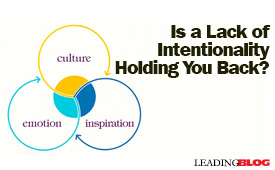

Posted by Michael McKinney at 02:33 PM
Permalink
| Comments (0)
| Books
, Personal Development
IF YOU are like most of us, anything going on but what you want, warrants a complaint. Not an action-oriented, let’s get this solved kind of complaint, but your everyday run-of-the-mill mindless kind of complaining that leads nowhere (except to more negative thinking).
Jon Gordon, author of The No Complaining Rule, says there are two main reasons why we complain: (1) because we are fearful and feel helpless and two, because it has become a habit. He urges us to outgrow the complaining habit. He cites a Gallup poll that finds that negativity costs companies nearly $300 billion each year.
“In life,” Gordon writes, “you have a choice between two roads. The positive road and the negative road. The positive road will lead to enhanced health, happiness, and success and the negative road will lead to misery, anger, and failure. Since your bus can’t be on two roads at the same time, you must decide which road you want to be on. And when you complain you travel down the negative road.”
“In life,” Gordon writes, “you have a choice between two roads. The positive road and the negative road. The positive road will lead to enhanced health, happiness, and success and the negative road will lead to misery, anger, and failure. Since your bus can’t be on two roads at the same time, you must decide which road you want to be on. And when you complain you travel down the negative road.”
As former chronic complainer, Gordon effectively delivers his message through a story. The No Complaining Rule doesn’t rule out complaining – it requires that it be constructive.
Employees are not allowed to mindlessly complain to their coworkers. If they have a problem or complaint about their job, their company, their customer, or anything else, they are encouraged to bring the issue to their manager or someone who is in a position to address the complaint. However, the employees must share one or two possible solutions to their complaint as well.
Start a revolution in your own life, at work, and at home. Download free No Complaining Rule posters and other tools from Jon Gordon’s web site. Have no complaining day!
Like us on Instagram and Facebook for additional leadership and personal development ideas.

Posted by Michael McKinney at 09:22 PM
Permalink
| Comments (0)
| Management
, Personal Development
, Problem Solving

I first heard the term PITA (Pain In The Ass) when referring to clients or coworkers from friend and international consultant to accountancy firms, Chris Frederiksen (The 2020 Group), in his seminar, How To Build A Million Dollar Practice in the early 80s. It resonated with everyone there as Robert Orndorff’s and Dulin Clark’s new book, The PITA Principle: How to Work With (and Avoid Becoming) a Pain in the Ass, will resonate today with anyone that has had experience working with groups of people anywhere. Mention PITA and no doubt someone’s name or face will pop into your head.
They define PITAs as those “folks who arouse our emotions, challenge our patience, and make us labor for our money on a daily basis.” Their goal in mentioning this is two-fold. First, they want to give you some coping strategies to help you deal more effectively with those people. Secondly, they want you to avoid being on someone else’s PITA list. We can all be PITAs from time to time, but by promoting a little self-awareness, they hope to help you to either avoid or emerge from being a PITA. This second goal is not an easy task.
Heightened self-awareness, or lack of, appears to mystify some of society’s most prominent figures, from the corporate executive who unknowingly yet chronically berates his employees through abuses of power, to the physician who patronizes her patients through her intellectual arrogance to the politician who cannot and will not admit mistakes in judgment out of ego-preserving stubbornness.
The authors note that those people who refuse to take the time to gain a little self-awareness and learn to soften or manage their PITA tendencies, “don’t get the importance of developing the other side of themselves because they are either too self-absorbed, too unaware, or too defensive to let other information enter into their consciousness.” This is a prescription for self-destruction.
They describe eight types of PITAs in detail and offer some coping strategies for each and advice to help you get some perspective on their behavior. You’ll also find a selection of ten more PITA types that get honorable mention.
Follow us on Instagram and Twitter for additional leadership and personal development ideas.
Posted by Michael McKinney at 07:58 AM
Permalink
| Comments (0)
| Personal Development
Strongly Disagree | Disagree | Slightly Agree | Agree | Strongly Agree |
| 1. | _____ | Being organized is not one of my greatest strengths. |
| 2. | _____ | I primarily respect people of power and status. |
| 3. | _____ | I like to plan everything out in advance and I’m frustrated by changes to the plans. |
| 4. | _____ | People would describe me more as a cynic than a Pollyanna. |
| 5. | _____ | I expect to get what I want when I go after it. |
| 6. | _____ | I’d rather work with people who are accommodating and friendly versus tough and competitive. |
| 7. | _____ | I get defensive when a co-worker disagrees with me. |
| 8. | _____ | It’s important to me that my co-workers acknowledge my accomplishments. |
| 9. | _____ | I tend to see the glass as half empty. |
| 10. | _____ | It’s a challenge for me to be on time. |
| 11. | _____ | I believe that the needs of the worker are as important as the needs of the company. |
| 12. | _____ | It’s difficult to work on a committee and try to accommodate everybody’s ideas. |
| 13. | _____ | It’s important for me to have a boss who compliments me when I’m doing my job well. |
| 14. | _____ | I have difficulty owning up to my mistakes. |
| 15. | _____ | I have difficulty saying what I mean in a concise manner. |
| 16. | _____ | I enjoy being the talker rather than the listener. |
| 17. | _____ | I don’t like to tap-dance around people’s feelings; I tell it like it is. |
| 18. | _____ | I believe in the saying, “If you want it done right, do it yourself.” |
| 19. | _____ | I prefer to put myself first. |
| 20. | _____ | I am very guarded against negative feedback. |
| 21. | _____ | I am most comfortable working in a supportive and nurturing environment. |
| 22. | _____ | I get annoyed when other people achieve more than me or acquire more than me. |
| 23. | _____ | I have to force myself to attend to details. |
| 24. | _____ | I get annoyed with co-workers who can’t see my point of view. |
| 25. | _____ | I am impatient when it comes to my career; I want more challenges, creativity, and responsibility. |
| 26. | _____ | I believe that social gatherings and “feel-good” activities are a waste of time. |
| 27. | _____ | I have trouble identifying my weaknesses when completing performance evaluations. |
| 28. | _____ | It’s important for me to get regular feedback from my co-workers. |
| 29. | _____ | I prefer projects in which I get to make the final decision. |
| 30. | _____ | I deserve a job that is challenging, but also allows me plenty of personal time. |
| 31. | _____ | I prefer a highly flexible work environment over a highly structured one. |
| 32. | _____ | I believe that I have more skills and abilities than the great majority of my co-workers. |
| 33. | _____ | It’s much more important to be respected than liked. |
| 34. | _____ | I have a tendency to take minor criticisms and blow them out of proportion. |
| 35. | _____ | I value co-workers who address issues and concernts with me in a sensitive and caring way. |
| Total Your Scores | Learn More About Your PITA Type |
|---|---|
____ TOTAL The Sealed PITA | A Sealed PITA is someone who is closed off and defensive about receiving feedback. He or she is generally on guard when it comes to receiving constructive criticism. |
| Add #'s 4, 9, 17, 26, aand 33 ____ TOTAL The Crusty PITA | A Crusty PITA is someone who is negative, cynical mean-spirited, grouchy, and pessimistic. These types of people see the glass as half-empty. |
| Add #'s 2, 8, 16, 22, and 32 ____TOTAL | An Overstuffed PITA is someone who is self-absorbed, attention hungry, and aggressively self-promoting. |
| Add #'s 6, 13, 21, 28, and 35 ____TOTAL The Soggy PITA | A Soggy PITA is someone who tends to be whiny, high-maintenance, needy, and afraid of addressing issues head on. |
| Add #'s 1, 10, 15, 23, and 31 ____TOTAL The Sloppy PITA | A Sloppy PITA is someone who tends to be disorganized, inattentive to detail, imprecise in tasks, and generally "all over the place." |
| Add #'s 3, 12, 18, 24, and 29 ____TOTAL The Rigid PITA | A Rigid PITA is someone who tends to be picky, particular, stubborn, inflexible, and incompromising. |
| Add #'s 5, 11, 19, 25, and 30 ____TOTAL The Royal PITA | A Royal PITA is someone who tends to be self-centered and spoiled and who has a sense of entitlement, expecting to get everything that he or she wants and being somewhat oblivious to how others receive him or her. |
Posted by Michael McKinney at 07:56 AM
Permalink
| Comments (0)
| Personal Development

YOU WON'T GROW to your potential without a plan. You’ll get older, but not better. Experience guarantees nothing. Growth is intentional. If you are not growing you’re just putting in time. Waiting.
Crucibles of Leadership by Robert Thomas, is an important book that asks, “What is your personal learning strategy?” A PLS is “a highly individualized plan for leveraging hard-won insights about learning from adversity and using practice to improve performance.”
We all have crucibles, but it’s what we do with them that is important. Thomas writes that crucibles “are like trials or tests that corner individuals and force them to answer questions about who they are and what is really important to them.” Crucibles become valuable when we intentionally mine them for lessons that make us more effective, aware and integrated. Warren Bennis points out in the foreword that the self-awareness we should gain is “the kind of deeper understanding of self that then turns outward rather than inward and results in better understanding of others and the organizations that matter to us.”
Thomas says that we have to change our approach to learning. We shouldn’t wait for just the right moment to arrive, but learn in the moment—in real time—to, as he writes, “learn while doing.”
Preparation is essential to learning. In order to take advantage of our crucibles, we must develop a Personal Learning Strategy (PLS). Thomas introduces a framework for crafting a PLS complete with exercises to help you properly move through each step. It begins with a little introspection—understanding why you want to lead, what motivates you to do so and understanding how you learn. Then you need to access your capability in three core areas: adaptive capacity, engaging others through shared meaning, and integrity. From here you can see areas where you need to improve and strengthen in order to reach your leadership goals. Now you can assign behaviors to each of these areas that you can consciously practice at work and at home. He suggests that you “scan your landscape at work and at home, and identify those instances and roles out of your comfort zone that will allow you to stretch into new behaviors, perspectives, and leadership capabilities.”
Organizations too, can tap into the power of a PLS by adopting an experience-based approach to their leadership development program. Organizations need to recognize the importance of crucible experiences and provide the resources people need to extract insight from them in addition to the regular technical and skills training people should be receiving. Most often those resources involve creating a process that links the two learning opportunities together.
One important note on a trap that people and organizations sometimes fall into in their zeal to develop character and leadership, Thomas writes, “We create enough pressures to perform that we don’t need to invent new ones just so that we can accelerate leader development. The trick is to harness the crucibles that life sets in motion so the opportunity for learning is not squandered.” Life gives us enough opportunities to learn, but often, we just need help getting the lesson we should be getting from it.
Accomplished leaders say that experience is their best teacher. They learned their most meaningful and important leadership lessons—lessons that they’ve integrated into their own leadership style—through crucibles. These were critical events and experiences, times of testing and trial, failure more often than grand success, that grabbed them by the lapels and demanded to know “What do you stand for?” and “What are you going to do?” A situation arose that did not respect age, gender, generation, nationality, talent, or charisma; all it asked was that the person step up and be someone or do something they’d never been or done before.
Having a Personal Learning Strategy is a way of thinking about and looking at life that allows you to proactively grow from what life throws at you, rather than being knocked out by it. You need a Personal Learning Strategy.
Like us on Instagram and Facebook for additional leadership and personal development ideas.
Posted by Michael McKinney at 02:06 PM
Permalink
| Comments (0)
| Books
, Leadership Development
, Personal Development

Posted by Michael McKinney at 10:32 AM
Permalink
| Comments (0)
| Management
, Personal Development
OUR emotions can derail us. Keeping them under control is a huge part of our success as a leader. Of course, self-awareness is the key to making this happen.
Before your emotions get the best of you, Dondi Scumaci, author of Designed For Success, recommends that we learn to ask a new set of questions:
How am I feeling?
Why am I feeling that way?
What do I need?
What am I afraid will happen?
How do I want this to turn out?
What can I do to achieve the result I need?
She writes, “The moment you begin this self-inquiry, a switch flips in your brain. You are moving from a purely emotional response to an objective-based response.”
Update:
Stephen Baum, author of What Made jack welch JACK WELCH, has a good post on his blog about “grabs” or Taking Charge of Your Behavior. These are instinctive responses to events by which we are emotionally hijacked by deep-seated fears embedded in us years ago. Check it out.
Follow us on Instagram and Twitter for additional leadership and personal development ideas.
Posted by Michael McKinney at 07:14 AM
Permalink
| Comments (0)
| Personal Development
Learn to Love the Pressure. To do that you must dedicate yourself to constant self-improvement. That is made a lot easier if you learn to compete with yourself and block out the drama of those around you. It’s a choice. “Greg Searle, who won an Olympic gold medal in rowing, is often asked whether success was worth the price. He always gives the same reply: ‘I never made any sacrifices; I made choices.’”
Fixate on the Long Term. Map out short-term goals in every area that affects your performance to make sure you meet your long-term goal. Long term success is paved with small achievements.
Iron Sharpens Iron. “Train” with the people who will push you the hardest. “Smart companies consciously create situations in which their elite performers push one another to levels they would never reach if they were working with less-accomplished colleagues.”
Reinvent Yourself. Once you become the benchmark, you need to keep reinventing yourself. To do this you need to develop an insatiable appetite for feedback; you need to be “hungry for advice on how to develop and progress. One word of caution, however: While it’s good to feel challenged, you need to make sure that any feedback you get is constructive. If criticism doesn’t seem helpful at first, probe to see if you can get useful insights about what’s behind the negative feedback. Get more specifics. You should be able to see concrete improvements in your performance after getting detailed coaching advice.”
Celebrate the Victories. Think of it as constructive celebration. Otherwise it can lead to complacency. “Celebration is more than an emotional release. Done effectively, it involves a deep level of analysis and enhanced awareness. The very best performers do not move on before they have scrutinized and understood thoroughly the factors underpinning their success.”
Posted by Michael McKinney at 12:11 AM
Permalink
| Comments (0)
| Five Lessons
, Personal Development

When it comes to power, most people think of accumulating material wealth, status, authority, knowledge, and expertise. These are potent external sources of power. AS such, they provide you with control over a vast array of resources – from money, to land, to market share, to intellectual property. While building large reservoirs of external power may be useful, it is not enough for getting results. There is another source of power equally important and often more vital to your leadership and success.
Instead of relying primarily on external power sources to fuel your progress, look deeply inside for what can move you forward. You have a huge reservoir of internally generated power just waiting to be tapped. Internal sources of power derive from who you are – not what you have. Your internal power is defined by your Signature Presence – your unique combination of passions, capabilities, qualities, values, and beliefs. Signature Presence power gives you what it takes to get results when externally derived power is not enough.

Leadership sage Warren Bennis once said, “A point of view is worth 50 IQ points.” He knew That when you live by the power of your convictions you stand taller, sit straighter, and speak more confidently. You raise the level of your game. Others know you as a “force of nature” – someone who will not be deterred and who doesn’t give up.
People crave clarity … your voice rings clear when you stand for something.
People want wisdom … your mind creates meaning when you stand for something.
People gravitate toward hope … your ideas and promises hold sway when you stand for something.
Asset-Based Thinking
Posted by Michael McKinney at 10:40 AM
Permalink
| Comments (0)
| Books
, Leadership
, Personal Development
 You have to be something before you can get something. Maybe we don’t actually say it, but there are times when we hold back the best of who we are because “that’s not our job”? Admit it. Haven’t you ever thought, “That’s not my problem,” or “I don’t get paid enough to put up with this!”? OK, I’ll go first. I have. When it comes to personal leadership, we can’t wait for the position to demonstrate it. We can’t wait for the promotion to make the difference, because the difference is what makes the promotion.
Knowing how you fit – how your work fits – into the bigger picture, is really important. When you understand the flow of work and the broader objectives of the organization, you work in context.
Check for alignment between what you are doing and what matters most to your organization. The more aligned you are with the goals and priorities of the organization, the more valuable and relevant you become.
Instead of trying to increase compliance with your processes, view them from your customer’s perspective and find ways to make them more user friendly. You become more valuable to the organization when you search for and deliver solutions. At this level you are not waiting for an assignment. You are actively engaged in the process of continuous improvement.
The most valuable, vital employees are rivers, not reservoirs of information. They do not collect and store knowledge. They allow knowledge to flow through them by coaching and mentoring others, They give information away.
You have to be something before you can get something. Maybe we don’t actually say it, but there are times when we hold back the best of who we are because “that’s not our job”? Admit it. Haven’t you ever thought, “That’s not my problem,” or “I don’t get paid enough to put up with this!”? OK, I’ll go first. I have. When it comes to personal leadership, we can’t wait for the position to demonstrate it. We can’t wait for the promotion to make the difference, because the difference is what makes the promotion.
Knowing how you fit – how your work fits – into the bigger picture, is really important. When you understand the flow of work and the broader objectives of the organization, you work in context.
Check for alignment between what you are doing and what matters most to your organization. The more aligned you are with the goals and priorities of the organization, the more valuable and relevant you become.
Instead of trying to increase compliance with your processes, view them from your customer’s perspective and find ways to make them more user friendly. You become more valuable to the organization when you search for and deliver solutions. At this level you are not waiting for an assignment. You are actively engaged in the process of continuous improvement.
The most valuable, vital employees are rivers, not reservoirs of information. They do not collect and store knowledge. They allow knowledge to flow through them by coaching and mentoring others, They give information away.
Posted by Michael McKinney at 01:05 PM
Permalink
| Comments (0)
| Five Lessons
, Personal Development
With so many battles raging around us, it’s important to realize our limitations. We deal with other’s emotions and our emotions; we deal with coworkers’ inadequacies and our own inadequacies; we deal with abused authority and our own frustrations with abused authority. There are so many opportunities to become frustrated, disheartened, exasperated, angry and dejected that we really don’t need to go looking for things to add to our emotional and professional plates.Keep in mind too, that from time to time you will be the one with the “brilliant” solution that proves to be defective or your assessment of someone else’s solution is wrong and it may just be the thing that works. So don’t sabotage the situation. He cautions, “Don’t walk through the situation constantly trying to prove that you are right and others are wrong. When the decision is made, try with all your might to make it work, and if it fails, you will have no regrets. Equally as important, you have proven yourself to be a team player who is not a spoiled child and who can continue to bring great value to an organization even when you don’t get your way.” Well put.
Because these stressors are so prevalent, we can’t carry all of them or we’ll break. So, how do you keep the stressors down to a minimum, increase your productivity and keep yourself out of trouble with your boss all at the same time? Evaluate the situation and ask yourself this question, “Is this self-correcting?” If the answer is “yes,” ten you have discovered one more key to unlocking yourself from a heavy burden.
How many times have you run across experiences that were so extremely frustrating that you wanted to retaliate but felt the prison term wasn’t worth the effort? You can see the problem, you can see the proposed solution won’t work, and yet, no one will listen to you. Then, to add insult to injury, the problem that will arise by following this so-called solution directly affects your area of concern. That means you will be the one having to clean up the mess in the end. As frustrating as this my be, you must realize that no matter how hard you try to fight the process, you are destined to lose because the political waters you are skiing in are shark-infested, and the only people who have the shark repellant are too busy steering the boat into the most beautiful sunset they have ever imagined. So now you are faced with a dilemma. You ask yourself, “Do I continue to fight and possibly sacrifice my position and future with my employer? Or, do I calmly vocalize my concerns, go along for the ride (knowing that it’s going to be inconvenient) and just do as I’m told, hoping that sooner or later management will se that this solution is as futile as I had suggested?” To answer this question, first ask yourself, “Is this self-correcting?” It is it self-correcting, you’re done. Consider it job security.
Focus on the War, Not the Battle
A Pyrrhic Victory
Posted by Michael McKinney at 10:52 AM
Permalink
| Comments (0)
| Personal Development
Fortune magazine asked 19 people for the best advice that most influenced their lives. Here are several excerpts from that feature:
General David Petraeus: Commanding general, multinational force – Iraq
The bottom line is that seriously bright folks thought very differently about important issues, and the debates on various topics were wonderful. All in all, in fact, the experience was invaluable. It may sound trite, but experiencing that not everyone saw the world at all remotely the same was good preparation for many of the experiences I've had since then.
Indra Nooyi: Chairman and CEO, Pepsico
Whatever anybody says or does, assume positive intent. You will be amazed at how your whole approach to a person or problem becomes very different. When you assume negative intent, you're angry. If you take away that anger and assume positive intent, you will be amazed. Your emotional quotient goes up because you are no longer almost random in your response. You don't get defensive. You don't scream. You are trying to understand and listen because at your basic core you are saying, "Maybe they are saying something to me that I'm not hearing." So "assume positive intent" has been a huge piece of advice for me.
Sam Palmisano: Chairman and CEO, IBM
I've noticed that some of the most effective leaders don't make themselves the center of attention. They are respectful. They listen. This is an appealing personal quality, but it's also an effective leadership attribute. Their selflessness makes the people around them comfortable. People open up, speak up, contribute. They give those leaders their very best.
Tony Robbins: Performance coach
Jim Rohn, a personal-development speaker, said, 'Tony, think about it this way. If your worst enemy drops sugar in your coffee, what's going to happen to you? Nothing. But what if your best friend drops strychnine in your coffee? You're dead. You have to stand guard at the door of your mind."
What’s the best advice you ever got?
Follow us on Instagram and Twitter for additional leadership and personal development ideas.
Posted by Michael McKinney at 12:23 AM
Permalink
| Comments (0)
| Personal Development
The success of great leaders is all about creating the right level of anxiety for growth and performance. It is their uncommon ability to create just enough tension—within themselves and their organizations—that unleashes the human energy that drives powerful leadership, accelerated growth, and winning companies.What’s wrong with having too much or too little anxiety?
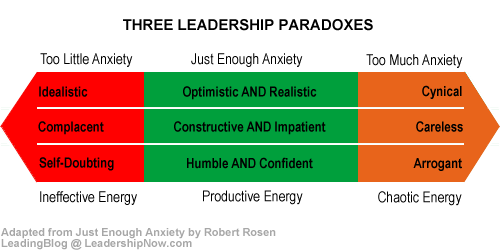 Like us on Instagram and Facebook for additional leadership and personal development ideas.
Posted by Michael McKinney at 10:30 AM
Permalink
| Comments (0)
| Books
, Change
, Personal Development
, Thinking
SAMUEL JOHNSON once wrote, “The natural flights of the human mind are not from pleasure to pleasure, but from hope to hope.” This statement seems to define Bill Strickland’s life. Make the Impossible Possible is an engaging, inspirational book written with humility and passion.
Bill Strickland’s life changed when as a boy in a Pittsburgh ghetto, a teacher took the time to show him that he mattered and allowed him to see himself in a new way. (An integral part of any leader’s job.) As a result, he became open to opportunities and created at 19 what became the Manchester-Bidwell Center, the now famous arts-education and job-training center for disadvantaged kids and adults. This extraordinary school was built on Strickland’s belief that “all of us have the potential to make our dreams come true, and that one of the greatest obstacles blocking us from realizing that potential is that we believe, or are told, that things we want most passionately are impractical, unrealistic, or somehow beyond our reach.” He convincingly demonstrates his belief that:
Each one of us, no matter who our parents are, where we live, how much education we have, or what kinds of connections, abilities, and opportunities life may have offered us, has the potential to shape our lives in ways that will bring us the meaning, purpose, and success we long for….I want everyone who comes to this book, no matter what their age or accomplishments or the circumstances of their lives, to rethink their assumptions about what is and isn’t possible in their lives, and to convince themselves that they have not only the right but also the responsibility, and the capacity, to dream big and to make those dreams come true.
Strickland narrates his successes and failures, obstacles and opportunities, his thinking and rethinking, as he went about to create the success he has achieved. It’s a fascinating story. While he has dedicated his life to helping other people, he denies the do-gooder label. He writes, “I didn’t do any of it out of selflessness. I did it to be myself. I did it to enrich my own life, to deepen the quality and meaning of my own experience. I did it because it was a part of what I had to do if I genuinely wanted to be me.”
How often have we been burdened by self-defeating assumptions? Strickland writes that “once we accept the idea that poverty is, essentially, the acceptance of meager possibility, we can’t deny that all of us are in some fashion poor. We all suffer some form of poverty—poverty of imagination, or courage, or vision, or will. We allow ourselves to be limited by our fears—fear of failure, fear of change, fear of being criticized or of looking like a fool.”
This isn’t another see-what-I-did self-help book. It’s a book that invites introspection. Read it and learn from his experience and thinking.
Like us on Instagram and Facebook for additional leadership and personal development ideas.

Posted by Michael McKinney at 02:41 PM
Permalink
| Comments (0)
| Books
, Personal Development

 PERSONALITY AND TEMPERAMENT are a group of traits that are only partly genetic. They are affected by social factors but remain stable throughout one’s life. But, while our basic personalities don't change significantly after childhood, our behavior can. Psychology Today reports that most traits – like optimism, passion, and joy – can be changed. In Second Nature, author Kathleen McGowan, writes:
Tweaking the way you interpret and react to the world can be a transformative experience, freeing you up to act in new ways. At first, it feels awkward, even bizarre. But with new behaviors come new experiences, creating a feedback loop that, over time, reinforces the transition.
Some sought-after qualities are easier to develop than others. Courage, joy, passion, and optimism are among the more amenable to cultivation, but each requires mastering a different—and sometimes surprising—set of skills. To bring more joy and passion into your life, you must paradoxically be more open to experiencing sadness, anxiety, and fear. Learning to think like an optimist, it turns out, is less important than acting like one. And being courageous has nothing to do with how afraid you are: It's a matter of how strongly you feel about your goals. Cultivating these characteristics puts you on the road to that blend of happiness, satisfaction, and purpose that is the height of human functioning, what positive psychologists call "the good life."
British psychologist Daniel Nettle, author of Personality: What Makes You the Way You Are, writing for the BBC, states that when we watch how people respond differently to different circumstances, “something about the way the person is ‘wired up’ seems to be at work, determining how people react to situations, and, more than that, the kind of situations they get themselves into in the first place. This is why personality seems to become stronger as we get older; when we are young, our situation reflects external factors such as the social and family environment we were born into. As we grow older, we are more and more reaping the consequences of our own choices (living in places we ourselves have chosen, doing jobs that we were drawn to, surrounded by people like us whom we have sought out). Thus, personality differences that might have been very slight at birth become dramatic in later adulthood.”
While there is no one best personality to have, each has their advantages and disadvantages, we could do better by getting out of our programmed reactions and try to cover some new ground. Nettle recommends, “If you are an extreme introvert, you might want to challenge yourself to experience the rewards of greater spontaneity and exchange; if you are an extreme extravert, you might want to teach yourself to undertake a long and lonely project that will ultimately be very rewarding. As human beings, we have the unique ability to look in at our personality from the outside and decide what we want to do with it.”
Like us on Instagram and Facebook for additional leadership and personal development ideas.
Posted by Michael McKinney at 11:20 AM
Permalink
| Comments (0)
| Personal Development

The stuff of command, especially in a giant deadly conflict, would not seem ordinarily to combine well with the stuff of forbearance and generosity. Executive skill and vigor, like a surgeon’s skill, would appear to require a certain withdrawal of empathy. The resolution necessary to great statesmanship would appear to invite, if not even to require, a certain ruthlessness with those whose wills and complex humanity complicate, impede, and even defy one’s vigorously pursued purpose.
In a letter to Captain James M. Cutts who had been found guilty in a court-martial of conduct unbecoming of an officer of a gentleman, Lincoln offered this advice:
Quarrel not at all. No man resolved to make the most of himself, can spare time for personal contention. Still less can he afford to take all the consequences, including the vitiating of his temper and the loss of self-control.
Yield larger things to which you can show no more than equal right; and yield lesser ones, though clearly your own.
Miller writes:
Interpreting Lincoln, we might say: We overestimate our own interest, and we underestimate our adversary’s, so that the advice to yield on all small matters, and on all matters than even to our distorting eyes seem equally balanced, is a moral corrective. Here is a lawyer, and a politician, and a war leader in the midst of tremendous battles giving this surprising advice: quarrel not at all.
Lincoln was a man possessed magnanimity and discriminating judgment, who was able to rise above vindictiveness to win the battles that mattered most. Miller’s book on Lincoln holds many lessons for leaders of today. He shows how Lincoln learned to balance his strengths and weaknesses in a way that made him one of the greatest and most respected leaders in modern times.
Like us on Instagram and Facebook for additional leadership and personal development ideas.
Posted by Michael McKinney at 09:37 AM
Permalink
| Comments (0)
| TrackBacks (1) | Leaders
, Personal Development

WHEN THINGS GO WRONG, we often begin by asking ourselves the wrong questions like “Why is this happening to me?” In QBQ, John Miller writes that “our first reactions are often negative, bringing to mind incorrect questions. But if in each moment of decision we can instead discipline our thoughts to look behind those initial questions and ask better ones (QBQ’s – the Questions Behind the Questions), the questions themselves will lead us to better results….The answers are in the questions.”
When a problem (or a challenge is you prefer) arises, we start looking for some control of the situation. The problem is, we quite naturally begin by looking at those around us and ask the wrong types of questions like “why?” and “who?” The wrong questions take away any control of the situation we might otherwise gain.
In LeaderShock, Greg Hicks suggests that we look for meaning in the situation first. Ask self-revealing questions like:
He adds, “You’re on shaky ground if you attempt to fix a problem without first understanding what it means to you and your organization. By looking for inherent meaning, you open a rich treasure chest of valuable gems that lead to new information, insight, and opportunities.”
John Miller stresses that the right questions contain an “I” and not “you,” “they,” and “them.” “I” questions lead to action. “Questions that contain an “I” turn our focus away from other people and circumstances and put it back on ourselves, where it can do the most good. We can’t change other people. We can’t control circumstances and events. The only things we have any real control over are our own thoughts and actions. Asking questions that focus our efforts and energy on what we can do makes us significantly more effective, not to mention happier and less frustrated.”
Like us on Instagram and Facebook for additional leadership and personal development ideas.

Posted by Michael McKinney at 10:28 AM
Permalink
| Comments (0)
| Personal Development
, Problem Solving


He also cited another reason. Scientists have found that from ages 11-14, kids lose some of the connections between cells in the part of their brain that enables them to think clearly and make good decisions. The brain is pruning itself. It’s ridding itself of ineffective and weak brain connections. This creates a situation where the brain is between the child brain and the not fully developed adult brain which forms around age 20.
Elmore asks, “What does this mean?”
Students today are consuming information they aren't completely ready to handle. The adult part of their brain is still forming and isn't ready to apply all that our society throws at it. Their mind takes it in and files it, but their will and emotions are not prepared to act on it in a healthy way. They can become paralyzed by all the content they consume. They want so much to be able to experience the world they've seen on websites or heard on podcasts, but don't realize they are unprepared for that experience emotionally. They are truly in between a child and an adult.
Elmore lists the qualities that we should begin developing in our own kids (and we might look for in ourselves).
Follow us on Instagram and Twitter for additional leadership and personal development ideas.

Posted by Michael McKinney at 07:30 AM
Permalink
| Comments (0)
| TrackBacks (1) | Personal Development

He divides success enhancing choices into 3 areas: Personal Choices (choices people make that will mold their character), Action Choices (choices that move you beyond just talking about what you want to do) and Investment Choices (those choices about investing in people who will make your life better). To help you to develop your skills for making good choices, he has designed a weekly Ben-Franklin-type program that addresses four key choices in each of the three categories. As Monday sets the tone for the rest of the week, he suggests starting each Monday morning with one of the areas and make a commitment to do something different as a result. In brief, the 12 key choices we all need to address are:
Cottrell has a well-thought-out chapter devoted to each of the above choices. Each chapter has discussion questions that you can use with your own team each Monday morning.
Follow us on Instagram and Twitter for additional leadership and personal development ideas.

Posted by Michael McKinney at 09:44 AM
Permalink
| Comments (0)
| Personal Development
BRIAN TRACY has produced another level-headed book with Flight Plan. He correctly asserts that “Every year or two, someone comes along with a book like The Secret, suggesting that there is a quick and easy way to be happy and make a lot of money. According to The Secret, all you have to do is to think and visualize positive thoughts and you will attract into your life all the good things you want. This idea appeals to people who are unwilling to do the hard work that is necessary to achieve anything worthwhile.”
Success happens for a reason and it’s not wishful thinking. We are all subject to the Law of Cause and Effect: For every effect, there is a cause or causes. You get what you put in. It’s as simple as that. It’s not luck or mysterious forces. Actually, that should provide some comfort. It means that it is up to you. You’re in the driver’s seat. Tracy applies the principle well: “If you do what other successful people do, over and over again, nothing can stop you from eventually getting the same results that they do. Conversely, if you don’t do what other successful people do, nothing can help you.” That’s pretty straightforward.
Tracy lays out twelve steps to follow to help you determining and responding correctly to the many hundreds of choices in your journey through life that will help to create the results you’re looking for.
Tracy’s ideas are well worth putting into practice as you begin the new year. He writes, “Character is the ability to follow through on a resolution after the enthusiasm with which the resolution was made has passed.”
Follow us on Instagram and Twitter for additional leadership and personal development ideas.
Posted by Michael McKinney at 08:56 AM
Permalink
| Comments (0)
| Personal Development
IN his book, Civilized Man’s Eight Deadly Sins, Austrian zoologist and Nobel Prize winner Konrad Lorenz, wrote of what is lost in man’s race against himself.
Anxious haste and hasty fear help rob man of his most essential properties. One of these is reflection. . . . A being unaware of the existence of its own self cannot possibly develop conceptual thought, word language, conscience, and responsible morality. A being that ceases to reflect is in danger of losing all these specifically human attributes.
One of the worst effects of haste, or the fear engendered by it, is the apparent inability of modern man to spend even the shortest time alone. He anxiously avoids every possibility of self-communion or meditation, as though he feared that reflection might present him with a ghastly self-portrait, such as that of Dorian Gray. The only explanation for the widespread addition to noise—paradoxical considering how neurasthenic people are today—is that something has to be suppressed. . . . I think he [is] only afraid of meeting himself.
Follow us on Instagram and Twitter for additional leadership and personal development ideas.
Posted by Michael McKinney at 09:50 AM
Permalink
| Comments (0)
| Personal Development

When Yen Ho was about to take up his duties as tutor to the heir of Ling, Duke of Wei, he went to Ch’u Po Yu for advice. “I have to deal,” he said, “with a man of depraved and murderous disposition. . . . How is one to deal with a man of this sort?”
“I am glad,” said Ch’u Po Yu, “that you asked this question. . . . The first thing you must do is not to improve him, but to improve yourself.”
 Let's all resolve to get better.
Like us on Instagram and Facebook for additional leadership and personal development ideas.
Let's all resolve to get better.
Like us on Instagram and Facebook for additional leadership and personal development ideas.
Posted by Michael McKinney at 12:36 PM
Permalink
| Comments (0)
| Personal Development

Posted by Michael McKinney at 10:16 AM
Permalink
| Comments (0)
| Management
, Personal Development
Christine Comaford-Lynch relates the following story in her book Rules for Renegades:
There was once a monk who lived in a tiny hut on a hill overlooking a village. He kept to himself, only coming down to the village for food. In that village, a young woman had become visibly pregnant, and when her screaming father insisted on knowing who her lover was, she named the monk. An angry mob marched up the hill and stormed the monk’s hut.
“You are a disgrace to Buddhism!” they shouted. “All these years we’ve given you alms and now you impregnate one of our women! You should be ashamed! How dare you call yourself a holy man!”
“Is that so?” the monk said, and returned to his meditation.
Time passed, and the child was born. The young woman’s father again marched up the hill and handed the baby to the monk. “Here. You take care of your bastard child. You caused this problem, you live with the consequences.”
“Is that so?” The monk said. He accepted the child and returned to his meditation.
After a few weeks, the young woman was overcome with remorse for falsely fingering the monk. She told her father that the monk was not her lover after all, that her true love had left, and she wanted to raise the child on her own. Again her father marched up the hill, this time with townspeople in tow.
“Please forgive our mistake. We are so sorry. What a truly holy man you are for tolerating our cruel words and caring for this child. We will relieve you now of this burden. The Buddha himself is singing your praises in the higher worlds, all the higher beings are smiling down upon you, no greater monk has ever lived.”
“Is that so?” The monk said, and return to his meditation.
Whether people are praising you or trashing you, neither changes your intrinsic value. Don’t be easily swayed. It reminds me of a statement originally offered by prime minister Benjamin Disraeli, that Henry Ford II once famously said, "Never complain. Never explain." It's good advice. (Although, he probably meant it more as a corollary to the Fifth Amendment than good advice for leaders.) It speaks to accountability—personal accountability.
“Never explain—your friends do not need it, and your enemies will not believe you anyway.”–Elbert Hubbard
Although it gives your power to others, there are times to explain to obtain a positive resolution in a relationship. Explaining often draws you into conversations that are a complete waste of time. Silence is often your best friend. The Proverbs tell us, “When words abound, transgression is inevitable, but the one who restrains his words is wise.”
Complaining is the outward expression of inner frustration. A complaint acknowledges that something is not as we think it should be. (And that may or may not be true. Quite often we lack all of the pertinent information.) The problem is that we often begin to complain as if that will lead to a solution. It rarely does. Complaining is outward focused and is a form of blaming. The issue is internal. If you can fix the problem, then you should quietly fix it. If you can’t, you should change your perspective on it and move on.
Complainers generally have a lot to complain about because they are in fact, complainers. Complaining, explaining and excuse-making extend the time you are embroiled in the issue. It amplifies frustration—your own and others—spreads discontent and discord and generally makes you unpleasant. Jane Austin observed that "those who do not complain are never pitied." Pity, however, is not the goal of a well-adjusted person let alone a leader. Of more value is novelist Cesare Pavese comment that "one stops being a child when one realizes that telling one's troubles does not make things better." Recognize your part, take responsibility and move on.
Like us on Instagram and Facebook for additional leadership and personal development ideas.
Posted by Michael McKinney at 10:47 AM
Permalink
| Comments (0)
| Personal Development

I’m very fond of gardening myself, and I’m fond of gardening examples. To some degree, developing people in an organization is impossible. You can’t develop them; they develop themselves, and so your job is like that of a head gardener. You figure out what the various microclimates are around the place, and then you figure out the qualities of the plants that you need to go into those microclimates. Similarly, you select the people based on their strengths and place them in those jobs. I’ve seen notes of appraisal interviews, which say that two-thirds of the interview is spent talking about what the guy’s not good at. Now, that’s great—I can’t imagine anybody coming out of an interview like that feeling anything other than very depressed.
What you want to do is spend time talking about what the person is good at and how he’s going to develop that. Sure, see whether you can do something about the weaknesses, but to my way of thinking, appraisal interviews should be two-thirds about what the person is good at and how those great assets can be used within the organization. If you look at good coaches in the sports field—and I’ve always been fascinated about how good coaches work—they don’t actually coach technique very often. The really good coaches are the ones that coach the mind and the attitude.
You’ll always have people that find it much easier to be critical than to be encouraging. The tome at the top has to be right. If you start criticizing your colleagues about what they’re bad at all the time rather than encouraging them, that’s sure as hell going to get down through the organization very quickly.
Posted by Michael McKinney at 09:15 PM
Permalink
| Comments (0)
| Leadership
, Personal Development

Make It Great! means it's my choice, which means it's your choice too. Whether you actually have a good day is not the important thing; what's important is how you choose to deal with the things that each day brings. Each encounter presents you with an opportunity to either let it pass by, or tackle it head on and truly Make It Great!
Phil makes an important point. It's relatively easy to have a great day when things are going your way. The discipline comes in when things aren’t going our way. It’s easy to use circumstances as an excuse as to why you couldn’t do what you know is right—“Don’t make me mad!” “I would have but they ….” The ball is always in your court. You can find Phil over at Make It Great!
Like us on Instagram and Facebook for additional leadership and personal development ideas.
Posted by Michael McKinney at 07:06 AM
Permalink
| Comments (0)
| Personal Development
“Foolish is the person that takes offense when none was intended. More foolish is the person that takes offense when it was intended.”

Finally, in the spirit of vigorous debate and deepened understanding, humility prompts us to ask, “Who cares if I’m right at this instant if we get it right eventually?” If we’re devoted to progress, it doesn’t matter who has the answer, but that the answers are found.In the balance of the book, Marcum and Smith show that shifting conversations from statements and judgments to exploration requires not just humility, but the relentless application of two more principles—curiosity and veracity. They maintain a good blog that is worth checking out also.
Posted by Michael McKinney at 12:33 AM
Permalink
| Comments (0)
| Communication
, Leadership Development
, Personal Development

HERE'S a book for organizations and individuals that struggle with “getting it all done.” That is to say, nearly all of us.
Authors Jones Loflin and Todd Musig have put together a memorable and fast-paced story in Juggling Elephants. By bringing out principles designed to help you juggle the acts in your life, and demonstrating through examples, practical tools being applied in the life of the main character, Mark, this book delivers. Here are several of the principles in brief:
 The result of trying to juggle elephants is that no one, including you, is thrilled with your performance.
The ringmaster cannot be in all three rings at once. “I have to give my full attention to the ring I am in an, when it’s time, I must move to the other ring as quickly as possible” said the ringmaster.
The key to the success of the circus is having quality acts in all three rings. What ring should you be focusing in on right now—work, relationships or self?
 There is no shortage of acts for the circus. Every act must serve a purpose. “Choosing acts based on your purpose works best when it becomes a habit. It’s easy to make a wrong choice based solely on emotion, laziness, convenience, or pressure from others who don’t have a good understanding of your purpose. No matter who we are, we can’t do it all. That is why it is essential that every act must serve a purpose.” Tip: Leave room for interruptions.
The relationship between the ringmaster and the performers affects the quality of the circus. People have needs that extend way beyond the obvious ones. “An effective animal trainer recognizes that discipline is a small part of the training process. Getting to know the animal is much more important. Once he understands the animal, he can work with the animal’s personality instead of always trying to force the desired behavior. It’s the same with people. Once you get to know an individual, you can better understand how to fully engage their energies to accomplish a specific goal of task.”
Intermission is an essential part of creating a better circus performance. “Intermission is a time for the audience to mentally relax, physically stretch, and be better prepared for the second half.” We all need to regroup, renew and prepare.
Your circus is only as good as your next performance. Get feedback and actively pursue learning experiences. Take the time to get your act together.
Like us on Instagram and Facebook for additional leadership and personal development ideas.
Posted by Michael McKinney at 08:47 AM
Permalink
| Comments (0)
| Personal Development
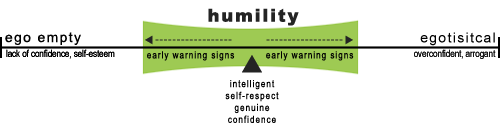
Ego doesn’t suddenly pull us to the extremes and twist us overnight into egomaniacs, or lead us to believe we’re above the law. But once we’re in the habit of being off-center, we do slowly start to believe we’re above other things: reproach, being wrong, being questioned, the need to prove we’re right, having a bad idea, following the lead of others, and so on. Being consistently off-center leads us gradually toward the extremes.When we lose control of ego, we lose “trust, respect, relationships, influence, talent, careers, clients, and market share. Each of us has occasionally, perhaps unknowingly, let ego weaken our talents despite our qualifications, expertise, charisma, track record, or remarkable ability.”
Posted by Michael McKinney at 12:32 AM
Permalink
| Comments (0)
| Books
, Leadership Development
, Personal Development
AS ONE studies leadership, I am reminded of Louis Nizer’s words to be “a scholar who is not confused by his own learning.” It’s easy to get caught up in some of the theory, jargon and formulas and find the whole thing inaccessible but to the best minds. Don’t get me wrong, I believe that the books, training, and mentoring are essential to opening our minds to think in new ways. But ultimately, leadership development begins with self-knowledge and the development of a disciplined mind and character. It is specific to our varied own backgrounds and situations. There are hundreds of great tools to help you get there, but the only one that can begin the journey, is you.
The late great diplomat, Abba Eban once wrote, “An ‘expert’ is a man who understands everything—but nothing else. He sometimes becomes immune to the intangible but powerful human impulses that lie beneath the surface of his discipline.” Yet, it is in the “intangible but powerful human impulses that lie beneath the surface” where you will find leadership. Fortunately, that is accessible to everyone who makes the effort.
Like us on Instagram and Facebook for additional leadership and personal development ideas.

Posted by Michael McKinney at 11:07 AM
Permalink
| Comments (0)
| Leadership Development
, Personal Development

WHEN we take personality tests we need to understand that they are snapshots not indictments. They are a point to grow from. It’s easy to confuse behavior and personality. Personality is reflected in behavior. But, behavior can be changed. One may be especially competitive. However, one need not be boorish or rude.
In a recent TeleForum presented by LeadingNews, Marshall Goldsmith, author of What Got You Here Won’t Get You There, stated that personality testing can lead to stereotyping. To say my personality type is this and is unchangeable is wrong thinking. Executive coaches that believe that people can change are much more effective than executive coaches that do not believe people can change. This may seem like a “Duh!” moment, but it is surprising how many people talk about personality testing as though people cannot change. If you don’t believe people can change, coaching is the wrong business for you to be in.
Goldsmith commented on a common misconception surrounding the new emphasis we now see being placed in the build-on-your-strengths movement. The idea of building on your strengths is an effective life strategy but not an excuse. He stated:
The build-on-your-strengths idea makes total sense when it’s at the level of the occupation. For example, Tiger Woods should be a golfer, not a stand-up comedian. He’s building on his strengths becoming a golfer and he shouldn’t be a stand-up comedian. On the other hand, I think what happens on the build-on-your-strengths stuff, is people misinterpret it. So they would say, “Well, Tiger Woods is a great driver, so he doesn’t have to worry about putting. He can ignore his putting.” He really cannot ignore his putting. It’s part of his job. If you’re a leader and you’re great at strategy but terrible with people, you can’t just sit there; if your CEO, and say, “It doesn’t matter.” It does matter. It all matters. You can’t sit there an ignore part of your job and say “I’m not good at that, therefore, I have an excuse to ignore it.” All that does is reinforce a useless stereotype.
While most advocates of build-on-your-strengths do not encourage that, Goldsmith is right. The idea is often misinterpreted. We must build on our strengths and minimize activities that call upon our weaknesses, but our weaknesses have to be dealt with. And that requires some behavior modification. Too often it can be taken an excuse to do-your-own-thing and not a position to grow and learn from. We can’t let ourselves fall into the trap of saying, “That’s just the way I am” because it’s hard to change. It may be the way you are, but you can be better. You can grow if you decide to. As a leader, you have an obligation to.
Mark Sanborn said in a recent interview that he thinks most of us “sell ourselves short in terms of the impact that we can have in the world or in the marketplace, or in our homes and communities. We all have the opportunity, and maybe to a degree, an obligation, to take whatever talents we've been given and develop them to the fullest, so that we can more positively benefit and contribute to others.”
Like us on Instagram and Facebook for additional leadership and personal development ideas.
Posted by Michael McKinney at 09:20 AM
Permalink
| Comments (0)
| Change
, Personal Development

Posted by Michael McKinney at 08:55 AM
Permalink
| Comments (0)
| Personal Development
We actually can do more in a given time than we could even five years ago. Therefore, the expectations we face to produce faster are often valid. But we don’t have to work harder or work longer hours to accomplish more.“So,” Poscente asks, “why do people become irritated and rail against the expectation to speed up?” Here’s the key:
Perhaps it’s because we don’t often use the extra time for more rewarding experiences. Frequently, when we reduce the time it takes to do something insignificant, we end up using the saved time on yet another insignificant activity. If you figure out a way to save time at the bank and the grocery store, for example, do you earmark that time for something more rewarding, or do you just fill that time passively with other responsibilities that pop up? The latter scenario would leave anyone feeling exhausted, burnt out.I think we have all been guilty of that. He explains:
Speed is a great solution for increasing income and productivity, but those benefits are only one piece of the picture. The bigger reason we should speed up is to make time for meaningful experiences. Speed is not just the way to get more work done—speed is the secret to having time to do what we want.Poscente say we can speed up and still have the time to smell the roses. We need to know when speed will and will not benefit us. Are there ways you can approach what you do in a different way that would allow you to spend more time with your priorities, strengths, talents, and passions?
Posted by Michael McKinney at 10:46 AM
Permalink
| Comments (0)
| Books
, Personal Development
Human freedom involves our capacity to pause, to choose the one response toward which we wish to throw our weight.—Rollo May

Posted by Michael McKinney at 09:08 AM
Permalink
| Comments (0)
| Books
, Personal Development

We tend to think that what we see is reality, and to forget that there is a much bigger world out there that, if we considered it, would put our situation into perspective. When we forget this, we tend to take our own perspective a little too seriously, and in the process, we take ourselves too seriously as well.Brandt suggests that a well-developed sense of humor makes a good antidote.
Posted by Michael McKinney at 08:25 AM
Permalink
| Comments (0)
| Books
, Personal Development
, Problem Solving
PUBLIC RELATIONS guru Robert Dilenschneider’s excellent new book, Power and Influence: The Rules Have Changed, is worth your time because it is filled with a lifetime of wisdom about how to get along with others—a skill that is at the heart of leadership. He presents ten rules to think about and apply variously to your own situation. I think the most important ideas coming from these rules revolve around how to adapt to your changing world and situation, the importance of knowing how to be relentless, and the need for civility and humility.
Rule Four is Seize the Opportunity in Every Crisis. All of us experience some crisis of one form or another, at any given moment in our lives. The big question is how we handle it. Dilenschneider writes, “The ability to survive in an uncertain time is critical…. [A] big part of power lies in knowing the moment to move. It’s not being all over the place all the time; it’s knowing that one critical instant to move, taking action, and getting the result.” He asked his friend, power player Alan Goodman how he viewed power players and their ability to respond to a crisis:
They are not impressed with power, and they are not concerned with power. They are concerned with ideas and impact. To me, that’s the biggest lesson I’ve learned from the people I’ve met. Their focus, and the focus of any of us that are lucky enough to lead an institution, has got to be what you do with it. How you make the world less dangerous, how you make your community a better place, how you energize people to get their ideas, because you don’t have all the ideas yourself. The best leaders focus on getting the best ideas and then doing something with them.
Here are a few other lessons from Dilenschneider:
LESSON: For a power player, it’s important to reach out to the shoeshine boy as well as the CEO. In fact, sometimes it’s more important to reach out to the shoeshine boy so that the CEO sees that you’re a person of the people, a person who’s generous, who’s humble, who’s willing to do outreach.
LESSON: What is it like to be with these men and women of power? With the best of them, it is terrific because they are essentially humble people who understand their own shortcomings.
LESSON: Keep your friendships, nurture them, and don’t expect anything in return. At the same time, when someone else has a problem, help that person instead of shying away from him or her. Most people tend to look at people with problems and say, “I want to avoid those people.” The time to go to people is when they’re down and out. They are unlikely ever to forget your goodwill.
Follow us on Instagram and Twitter for additional leadership and personal development ideas.
Posted by Michael McKinney at 10:58 AM
Permalink
| Comments (0)
| Books
, Personal Development

MARK SANBORN (author of, among other things, You Don't Need a Title to be a Leader) wrote a good post about digging a little deeper to find those things to think about that will really make a change in our lives.
We often don’t give attention to those things that have become familiar to us. Familiarity breeds contempt, and so we tend to gloss over those things in search of the big thing. In actuality, it is the little everyday life issues that, when acted upon, will have the greatest long-term effect on our life.
Sanborn challenges us with an important question: “What in my life that I can influence or control should I be giving serious thought to today? That would include things like relationships, family issues, financial planning, career choices, health and exercise, and one of my favorites, the difference between activity and accomplishment.”
He adds, “The agenda set by print and broadcast media don’t always focus us on what we need to be thinking about. The only person who can determine the appropriate thinking agenda for your life is you.”
Follow us on Instagram and Twitter for additional leadership and personal development ideas.
Posted by Michael McKinney at 04:12 PM
Permalink
| Comments (0)
| Personal Development
GARY BRANT asks us in his book The Ring in the Rubble, to look at how we are perceiving change in our life. He writes that “change is the great equalizer; it affects all of us. Organizations that view change as an opportunity and aggressively seek to find and capitalize on it, win. Those who don’t fall behind and are doomed to forever play catch-up.
For his metaphor, “the ring represents the valuable opportunities that change always creates. The rubble symbolizes the disruption, fear, and uncertainty that change almost always stirs up. My goal is to help you find the rings in the rubble of whatever changes you face, both at work and at home.”
Our perceptions of events in our life are based on how we view our world – our attitude. Sometimes our attitude is based in reality, but you would be surprised how often it is not. Often these false assumptions block us – and our organizations - from seeing things as they are and advancing to our full potential. Brant asks a series of questions to help us get at the emotional issues of regret and worry that are holding us back from taking positive action that is worth reviewing from time to time:
Follow us on Instagram and Twitter for additional leadership and personal development ideas.
Posted by Michael McKinney at 09:03 AM
Permalink
| Comments (0)
| Personal Development

[Imagination] is something different from knowing things and being able to reason. It’s the part of the mind that creates stories, that feels what it’s like to be someone else (and so much so that for a moment you become that other person), that grasps the essence of a human dilemma, that eagerly absorbs the complexities of complex matters, that can see how people change in different circumstances, that is always trying to improve on things, that can conceive of a world different from the one we are living in.Seeking balance too, requires keeping a long term view and personal integrity with our values and beliefs. Even in thinking about today’s big issues, it’s all too easy to jump on the band wagon of the latest speech, the newest study, or an organization’s well-rehearsed agenda. These issues are complex and need to be thought through in a well-ordered manner.
We hear it from our Nobel Prize-winning economist Edmund Phelps, who teaches us that mental stimulation, problem-solving, and personal growth are the sine qua non of a thriving economy.
This is the key point: Our imaginations have trouble seeing their potential, and can do so only when we try ourselves and then compare our achievement against a greater achievement, and then repeat the process again and again.
Our New Age is so very much in need of imagination. The potential, as we have said, is so high now at the beginning, yet the problems ahead are already so massive, too. When the Arctic sea loses a chunk of ice the size of Texas, we have a sense things are not in balance.
When a billion people still have none of the benefits of modernity and face premature death and a life of squalor, we know things are not yet in balance.
When millions of people have stagnant incomes or face the dislocations of loss of employment, because of the shifting patterns of trade, we know there is still much too much imbalance.
When we barely understand the history, religious and cultural beliefs, and aspirations of other major societies around the globe, we know we have an imbalance of trade in knowledge.
And if the world — or our own lives — seem out of balance, it may be because the temptation to see things in a simple binary form — up or down, good or evil, right or wrong — is stoked every day by a culture that wants us to do anything but think too hard about the issues that matter so much.
Posted by Michael McKinney at 01:04 PM
Permalink
| Comments (0)
| Personal Development

Some Years ago, Fisher, who was in the real estate business, went to a store and bout a pair of Levis. In too much of a hurry to try them on, when he got home he discovered they were an inch too short. He took them back, but the store where he’d bought them had such a small selection that they couldn’t accommodate him. Knowing that the ubiquitous Levis had to be stockpiled somewhere, he became so frustrated that it gave him an idea.
He called the company at its headquarters in San Francisco and offered them a deal: If they would agree to supply him, he would open a store that had the largest selection of their products ever offered for sale in one spot. Fine, said the company, and thus the Gap was born. Don later told me, “If my pants had been an inch longer. I’d still be in real estate instead of owning The Gap!”
Posted by Michael McKinney at 12:13 AM
Permalink
| Comments (0)
| Personal Development
 In fairness, calls for a new rule points to the very real need to explain the intent of the original. That it should and would need to be explained properly to each succeeding generation is a fact of life.
Posted by Michael McKinney at 09:05 AM
Permalink
| Comments (0)
| Ethics
, Leadership
, Personal Development

 Without it we limit our input—distance ourselves from reality—and virtually assure that we are not effective with others. Consequently, the respectful mind is the first mind we should seek to develop in children and demand from ourselves.
Posted by Michael McKinney at 12:22 AM
Permalink
| Comments (0)
| Books
, Leadership Development
, Personal Development
THE President of the United States, on the Fox TV show 24, made a comment regarding leaders and followers that we all—celebrity or not—should consider before trying to weigh-in on the decisions that any of our leaders make.
We all too often offer opinions on what should have been done in hindsight based on such limited information. This doesn’t mean that we should be blind followers, but that any criticisms we have should be tempered with humility and an understanding that the information we have at our disposal is most often simplistic at best. We should judge the way we would want to be judged.
On the show, President Noah Daniels reflected, “You know Tom, it’s easy to think you’ve got all the answers when none of the ultimate responsibility lies with you. But sittin’ in this chair.… Until you sit in this chair, you don’t know anything.”
How true and how easily we forget.
John F. Kennedy once said, “No one has the right to grade a President—not even poor James Buchanan—who has not sat in his chair, examined the mail and information that came across his desk, and learned why he made his decisions.”
Michael Watkins wrote on the Harvard Business Review site about a circular prison design whereby the inmates could be observed by a centrally-located warden. “The prisoners were unable to tell at any given moment whether or not they were being observed. The goal was to create what Bentham described as a debilitating ‘sentiment of an invisible omniscience’ and ‘a new mode of obtaining power of mind.’”
As a society, are we moving to such an Orwellian approach to others? He observes:
But we are hurtling toward something that could be far worse, the multitudes observing every act of the powerful, waiting (even hoping) for the fatal flaw to emerge, and then inciting the web-based mob to cry for blood.
When do we cross the line from appropriate safeguards to paralyzing surveillance?
Like us on Instagram and Facebook for additional leadership and personal development ideas.

Posted by Michael McKinney at 08:49 AM
Permalink
| Comments (0)
| TrackBacks (1) | Personal Development
Strategic quitting is the secret of successful organizations. Reactive quitting and serial quitting are the bane of those that strive (and fail) to get what they want. And most people do just that. They quit when it’s painful and stick when they can’t be bothered to quit.Finding and successfully moving through your Dip is really a matter of counting the cost. Consider first, if you have the resources to carry on and then, if you succeed, is it worth the effort?
It’s the incredibly difficult challenges (the Dips) that give you the opportunity to pull ahead.If you’re looking for some inspiration you might try reading New Ideas from Dead CEOs by Todd Buchholz. He writes: “Each of these CEOs failed at some point. Faced with bankruptcy and defections, they could have succumbed to psychological depression or the siren call of politicians offering class warfare. He each heard nos, the tsk-tsks of friends, and a schadenfreude chorus scoffing at their failure. But they pushed on, energized by passion, ego, money, and the promise of glory. You cannot build a successful business or economy on the kindness of strangers. These CEOs relied on more dependable, more human drives. Drives that took them on fascinating rides.” In short, they embraced the Dip.
A few people will choose to do the brave thing and end up the best in the world. Informed people will probably choose to do the mature thing and save their resources for a project they’re truly passionate about. Both are fine choices. It’s the last choice, the common choice, the choice to give it a shot and then quit that you must avoid if you want to succeed.
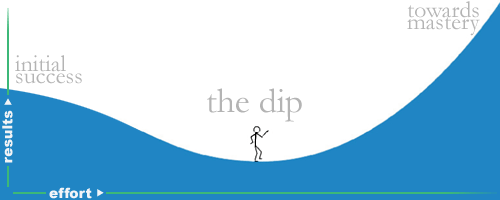 Like us on Instagram and Facebook for additional leadership and personal development ideas.
Posted by Michael McKinney at 12:15 AM
Permalink
| Comments (0)
| Books
, Personal Development

"I always thought they didn't want me around because I was a skunk, well...you know it turns out they didn't want me around because I was a jerk."—Reeko (the Skunk), Stuart Little 3: Call of the Wild
Posted by Michael McKinney at 12:06 AM
Permalink
| Comments (0)
| Personal Development
 Relying on a single person to lead the charge reflects a dysfunctional concept of leadership. It sets up expectations that can’t be met. No one person can do everything. No wise leader would. Leadership is a group activity. There is an implied interdependency.
Posted by Michael McKinney at 08:35 AM
Permalink
| Comments (0)
| Leadership Development
, Personal Development

IT IS EASY to succumb to the tyranny of the urgent. There is always something competing for our attention. Worse still, we might find we have to deal with what Michael Watkins calls pyromaniacs—those people like to create fires for you to put out. The only way out is to get some perspective. In White Hat Leadership, author Ty Warren writes about the importance of making time to disengage:
Part of preparing to lead is recognizing when to step away to recharge. Most of us have experienced the benefits of taking time away from the office (or family) for a few days, then returning with new energy and a better perspective.
Stepping away allows us to work through issues and problems without the stress induced by a sense of urgency. It is usually in these moments of relaxation that we generate objective solutions. We must go away to return with clarity.
Those who feel task saturated are the very people who need to step away most.
Leaders must have time to think or they will likely forfeit their ability to lead. Task saturation causes us to react rather than respond. Reaction is a mechanical, almost involuntary reflex to events. It comes from the primal areas of the brain and does not involve real thought. Response is initiated from the cognitive regions of the brain. Reaction is normal for the task-saturated person; response comes from the leader who makes certain to allocate time for cognitive consideration.
The urgent will always be with us. How we handle it will determine how effective we are.
Once we begin to let the urgent take over the important we loose perspective and get sucked into a cycle that perpetuates the problem and drains us. Without direction, we mistakenly find ourselves trying to compensate by going twice as fast. We must take time out to think. The perspective you gain will help you to handle everything you do better.
Are you part of the problem? Do you create fires for others to put out? Take the “Are you a pyromaniac?” quiz.
Follow us on Instagram and Twitter for additional leadership and personal development ideas.
Posted by Michael McKinney at 04:51 PM
Permalink
| Comments (0)
| Leadership
, Personal Development
“Talent is cheaper than table salt. What separates the talented individual from the successful one is a lot of hard work.”—Stephen KingIn John Maxwell’s valuable new book, Talent is Never Enough, he cites Peter Drucker on effectiveness, "There seems to be little correlation between a man's effectiveness and his intelligence, his imagination, or his knowledge...Intelligence, imagination, and knowledge are essential resources, but only effectiveness converts them into results. By themselves, they only set limits to what can be contained." "If talent were enough," Maxwell writes, "then the most effective and influential people would always be the most talented ones. But that is often not the case."
Talent might get you noticed but it won’t keep you there. Success requires hard work. To achieve the effectiveness that Drucker is talking about and to turn talent into results is matter of choice. Maxwell writes, “The key choices you make—apart from the natural talent you already have—will set you apart from others who have talent alone.” He has identified 13 choices you can make to maximize your talent. These choices form the framework of his book:
• Belief lifts your talent: Lack of belief in yourself can act as a ceiling on talent.
• Passion energizes your talent: A passionate person with limited talent will outperform a passive person who possesses greater talent.
• Initiative activates your talent: Socrates said, “To move the world we must first move ourselves.”
• Focus directs your talent: Attempting everything, like attempting nothing will suck the life out of you.
• Preparation positions your talent: Becoming more intentional. You can claim to be surprised once; after that, you’re unprepared.
• Practice sharpens your talent: Practice demands discipline and embracing change.
• Perseverance sustains your talent: People who display perseverance keep a larger vision in mind as they toil away at their craft or profession.
• Courage tests your talent: As we develop our talent and grow to our potential we will be tested continually. Courage is an everyday virtue.
• Teachability expands your talent: Teachability is not so much about competence and mental capacity as it is about attitude. It is the desire to listen, learn, and apply. Talented people can be the toughest to teach because they often think they know it all. It’s a problem of pride.
• Character protects your talent: People cannot climb beyond the limitations of their character. Talented people are sometimes tempted to take shortcuts. Character prevents that.
• Relationships influence your talent: Life is too short to spend it with people who pull you in the wrong direction. And it’s too short not to invest in others. Your relationships will define you.
• Responsibility strengthens your talent: Responsibility not only improves your life, but also will improve the life of those around you.
• Teamwork multiplies your talent: Teamwork divides the effort and multiples the effect.
“Make these choices,” Maxwell encourages, “and you can become a talent-plus person. If you have talent, you stand alone. If you have talent plus, you stand out.”Posted by Michael McKinney at 09:54 AM
Permalink | Comments (0) | Books , Personal Development

Posted by Michael McKinney at 12:58 AM
Permalink
| Comments (0)
| Books
, Personal Development
IN Marcus Buckingham’s book, Go Put Your Strengths to Work, he presents three myths that we need to deal with in order to make the most of our strengths. The first myth is, “As you grow, your personality changes.” The truth Buckingham says is, “As you grow, you become more of who you already are.” As it is presented, there could be some confusion. There are a few issues that need to be considered.


There is personality, there is behavior and there are attitudes. Although they are dependent on each other and intertwined, they are not all the same thing. In any discussion about any one of them, we have to be careful about what we are talking about.
We all have traits that become more apparent as we grow and develop. These traits and talents—strengths—do not change over our lifetime. On the other hand, our behavior and attitudes can be altered, overhauled, modified, transformed or ignored. A scrooge can become generous. An approach that says, “Hey, that’s just the way I am” is a recipe for self-destruction.
Buckingham contends that "as you grow, you don't change into somebody else .... Personality tests confirm this. Much as we would like to believe that we change as we grow, if we take a personality test twice separated by many years, the results from the two tests are almost exactly the same." This is true. However, what we are, how we are perceived, how we relate to others, is determined by and large by how we see ourselves and our world, how we see or filter our experiences—our attitude—and how we act based on what we think—our behavior.
We may be competitive by nature—our personality—but we need not behave in such as way as to be obnoxious, rude, inconsiderate or demanding. We need not see everything as an opportunity to conquer. We can develop that trait or strength into an asset or we can let it rule our lives by letting it run amok to the point where we become the jerk that Bob Sutton describes in his book, The No Asshole Rule. If we allow it, our strength sabotages us and ends up holding us back from achieving our potential and from functioning well with others. Strengths must be managed, not indulged. The character we develop functions to monitor our strengths so that they serve us and don’t become a liability that holds us back.
With that in mind, Buckingham’s point is well taken. It is imperative that we know ourselves—our personality, our strengths—and not try to be something we are not. If we don’t, we diminish our effectiveness. Too often we head in a direction or a career path that does not compliment our innate strengths. These don’t change over our lifetime, and when we work with them rather than against them we can have more effective and fulfilling lives and be of greater service in any area that we chose to make our contribution.
Like us on Instagram and Facebook for additional leadership and personal development ideas.
Posted by Michael McKinney at 12:31 AM
Permalink
| Comments (0)
| Books
, Personal Development
In many subtle and not-so-subtle ways, society tells us what’s valuable and what’s not—for example, that being strategic and future focused are tickets to the executive suite, whereas being a good wooer and craving significance for yourself get you not much of anything.
To make your greatest possible contribution, however, you’re going to have to look beyond society’s judgments.
All any of us can do is know ourselves well enough to identify where our greatest possible contributions lie, and then do our utmost to make those contributions real.
Posted by Michael McKinney at 07:11 AM
Permalink
| Comments (0)
| Personal Development
Marcus Buckingham’s latest work, Go Put Your Strengths to Work begins by speculating on the source of the strengths movement. He speculates that perhaps for many it may have begun with Peters Drucker’s 1966 comment in The Effective Executive: “The effective executive builds on strengths—their own strengths, the strengths of superiors, colleagues, subordinates; and on the strengths of the situation.”
For me, it began in the early seventies when Jack McKinney—my Dad—began presenting his Know Yourself seminars in English-speaking countries around the world. A big part of his seminar was identifying and building on strengths and learning to manage them as the excessive use of strength becomes a weakness.
Whatever your introduction was to the strengths movement, Go Put Your Strengths to Work is an attempt build on the shoulders of giants to advance the current strengths movement from just identifying and labeling our strengths to learning how to actually put our strengths to work. This is the real point of the whole process. His practical system is very useful in helping you to do just that. The system is based on 6 steps:
1: Bust the Myths—So, What’s stopping you?
2: Get Clear—Do You Know What Your Strengths Are?
3: Free Your Strengths—How Do You Make the Most of What Strengthens You?
4: Stop Your Weaknesses—How Can You Cut Out What Weakens You?
5: Speak Up—How Do You Create Strong Teams?
6: Build Strong Habits—How Can You Make This Last Forever?
The process involves the careful observation of your work habits—using a guided questioning procedure—to turn the best of your job into the most of your job. Simply put, Buckingham defines your strengths as “those activities that make you feel strong.” Conversely, the best definition of weakness is any “activity that makes you feel weak.”
Of course, the system is backed by a web site—SimplyStrengths.com—accessed by using the now familiar code given with the purchase of the book. The release of the book is also backed by a nationwide tour by Marcus Buckingham beginning today. This event will also include a private showing of his short feature film entitled Trombone Player Wanted.
Related Interest:
StrengthsFinder 2.0: A New and Upgraded Edition of the Online Test
Like us on Instagram and Facebook for additional leadership and personal development ideas.
Posted by Michael McKinney at 10:02 AM
Permalink
| Comments (0)
| Books
, Personal Development

Posted by Michael McKinney at 09:57 AM
Permalink
| Comments (0)
| Personal Development
 Like us on Instagram and Facebook for additional leadership and personal development ideas.
Posted by Michael McKinney at 12:05 AM
Permalink
| Comments (0)
| Books
, Personal Development
Dependent Pride: Pride based on what we hope to accomplish—future outcomes—rather than what we have done or are currently doing
Exaggerated Pride: Pride based on what we want to believe about ourselves rather than what the data or the feedback we are getting would really tell us (believing our own press releases)
Overweening Pride: Pride driven by potential outcomes or what we imagine we are doing as opposed to what we are actually doing
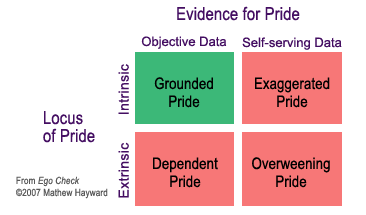 Like us on Instagram and Facebook for additional leadership and personal development ideas.
Posted by Michael McKinney at 10:30 PM
Permalink
| Comments (0)
| Books
, Personal Development
“Most people think they know what they are good at. They are usually wrong . . . . And yet, a person can perform only from strength.”—Peter Drucker
GALLUP PRESS has just released StrengthsFinder 2.0. It’s a handy and improved follow-up to Now, Discover Your Strengths. What’s so new? Gallup has this to say:
Our research and knowledge base on the topic of human strengths have expanded dramatically over the past decade. StrengthsFinder 2.0 picks up where the first version left off, and it is designed to provide you with the latest discoveries and strategies for application. The language of 34 themes remains the same, but the assessment is faster and even more reliable. And, the results yield a much more in-depth analysis of your strengths — featuring a look at the nuances of what makes you unique, using more than 5,000 personalized Strengths Insights that we have discovered in recent years.
Going far beyond StrengthsFinder 1.0's shared theme descriptions, which can be found in Part II of StrengthsFinder 2.0, these highly customized Strengths Insights will help you understand how each of your top five themes plays out in your life on a much more personal level. For example, even though you and a friend may both have the same theme in your top five, the way this theme is manifested will not be the same. Therefore, each of you would receive entirely different, personalized descriptions of how that theme operates in your lives.
These new Strengths Insights describe what makes you stand out when compared to the millions of people we have studied. Once you have completed the online assessment, you will receive a comprehensive Strengths Discovery and Action-Planning Guide that is based on your StrengthsFinder 2.0 results. This guide includes:
Like us on Instagram and Facebook for additional leadership and personal development ideas.

Posted by Michael McKinney at 09:51 AM
Permalink
| Comments (0)
| Books
, Personal Development
AS ONE OF the greatest journalists of all time, twice receiving the Pulitzer Prize, New York Times journalist James Reston (1909-1995) wrote in his memoirs about a trap we can fall into when judging others.
He related how his wife, Sally, helped to temper his comments and writing. It’s a trap that we most easily fall into when we are overly focused on our own agenda or frustrated over simply not getting our own way. It’s good advice for any of us to keep in mind when we are getting ready to air our opinion—especially on social media.
He wisely wrote:
One of the blind spots of reporters is that after a while, we are inclined to forget that officials are people. Preoccupied with issues, we come to regard them as liberals or conservatives, honest or crooked, but seldom as ordinary folk who have wives and children and cry when they’re hurt. Sally was always saving me from this folly. She knew a lot of these official families and knew also when their kids were sick or flunking out of school or fiddling with drugs. Thus when some political luminary seemed to be in a slump, talking more nonsense than usual, she would say maybe he was worrying about the family, or, as I was inclined to believe, about his own wandering and wayward habits. Still, it was useful to be reminded that these headline characters have things to worry about other than the national debt—their own debts, for example.
Times have changed. Journalism today is very different from the journalism Reston practiced. He said in on the occasion of the 50-year anniversary of the Pulitzer Prizes in 1966, that “Some of the old newspaper traditions, of course, we maintain. Our self-righteousness, I can assure you, is undiminished. Our capacity to criticize everybody and our imperviousness to criticism ourselves, are still, I believe, unmatched by novelists, poets or anybody else.”
In Scotty: James B. Reston and the Rise and Fall of American Journalism, author John Stacks writes:
He had access to the corridors of power because he was trusted to report and write with a sense of balance and humanity; He was often critical of policies and policy makers but rarely harsh on these judgments. He got to know the powerful as human beings, as people with strengths and weaknesses. He usually thought they were trying do their difficult jobs as well as they could and in what they saw as the best interests of the nation. There was, at the heart of Reston’s style of journalism, a sense of common purpose with the government and political leaders. He felt that journalism and government were integral parts of the fabric of the country, working in different ways toward the same goal: helping the country deal with threats to its health and survival from home and abroad. The press and government, although with different interests and different priorities, were seen by Reston as collaborators in on enterprise, the preservation of the United Sattes of America.
Like us on Instagram and Facebook for additional leadership and personal development ideas.

Posted by Michael McKinney at 09:30 AM
Permalink
| Comments (0)
| TrackBacks (2) | Personal Development
 Like us on Instagram and Facebook for additional leadership and personal development ideas.
Posted by Michael McKinney at 07:26 AM
Permalink
| Comments (0)
| Personal Development
YOU can help some of the people some of the time, but you can’t help all the people all the time. Not everyone wants help. Not everyone wants to change. Some people can’t or won’t be lead. It’s a fact of life. Marshall explains, “This may sound harsh, but some people are unsalvageable. You’re only banging your head against a wall if you think you can fix them.” Some flaws can’t be coached away by any boss, especially if the following conditions exist: 
Stop trying to change people who don’t think they have a problem.
Stop trying to change people who are pursuing the wrong strategy for the organization. If they’re going the wrong direction, all you do is help them get there faster.
Stop trying to change people who should not be in their job. Move them on.
Stop trying to help people who think everyone else is the problem. People like this will never give up on their near-religious belief that any failure is someone else’s fault.
More importantly, we need to be sure we are not deluding ourselves into being one of these people. Always be looking to change, grow and improve. Ask. Others are sure to point the way.
This is adapted from What Got You Here Won't Get You There by Marshall Goldsmith.
Follow us on Instagram and Twitter for additional leadership and personal development ideas.

Posted by Michael McKinney at 07:59 AM
Permalink
| Comments (0)
| TrackBacks (1) | Leadership
, Personal Development
THESE five lessons are from The Greatness Guide by speaker and leadership coach, Robin Sharma.
 The ultimate competitive advantage of your enterprise comes down to a single imperative—your ability to grow and develop leaders faster than your competition. The more quickly you can get every single person in the company demonstrating leadership behavior—regardless of their position—the more quickly you will lead the field.
 Being a leader isn’t about being liked. It’s about doing what’s right. Great leaders run their own race, making the right decisions and worrying little about public opinion. They are courage in action.
 Try not to teach your fears to your kids. Introduce your children to what’s possible. If you see the world as a place of limitation, so will those little people you are raising.
 Every day, life will send you little windows of opportunity. Your destiny will ultimately be defined by how you respond to these windows of opportunity. Shrink from them and your life will be small. Feel the fear and run to them anyway and your life will be big.
 Remember, every great leader (or visionary or brave thinker) was initially laughed at. Now they are revered. Push the envelope. Refuse to accept anything remotely close to mediocrity. Let go of the chains that have bound you to the ordinary. And definitely leave the crowd.
Follow us on Instagram and Twitter for additional leadership and personal development ideas.
Posted by Michael McKinney at 08:59 AM
Permalink
| Comments (0)
| Five Lessons
, Personal Development
MARSHALL GOLDSMITH introduces a concept called feedforward in his book, What Got You Here Won't Get You There. Essentially it is a refocusing of the practice of feedback. Feedback tells us what has happened or what we have done. Our history. Feedforward is future-oriented. It is asking for ideas that you can put into practice in the future. It takes away much of the perceived negativity that is associated with feedback—criticism and the tendency to kill the messenger.
Instead of, “What did I do wrong?” feedforward asks, “I am trying to improve in this area. What kinds of things might I do in the future to improve in this area?”
It works because, while they don’t particularly like hearing criticism, successful people love getting ideas for the future. If changing a certain type of behavior is important to them, they will gobble up any ideas that are aimed at changing that behavior.
It works because we can change the future but not the past.
It works because helping people be right is more productive than proving them wrong.
On the most elemental level, it works because people do not take feedforward as personally as feedback.
We can focus on hearing without having to worry about responding.
Marshall adds, “Feedforward forces us to ask—and in doing so, we enlarge our universe of people with useful ideas. Asking, of course, gives the other person a license to answer. I cannot overestimate how valuable this license can be. I’m sure that all of us are surrounded by smart well-meaning friends who “understand” us better than we “understand” ourselves. I suspect they would love to help us; most people like to help others. But they hold back because they think it is rude or intrusive to try to help someone who has not asked for our assistance. Asking solves this.
This is adapted from What Got You Here Won't Get You There by Marshall Goldsmith.
Follow us on Instagram and Twitter for additional leadership and personal development ideas.

Posted by Michael McKinney at 12:08 AM
Permalink
| Comments (0)
| TrackBacks (1) | Personal Development
WHEN we ask a friend, "What do you think I should do in this situation?" we are setting up the expectation that we want an answer—and that we will give the answer full consideration and quite possibly use it. We are not announcing that we're initiating an argument.
But that's exactly what we're doing when we ask for feedback from someone and then immediately express our opinion. This is certainly true when our opinion is negative ("I'm not sure about that . . . ."). Whatever we say, however softly we couch it, our opinion will sound defensive. It will resemble a rationalization, a denial, a negation, or an objection.
Stop doing that. Treat every piece of advice as a gift or a compliment and simply say, "Thank you." No one expects you to act on every piece of advice. If you learn to listen—and act on the advice that makes sense—the people around you will be thrilled.
Additionally, he cautions that it is not appropriate to pass judgments on people's opinions when we specifically ask them to give it to us. Naturally, we don’t like to be critiqued, but “the only sure thing that comes out of passing judgment on people’s efforts to help us is that they won’t help us again…. No matter what you privately think of the suggestion, you must keep your thoughts to yourself, hear the person out, and say, ‘Thank you.’” Solid advice.
This is adapted from What Got You Here Won't Get You There by Marshall Goldsmith.
Follow us on Instagram and Twitter for additional leadership and personal development ideas.
Posted by Michael McKinney at 09:38 AM
Permalink
| Comments (0)
| TrackBacks (1) | Personal Development
 IT’S not that you don’t know who you are or where you’re going or what you want to achieve. Nor is it that you don’t have an adequate sense of self-worth. What’s wrong is that you have no idea how your behavior is coming across to the people who matter—your boss, colleagues, subordinates, customers, clients and family.
You think you have all the answers, but others see it as arrogance.
You think you’re contributing to a situation with helpful comments, but others see it as butting in.
You think you’re delegating effectively, but others see it as shirking responsibilities.
You think you’re holding your tongue, but others see it as unresponsiveness.
You think you’re letting people think for themselves, but others see it as ignoring them.
These are the kinds of things that are holding you back. Executive coach Marshall Goldsmith, pulls no punches in his new book, What Got You Here Won't Get You There. This book is for those who really want to change. It’s for those who really want to see things for what they are and do something about it. There is something you'll recognize about yourself in this book.
We all hold superstitious beliefs—a mistaken belief that a specific activity followed by positive reinforcement is actually the cause of that positive reinforcement. Superstitions based on the mistaken idea that because I behave this way, I achieve results. Therefore, I must be achieving results because I behave this way. These superstitions make it hard for us to change. Goldsmith writes that this is the paradox of success: The beliefs that carried us here may be holding us back in our quest to go there.
Goldsmith looks at 21 specific habits that may be holding us back from getting to the next level. We’ll look at some of these over the next several weeks. How are you coming across to other people? Really? Are you sure? How are you holding yourself back?
Follow us on Instagram and Twitter for additional leadership and personal development ideas.

Posted by Michael McKinney at 07:55 AM
Permalink
| Comments (0)
| Personal Development
Posted by Michael McKinney at 12:02 AM
Permalink
| Comments (0)
| Leadership
, Personal Development

Arden Barker had planted a 50-acre field of wheat that was now golden-brown, very full, and ready for harvest. It was a sight to touch the heart of any farmer. When his Uncle Harry came to visit, Arden proudly took him out to look at the field of wheat. Harry looked around, put his hand over his eyes to peer into the distance, and fixed his gaze on a boulder that had been too large to move in the middle of the field. “Is that a stone on the hill?” he asked. He said nothing about the field of wheat. Arden was crushed by his lack of enthusiasm.Too often leaders, managers and parents think that it is crucial to their role to point out where people could improve—to be critical. Certainly, there is a time for that, but it happens all too often. Effective leaders will look for the positive and show gratitude and appreciation for it. People often look to others for direction and support and if it is not forthcoming it can kill the spirit and impede growth.
The Uncle Harry incident became the subject of discussion at many Barker family dinners thereafter. A few years later, their daughter, Brenda, had just finished cutting and trimming the family’s huge lawn. Arden came home and surveyed her work from the kitchen window. “You missed a patch under the trees,” he pointed out. Brenda came over to him, put one arm around his waist, and her other hand over her eyes to peer off into the distance and asked, “Is that a stone on the hill?”
Posted by Michael McKinney at 07:52 AM
Permalink
| Comments (0)
| TrackBacks (1) | Personal Development

Posted by Michael McKinney at 08:32 AM
Permalink
| Comments (0)
| Books
, Personal Development

MENTORS, seminars, multimedia, and books (and this site, of course) are great ways to learn about leadership and areas that you need to think about to round out your leadership capabilities. But nothing takes the place of application and practice. Leadership is not developed in the classroom. The problem (sorry, I meant challenge) we often run into is the opportunity to practice leadership. According to Cindy McCauley from the Center for Creative Leadership, “Seeking out new challenges while remaining in your current job is a practical, effective strategy to pursue.” Taking on new or different assignments allows leaders to intentionally develop new skills, practice new behaviors and improve on weaknesses. She suggests three ways to do this in her book, Developmental Assignments: Creating Learning Experiences without Changing Jobs:
Not every challenge is a prime opportunity to learn, says McCauley. Research shows that certain kinds of challenges stimulate learning more than others. "To adapt and grow, leaders need to be constantly seeking out new experiences and challenges that, by their very nature, foster learning.”
Ten key challenges are listed below, along with a few suggestions for ways to seek such challenges.
| Unfamiliar responsibilities: Handling responsibilities that are new or very different from previous ones you've handled. |
|
| New directions: Starting something new or making strategic changes. |
|
| Inherited problems: Fixing problems created by someone else or existing before you took the assignment. |
|
| Problems with employees: Dealing with employees who lack adequate experience, are incompetent or are resistant to change. |
|
| High stakes: Managing work with tight deadlines, pressure from above, high visibility and responsibility for critical decisions. |
|
| Scope and scale: Managing work that is broad in scope or large in size. |
|
| External pressure: Managing the interface with important groups outside the organization, such as customers, vendors, partners, unions and regulatory agencies. |
|
| Influence without authority: Influencing peers, higher management or other key people over whom you have no authority. |
|
| Work across cultures: Working with people from different cultures or with institutions in other countries. |
|
| Work group diversity: Being responsible for the work of people of both genders and different racial and ethnic backgrounds. |
|
McCauley counsels to select a challenge that will broaden your experience base. Ask yourself: Which of the challenges have I had the least exposure to? Are there some that I haven't experienced in a number of years? Are there any that my current job never provides? Then choose a specific activity or assignment from the list or make up your own.
You can find many more specific ideas in Developmental Assignments: Creating Learning Experiences without Changing Jobs
Follow us on Instagram and Twitter for additional leadership and personal development ideas.
Posted by Michael McKinney at 05:13 AM
Permalink
| Comments (0)
| Personal Development

LEADERS not only ask smart questions, but are smart about asking questions. And listening. A good question can change everything. Gordon MacDonald maintains that a key to effective leadership is the ability to ask the right questions at the appropriate time that will elicit insight and clarity. Of course, that's not always an easy thing to do. It takes thoughtful practice. He writes in the Fall 2006 issue of the Leadership Journal, “That’s the power of the interrogative sentence. A good one, a real good one, alters things. It ignites thought; it can demand commitment, reveal depth or shallowness in a person’s soul, disclose hidden agendas.”
He writes about all kinds of questions, but there was a section that was especially helpful. He referred to times when we should be asking questions when we desperately want to be talking—like when we feel we have been wronged or run into conflict with another person or organization. The temptation is to launch an attack, lay down the law, or simply explain our point of view and let the pieces fall where they may. MacDonald wisely advises that instead, this is the time to proceed first with a few questions. He writes:
Over and over this principle—ask before accusing—has rescued me from making a fool of myself. So in conflicting moments I’ve learned to use questions like these:I need to tell you about an impression I have and ask you if it’s accurate.
The ability to ask smart questions requires that you take the time to think beyond the issue on the table and see often times what are the real underlying issues.
Like us on Instagram and Facebook for additional leadership and personal development ideas.
Posted by Michael McKinney at 07:20 AM
Permalink
| Comments (0)
| Personal Development

There is a way that you can test your excuses to see if they are valid. It is simply to ask yourself, ”Is there anyone else who has my same excuse but who is moving ahead and succeeding nonetheless?”He suggests once you have identified your main constraint, focus on it until it is eliminated. Don’t let minor issues sidetrack you from alleviating that one constraint.
If you are honest with yourself, you will immediately realize that there are hundreds of thousands, if not millions, of people who have it worse than you could ever imagine and are succeeding anyway. If this is the case, your excuse is invalid. Don’t let it hold you back anymore.
Always bear in mind that your own resolution to succeed is more important than any other one thing. —Abraham LincolnRelated Post: Challenge Assumed Constraints
Posted by Michael McKinney at 12:17 AM
Permalink
| Comments (0)
| Books
, Personal Development
Analyzing three years’ worth of written and survey data on students, as well as students’ assessments of their own former bosses, Flynn and Ames found that excessive or inadequate assertiveness was the No. 1 issue listed in the weakness column when it came to evaluating individuals’ leadership potential. “It was mentioned twice as frequently as any other issue. It appeared as a clear factor in weakness comments more than lack of intelligence, conscientiousness, and charisma combined,” Flynn says. Specifically, what the researchers found was essentially an “inverted U” between the ratings of a person’s assertiveness and his or her leadership ability: Up to a certain point it was positively associated, but then it went back down.
“The analogy we use is that assertiveness is like salt in a sauce: Too much spoils the dish, but too little is equally distracting,” Flynn says. Interestingly, at the “just right” point, assertiveness disappears as a leadership quality, either positive or negative. “While getting assertiveness wrong in one direction or the other dominates perceptions of weakness, getting it right is not a major theme in perceptions of strengths,” Flynn says. “In other words, nobody ever compliments the chef on a perfectly salted dish.”
What Flynn and Ames discovered was that when people were determined to be extremely assertive, the social costs of their behavior—others’ hurt feelings and damaged relationships—were seen to override the positive aspects of their ability to get the job done. Conversely, when they were deemed too passive, their inability to move projects along and achieve goals was what stuck in people’s minds, not their ability to preserve social harmony. “People pay more attention to what’s bad about assertive or non-assertive behavior than what’s good about it,” Flynn explains.
Posted by Michael McKinney at 12:32 AM
Permalink
| Comments (0)
| Leadership
, Personal Development
A SURPRISE in this month’s crop of books is The Nature of Leadership by B. Joseph White. Essentially, it is a blueprint for leadership development. He has created a leadership pyramid founded on basics such as a desire to be in charge, and the corresponding ability, strength, and character that all leaders—especially the great ones—must possess.
 From there he divides leadership characteristics between analytical reptilian leadership characteristics and those of the nurturing, engaged mammal. While we generally have a tendency to lean one way or the other, we must develop a capacity to deal effectively with both the reptilian economic and performance issues and the mammalian soft or people issues.
White cautions, “I make no judgment about the inherent value of Reptiles and Mammals in the workplace. Both are vital and most people are, of course a complex mix of the two. We need task-oriented, no-nonsense Reptiles to ensure the work gets done and done well. We need people-oriented, nurturing Mammals to maintain the human community through which work gets done.” He adds, “I believe organizations falter, fail, or don’t reach their potential both because of leadership that is inadequately Reptilian and because of leadership that is inadequately Mammalian.”
 Finally, all these skills and qualities will coalesce into something bigger than the sum of their parts, an intangible but very real "sparkle factor" that separates the great leaders from the merely good.
You can read Chapter 1 online: Become a Leader, a Better Leader, a Great Leader
Like us on Instagram and Facebook for additional leadership and personal development ideas.
Posted by Michael McKinney at 05:51 AM
Permalink
| Comments (0)
| Books
, Leadership Development
, Personal Development

EARLY Christian philosopher, Augustine of Hippo (354-430), proposed that to drive out the bad—those habits or qualities we don’t want—we need to focus on the good—those habit, qualities or strengths we do want. At home, this was always referred to as focus on the war, not the battle. The implication is that when we have a problem we want to change, we need to focus on the new habit we want to form and not the bad habit we want to replace. In relationships, we need to focus on the good that we want to develop and strengthen and not the bad we would like to drive out. Focus on the strengths and they will drive out or minimize the weaknesses.
There seems to be some support for this in current studies of neuroplasticity. Our brain physically changes—makes new connections—based on what we pay attention to; it moves in the direction of our most dominant thoughts. Jeffrey Schwartz and Sharon Begley write in The Mind and the Brain, “Physical changes in the brain depend for their creation on a mental state in the mind—the state called attention. Introspection, willed attention, subjective state—pick your favorite description of an internal mental state—can redraw the contours of the mind, and in so doing can rewire the circuits of the brain, for it's attention that makes neuroplasticity possible." We literally change our brain consistent with that which we send our time thinking about. Shouldn’t we then be thinking about where we want to go and not the miles we have to go to get there?
In terms of leadership, David Rock writes in Quiet Leadership, “[W]e need to help people focus on solutions instead of problems. We need to give up our desire to find behaviors to fix and become fascinated with identifying and growing people’s strengths.” Focus on the war—the desired end—and not the battle—the obstacles we face in getting there.
Like us on Instagram and Facebook for additional leadership and personal development ideas.
Posted by Michael McKinney at 08:32 AM
Permalink
| Comments (0)
| Personal Development
“Why do most of us like to talk so much? Because we want to be noticed. We get a charge out of being the center of the universe. But when you yap on, you use up all of the oxygen and energy in the room, which is debilitating for everyone else” say authors Linda Kaplan Thaler and Robin Koval in The Power of Nice. Often times, more communication is less communication.
They suggest five ways to fine tune your listening skills:
Let the Other Guy Be Smarter. When you let the other guy’s brilliance shine through, you not only gain new information, you also earn their goodwill. Everyone likes to be around people who make them feel intelligent.
Keep It Simple. Sometimes the simplest answer is the best one. By listening rather than pontificating you will often hear the simple connection that makes the difference.
Ask, Don’t Tell. When you ask questions, you tell people that you care about them, that you’re interested in what they have to say. You also send an oh-so-subtle message that you’re a bright, inquisitive individual who would like to know more. That’s why even the smallest question can have a huge impact.
Don’t Argue So Much. Whenever problems or conflicts arise, there is a natural tendency to try and “talk your way out of it.” But sometimes you win your case by shutting up and listening your way out of it.
Everyone Is Worth a Listen. Jay Leno says, “We live in a society of exclusion. There is this idea that you should try to keep people out—‘Oh, you can’t come into this club, you have to be a member, you don’t have enough money, you’re not handsome enough.’ But if you go through life with the opposite attitude and try to include everybody, it opens up doors.”
Remember Dale Carnegie's quote: "You can make more friends in two months by becoming interested in other people than you can in two years by trying to get other people interested in you."
Follow us on Instagram and Twitter for additional leadership and personal development ideas.
Posted by Michael McKinney at 08:59 AM
Permalink
| Comments (0)
| Communication
, Personal Development
David Abshire, President of the Center for the Study of the Presidency, in a speech delivered this summer had this to say about trust:
Trust is a word with which we are truly familiar. Yet, it is difficult to define in a truly comprehensive way. You may not know that it is a word of Scandinavian origin. It connects “agreement,” “pact,” and “faith”—all wrapped into one. Webster notes two definitions: first, “a confident dependence on the character, ability, strength, or truth of someone or something”; second, “something committed or entrusted to one to be used or cared for in the interest of another.” The first definition is commonplace and correlates with our grade-school interpretation. But, the latter definition embraces the transcendent qualities of the word.
Trust, in its fullest sense, extends beyond simply having great confidence in a person or faith that a task will be performed. What I will call interactive trust manifests itself when one becomes committed to the protection and care of someone else—he is entrusted to that person, who holds his faith in trust.
Like us on Instagram and Facebook for additional leadership and personal development ideas.
Posted by Michael McKinney at 08:59 AM
Permalink
| Comments (0)
| Personal Development
, Trust
Indicators that an assumed constraint may be holding you hostage are negative internal dialogue, excuses, and blaming statements. At one time or another, most of us have assumed that because we did not have direct authority or position power, we could not be leaders or influence outcomes. This is one of the most common constraints in the workplace.
This is not to say that all of us aren’t constrained by outside forces, whether it’s a lack of time, money, or position of authority. Yet self leadership teaches that the constraints are not the problem; the problem is that we think these things are the only sources of power that are available to us. Every successful person can almost name the time and date when they decided to let go of an assumed constraint.
Posted by Michael McKinney at 12:17 AM
Permalink
| Comments (0)
| Books
, Personal Development
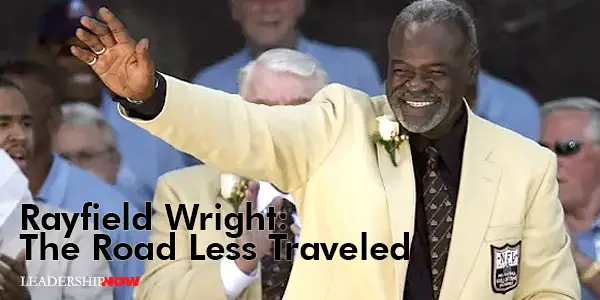

And to my mother, Mrs. Opel Wright, from the day I was born, you watched me take the road less traveled. Mom, you are my rose garden, you watered each day with your love, with your faith, and with your prayers. Your roots are deeply instilled in me, and your soul is so beautiful, in spite of all the painful thorns that life has put in your way.
Now, parents, teach your children well. Encourage them with your faith and leadership. Remember that you are the windows through which your children see this world. Take notice of yourself and the things that you do in hopes that your example will stir their hearts and souls.
To every young athlete within the sound of my voice, it takes courage to dream your dream. Don't let them sit in the locker room. Take a leap of faith. Listen to your parents and respect your elders. Learn from your successes and your losses. Defeat is possible and as a challenge to do better next time. Be satisfied you gave the game everything that you had and remember this: Don't be afraid to travel the road less traveled because Larry Rayfield Wright did, and you can, too.
Like us on Instagram and Facebook for additional leadership and personal development ideas.
Posted by Michael McKinney at 06:23 AM
Permalink
| Comments (0)
| Personal Development

The root of the word “forgive” is actually to send away—to dismiss.My mother used to say, “You don’t forgive to let the other person off the hook, you forgive to let yourself off the hook.” Good advice.
“Dismiss” is a very strong word,” said Reverend Deborah Johnson. “When something is dismissed, it’s over. When it’s dismissed, you don’t keep going back over it.” That’s what successful people do. They don’t necessarily call it forgiveness, but they do abandon blame as a way of life.
“Now there’s a funny thing about this notion of dismissing the case. When you’re in a court of law and, at some point, the judge says ‘case dismissed,’ that doesn’t mean case erased.There will still be a record of the case in the books. But what isn’t going to happen is we’re not going to keep going through the particulars of this case. Dismissed doesn’t mean that all parties in it experience resolution. It doesn’t mean that a crime didn’t take place.” When the judge dismisses the case, it’s because there will be no more presentation at this point. “It’s over,” she insisted.
Posted by Michael McKinney at 12:53 AM
Permalink
| Comments (0)
| Books
, Personal Development

When we respond to troubles and problems in a positive way, we can more easily maintain our creativity and resourcefulness that will come in handy in resolving the issue. A positive response can keep us in problem-solving mode.
A good example of reframing a situation for an overall positive outlook comes from one of my favorite opening lines. It is from a good piece of writing by George Orwell (Eric Blair) entitled Shooting an Elephant.
In Moulmein, in Lower Burma, I was hated by large numbers of people—the only time in my life that I have been important enough for this to happen.
Like us on Instagram and Facebook for additional leadership and personal development ideas.
Posted by Michael McKinney at 12:45 AM
Permalink
| Comments (0)
| Personal Development


I liked his question, “Who expects you to be somebody?” If you can’t think of anyone, there is something—or perhaps someone—seriously lacking in your life.
Rath gets a little tangled up in trying to understand how, with all of the personal development programs available to us, we fail in our relationships. He at times seems to blame self-improvement programs and throws the baby out with the bathwater. Improving yourself is the key to better relationships. But the key to good self-improvement is the focus—the what, why and how of it. Certainly, the I-gotta-be-me self-indulgent inner journey to self-understanding is worthless. I-gotta-be-me is what got us where we are in the first place. The point of personal development is to change me from what I am to a more principled and presentable me. An inward focus on personal development will only have a marginal effect on your relationships. Personal development needs to have an other-directed focus to it for it to be meaningful. Self-understanding helps you to understand others. And that understanding should give you a basis for creating relationships built on outgoing concern for and patience with other people. Improving yourself just to be improving yourself is selfish and of little value. In the end, it will give you little satisfaction and few friends. Selfishness kills relationships.
Rath suggests that maybe we need to take a course on friendship. He asks, “Could a second-grade student, a high-school junior, a college freshman, your boss, or even you benefit from time dedicated to this pursuit?” Resoundingly yes! To this end, Jeffrey Gitomer’s Little Black Book of Connections is full of sound principles that can be applied here. I know you’re thinking that this is "another sales tomb," but this is much more and applies to all relationships.
Rath also provides ample evidence that friendships at work should be encouraged. Although most companies don't encourage, and some outright forbid, Gallup research shows that close relationships between workers boosts employee satisfaction by almost 50%. Even though spending time with the boss was rated as the least pleasurable time of the day, they found that when employees do have close friendships with their boss, they are more than twice as likely to be satisfied with their jobs.
Do the people you influence know you expect them to be somebody?
With the purchase of Vital Friends you get access to the web site where you can not only take the Vital Friends Assessment, you can begin to catalog your vital friendships and employ tools to develop stronger relationships with those people.
Like us on Instagram and Facebook for additional leadership and personal development ideas.

Posted by Michael McKinney at 08:45 AM
Permalink
| Comments (0)
| Books
, Personal Development

 RAYMOND KOTCHER—CEO of Ketchum, a global public relations agency—spoke recently about a global conversation, powered by new technologies, that is integrating people as never before. He offered an piece of advice for joining in that conversation that caught my attention.
Never forget your integrity and credibility. Character takes a lifetime to build—it represents the sum of all of your actions. And now, more than ever, it can be destroyed in a moment. So please define your individual values and decide where the line is that you will not cross. Always communicate within the boundaries of those values.
Follow us on Instagram and Twitter for additional leadership and personal development ideas.
Posted by Michael McKinney at 09:00 AM
Permalink
| Comments (0)
| Personal Development


Choices Count: “When you accept the fact that you are in your present condition, good or bad, because of the choices you have made, you will then find yourself capable of changing your situation by making better choices.”
Respect: “What I didn't realize was that authority comes with the job: respect was what I needed to earn, and you earn respect only by proving yourself as a leader.”
Faith: “Before joining the Notre Dame family, I heard a lot about the spirit of Notre Dame, but I wasn't sure what that meant. The people were spiritual, and the leaders of the university were driven by the Holy Spirit, of that I had no doubt. But I wasn't convinced the campus itself held anything spiritual. Then, in my first year, I made an interesting observation. I realized that if you don't believe in the omnipresent spirit of Notre Dame, you never feel it. I made up my mind that I was going to believe in this spirit. The moment I started believing, I started feeling it. And the feeling never left.”
Staffing: “I expected us to recruit attitude over athleticism, and an aptitude for hard work over natural ability.”
Personal Responsibility: “Before you start blaming others, look at yourself. You will find you must look no further for the cause of the problem.”
Follow us on Instagram and Twitter for additional leadership and personal development ideas.
Posted by Michael McKinney at 08:34 AM
Permalink
| Comments (0)
| Books
, Personal Development
• Disorganization. Disorganization is a major brain drain. Not only does it consume time (“it’s right here—somewhere”) but it also raises anxiety (“what am I forgetting?”), which is another major cause of brain drain. The idea here is not to get your desk completely clean or that you match the organizational skills of someone who has a great propensity for this. You just want to defend against having a level of disorganization that creates a brain drain.
• Tendency to second-guess decisions. Depending on personality and cognitive style, leaders need differing amounts of information and lead times in order to make decisions. But once decisions are made, the best leaders practice little second-guessing. “Would I have made the same decision with the same information I had at the time?” is a good question for leaders to ask themselves when tempted to second-guess. If the answer is yes, then the leader can move on. If the answer is no, then the issue is to find a better way to make decisions.
Follow us on Instagram and Twitter for additional leadership and personal development ideas.
Posted by Michael McKinney at 09:25 AM
Permalink
| Comments (0)
| Personal Development

On July 31, 1941, Franklin Roosevelt named Hershey the director of the Selective Service System a position he held for almost 30 years. Needless to say, this was a difficult assignment. He had to get congress what they needed in the framework of what Americans would accept. His leadership style, humility, and sense of humor helped him to walk this tightrope. As a nationally renowned speaker, he used his Hoosier wit and philosophy to charm his audience.
Another great Hershey statement: “A boy becomes an adult three years before his parents think he does, and about two years after he thinks he does.”
Like us on Instagram and Facebook for additional leadership and personal development ideas.
Posted by Michael McKinney at 12:13 PM
Permalink
| Comments (0)
| Personal Development
FOR THOSE WHO WISH to increase their performance or to help others to do so, Dr. Henry Cloud believes integrity is the key. By integrity, he means being a whole, integrated person. It’s about wholeness. It means a person who is "running on all cylinders." It’s more than simple honesty and ethics.
In his book, >Integrity: The Courage to Meet the Demands of Reality, he focuses on the essential need for the character development necessary to make a person or an organization successful. The concept is built upon six traits of integrity:
1. Establishing Trust. This is the ability for someone to get outside their reality, agendas and concerns and connect with, understand, and work with the realities and concerns of the other person or people.
2. Orientation Toward Truth. This gets at the ability to operate in reality and deal with it.
3. Getting Results. Beyond a work ethic and working hard this trait is about how a person is put together that actually causes hard work and effort to end up in real results.
4. Embracing the Negative. Those who succeed are those that understand that life is about solving problems. They seek out the problems and develop the ability to solve them. The ability to move something forward when something bad happens.
5. Orientation Toward Growth. Not the desire to maintain but a real desire to grow and increase.
6. Orientation Toward Transcendence. The ability to see the big picture and to serve something larger than yourself.
Any of these areas can be developed, but growth won’t happen because you feel you ought to do this. “Ought “ is not a good motivator. So how do you change? Cloud suggests:
People change when they play the “movie,” which is to take a hard reality look at your life and work, then play that reality forward to see if you like the way the future movie of your life and career plays out. In that way, people begin to experience the future losses, rewards, and consequences right now and get with reality. When you look, for example, at your present performance, and the things that you are not getting, and then you realize that if you continue to do the same things expecting different results, you will never get what you want, you will change.
Like us on Instagram and Facebook for additional leadership and personal development ideas.

Posted by Michael McKinney at 04:00 AM
Permalink
| Comments (0)
| Books
, Personal Development

PROFESSIONAL speechwriter Andrew Wilson offers some tips for crafting a winning speech. First, three cardinal rules:
1.Speak from the heart. Talk about the things you really know and care about.
2. Don’t shy away from conflict. Conflict, and the resolution of conflict are the central elements in storytelling and all forms of dramatic expression—including speeches.
3. Get inside the minds of the audience. Speak to their needs and concerns or their shortcomings or failings. People will accept criticism but they don’t want to be finessed.
Next are some techniques that are useful in thinking through a speech from start to finish:
1. Open with a bang. Don’t waste time with niceties. Aim to capture your audience with your first words.
2. Tell stories and look for ways to build suspense. You build suspense by creating a potential disaster and delaying the moment of truth.
3. Write for the eye, the ear, the nose, and all the senses. In other words, be as vivid as you can.
4. Create a plot just as you would if you were writing a short story. Most plots have a protagonist and an antagonist—or a good guy and a bad guy.
5. Show first, then tell, using examples and stories that lead (through various twists and turns) to a few easily stated and readily understood conclusions.
6. In ending a speech, it is usually a good idea to hark back to the beginning—giving the audience a satisfying sense of coming full circle.
Like us on Instagram and Facebook for additional leadership and personal development ideas.

Posted by Michael McKinney at 07:22 AM
Permalink
| Comments (0)
| Personal Development

THE April/May issue of Worthwhile Magazine features a section on how people are redefining power in our organizations and in our culture. Claiming that power today has much more to do with power over yourself than others—I don't believe that this is a new phenomenon, but nevertheless—they bring us five tips to boost our power:
1. Be true to yourself, even (especially) if you're a little weird. High School is the last time conformity and power share a seat at the same table. Power comes from knowing what sets you apart from the crowd—and why the rest of the world should care. Which brings us to...
2. Know how to express yourself. If you want your ideas heard, you have to know how to command the right kind of attention. Witty (Jon Stewart) is powerful; constant quipping (name any sitcom actor) isn't. Don't qualify your opinions ("I may be the only person who thinks this, but..."). And never, ever ramble. Indeed...
3. Less is usually more. Great cooks and entertainers know to leave audiences wanting more. They aren't the only ones. Abraham Lincoln got it right. One of the most powerful speeches in history—the Gettysburg Address—was less than 300 words and lasted only two minutes.
4. Except when it isn't. Sometimes over-the-top works. This goes back to the know-thyself thing. Some people really are larger than life. Everything they do, say, wear, write or think is in bold letters. But there is nothing more exhausting than a larger-than-life wannabe.
5. Force isn't power. Unless you're a drill sergeant, a prison warden (or a parent), it's pretty hard to force anyone to do your bidding. Instead, people yearn to connect with purpose and passion or something bigger than themselves. Think inspiration. It's the new power.
Like us on Instagram and Facebook for additional leadership and personal development ideas.
Posted by Michael McKinney at 08:39 AM
Permalink
| Comments (0)
| Personal Development
IN The Power of Purpose, Peter Temes defines three levels of thinking:
Level One: The most important question for understanding the world and taking action is How do I feel? Or How do I look to myself? Who am I?
Level Two: You progress to How do others feel about me? Or How do I look to others? Who do others think I am?
Level Three: At this level, the central question is not about how I feel, or how others feel about me, but about how they feel about themselves. The basis of this level is not about what matters to me, but what matters to others. How can I help others?
He suggests,
“Develop the habit of asking level-three questions. Look hard at he clues other people give you about their personal goals and the ways they see themselves. Look for opportunities to help others feel stronger and more successful and you’ll see that you will gain as much as or more than others do. When you get past the zero-sum-game model of how the world works—the idea that for me to win someone else must lose—you begin to see the enormous power that comes from sharing your strength with others. That insight, and the moral strength that comes from helping others, are the greatest gifts you can give yourself, and they mark the clearest path to success.”
Like us on Instagram and Facebook for additional leadership and personal development ideas.
Posted by Michael McKinney at 09:12 AM
Permalink
| Comments (0)
| TrackBacks (1) | Personal Development
, Thinking

ACTOR ALAN ALDA wrote about a dog he had when he was eight years old. In his book, Never Have Your Dog Stuffed, he describes how he was so upset about burying his dog that his Dad suggested that they have it stuffed. In a Newsweek interview, he said:
It turned out to be a really terrible idea because the dog came back from the taxidermist with a hideous expression on its face that frightened everybody. After a while, I started to think of that as an image of something that went a lot deeper than the dead dog, which is you can’t bring back anything to life.
It’s really clear to me that you can’t hang onto something longer than its time. Ideas lose certain freshness, ideas have a shelf life, and sometimes they have to be replaced by other ideas. Hanging onto things the way you wish they were, I’ve come to see isn’t a good idea."
Alda continued that there are a lot of ways we stuff the dog, trying to avoid change or hanging on to a moment that's passed.
We all of course, like to hang on to the familiar. What things are you hanging on to that once abandoned would allow you to move to the next level? Joseph Schumpeter (1942) coined the phrase “creative destruction” to describe the process by which people and organizations determine what they should stop doing.
So much of building a good life or organization is a process of elimination. A process where we replace the outdated with the new more productive behaviors or products. Start by creating a not-to-do list.
Have you stuffed the dog lately?
Like us on Instagram and Facebook for additional leadership and personal development ideas.
Posted by Michael McKinney at 09:56 AM
Permalink
| Comments (0)
| Management
, Personal Development


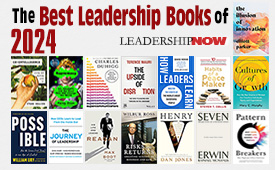









 |
| ||
 | Follow us on:
© 2025 LeadershipNow™  |
| |