  Leading Blog | Posts by Month |
09.30.26

LeadershipNow 140: September 2026 Compilation
See more on   Follow us on Instagram and X for additional leadership and personal development ideas. Follow us on Instagram and X for additional leadership and personal development ideas.
Posted by Michael McKinney at 07:59 AM
09.24.26
Leading Thoughts for September 24, 2026
IDEAS shared have the power to expand perspectives, change thinking, and move lives. Here are two ideas for the curious mind to engage with: Richard Hagberg and Tien Tzuo on strategy: "How do you know when your strategy is working? When your employees wake up in the morning knowing (a) why they are working for your company, (b) what the corporate strategy is, and (c) how they can contribute to that strategy by achieving specific goals and objectives. That’s the ideal green light situation." Source: Founders, Keepers: Why Founders Are Built to Fail, and What it Takes to Succeed Geoff Tuff and Steven Goldbach on improving the process: "The problem with best practices is that, by definition, if everyone around you follows the same best practices, they are no longer best. They are average. And what business leader wants to be average? The playbooks of business that have been crafted over decades yield an approach to management that is more concerned with risk mitigation than delighting customers and staying ahead of accelerating change. Many of these are so ingrained in business habits that there is no explanation for why we do things the way we do beyond ‘Well, that’s just how we do things around here.’" Source: Hone: How Purposeful Leaders Defy Drift Look for these ideas every Thursday on the Leading Blog. Find more ideas on the LeadingThoughts index. Follow us on Instagram and X for additional leadership and personal development ideas.
Posted by Michael McKinney at 07:28 AM
09.16.26
Leading Thoughts for September 17, 2026
IDEAS shared have the power to expand perspectives, change thinking, and move lives. Here are two ideas for the curious mind to engage with: Marshall Goldsmith and Mark Reiter on inertia: "Our default response in life is not to experience meaning or happiness. Our default response is to experience inertia. We think of inertia as the state of being inert or motionless—one of our purer displays of passivity and disengagement. It's not. Inertia is an active event in which we are persisting in the state we're already in rather than switching to something else." Source: The Earned Life: Lose Regret, Choose Fulfillment Sebastian Wernicke on data objectivity: "It's easy to understand why one would intuitively view data as a kind of 'objective truth.' After all, we assume that data originates from objective measurements, making the resulting numbers clear and unequivocal. However, capturing our reality in numbers is rarely straightforward. Defining precisely how we arrive at a number isn't mere nitpicking, as these choices can carry significant consequences when we use that number to make a decision. Fundamentally, there is no single 'right' method to translate reality into data. Usually many valid methods exist, but each will turn the facts into a different number. Data compresses a subjective view of the world. Those who look at data see not an objective truth but rather a specific (hopefully at least consistent and documented) interpretation of the world, expressed as numbers." Source: Data Inspired: Building an Organizational Culture of Inquiry for Lasting Transformation Look for these ideas every Thursday on the Leading Blog. Find more ideas on the LeadingThoughts index. Follow us on Instagram and X for additional leadership and personal development ideas.
Posted by Michael McKinney at 05:46 PM
09.10.26
Leading Thoughts for September 10, 2026
IDEAS shared have the power to expand perspectives, change thinking, and move lives. Here are two ideas for the curious mind to engage with: Nick Bare on doing the work: "Sometimes, we think that just doing more of something or working harder on anything will get us to our goal, but just because you're working harder doesn't mean you deserve the outcome. It doesn't mean you've earned it. The work we put in needs to be strategic, intentional, and very thoughtful to have the outcome we want and desire." Source: Go One More: Find the Clarity to Make Intentional, Life-Changing Choices Aaron Chapman on cutting corners: "There's only so many places the opportunivore can go before you completely run out of options altogether. If you could just go back to the beginning, work in the service of others. Ensure their benefit. The time will come that the compound effect of all that energy and work returns to benefit you. Those who choose to take from others or cut corners from the beginnin' eventually find that there is nothin' left for them. Fits right into the overall concept: take a beatin' up front doin'the right thing, bein' accountable, bein'trustworthy, and you'll have an abundance poured upon you. Cuttin' corners, takin' advantage of people, and cheatin'the process might make for some easy returns up front, but over time avenues will dry up; others become wise to your BS, and now you're takin' an enormous beatin' 'cause you can't find a single soul to deal with you." Source: Redneckonomics: Unconventional Success by Takin' the Beatin' Path Look for these ideas every Thursday on the Leading Blog. Find more ideas on the LeadingThoughts index. Follow us on Instagram and X for additional leadership and personal development ideas.
Posted by Michael McKinney at 11:41 AM
09.04.26
Inside the Box: How Constraints Make Us Better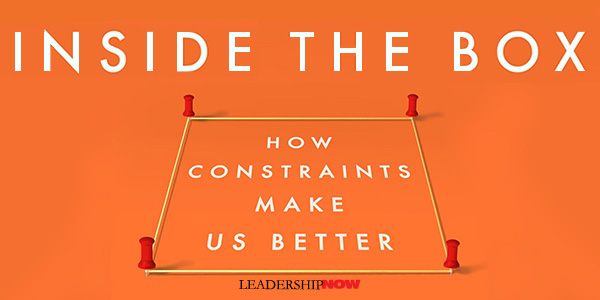
WE don’t need more freedom; we need more helpful boundaries. David Epstein, author of Inside the Box: How Constraints Make Us Better, says we don’t need to work outside the box as much as we need to be working inside the right box. We instinctively add to solve a problem when the best course of action is to subtract. Boundaries provide clarity. Ideas are plentiful. Figuring out what not to do is the key. You need constraints. Constraints are so important that engineer and designer Tony Fadell admonishes, “If you don’t have constraints, then make up constraints!” Constraints make room for learning. Constraints make you think. Epstein explains: As the cognitive scientist Daniel Willingham has written: “Contrary to popular belief, the brain is not designed for thinking. It’s designed to save you from having to think.” Because the brain is naturally inclined to avoid effortful thinking and to rely instead on familiar patterns, complete freedom tends to lead to unoriginal ideas, simply repeating what is known. Constraints push the brain beyond its default tendencies, forcing it to engage in deeper problem-solving. Total freedom, then, is the enemy of creativity, and constraint its companion. “In other words,” says Epstein, “when anything is possible, it becomes nearly impossible to do anything new. Complete freedom, paradoxically, leads to conformity.” In a chapter entitled The Remix of Everything, he explains that Martin Luther King, Jr. borrowed and remixed to create his messages. He “grew up in the folk-preaching tradition—beginning with watching his father—in which borrowing words was not only encouraged but expected, and language was not thought of as proprietary. Excessive originality, in fact, was seen as self-centered, if not downright suspicious. Listeners expected the reinforcement and recharging of lessons with authority and familiarity, not originality.” The lesson here is that “The more novel his ideas, the more familiar the context had to be.” It connects because the audience had heard a version of it before. Even Edison and Shakespeare “constantly took the approach of looking for existing material that they could modify or perfect, rather than inventing from a blank slate.” The self-imposed constraint breaks down resistance. Lesson: “Familiarity acts as an anchor for radical ideas, providing a point of reference. The more disruptive the idea, the more essential that grounding becomes.” Focusing on inherent constraints of a system enables better design and useful innovations. Working memory is a bottleneck of human cognition. Connecting new concepts to the old and familiar takes the strain off of the working memory and facilitates problem-solving and critical thinking. It helps to put new information in writing that the learner can refer to instead of trying to hold it in their working memory. Classes often rightfully emphasize a need to teach critical thinking, but if we want a learner to practice it-whether they encounter the new material in school or at work-we need to make sure they have some background familiarity with the terms and subJect matter. Otherwise they won’t stand a chance; their working memory will be flooded just trying to keep track of new information. This familiarity effect is one reason why rereading a book or rewatching a movie unlocks new layers of depth. Too few constraints remove the clarity. Vagueness works against you. Projects balloon and nothing gets done. You lose track of the end-goal. If you can work out the boundaries ahead of time, you can move quickly when the time comes. “As the renowned venture capitalist Bill Gurley (Uber, Zillow) told me: ‘We have a saying in venture: ‘More startups die of indigestion than starvation.’” Follow us on Instagram and X for additional leadership and personal development ideas.

Posted by Michael McKinney at 07:08 PM
09.03.26
Leading Thoughts for September 3, 2026
IDEAS shared have the power to expand perspectives, change thinking, and move lives. Here are two ideas for the curious mind to engage with: Jenna Nicholas on hope: “Hope is more than a lofty ideal; it's a lifesaving force. Ultimately, hope encourages us to think expansively while integrating our vision into our daily actions, both big and small. It also challenges us to remain realistic and grounded. We may never achieve a human utopia on earth, but hope doesn't require us to remake the world in some sparkly image of perfection. Instead, we can stay focused on making the next positive changes, both personally and professionally, that support those around us and our vision of integrated, healthy progress.” Source: Enlightened Bottom Line: Exploring the Intersection of Spirituality, Business, and Investing Lloyd Blankfein on a partnership culture: “It takes more time to treat your partners as owners. It takes time to inform people, entertain objections, and, sometimes, accede to contrary views. It means more iterations and slower decision-making. But the decisions are likely to be better, and the outcomes better accepted, because people were consulted and listened to, even if they didn't get their way in the end.” Source: Streetwise: Getting to and Through Goldman Sachs Look for these ideas every Thursday on the Leading Blog. Find more ideas on the LeadingThoughts index. Follow us on Instagram and X for additional leadership and personal development ideas.
Posted by Michael McKinney at 10:32 AM
09.01.26
First Look: Leadership Books for September 2026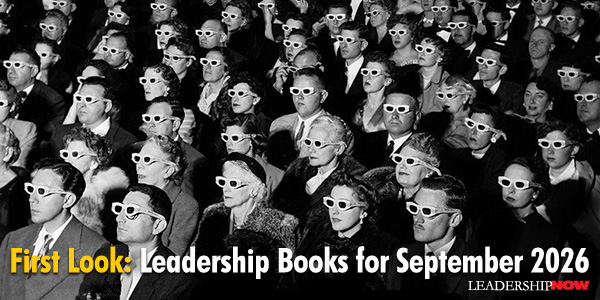
HERE'S A LOOK at some of the best leadership books to be released in September 2026 curated just for you. Be sure to check out the other great titles being offered this month.
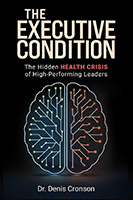
High performers aren't burning out—they're breaking down. The Executive Condition exposes how modern leadership accelerates biological decline and then shows executives how to turn health into their next strategic advantage. Leadership performance is built on biology—and that foundation is failing. Sleep debt becomes personality. Stress hardens into culture. Decision quality narrows even as résumés grow longer. Boards notice it late. Teams feel it early. And the body—quietly, relentlessly—keeps the score. For too long, modern leadership has rewarded the very habits that erode it: relentless pace, chronic sleep loss, performance martyrdom, and identity fused to output. The result is a hidden crisis at the top of organizations: leaders who still look successful while their cognition, metabolism, emotional range, and judgment quietly decline. This is not a character flaw. It is an operating-system failu
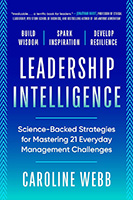
In times of great change, great leadership is crucial—and our current times are no exception. Today, along with the demands that leaders have always faced—balancing short-term progress with long-term planning; delivering strong results without burning people out—we're also in an era of major technological disruption. As that change accelerates, the instinct to lean hard into AI can feel more urgent than anything else. But the best leaders know better. As AI capabilities become more universal, the leaders who stand out won't be those who only use technology well—it will be those who can also draw out and develop the best of the human intelligence on their teams, by maximizing distinctly human strengths like critical thinking and interpersonal insight. In Leadership Intelligence, economist and former McKinsey partner Caroline Webb shows readers how to rise to this challenge.
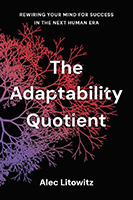
Groundbreaking investor and global enterprise builder Alec Litowitz shows how to move from "making the right decision" to "making decisions right" in The Adaptability Quotient, a guide to thinking and acting under uncertainty. Over decades of success across volatile markets, creating cultures and businesses that innovate at scale and endure, Litowitz arrived at a crucial insight. What separates progress from paralysis is not foresight, but adaptability. In an era of uncertainty, decision-making and problem-solving require developing a high adaptability quotient or AQ―the ability to think clearly, act decisively, and pivot when the path ahead isn't clear. And unlike intellect or emotional intelligence, AQ is not fixed. It can be learned.
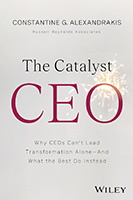
In The Catalyst CEO, veteran leadership advisor Constantine G. Alexandrakis delivers an insider's guide to leading systemic change across complex organizations. Drawing on decades of experience advising world-leading companies, he challenges the cult of the hero CEO and offers a powerful new paradigm on what it truly takes to make business transformation happen―and stick. Through real-world stories of CEOs globally who have successfully transformed their organizations, Alexandrakis reveals why even brilliant visions and strategies fail if they're not owned, led, and executed by the right teams. You'll learn how to turn your board, executive team, and leaders into force multipliers―creating the conditions required for transformation to scale and endure.
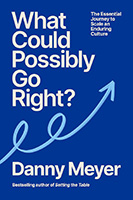
Restaurateur, entrepreneur, and New York Times bestselling author Danny Meyer reveals the secrets of his widely admired leadership philosophy and the tools he uses to build an energized, cohesive, and motivated culture. In 2006, Danny Meyer owned eleven restaurants, was nurturing a single parkside burger kiosk called Shake Shack, and had just written a bestselling book, Setting the Table, about his company's unique culture of Enlightened Hospitality. On the first page of that book, Danny proudly declared that in twenty-five years he had never closed a restaurant. But just a few years later, he shuttered his beloved Tabla, a decision that filled him with shame—but sparked a reckoning within him about what it means to be a leader. Danny realized that his fear of failure wasn't just misguided: it was also an impediment to his innate entrepreneurial spirit. In What Could Possibly Go Right?, he takes the reader along on his journey to learn how he's delivered a winning culture of excellence at scale. Businesses and organizations have long understood how to scale systems of production. But it's a much trickier challenge to scale uplifting human relationships, particularly in a fluid, growing organization—one that has now spawned 700 businesses spread across twenty-four countries.
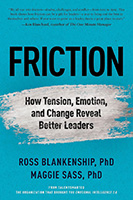
Emotions are messy. Life is full of friction. Here's what to do about it. You've felt it — the meeting that goes sideways after one wrong word, the feedback that lands wrong no matter how carefully you planned it, the relationship that keeps getting stuck in the same loop. You've felt it inside yourself too: the moment you react before you mean to, the pressure that makes everything harder than it should be, the Sunday evening dread that has nothing to do with the actual work. That tension has a name. It's friction — and most of us have never been taught what to do with it. In Friction, Sass and Blankenship make the case that friction isn't random, it isn't weakness, and it isn't just "bad communication." It's a predictable force that shows up in three distinct places — inside you, between people, and in the systems and structures around you — and it's quietly shaping everything from your own performance to your team's culture.
“Books are the quietest and most constant of friends; they are the most accessible and wisest of counselors, and the most patient of teachers.” — Charles W. Eliot
Follow us on Instagram and X for additional leadership and personal development ideas.
Posted by Michael McKinney at 07:09 AM
|
 |
BUILD YOUR KNOWLEDGE


How to Do Your Start-Up Right STRAIGHT TALK FOR START-UPS 
Grow Your Leadership Skills NEW AND UPCOMING LEADERSHIP BOOKS 
Leadership Minute BITE-SIZE CONCEPTS YOU CAN CHEW ON 
Classic Leadership Books BOOKS TO READ BEFORE YOU LEAD |
|
ABOUT
FOLLOW US:
     

Recent Posts
Categories
Full site feed
MONTHLY ARCHIVE
|
 |
| ||
 | Follow us on:
© 2024 LeadershipNow™  |
| |
 Here is a selection of



 The Executive Condition
 Leadership Intelligence
 The Adaptability Quotient
 The Catalyst CEO
 What Could Possibly Go Right?
 Friction