  |
|
08.21.26

Mastering Uncertainty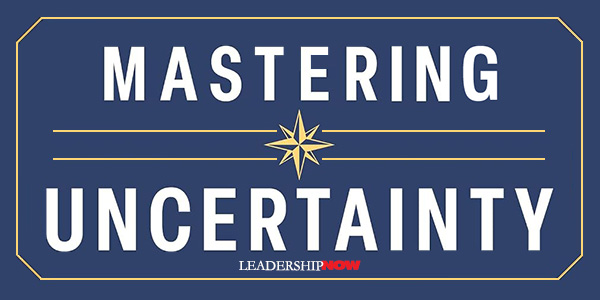
WE all face uncertainty. The question is: how can we keep performing when faced with the disorder of uncertainty? Life will not happen according to our expectations. Peak performance at all times is not realistic. Instead, success is about optimal performance. Rich Diviney states in Masters of Uncertainty that “True success in life and business hinges instead on optimal performance, which means delivering your ‘best’ in the moment, whatever your best looks like in that moment. Sometimes your best is about persevering, moving forward step-by-step in the midst of challenges, embracing the messy, grueling, and unpolished reality.” Diviney’s Mastering Uncertainty Method comprises three steps: Move Horizons, Keep Going, and Stay Cool. Move Horizons Asking what I know now and what I can control keeps you in the here and now without overthinking and spiraling into negative thinking. Levels of uncertainty are determined by three key factors: Duration (How long will this situation last?), Pathway (What should I do next?), and Outcome (What is the goal?). “Moving Horizons is a process where you remain anchored in the present while actively shaping your own Duration, Pathway, and Outcome. Life’s unpredictability often leaves us without clear timelines, defined steps, or guaranteed outcomes for our challenges.” It’s how we best deal with uncertainty one step at a time. Through this process, “you sequentially grow the sphere of what you know and control.” Keep Going As you progress, keep setting goals that are not too big but just outside your comfort zone. A rightly sized goal will keep you going. Staying focused on the current situation, you will find that sometimes a goal will involve a detour. That’s OK. Stay in the present moment. “Refocus on what you know and what you can influence right now. The old saying ‘Keep your eyes on the prize’ is often touted to hone focus and stir passion. However, fixating on the end goal isn’t necessary to make progress or to maintain zeal.” Stay Cool Keep your mind on the big picture. Take a panoramic view. It will help you avoid becoming overstimulated. “When a threat looms and autonomic arousal begins to rise, focused vision activates, and vision tends to narrow. This natural response heightens the ability to concentrate on the critical circumstance demanding attention. In extreme cases, this can lead to ‘tunnel vision,’ where perception is limited to the threat itself, and all else falls away.” Facing uncertainty is easier when you know yourself—what you are good at and what you are not. “Use your strengths to your advantage, and find ways to counterbalance your weaknesses.” Your identity – how you see yourself and how you interact with the world around you – plays a large part in how you respond to uncertainty. Our identities give us guideposts as we navigate our world. Diviney recommends that we “seek, if possible, perspective or help from others who have different identities. Make space for yourself to consider alternative strategies or to take things slower. Often, simply committing to slowing down while you set horizons can help you see beyond the instincts you carry.” Another perspective can go a long way to bringing down our anxiety level.   Follow us on Instagram and X for additional leadership and personal development ideas. Follow us on Instagram and X for additional leadership and personal development ideas.

Posted by Michael McKinney at 07:47 AM
|
 |
BUILD YOUR KNOWLEDGE


How to Do Your Start-Up Right STRAIGHT TALK FOR START-UPS 

Grow Your Leadership Skills NEW AND UPCOMING LEADERSHIP BOOKS 
Leadership Minute BITE-SIZE CONCEPTS YOU CAN CHEW ON 
Classic Leadership Books BOOKS TO READ BEFORE YOU LEAD |
|

ABOUT
FOLLOW US:
     

Recent Posts
Categories
Full site feed
|
 |
| ||
 | Follow us on:
© 2025 LeadershipNow™  |
| |