  |
|
08.14.26

The Panoramic Leader: How Great Leaders See Differently
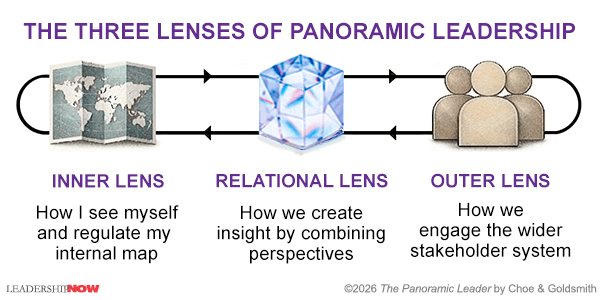
TO make the best decisions, we need to expand our view and think through a wider range of experiences and opinions. See panoramically. Increasing change and complexity require that we get more complete and diverse information and look outside of our usual suspects. We need panoramic intelligence. In The Panoramic Leader, Cornelia Choe and Marshall Goldsmith say that “panoramic intelligence is about training yourself to see through more than just your own lens. The real power is when you move beyond simply noticing others and start to see the world through their eyes, understanding the experiences and beliefs that shape their maps.” The lenses we choose to see the world determine the reality we see. The authors have identified three lenses—inner, outer, and relational—that allow us to see more fully.
The inner lens helps us to gather self-awareness through self-reflection. It impacts how we see the world through our outer lens. The outer lens expands our view through our interaction with others, “taking in the systems, perspectives, and shifting conditions that define the world around us.” The relational lens creates insights between our inner and outer perspectives and transforms each with the insights gained from that enhanced perspective. We grow from the intersection of each lens. The relational lens gathers the insights we develop internally and shines that light back outward to our stakeholders through our outer lens, expressed in dialogue and leadership. This continuous refraction of insight—taking in light and returning it transformed—is what distinguishes panoramic leaders. They do not merely absorb understanding from all sides; they refract it back outward toward their stakeholders, shaping conversations and aligning teams. This model highlights the need for feedback. Feedback helps to remove blind spots from our inner lens. If you are not getting input from outside yourself, you will not see clearly what is going on around you. It has always been the case, but especially today in a rapidly changing world, if you are not adjusting and experimenting, you will become irrelevant. Many of us continue to cling to outdated mental maps because they’re familiar and comfortable, even if they lead us to constant disappointment because they don’t take us to where we want to go. They suggest we ignite our courageous curiosity, question ourselves, and to know our map and keep adapting it. I love this question: Who’s not at your table? Who should we have join us? Inviting people in that we normally don’t associate with opens us up to new perspectives and ideas. Developing panoramic leadership requires that we “go beyond understanding stakeholders to building meaningful relationships with them and staying attuned to their evolving circumstances and views.” As we work with others, we find where their perspective or map aligns with ours and how they might fit together. Where other people’s maps are different or contradictory to our own can reveal areas where we need to pay closer attention and find previously unseen opportunities. For panoramic leaders, differing perspectives are the raw material of better judgment. They help us sort through the information we collect, clarify priorities, and anticipate risks. They test assumptions and reveal how various stakeholders’ perspectives can be integrated into a coherent picture. By engaging with conflicting views productively, leaders uncover blind spots, refine their priorities, and navigate growing complexity with sounder judgment. Combining maps requires that we interpret their perspective and microtranslate our perspective for them. In this way, we learn from one context so that we can apply those lessons to our own. We begin to see where our maps may be incomplete and fill in our blind spots. Another component to consider, as we evaluate what insights we should add to our own and which ones to leave out, we should identify not only what loyalties our stakeholders have but what loyalties we have that might be swaying our judgment. They suggest that we ask ourselves: “To whom do I feel most responsible? Who would react most vigorously if I did something out of the routine? Whom am I trying hardest to please or impress? Who would I most disappoint? Whose support do I most need?” We can never allow complacency to creep into our worldview. The world continues to change around us, and, like explorers sailing to uncharted lands, we must constantly adjust our maps accordingly.   Follow us on Instagram and X for additional leadership and personal development ideas. Follow us on Instagram and X for additional leadership and personal development ideas.

Posted by Michael McKinney at 11:26 AM
|
 |
BUILD YOUR KNOWLEDGE



How to Do Your Start-Up Right STRAIGHT TALK FOR START-UPS 

Grow Your Leadership Skills NEW AND UPCOMING LEADERSHIP BOOKS 
Leadership Minute BITE-SIZE CONCEPTS YOU CAN CHEW ON 
Classic Leadership Books BOOKS TO READ BEFORE YOU LEAD |
|

ABOUT
FOLLOW US:
     

Recent Posts
Categories
Full site feed
|
 |
| ||
 | Follow us on:
© 2025 LeadershipNow™  |
| |