  |
|
11.23.26

Your Team Is Split Over AI. Don't Pick a Side Yet.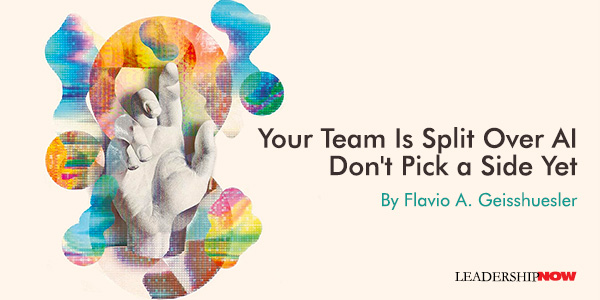
IN Herodotus's account, Croesus, the fabulously rich king of Lydia, had to decide whether to go to war with Persia. Too shrewd to trust an oracle blindly, he first tested seven of them. On the same appointed day, each was asked what the king was doing at that moment. Croesus made sure nobody could guess: he was boiling a lamb and a tortoise together in a bronze cauldron. The oracle at Delphi described the meal exactly. Satisfied, Croesus sent the real question, along with a fortune in gold. If he attacked the Persians, the oracle replied, he would destroy a great empire. He attacked, and he did destroy one. It was his own. Croesus ran what we would now call a benchmark, and the oracle passed. His mistake came afterward, when he let one correct answer end the work of interpretation. For anyone leading a team, that is still the danger point: the moment the system succeeds and skepticism relaxes. Two Rooms, One Reflex I think about Croesus whenever I move between two kinds of rooms. On a rooftop in Tel Aviv, I once pitched an AI guide that would step in at moments of crisis. Within ninety seconds, a product lead had turned it into "infrastructure for human transcendence." My own pitch had started the sermon. Three days later in Jerusalem, I presented my AI research on ancient texts to a room of scholars. "This is capitulation," the first one said, before I had closed my laptop. Another called such systems vampires. Beneath the anger lay a fair fear, that AI would be persuasively wrong. The two projects were different, and either room could have been right about its own case. What struck me was how quickly both conversations turned into verdicts on AI itself: salvation on the rooftop, contamination in the seminar room. Technopsychology, my field, studies what intelligent machines do to human judgment. I call this pattern technotheism: treating a tool as a savior or a threat so absolute that the verdict arrives before the evidence. It spreads because certainty is considerably cheaper than judgment. Once a tool has been consecrated or condemned, the hard thinking feels finished. Inside organizations, much of this goes underground. In Microsoft and LinkedIn's 2024 survey of 31,000 knowledge workers, more than half of those using AI at work were reluctant to admit using it for their most important tasks. About as many worried it made them look replaceable. Every leader should be asking: what is my team reluctant to tell me about AI? Judge the System, Not the Technology Between the two rooms lies the work almost nobody wants to do: judging this particular system instead of ruling on AI itself. It takes the one capacity a prediction machine can't supply, which I call erratic intelligence: a willingness to depart from the pattern a whole room is falling into. That departure can still end in a firm yes or a firm no. The point is to reach it by examining the system, so you can explain the decision and revisit it. In practice, that means three moves if you run the room and one if you don't. Don't open with your view. Set out the decision and what's at stake, then ask for three minutes of silence. Ask everyone to write down what they most hope this system will do and what they most fear it will do, so that each person holds both sides at once. Write your own answers too, and speak last. Three minutes will feel long, and that's the point: the pressure to fill the silence is the same pressure that flattens a real disagreement into a premature vote. Make each side argue the other's best case. Then postpone the vote and ask each camp to state the strongest version of the opposing view, in terms its holders would recognize. Roger Martin, who interviewed more than fifty highly successful leaders, found that most of them refused forced choices and used the tension between opposing models to build an option better than either. You can't do that with caricatures of the skeptic as afraid of change or the enthusiast as dazzled by novelty. Bring the question down to earth. Give the team one sentence to use: Let's look at what this system actually does, in this context, with these stakes. Suppose your customer service team is split over AI-drafted replies: one side sees faster answers, the other confident mistakes. Run the drafts on last month's inquiries and ask whether the system still saves time once checking and corrections are counted. Now both camps have something real to argue about. And even a test the system passes leaves the decision Croesus skipped: how much authority to give it. If the room isn't yours, do it on paper. Before you join the side that feels like yours, write down the best argument against it. If you notice yourself tensing, or rushing to dismiss it, pause and ask which claim you're reacting to. You don't have to change your mind, but you do have to see what it has been refusing to see. Decide, Then Keep Listening Both camps will push you to pick a side early; the enthusiasts will call you timid and the skeptics naive. Set a decision date instead, and when it comes, decide and explain why, even if some people still disagree. Then make it easy for anyone to raise a problem later, especially once the system seems to be working. Success, remember, is when scrutiny relaxes. A group that closes too early rarely becomes clear. It simply becomes quiet. When Croesus complained to Delphi, the oracle didn't apologize: a great empire had fallen, as foretold, and asking which one had been his job. Your AI systems will keep producing answers, many of them right. What matters is whether your organization is still capable of interpretation.    Follow us on Instagram and X for additional leadership and personal development ideas. 
Posted by Michael McKinney at 02:39 PM
|
 |
BUILD YOUR KNOWLEDGE



How to Do Your Start-Up Right STRAIGHT TALK FOR START-UPS 

Grow Your Leadership Skills NEW AND UPCOMING LEADERSHIP BOOKS 
Leadership Minute BITE-SIZE CONCEPTS YOU CAN CHEW ON 
Classic Leadership Books BOOKS TO READ BEFORE YOU LEAD |
|

ABOUT
FOLLOW US:
     

Recent Posts
Categories
Full site feed
|
 |
| ||
 | Follow us on:
© 2025 LeadershipNow™  |
| |