  |
|
07.20.26

Apply Lessons from “Moneyball” to Business Recruiting and Find Your Next Tom Brady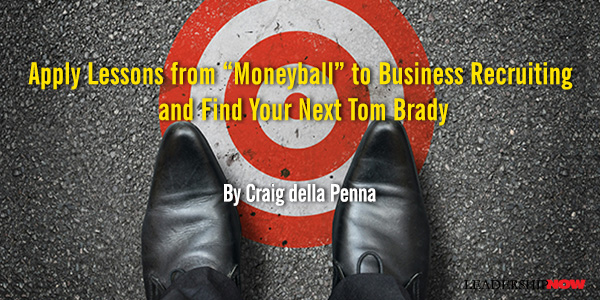
ORGANIZATIONS often believe they’re selecting the best candidate when in reality they’re selecting the person who best matches familiar credentials, patterns, or assumptions. That distinction matters. As the 2011 movie Moneyball demonstrated through baseball recruiting how success improves dramatically when talent is evaluated against the factors that actually predict performance — not the ones people traditionally favor. The same lesson applies in hiring. If companies want to identify exceptional talent before competitors do, they need a clearer, more disciplined way to define what success in a role truly requires. What Baseball Got Right About Talent Billy Beane of “Moneyball” fame inherited one of the smallest budgets for any MLB team player salaries in 2002. Frustrated with his inability to outbid other teams for talented players, he took a different approach. He called Paul DePodesta, a Harvard alum and professional sports executive interested in data analysis. They combed through decades of data on hundreds of individual players to devise a better strategy for recruiting players. They discovered scouts were overlooking statistics that could better predict a player’s performance versus relying on subjective things like attitude or whom they’d played for in the past. In short, scouts were asking the wrong questions to assess talent. The scouting process failed to include individual components that made up a player’s performance and match that to what the baseball team needed — much like hiring managers looking at academic qualifications or years of experience as a proxy for the responsibilities the individual needs to take on in a new role. In the end, Beane’s big bet on analytics paid off. Despite their smaller budget, the Oakland A’s won against bigger teams and made history by winning 20 consecutive games in American League baseball. Recruitment in sports was transformed as Beane’s method made player assessment a quantifiable process rather than a subjective one. A Better Way to Define Success The Moneyball lesson teaches us that, to win, we must know what we’re looking for and ignore our biases. There needs to be a mechanism that enables a clear choice, linked to the specifics of what we want to achieve. That’s where a Cipher comes in. A Cipher is a structured and prioritized method of zeroing in on what matters most for a specific role. It explicitly lays out, in a prioritized fashion, how success will need to be achieved in the role you’re looking to fill. It creates a clear understanding of what the person will need to do to be successful in the role, how “integration into the existing culture” is defined within the organization, and what’s required to manage their team. Ultimately, this framework establishes uniform comparison across multiple candidates for any role, enabling better decision-making based on data rather than a gut feeling. You can create your Cipher by simply using the acronym CODE to help you define a role: Charge: the one-sentence impact this person must have on the company. What will be different because they were hired?
Here’s an example of what this looks like in practice: Most everyone in the US has probably heard of New England Patriots QB Tom Brady. Not everyone knows that he was passed over in his draft — 198 times. Why? Brady didn’t look especially athletic, he wasn’t particularly fast, and he didn’t match the physical profile many scouts expected from an elite quarterback. Furthermore, no one else seemed to be interested in him, so why should “we” be? But Bill Belichick and newly hired QB/Assistant Coach Dick Rehbein were willing to look past biases to find the talent they needed. Even with his extensive overall experience, Rehbein was new to coaching the QB position and brought no biases to the draft, which allowed him to pick up the game’s greatest player of all time. While the Cipher didn’t exist back then, the evidence suggests that they employed a deeper analysis to arrive at the conclusion that Brady was the QB to bet on. It’s easy to envision them using something like the following: Charge: An adept and charismatic QB to lead the Patriots franchise back from mediocre results to the glory days. Outcome: Perform individually as an athlete while leading the team to deliver AFC (American Football Conference) championships in two out of three years. Deliver at least one Super Bowl championship within the same three-year window. Deliverable 1: Leverage superior athletic ability for success on the field.
Deliverable 2: Incorporate intelligence and experience into making the right calls during the heat of battle.
Deliverable 3: Develop a humble continuous improvement system, leading peers as a role model.
If you’re a fan elsewhere, imagine how much better your favorite team would’ve been had they looked past their biases and scooped up Brady before the Patriots did. The lesson from sports isn’t simply that data beats intuition. It’s that better outcomes come from asking better questions. Organizations miss strong candidates every day when they rely on reputation, polish, pedigree, or familiar proxies instead of clearly defining what the role demands. A structured framework like the Cipher helps leaders evaluate talent against the realities of the job rather than against bias or convention. In a competitive market, that shift can mean the difference between hiring the obvious candidate and identifying the right one. Before asking who looks like the best candidate, ask what success in the role actually requires.    Follow us on Instagram and X for additional leadership and personal development ideas. Follow us on Instagram and X for additional leadership and personal development ideas.

Posted by Michael McKinney at 07:45 AM
|
 |
BUILD YOUR KNOWLEDGE


How to Do Your Start-Up Right STRAIGHT TALK FOR START-UPS 

Grow Your Leadership Skills NEW AND UPCOMING LEADERSHIP BOOKS 
Leadership Minute BITE-SIZE CONCEPTS YOU CAN CHEW ON 
Classic Leadership Books BOOKS TO READ BEFORE YOU LEAD |
|

ABOUT
FOLLOW US:
     

Recent Posts
Categories
Full site feed
|
 |
| ||
 | Follow us on:
© 2025 LeadershipNow™  |
| |