  |
|
07.24.26

Your Business Has a Pest Problem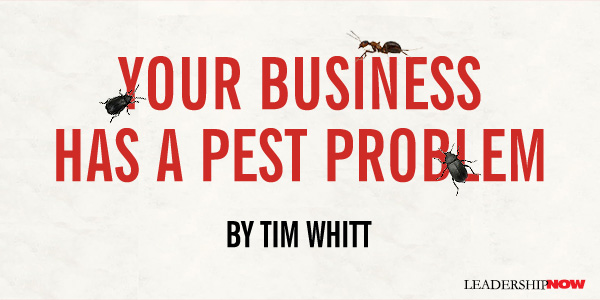
I’VE SPENT 45 years in the pest control industry: 30 in corporate leadership and 15 building my own company, Pied Piper Pest & Lawn, from the ground up. In that time, I’ve seen just about every kind of infestation imaginable. But some of the worst ones never required a spray wand. Early in my management career, I started noticing something strange: the same thought processes I used to assess and control pest infestations worked just as well for diagnosing problems with employees, clients, and suppliers. The behaviors were almost identical. The strategies for dealing with them? Surprisingly similar. Whether you’re managing a cockroach or a coworker who helps themselves to whatever they want, understanding their behavior is the key. Once you know what motivates them, what they’re scared of, and what their kryptonite is, you can manage your environment and make your business a place where good people actually want to stay. Here are four field-tested principles I use to keep both kinds of pests from taking over. 1. Know your pest before you decide how to control it. In pest control, the biggest mistake an amateur makes is the shotgun approach: buy whatever’s on the shelf, apply it everywhere, and hope for the best. It rarely works. That’s because different pests require completely different treatment methods. What eliminates a flea infestation will do nothing for termites. The same logic applies to managing difficult people. In my book Infested, I break workplace pests into four categories: Bloodsuckers (those who drain the energy and resources of everyone around them), Raiders (those who take without giving), Saboteurs (those who quietly undermine systems and morale), and Assailants (those who actively attack the organization or the people in it). Misidentifying the type of pest is where most managers go wrong. A passive-aggressive underperformer who does the bare minimum to avoid being fired is a Saboteur, not a Bloodsucker. Treating them the same way will get you nowhere. Take the time to honestly assess the behavior pattern before you act. Observe, gather data, and resist the urge to react emotionally. 2. Look in the mirror: Sometimes the infestation starts at the top. Here’s an uncomfortable truth I learned early: some pests, like roaches and rats, thrive specifically in dirty, poorly maintained environments. If your building is clean and well-managed, they have nowhere to hide. If it isn’t, you’re practically rolling out the welcome mat. The same dynamic plays out in business. Toxic employees tend to flourish in organizations with weak management, unclear expectations, and inconsistent accountability. Difficult clients and suppliers take advantage of vague contracts and disorganized processes. Before you zero in on a problem person, ask yourself: What conditions in my business are allowing this behavior to continue? One thing pest control and management have in common is the need for honest assessment. You have to judge situations on what is actually there—not what you hope might be there or what you think should be there. Base your decisions on real, verified data. And always be willing to consider that the problem might partly be you. 3. Build systems, not just solutions. In pest control, a one-time treatment rarely solves the problem permanently. The real goal is to create conditions that prevent reinfestation. That means sealing entry points, eliminating food sources, and implementing a regular monitoring protocol. You don’t wait until you have a rat problem to start thinking about rats. Healthy businesses work the same way. Once you’ve addressed a problem—whether it’s a toxic employee, a predatory client, or a supplier who’s been quietly taking advantage of you—your job isn’t done. You need to put checks and balances in place so the problem can’t recur unchecked. At Pied Piper, I put simple systems in place like color-coded tool tracking to tighten up our inventory and stop equipment theft, post-service client calls within 48 hours to catch service failures early, and clear written expectations for every role so that underperformers couldn’t hide behind ambiguity. These aren’t complicated or expensive. They just need to exist, be consistently followed, and updated as the business evolves. A system that nobody enforces is just a document. 4. Fix before you fire—but know when it’s time to relocate the raccoon. In pest control, the goal isn’t total elimination. It’s control and balance. Most of the animals we call pests aren’t evil; they’re just in the wrong environment. A raccoon in the wild is doing exactly what raccoons do. A raccoon in your attic is a different matter entirely. I apply the same philosophy to managing people. My first instinct is never to fire—it’s to fix. Firing someone has consequences that ripple through the rest of your team. It creates anxiety, disrupts operations, and signals that the organization is unstable. Whenever possible, I try to get to the root of the behavior and address it head-on. Sometimes a conversation, a role change, or clearer expectations is all it takes. But sometimes the raccoon just has to go. If someone is actively harmful to your team, your clients, or your culture, and genuine attempts to correct the situation haven’t worked, the most humane thing—for everyone, including them—is to part ways. Just do it ethically, with documentation, and without drama. In pest control, we’re careful with how we handle animals even when we’re removing them. The same standard applies here. A healthy ecosystem is built, not found. A thriving business, like a healthy natural ecosystem, doesn’t happen by accident. It requires the right balance of people, clear systems, consistent accountability, and a leader willing to take an honest look at what’s working and what isn’t. The best businesses—and the most pest-free homes—aren’t the ones that react fastest when things go wrong. They’re the ones that make it hardest for things to go wrong in the first place.    Follow us on Instagram and X for additional leadership and personal development ideas. Follow us on Instagram and X for additional leadership and personal development ideas.

Posted by Michael McKinney at 06:44 AM
|
 |
BUILD YOUR KNOWLEDGE



How to Do Your Start-Up Right STRAIGHT TALK FOR START-UPS 

Grow Your Leadership Skills NEW AND UPCOMING LEADERSHIP BOOKS 
Leadership Minute BITE-SIZE CONCEPTS YOU CAN CHEW ON 
Classic Leadership Books BOOKS TO READ BEFORE YOU LEAD |
|

ABOUT
FOLLOW US:
     

Recent Posts
Categories
Full site feed
|
 |
| ||
 | Follow us on:
© 2025 LeadershipNow™  |
| |