  |
|
07.03.26

Respond, Don't React: Three Questions Every Leader Should Ask Before Making a Tough Call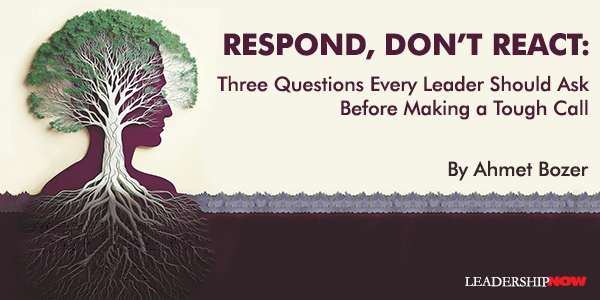
A colleague once approached me to discuss a difficult career decision. He had been asked by a very senior person in his organization to consider a new role. Based on his description, it was only marginally better than his current one — somewhere between a lateral move and a promotion. The career paths didn't seem stronger, and it required a relocation he was reluctant to make. He didn't want to accept the offer. But he was uncomfortable with the risk of saying no to a senior leader. The key question on his mind was: how could he decline the offer and avoid damaging his career or his relationship? We worked together on talking points, potential questions, and avenues the conversation could take. But after all that preparation, I sensed he was still worried. So I asked him directly: how confident did he feel about the conversation he was about to have? To his credit, he openly acknowledged his concerns. We agreed that in addition to the right talking points, he would also have to prepare himself psychologically — to engage with his senior leader on equal terms, not from a position of trepidation. A few weeks later, I followed up. The conversation had gone really well. He had declined the offer, and the senior leader had praised him for the way he had done so. This experience stayed with me because it illustrates something leaders encounter constantly: our preparation may be top-notch, but we are unable to put the plan into action when it matters. The gap between knowing what to do and actually doing it is rarely a knowledge problem. It is a readiness problem. A quote widely attributed to the Austrian psychiatrist and Holocaust survivor Viktor Frankl captures this well: "Between the stimulus and response, there is a space and, in that space, lies our freedom and power to choose our response. In our response lies our growth and our freedom." Most leaders understand this intellectually. Fewer use that space deliberately. Through my own experience navigating challenges across a 30-year career, I've arrived at three questions that help me — and those I mentor — use that space more resourcefully. 1. Am I guided by a clear vision of how I emerge? When a challenge hits, our instinct is to focus on the problem. But the leaders who navigate adversity most effectively begin by envisioning the outcome — not as a wish or a hope, but as a vivid image of a future they believe they can bring into existence. This applies at every scale. It could be a vision for how you emerge from a restructuring, how you want a difficult conversation to land, or even how you want to show up on a tough day. The principle is the same: first envision the desired outcome, then bring that vision to life. The harder part is that serious challenges disrupt the baseline from which we project into the future. Conceiving an aspirational vision from a new and unwelcome reality requires a meaningful shift in perspective — and that shift begins with acceptance. Accepting a challenge doesn't mean agreeing with it. It means clearing the mental space to start building forward. After all, if we can create musical instruments and art by upcycling garbage, we can always create a brighter future for ourselves, no matter the circumstances. 2. Am I using all of the resources available to me? Tougher challenges come with ambiguity, uncertainty, and high stakes. In such moments, the question is whether we are drawing on everything available to us — especially the wisdom of our inner selves and that of our human ecosystem. Earlier in my career, I was asked to move to a position that looked promising on paper — the right experience, senior leadership support, a strong financial package. But my intuition resisted it from the moment I heard the offer. I sensed that the leadership and culture of the organization might hinder my progression, though I couldn't articulate why. I followed my intuition and declined. There was no backlash, and better opportunities came later. Reflecting on that decision, it felt as if something within me knew better than my conscious mind — and fortunately, I listened. Each of us possesses this inner knowledge. We call it intuition, instinct, or gut feeling. Learning to trust it is a key part of the art of decision-making. Equally important is connecting with the wisdom in our human ecosystem. As a Turkish maxim puts it: "Talk with many, think with a few, and decide on your own." 3. Am I prepared — not just strategically, but psychologically? This is the step leaders most often skip. We prepare our arguments, our data, our talking points — but not ourselves. The doubts and fears we experience in making a decision can linger while we are acting on that decision. Taking the time to prepare ourselves psychologically, just as a coach of a sports team would, is critical. Three elements of that preparation stand out. First, prepare for others' emotional reactions. As emotions are contagious, an unexpected reaction can easily throw us off balance. Second, develop self-belief. Feeling doubtful doesn't mean we don't believe — it means we still need to confront our doubts and find actionable ways to overcome them. Third, lean on coaching. An outside perspective — formal or informal — can help us see what we cannot see ourselves. I learned this firsthand when a friend and coach told me directly that she thought I was struggling in a new leadership role. It wasn't easy for my sense of self to swallow that comment. After all, I had already reached a senior position. But after reflection, I accepted that change had to start with me. The coaching that followed was transformative — not because it gave me answers, but because it held up a mirror through incisive questions. Using the Space When faced with a challenge, reflecting on these three questions reveals the true extent of control we have over our lives. They shift us from reacting — driven by fear, habit, or ego — to responding with clarity, resourcefulness, and inner strength. The space between stimulus and response is always there. The discipline is to use it.    Follow us on Instagram and X for additional leadership and personal development ideas. Follow us on Instagram and X for additional leadership and personal development ideas.

Posted by Michael McKinney at 07:25 PM
|
 |
BUILD YOUR KNOWLEDGE



How to Do Your Start-Up Right STRAIGHT TALK FOR START-UPS 

Grow Your Leadership Skills NEW AND UPCOMING LEADERSHIP BOOKS 
Leadership Minute BITE-SIZE CONCEPTS YOU CAN CHEW ON 
Classic Leadership Books BOOKS TO READ BEFORE YOU LEAD |
|

ABOUT
FOLLOW US:
     

Recent Posts
Categories
Full site feed
|
 |
| ||
 | Follow us on:
© 2025 LeadershipNow™  |
| |