  |
|
05.11.26

Have You Outgrown Your Own Company?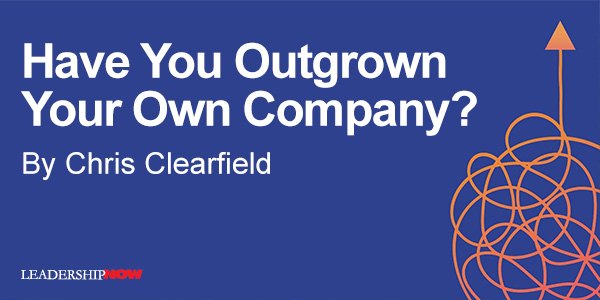
MOST leaders reach a point where they can see exactly where their company needs to go. The vision is clear — more sophisticated, more scalable, more aligned with the leader they’ve become. They didn’t get to this point by accident. The clarity they have now is the product of a commitment to transformation expressed through years of building, learning, and evolving. But the company is still organized around an earlier version of their leadership. The revenue is real. The clients are happy. On paper, it works. But the routines, the roles, the decision-making patterns were designed for a different stage. Maybe a different strategy entirely. As the founder, every day pulls you back into the same patterns: the firefighting, the decisions only you can make, the sense that if you stop moving, everything stops. This is the tension between where you’re going and what got you here, and it’s one of the most common inflection points in a founder’s journey. At this stage, part of your responsibility as a leader is to transform the company along with you. New Goals Demand New Thinking A founder I worked with ran a specialized professional services firm. Over a few years, he had made an important leap from transactional operator to strategic advisor. He built a new framework, renamed his practice, and reimagined his value proposition to create a market segment he could own — higher-trust, higher-fee, more durable client relationships. He knew where he was going. But the company was still organized around what had gotten him here. The team’s routines were built for the old model: high volume, fast turnaround, lots of reactive work. The systems rewarded output, not depth. His top producer embodied the old approach perfectly, earning seven figures doing it the traditional way. There was no reason for that person to change. Because they were successful, challenging the model felt like challenging results. The founder said it plainly: I can see it. My challenge has been to get there. He wasn’t confused about the destination. He was caught in the tension between the leader he had become and the organization that was still designed to produce something else. This is the principle most founders eventually collide with: personal transformation enables organizational transformation, but it doesn’t happen automatically. You have to redesign the organization to match the leader you’re becoming. Creating that alignment is the hardest part of leadership. But there is a way through it, and it starts with seeing clearly. Stepping Back to Move Ahead Rose, a co-founder I worked with, ran a predictive-maintenance startup. In a single hour-long meeting about one of her strategic priorities, she got interrupted eight times; every decision, every customer question, every call was routed through her. She was the bottleneck and she knew it. The conventional answer would have been to delegate more. However, delegation wasn't the issue. As we worked together, Rose started to recognize that she was actively choosing urgency. Once she could see what urgency gave her (a feeling of being essential and in control) and what made strategic focus so easy to avoid (it felt boring and lacked immediate payoffs), she recognized that her own choices were keeping her stuck as the bottleneck. Her dedication to urgency had built a system where her team had no way to make decisions without her, not because they lacked capability, but because she had never designed the conditions for them to use it. As she changed her relationship to urgency, her team’s relationship to it started to shift as well. Instead of answering questions, she started designing what her team needed to move ahead on their own: clear context, clear constraints, clear freedoms. The company didn't change because she hired new people. It changed because she became a different kind of leader — a designer instead of a doer. And once she made that shift, she could actually spend her time on strategy instead of being drowned in the urgent. That shift didn't just free up her calendar, it changed what the company was capable of without her in the room. This kind of transformation starts with three moves:
The next phase of growth is a different kind of growth. Not more effort, not better systems, not another hire who’ll finally take things off your plate. It’s the work of closing the gap between where you’re going and what got you here so that growth stops being a grind and starts feeling like momentum.    Follow us on Instagram and X for additional leadership and personal development ideas. Follow us on Instagram and X for additional leadership and personal development ideas.

Posted by Michael McKinney at 10:54 AM
|
 |
BUILD YOUR KNOWLEDGE


How to Do Your Start-Up Right STRAIGHT TALK FOR START-UPS 

Grow Your Leadership Skills NEW AND UPCOMING LEADERSHIP BOOKS 
Leadership Minute BITE-SIZE CONCEPTS YOU CAN CHEW ON 
Classic Leadership Books BOOKS TO READ BEFORE YOU LEAD |
|
ABOUT
FOLLOW US:
     

Recent Posts
Categories
Full site feed
|
 |
| ||
 | Follow us on:
© 2025 LeadershipNow™  |
| |