  |
|
04.26.26

2026 State of EQ Report Finds Human Skills Drive Performance in AI Economy
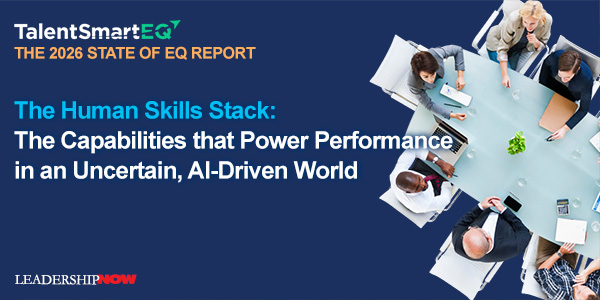 While Companies Race to Adopt AI, Many Lack the Skills to Make It Work
AI isn’t the top workplace advantage, human skills are. TalentSmartEQ, the world’s premier provider of emotional intelligence (EQ) solutions, has released its 2026 State of EQ Report, examining how leaders and organizations navigate rising economic uncertainty, rapid change and the acceleration of AI adoption. The report reveals that the human skills required to make technology effective are now the strongest predictor of organizational performance in an AI-driven world.
Drawing insights from nearly 700 leadership, HR and L&D professionals and EQ data from more than 23,000 individuals, this year’s report shows a widening gap between companies’ technological ambition and their human readiness to execute.
“Technology has dominated the workplace conversation, but data continues to show that technology doesn’t create performance, people do,” said Howard Farfel, TalentSmartEQ CEO. “As AI adoption accelerates, the organizations coming out ahead in 2026 are deliberately building the people skills that allow leaders and teams to think clearly, stay steady under pressure and execute when conditions are uncertain.”
Four themes that will define a company’s performance in the next three to five years:
Build the “Human Skills Stack”
When asked which skills will matter most in the years ahead, the top response was keeping up with technology, followed closely by adaptability to change, critical thinking, emotional intelligence and communication. Together, these capabilities form an integrated “human skills stack” that enables technology to deliver results. EQ sits at the center, shaping how leaders respond when priorities collide, feedback is difficult, customers are frustrated and decisions must be made with incomplete information. Technical capability only creates an advantage when human capability keeps pace.
Rising Uncertainty and Change are Testing Leaders
Economic uncertainty is now the top factor expected to impact businesses in the coming years. Organizational change is no longer occasional: 54% of organizations report experiencing frequent or constant change, up from 45% in 2025. However, only 41% say they are well-prepared to handle changes or disruption. How leaders manage this constant pressure is emerging as a key performance differentiator.
Internal Alignment is the Hidden Performance Constraint
While external forces dominate headlines, the report finds that the most significant barrier to execution is internal alignment. Misalignment is a natural consequence of sustained change, ongoing uncertainty and the quality and consistency of communication. When alignment breaks down, teams slow decision-making, execution falters and trust erodes.
Leaders are Working on the Wrong Things
TalentsmartEQ’s 2026 State of EQ Report reveals a disconnect between leadership intent and real-world impact. Data from TalentSmartEQ’s multi-rater assessment shows fewer than 5% of leaders share the same top three development priorities as their raters, and 45% show no overlap between the behaviors they want to improve and the behaviors that their teams say limit their effectiveness. As a result, well-intentioned development investments often fail to produce measurable performance gains.
To gain additional insights into challenges and strategies shaping organizations, download the free 2026 State of EQ.
Posted by Michael McKinney at 09:52 AM
|
 |
BUILD YOUR KNOWLEDGE



How to Do Your Start-Up Right STRAIGHT TALK FOR START-UPS 

Grow Your Leadership Skills NEW AND UPCOMING LEADERSHIP BOOKS 
Leadership Minute BITE-SIZE CONCEPTS YOU CAN CHEW ON 
Classic Leadership Books BOOKS TO READ BEFORE YOU LEAD |
|

ABOUT
FOLLOW US:
     

Recent Posts
Categories
Full site feed
|
 |
| ||
 | Follow us on:
© 2025 LeadershipNow™  |
| |