  |
|
06.09.26

Your Company Doesn’t Just Need a Defensible Strategy – It Needs One that Can Adapt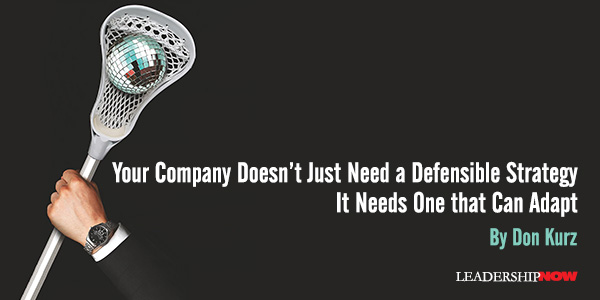
IT'S a well-worn saying that the only constant in life is change, and that’s doubly true of the business world. If you’re successful, you need to constantly check your rearview mirror because there are always competitors right behind you. Earlier in my career, I became CEO of a company, Equity Marketing (which became EMAK Worldwide). My thinking at the time was: “Okay, you’re the boss, so you need to come up with all the important strategic and visionary ideas because that’s what your job is and that’s what you’re expected to do.” But I ultimately concluded that’s actually not the job. The job as CEO is to make sure the company has a unique, compelling, and defensible advantage — whether you develop that strategy by yourself, or you curate it from your team. Defensible in this context means that a competitor can’t easily remove you from your perch in the marketplace because you have a unique process, or unique technology, or unique talent with a unique culture, or unique client relationships. Whatever it is, you own something that makes it hard for a competitor to dislodge you from your position. The ultimate hallmark of a defensible strategy is that it’s adaptable to the inevitability of change. So, if nepotism is your strategy and you got into Yale or Harvard despite your mediocre high school GPA because you’re a legacy, that’s not going to be sustainable when you get out into the world and your circumstances change. When you graduate from a college you never should have gotten into, all of a sudden you’ll find yourself competing with smarter and more talented people for jobs that they deserve more than you do — and you’ll be out of luck. Defensible advantages are more fleeting these days than they used to be because technology levels the playing field. And the pace of disruption is also much faster than it used to be. Take advertising and marketing, for example: because of AI and other factors, our industry is undergoing a lot of change and consolidation. Why does the world need our advertising and marketing company (Omelet LLC)? For us, that’s the ultimate question. It’s a hard question to answer, but our survival ultimately depends on our ability to answer it. The best our service business can do to stay ahead of the curve is to truly understand our defensible advantages and capitalize on them. Here are some keys to making sure our company has a defensible strategy: 1. Hire uniquely strong people. I’m a reasonably smart guy, but my biggest strength is recruiting good people, letting them have a real say, and then creating an environment to let the magic happen. Our competitive advantage when we hire good people is doing incredible work every time and providing impeccable client service. 2. Tap the team’s strategic ideas. The best thing about devising a defensible strategy for your business is that you don’t have to do it all by yourself. If the people on your management team come from different backgrounds and have different perspectives and different kinds of expertise, you can curate the best of everyone’s ideas and then formulate your strategy from their input — getting their ideas and then blending them with your own. It’s useful to have as many different perspectives as possible, because there are many things you might not know. In this way, not only are you developing a more robust strategy, but you’ll find it’s far easier to execute the plan when your people have had a say in developing it. 3. Define the business by the solutions we provide. Because disruption is inevitable, don’t define your business by your product or process. A defensible strategy is never defined by a simple product or service — it has to be something that evolves with the marketplace. And if there’s a better way to provide that solution, you should be indifferent to how you provide it. Some say that horse-and-buggy drivers should have been the inventors of the automobile because they were in the transportation business. I think that’s a bit of a stretch, but the underlying point is valid: you aren’t in the horse-and-buggy business; you’re in the business of getting from point A to point B. When automobiles began to emerge on the scene, the buggy manufacturers should have actively explored building cars. 4. Deliver on a strong work ethic. As I previously noted, I believe I’m a reasonably smart guy, but I’m definitely not smarter than everyone else around me. I don’t have to be smarter than everyone else, however, because there’s a more reliable way to make up for smarts — and that’s honest, hard work. Don’t get me wrong — I’m not saying that natural gifts like intelligence and athleticism don’t matter, or that they don’t provide a strong advantage. But an advantage can be squandered if you don’t have the grit to do the hard work of maximizing it. Companies can have a variety of defensible advantages — a premium brand, a low-cost operating model, access to low-cost capital, or a network effect like social media titan Meta. The key to winning in the long run is to curate a good strategy, execute it flawlessly, bend with the times, and stay true to your brand identity.    Follow us on Instagram and X for additional leadership and personal development ideas. Follow us on Instagram and X for additional leadership and personal development ideas.

Posted by Michael McKinney at 09:36 AM
|
 |
BUILD YOUR KNOWLEDGE



How to Do Your Start-Up Right STRAIGHT TALK FOR START-UPS 

Grow Your Leadership Skills NEW AND UPCOMING LEADERSHIP BOOKS 
Leadership Minute BITE-SIZE CONCEPTS YOU CAN CHEW ON 
Classic Leadership Books BOOKS TO READ BEFORE YOU LEAD |
|

ABOUT
FOLLOW US:
     

Recent Posts
Categories
Full site feed
|
 |
| ||
 | Follow us on:
© 2025 LeadershipNow™  |
| |