  |
|
03.20.26

I Stopped Wearing the Corporate Costume — and My Business Exploded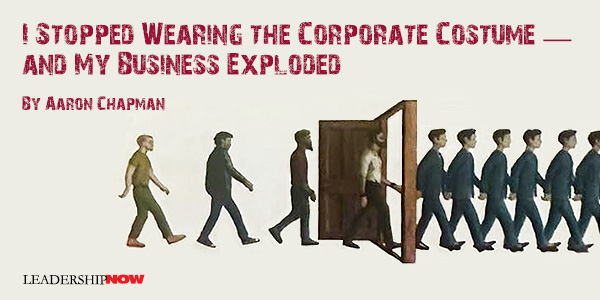
A former rancher turned finance leader explains why the “costume of conformity” is costing you clients, credibility, and the career you actually want. EARLY in my finance career, a client and I hit it off over the phone. We had a natural personality match — easy conversation, good rapport, real trust building in real time. When he came to my office for a face-to-face consultation, he saw me from across the room before we’d been formally introduced. He walked out. Didn’t say a word. He wasn’t going to trust the largest transaction of his life to what he saw as an immature individual who didn’t look the part. At the time, I was doing everything I’d been told to do. I’d come into finance from cattle ranching, welding, heavy equipment, truck driving, and underground mining — environments where you dressed for utility, not appearances. When I entered the corporate world, I was subjected to constant scrutiny: how I talked, how I groomed, how I dressed, how I stood. All of it presented as a necessity of success. So I conformed. I put on the costume. And I lost a client anyway — not because I was being myself, but because I wasn’t. That experience, and several like it, taught me something that changed the trajectory of my career: authenticity isn’t just a feel-good buzzword. It’s a business strategy. Here’s why. The People Who Told Me to Conform Didn’t Stick Around Not long after I started dressing and grooming the way I was told to, every single one of the people who insisted their way was the path to success had disappeared. They left the business. They weren’t successful. And there I was, sitting alone in an office, “dressed for success” according to the standards of people who had failed. That forced a hard question: if the people prescribing the formula couldn’t make it work for themselves, why was I following their playbook? The advice we accept about how to present ourselves often comes from people who haven’t achieved what we’re trying to achieve. Before you take someone’s word on what success looks like, check whether they’ve actually built any. The Costume of Conformity Creates a Mismatch — and People Can Feel It Here’s what I figured out from losing that client: the problem wasn’t that I didn’t look like a finance professional. The problem was that I looked like one on the outside and sounded like something completely different on the inside. My words and personality created one impression. My appearance created another. The mismatch made people uneasy, even if they couldn’t articulate why. I was essentially lying with my appearance. When your outside doesn’t match your inside, people sense it — and any trust you built through conversation gets undermined the moment they see the disconnect. Conformity doesn’t build trust. Consistency does. Authenticity Is the Fastest Way to Sort Through People When I finally made the decision to let my outward appearance match the person inside, something unexpected happened: I started saving an enormous amount of time and resources. If someone took issue with the honest representation of who I am before we ever discussed business, neither of us invested time that would result in a loss. No deep personal analysis across multiple meetings just to discover we weren’t a fit. No weeks of small talk built on a false first impression. Showing up as yourself is the most efficient filter in business. The people who can’t get past how you look were never going to be the right clients, partners, or colleagues anyway. Better to find that out in the first thirty seconds than the first three months. Walls Come Down When the Costume Comes Off The flipside was just as powerful. When I stopped conforming, the people who were a fit connected with me faster and deeper than they ever had before. Walls came down. Conversations were more open and relaxed. There was no scripted small talk, no rehearsed objection-handling techniques taught by industry trainers. Just two people having a real conversation. I’ve found that the greatest way to overcome objections is to develop an actual relationship with a person — to truly care about them. And the best way to evidence that care is by being authentically yourself. Any sort of fakeness, no matter how polished, brings everything into question. If someone suspects you’re performing, they’ll wonder what else you’re hiding. Being Yourself Is a Risk — Take It Anyway I won’t pretend this is easy. When you stop conforming, you will lose people. Some clients will walk. Some colleagues will judge. Some opportunities will close before they open. That’s the cost, and you have to be willing to pay it. But here’s what I’ve learned over decades in this business: the opportunities you lose by being yourself are always smaller than the ones you gain. The clients who stay are better clients. The relationships are deeper. The referrals are stronger. And you get to wake up every morning without dreading the performance you have to put on. If you’re going to be judged for your appearance either way, you might as well make sure what people are judging is actually you. Drop the Costume The choice is simple, even if it’s not easy: you can keep hiding behind the costume of conformity, hoping it earns you approval from people who may not even be around next year. Or you can show up as the best, most honest version of yourself and let the sorting happen naturally. Be authentic. Be kind. Be excellent at what you do. And if someone can’t get past the packaging to see the substance, that’s not a client you lost — it’s time you saved.    Follow us on Instagram and X for additional leadership and personal development ideas. Follow us on Instagram and X for additional leadership and personal development ideas.

Posted by Michael McKinney at 12:13 PM
|
 |
BUILD YOUR KNOWLEDGE


How to Do Your Start-Up Right STRAIGHT TALK FOR START-UPS 

Grow Your Leadership Skills NEW AND UPCOMING LEADERSHIP BOOKS 
Leadership Minute BITE-SIZE CONCEPTS YOU CAN CHEW ON 
Classic Leadership Books BOOKS TO READ BEFORE YOU LEAD |
|

ABOUT
FOLLOW US:
     

Recent Posts
Categories
Full site feed
|
 |
| ||
 | Follow us on:
© 2025 LeadershipNow™  |
| |