
Leading Blog


« 5 Leadership Lessons: James M. Kilts on Building the Right Team | Leading Blog Main Page | Out of Context: Everyone is a Leader »


11.28.07

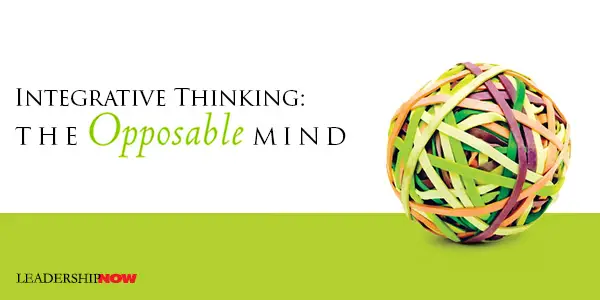
Integrative Thinking: The Opposable Mind

The Opposable Mind
Not one to put the cart before the horse, Roger Martin understands the importance of doing but he prefers “to swim upstream to the antecedent of doing: thinking.” He writes in The Opposable Mind, “My critical question is not what various leaders did, but how their cognitive processes produced their actions.”

In examining how exemplary leaders think, he found an approach that was common to many, that he has termed integrative thinking. Integrative thinking is:
The ability to face constructively the tension of opposing ideas and, instead of choosing one at the expense of the other, generate a creative resolution of the tension in the form of a new idea that contains elements of the opposing ideas but is superior to each.
In other words, integrative thinking examines problems as a whole, taking note of the complexities that exist and embrace the tension between opposing ideas to create new alternatives that take advantage of many possible solutions.

Is integrative thinking necessary for all problems? No. For some problems there is an easy solution. Some problems benefit from breaking them down to a single manageable issue and nailing the solution. These are generally simple, linear cause and effect problems. But there are those problems that stem from multiple avenues of causation and nonlinear relationships between cause and effect. For example, when you find yourself faced with win/lose solutions, problems to which there is no apparent solution or issues for which all of the solutions are choices between bad alternatives, then integrative thinking becomes necessary.

It’s easy to get into the destructive rut of thinking that money is the solution to most problems. School boards are notorious for claiming that their hands are tied because they lack the money they want. They cripple themselves. What they really need are creative solutions. Education is a complex issue and has for too long been subject to tunnel-vision problem solving. They need integrative thinking.

Einstein opined that we should make everything as simple as possible, but no simpler. Too often we try to make complex issues too simple and leave ourselves with too few options based on our limited point-of-view. If we instead embrace complexity and learn to deal with it, we might find more and better solutions. Martin writes, “More salient features make for a messier problem. But integrative thinkers don’t mind the mess. In fact they welcome it, because the mess assures them that they haven’t edited out features necessary to the contemplation of the problem as a whole. They welcome complexity because they know the best answers arise from complexity.”

In The Opposable Mind, Martin clearly illustrates this thinking process in action by dissecting varied examples from both business and interpersonal situations. Martin claims that we are all born with an opposable mind—the ability to hold two conflicting ideas or models in constructive tension. “We can use that tension to think our way through to a new and superior idea….Opposing models, in fact, are the richest source of new insight into a problem. We learn nothing from someone who sees the problem exactly as we do.”

Related Posts:
Roger Martin on Assertive Inquiry
How to Develop Integrative Thinking

Posted by Michael McKinney at 09:45 AM
| Comments (4) | TrackBacks (0) | Books , Creativity & Innovation , Thinking


TrackBack

TrackBack URL for this entry:
http://www.leadershipnow.com/cgi-bin/mt/mt-tb.cgi/313

Comments

Michael,

Thanks for the information. Elliott Jaques spent decades studying cognitive capacity and published his findings in Human Capability.

His model would say that what Roger Martin is talking about is moving from declarative thinking (this OR this OR this OR this)to cumulative thinking (this AND this AND this). Jaques found four cognitive processes, declarative, cumulative, serial and parallel. These four processes repeat themselves at higher and higher levels of complexity and abstraction (similar to octaves in music, notes repeat themselves at higher pitches).

Jaques's model would argue that yes, all humans are capable of holding two items in tension but the complexity level of the items will vary from person to person.

Meaning, a child can hold to tangible items in tension - do I want a dog or a cat? But holding two models in tension and thinking through all the intricacies associated with the decision, e.g. do we want to adopt a low-cost marketing position or a high-service market position, is not something children, nor all adults could do. Unfortunately, it is not something one can will nor teach himself to be able to do. Because this finding runs counter to the American way of thinking - we all have equal and unlimited cognitive potential - Jaques' ideas are not very popular.

Through decades of longitudinal studies, Jaques found that we all mature in cognitive capacity throughout adulthood. Different people matured at different rates that could not be explained by socioeconomic status, education level, or any demographic.

If this line of thinking is of interest, I urge you to read his material including, Requisite Organization.

Regards,

Michelle

Thanks Michelle. I've read his Executive Leadership, but it sounds similar to the Requisite Organization title you recommended. Martin believes you can improve your abiltity to deal with complexity. I'll post something on that on Friday. Thanks again for your well thought out comments.

We can improve our ability to deal with complexity and on my website you will find training tools for doing so.

After many years advancing the subject of Integrative Thinking it is pleasing to see more interest being shown in the subject.

Michael:
Thanks for your three helpful and well-crafted posts. I enjoyed reading them and think they provide incisive summaries.
Lots of people ask me about Elliot Jacques in reference to my work. I think that Jacques made a contribution with his work. For me, however, I find him more deterministic than my experience suggests is optimal. He is a little to quick to classify people in terms of their inherent capability and leave it at that. My perspective is that Integrative Thinking capability is like a muscle. If you don't use it, it isn't good for much. If you exercise it, the muscle can do a lot of useful things.
That doesn't mean everyone was born with the exact same muscle development potential. But there is a lot of room for improvement.
Hope that helps and again thanks for the well-written blogs.
R.

Post a comment

(If you haven't left a comment here before, you may need to be approved by the site owner before your comment will appear. Until then, it won't appear on the entry. Thanks for waiting.)


excerpts


Copyright ©1998-2007 LeadershipNow / M2 Communications All Rights Reserved
All materials contained in http://www.LeadershipNow.com are protected by copyright and trademark laws and may not be used for any purpose whatsoever other than private, noncommercial viewing purposes. Derivative works and other unauthorized copying or use of stills, video footage, text or graphics is expressly prohibited. LeadershipNow is a trademark of M2 Communications.