
Leading Blog


« Growth: The Key to Leading for a Lifetime | Leading Blog Main Page | Cast a Vote For the Best Leadership Blog »


06.18.07

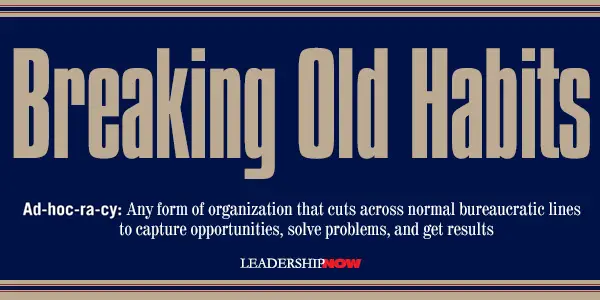
Breaking Old Habits

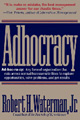
Adhocracy
Robert Waterman, Jr. tells us in his book Adhocracy—any form of organization that cuts across normal bureaucratic lines to capture opportunities, solve problems, and get results—that we have created organizations that are resistant to change. He writes:
We’re controlled by ideas and norms that have outlived their usefulness, that are only ghosts but have as much influence on our behavior as they would if they were alive.

Habit haunts us even when we ought to know better. Stress—the kind produced by rapid change—seems to make us revert to mindless, programmed behavior. Maybe we’re just fearful of change and failure, for even when we know a situation cries out for adhocracy, we often chose the old, familiar path.

Many habits are useful; we wouldn’t be able to get through the day without them. Habit in general is comforting. But how do we break those habits that have outlived their usefulness?
He suggests four ways to help us break out of our comfort zones:
  1. Make a public commitment to change
  2. Take at least one small step in the new direction as soon as possible
  3. Go cold turkey; no lapses allowed
  4. Build in tremendous positive reinforcement for the new behavior, and don’t slow down long enough to let old habits sneak back

* * *

Like us on Facebook for additional leadership and personal development ideas.

Posted by Michael McKinney at 08:41 AM
| Comments (4) | TrackBacks (1) | Change


TrackBack

TrackBack URL for this entry:
http://www.leadershipnow.com/cgi-bin/mt/mt-tb.cgi/226

Listed below are links to weblogs that reference Breaking Old Habits:

» The Power of Habit from Leading Blog: A Leadership Blog
Habits will always be with us. Some good. Some bad. But how do you replace bad habits with good habits? More importantly, how often do we ask ourselves if what we are doing is really just a habit? We are... [Read More]

Comments

It has been my experience when addressing old habits whose usefulness has past its time, to solicit the accountability of a trustworthy peer or a wise mentor. In fact, I would venture to posit that I would not be the leader, much less the person, that I am today apart from the consistent accountability that I received through others at pivotal points in my life.

When I use the term accountability, I’m not talking necessarily about some nonchalant, evasive form of “accountability” that warms the hearts of both parties involve. Too much is at stake for such trivial, amusing games. Love confronts, with point-directed questions about the areas in need—without deflecting the real root issues. And, it is consistent, which is determined by the severity of the “bad habit” that is being addressed.

Are there any courses/training that could foster this kind of response in an organisation? I haven't seen too many. The only one that seems to approach these concepts is the Strategic Business Acumen course (offered by http://imia.edu.au).

Can anyone suggest any others?

Mr. Waterman lists four suggestions to breaking our comfort zones and thus erasing detrimental habits. His suggestions make sense and have merit. I would like to suggest a key component to the success of changing a behavior or habit which is a precursor to his four suggestions. First and foremost one must recognize the behavior. The very reason the behavior is called a habit is because it has moved to a subconscious level, it has become an automatic response. Only in the realization of our habits can we hope to change them. Then in realizing we must decide, we must decide to maintain or to extinguish the behavior. And in order to do that we must bring it to our active thought process. This idea goes along with the comments submitted by Brian. In which a trusted mentor can keep us on the "straight and narrow". But trusted individuals can also be used to help us see that which has become invisible to ourselves. Often this is referred to as coaching. Coaching is basically getting realistic feedback on our behaviors, with possible solutions in order to improve. Whether it is in sports or in business, coaches observe, evaluate, educate and hopefully motivate, which produces better results.

Positive reinforcement is indeed a powerful technique for breaking an old habits and establishing new ones. However, most organizations fail to apply positive reinforcement appropriately or consistently. As a result, new behaviors are unsustainable and people revert to the comfort of their old ways.

Post a comment

(If you haven't left a comment here before, you may need to be approved by the site owner before your comment will appear. Until then, it won't appear on the entry. Thanks for waiting.)


Copyright ©1998-2012 LeadershipNow / M2 Communications All Rights Reserved
All materials contained in http://www.LeadershipNow.com are protected by copyright and trademark laws and may not be used for any purpose whatsoever other than private, noncommercial viewing purposes. Derivative works and other unauthorized copying or use of stills, video footage, text or graphics is expressly prohibited. LeadershipNow is a trademark of M2 Communications.