  |
|
12.15.25

Lessons from the Octopus About Leading AI Transformation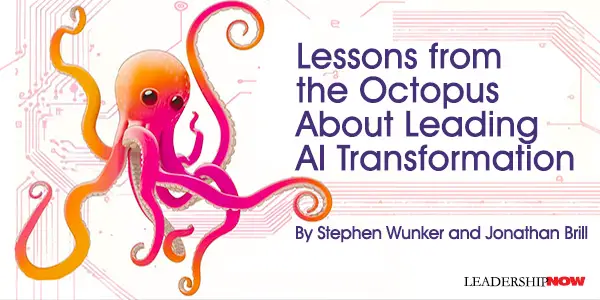
SIXTY-SIX million years ago, an asteroid strike wiped out the dinosaurs and 75% of Earth’s species. Among the survivors was a creature that would teach us critical lessons about thriving amid disruption: the octopus. While other animals’ external armor was useless against this new threat, the octopus survived by being radically adaptable. It has a rare ability; it can edit its RNA to adjust to new conditions within hours. Today’s leaders face their own asteroid strike: artificial intelligence. And like that ancient catastrophe, AI is reshaping the business landscape with breathtaking speed. The question isn’t whether your organization will be transformed, but whether you’ll lead that transformation or be overwhelmed by it. Having worked with dozens of organizations navigating AI adoption, we’ve seen that the most successful leaders don’t treat AI as just another technology implementation. Instead, they recognize it as a catalyst for fundamental organizational redesign. Here are four critical lessons for leading this transformation. 1. Distribute Intelligence to the Front Lines The octopus has two-thirds of its neural tissue in its arms, not its brain. As a result, each arm can solve problems independently while remaining coordinated with the whole. This is the ideal model for organizations: push decision-making power to where the action happens. Most companies still operate with a “hub and spoke” command structure, where information flows up for decisions and then back down for execution. This creates costly delays. AI changes the game by making sophisticated analysis available at every level. A sales rep can now access predictive customer insights. A supply chain manager can run complex optimization scenarios. A customer service agent can resolve issues that once required escalation. Take the case of Mass General Brigham, one of the world’s leading healthcare systems. AI tools help frontline clinicians identify patterns and make treatment decisions faster, while leadership focuses on ensuring these tools integrate seamlessly into workflows and align with core values. Action Step: Identify three decisions currently made at the management level that could be delegated to frontline teams with the right AI support. Then invest in making that support first-rate. 2. Create Knowledge Flow, Not Silos The octopus has a “neural necklace,” a ring of nerve bundles that connects all its arms, enabling instant information sharing without involving the central brain. Your organization needs the digital equivalent. Too many companies treat AI as a series of disconnected point solutions: a chatbot here, a forecasting tool there, an image recognition system somewhere else. But AI’s real power emerges when insights flow freely across organizational boundaries. When your customer service AI informs your product development AI, which feeds your supply chain AI, you create compounding intelligence. This requires rethinking your data architecture. Follow Amazon’s example: for over two decades, teams have been required to make every dataset accessible through well-documented interfaces. Action Step: Map the information flows your AI systems require to be most effective, then eliminate the structural barriers preventing those connections. This often means confronting uncomfortable truths about departmental turf and legacy systems. 3. Embrace Three-Hearted Leadership The octopus has three hearts: one for its body and one for each gill. These hearts serve different purposes, and one can even be stopped temporarily to redirect energy to the others. Modern AI transformation requires a similar multiplicity of leadership approaches and an ability to shift focus. First, you need operational leadership that maintains excellence in your core business while AI tools enhance productivity. Second, you need experimental leadership that explores how AI might create entirely new business models or revenue streams. Third, you need cultural leadership that addresses the very human concerns about what AI means for people’s roles and dignity. The computer accessories company Logitech has balanced all three hearts effectively. It has used AI to streamline operations, explored AI-powered new product categories, and conducted town halls where employees could voice concerns and shape how AI would be deployed. This has resulted in both productivity gains and sustained employee engagement. Action Step: Assess which of these three leadership dimensions you’re neglecting. Then tell managers which styles to focus on and when. 4. Accelerate Through Accurate Sensing The octopus has exceptional sensory capabilities. It has thousands of chemoreceptors on its arms that constantly feed information about its environment. In an AI transformation, your sensing mechanisms are how you detect both opportunities and emerging problems. Most organizations implement AI tools but fail to instrument them adequately. They can tell you if the tool is being used, but not how it’s changing workflows, where it’s introducing errors, or what new capabilities users wish it had. This is flying blind. Build comprehensive sensing into every AI initiative from day one. This means usage analytics, certainly, but also regular qualitative feedback sessions, error tracking with root-cause analysis, and competitive intelligence on how others in your industry are applying similar capabilities. When you spot patterns—positive or negative—you can respond at AI speed rather than committee speed. Action Step: Before deploying your next AI tool, design the feedback mechanisms that will tell you what’s really happening. Make reviewing this feedback a weekly ritual, not a quarterly afterthought. The Transformation Imperative The asteroid that killed the dinosaurs created the conditions for mammals to flourish. AI’s disruption is similarly clearing space for new organizational forms, ones that are more adaptive, more intelligent, and more resilient. The uncomfortable truth is that cautious, incremental approaches won’t cut it. The companies that thrive will be those willing to redesign their organizations around AI’s capabilities—distributing intelligence, connecting insights, embracing complexity, and moving at the speed of algorithms. The question facing every leader today isn’t whether to transform. It’s whether you’ll transform deliberately, learning from nature’s most adaptable creature, or be transformed by forces you didn’t see coming. The asteroid has already struck. The age of the Octopus Organization has begun.    Follow us on Instagram and X for additional leadership and personal development ideas. Follow us on Instagram and X for additional leadership and personal development ideas.

Posted by Michael McKinney at 11:31 AM
|
 |
BUILD YOUR KNOWLEDGE

 


How to Do Your Start-Up Right STRAIGHT TALK FOR START-UPS 

Grow Your Leadership Skills NEW AND UPCOMING LEADERSHIP BOOKS 
Leadership Minute BITE-SIZE CONCEPTS YOU CAN CHEW ON 
Classic Leadership Books BOOKS TO READ BEFORE YOU LEAD |
|

ABOUT
FOLLOW US:
     

Recent Posts
Categories
Full site feed
|
 |
| ||
 | Follow us on:
© 2025 LeadershipNow™  |
| |