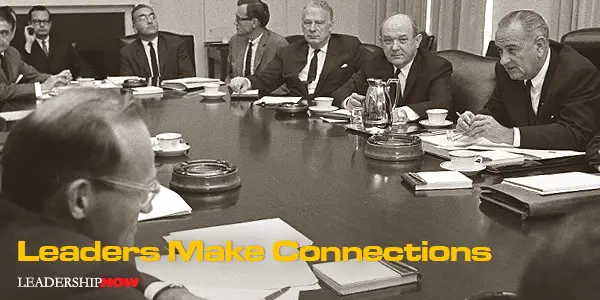

Leading Blog


« 12 Behaviors You Can Practice to Make You a More Inspiring Leader | Leading Blog Main Page | Getting Naked »


02.10.10

Leaders Make Connections

The Financial Times ran an excellent analysis on February 3rd by Edward Luce concerning the very tight inner circle—just four people—that Mr. Obama relies on for advice. In America: A Fearsome Foursome, Luce advocates a broader circle of advisers and notes, “To be successful, presidents need to separate the stream of advice they get on policy from the stream of advice they get on politics.” Intellectually we know that we need to get their advice and information from a wide variety of sources. In practice, however, it doesn’t always happen. We like to talk to those with whom we are comfortable with and share our views. It’s very reassuring. But dangerous.

Dangerous because it clouds our vision and makes us less agile. More importantly, seeking the opinions of others helps to make them feel a part of a larger purpose, connected to the leader and a part of a community. This points to a basic function of leadership: to make connections.
LBJ 02 1968
The point is made well in a follow-up letter to Luce’s article, published in the Financial Times, from Francis Bator, Harvard Kennedy School emeritus professor. Before coming to Harvard in 1967, he was for three years deputy national security advisor to President Lyndon B. Johnson. He shared the following story with FT readers:
Treasury Secretary Henry Fowler, shrewd, effective, a superb negotiator, but somewhat shy of Lyndon Johnson, would occasionally feel in need of a presidential laying on of hands even when he had no serious presidential business. After one such occasion - it had ended with Fowler, sitting on the edge of the Oval Office loveseat, reading in monotone from his own memo on the floor in front of him, while the president was plucking yellow news tickers from the ticker machine at the opposite end of the Oval – LBJ turned on me, angrily: “What on earth did you bring him in here for, wasting my time ...” and so forth, but then stopped himself mid-sentence. “No, I’m wrong. Make me see him when he asks even if he has no real business! While you staff fellows are safe in the White House, these cabinet fellows are out there every day being shot at, on the Hill, in the papers, on TV. They are my field generals. Never forget that. They’ll be useless to me if they don’t feel connected to me. Always treat them with dignity.
A leader’s position is in the middle; to share and connect. In a world bent on differentiation, leaders must make connections.

Posted by Michael McKinney at 12:00 AM
| Comments (4) | TrackBacks (0) | Government , Leaders , Leadership


TrackBack

TrackBack URL for this entry:
http://www.leadershipnow.com/cgi-bin/mt/mt-tb.cgi/702

Comments

It's a trade-off. The more advisers you have the more balanced your information and suggestions will be.

The down side is that you will have to use up more time listening to all of them and then more time afterwords deliberating through what they said.

To anyone who might govern: campaigns are merely popularity contests; and governing is not. Leaders should never surround themselves with persons whose opinions rely on the leader’s ego. Normally, what got you there, ain't necessarily going to help keep you there, though it doesn't have to hurt too. Your decisions should be fewer, more informed, deliberatively uncomfortable and courageously realistic. A staff is something you hold onto, not listen too. Your easy decisions should have been harder; and your hardest decision; might be right at least once. History will judge if you really sought out the best advise or just listened to the easiest to hear or nearest. Every nite, the thoughts and prayers of the masses are said for you; but when the morning comes, be prepared for their deserved discontent.

I recently wrote a post on a similar topic and called it Who are you listening to? It can be found here http://bit.ly/5RtUR3 The point was not just the numbers that you listen to, but as the previous comment indicated the agenda of the people you allow yourself to listen to. Malcolm Gladwell gives a great account of a Civil War General Hooker who refused to listen to any information that was contrary to what he wanted to believe was true. As a result, his 120,000 strong troops were soundly defeated by Lee's 40,000 troops. Sadly, there are many leaders (both business and political) who suffer from the same flaw.

Great post as a reminder to be careful who you listen to. Thanks.

Leaders often get wrapped up in who they are and what they are doing every day. It is easy for them to forget about their extended circle of influence. Looking at how great leaders have dealt with their charge of people is a great way to help managers today lead their teams.

Post a comment

(If you haven't left a comment here before, you may need to be approved by the site owner before your comment will appear. Until then, it won't appear on the entry. Thanks for waiting.)


Copyright ©1998-2012 LeadershipNow / M2 Communications All Rights Reserved
All materials contained in http://www.LeadershipNow.com are protected by copyright and trademark laws and may not be used for any purpose whatsoever other than private, noncommercial viewing purposes. Derivative works and other unauthorized copying or use of stills, video footage, text or graphics is expressly prohibited. LeadershipNow is a trademark of M2 Communications.