  |
|
12.23.09

The Nature of Small Wins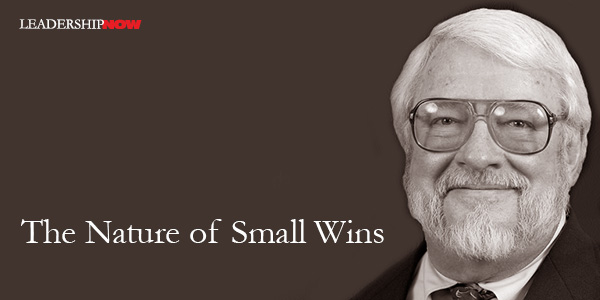
IN the face of overwhelming problems, we can feel helpless to do anything. Organizational theorist Karl Weick argues that calling a situation a serious problem requiring a sweeping change may be when the real problem starts. (e.g., "I can't solve that problem, so I'll just focus on something else.") And so nothing gets done. In the article Small Wins: Redefining the Scale of Social Problems, Weick explains that small wins help to create an environment where change is not overwhelming and therefore more likely to happen. He writes, "The massive scale on which social problems are conceived often precludes innovative action because the limits of bounded rationality are exceeded...People often define social problems in ways that overwhelm their ability to do anything about them." In order to solve social problems, he suggests that we define them as a series of smaller problems that can then be affected by small wins. He defines small wins as a "series of concrete, complete outcomes of moderate importance [that] build a pattern that attracts allies and deters opponents." This strategy of focusing on “a series of controllable opportunities of modest size that produce visible results”, works directly on the construction of a problem and indirectly on its resolution. A small win is a concrete, complete, implemented outcome of moderate importance. By itself, one small win may seem unimportant. A series of wins at small but significant tasks, however, reveals a pattern that may attract allies, deter opponents, and lower resistance to subsequent proposals. While small wins provide less effort to produce and provide stable building blocks to build on, they are not orderly because each small win changes the context for the next small win. Weick explains: “Small wins have a fragmentary character driven by opportunism and dynamically changing situations. Small wins stir up settings, which means that each subsequent attempt at another win occurs in a different context. Careful plotting of a series of wins to achieve a major change is impossible because conditions do not remain constant. Much of the artfulness in working with small wins lies in identifying, gathering, and labeling several small changes that are present but unnoticed, changes that in actuality, could be gathered under a variety of labels.   Follow us on Instagram and Twitter for additional leadership and personal development ideas. Follow us on Instagram and Twitter for additional leadership and personal development ideas.
Posted by Michael McKinney at 07:57 AM
|
 |
BUILD YOUR KNOWLEDGE

 


How to Do Your Start-Up Right STRAIGHT TALK FOR START-UPS 

Grow Your Leadership Skills NEW AND UPCOMING LEADERSHIP BOOKS 
Leadership Minute BITE-SIZE CONCEPTS YOU CAN CHEW ON 
Classic Leadership Books BOOKS TO READ BEFORE YOU LEAD |
|

ABOUT
FOLLOW US:
     

Recent Posts
Categories
Full site feed
|
 |
| ||
 | Follow us on:
© 2025 LeadershipNow™  |
| |
