  |
|
12.02.09

Managers Can (and Should) Be Leaders
IT HAS BECOME commonplace to regard managers as inferior to leaders. Leaders are out front getting things done and managers are … what are they doing? This is, in part, due to our proclivity to label people as one or the other. Henry Mintzberg is the antidote to that kind of unproductive thinking. He writes in a book simply titled Managing: “we should be seeing managers as leaders and leadership as management practiced well.” While I have maintained that there is value in separating the functions of managers and leaders for the better understanding of both, in practice, they shouldn’t be two different people. Mintzberg believes that managing is a practice that is learned on the job through apprenticeship, mentorship, and direct experience. He has good cause to assert that we should be more concerned about “macroleading;” people that manage by remote control; too far above it all. “We are now overlead and undermanaged, he writes.” By obsessing over the glories of leadership, we lose our grasp on the realities of management. And our leadership is all the worse for it. “The more we obsess about leadership, the less we seem to get.” Managing is a valuable read. Mintzberg always makes you stop and think. He’s at his best when he’s leveling the playing field. As we’ve stressed on this blog before, leadership isn’t evolving. Leadership (and management) are a fundamental human activity. How they are practiced may change depending on the context, but their essence remains unchanged. Much of what we have to learn and relearn are fundamental principles regarding how people get along and work together. Managers deal with different issues as time moves forward, but not with different managing. The job does not change. We buy new gasoline all the time and new shirts from time to time; that does not mean that car engines and buttons have been changing. Despite the great fuss we make about change, the fact is that the basic aspects of human behavior—and what could be more basic than managing and leading?—remain rather stable.Mintzberg has distilled management thought into a general model of managing—what do managers do? They operate on three plains of activity, from the conceptual to the concrete: They act through information. They work through people. They manage action directly. And they need to operate on all three planes. “Too much leading can result in a job free of content…and detached from its internal roots.” A blending of all three planes into a dynamic balance is required and is best learned on the job. “No simulation I have ever seen in a classroom … comes remotely close to replicating the job itself,” says Mintzberg. He playfully addresses the conundrums of managing like: How to keep informed when managing by its own nature removes the manager from the very things being managed? How to delegate when they are better informed than the people to whom they have to delegate? How to maintain a sufficient level of confidence without crossing over into arrogance? How to bring order to the work of others when the work of managing is itself disorderly? And how do you do all these things at once? Managers are flawed. “If you want to uncover someone’s flaws, marry them or else work for them. Their flaws will quickly become apparent. So will something else: that you can usually live with these flaws. Managers and marriages do succeed. The world, as a consequence, continues to unfold in its inimitably imperfect way.” [He adds in the notes: “Not always. Politicians seem to become particularly adept at hiding flaws during elections until they become fatal in office.”] We are successful to the extent that our weaknesses are not fatal relative to the situation we are in. Commitment is the key; commitment “to the job, the people, and the purpose, to be sure, but also to the organization, and beyond that, in a responsible way, to related communities in society.” He concludes, “To be a successful manager, let alone—dare I say—a great leader, maybe you don’t have to be wonderful so much as more or less emotionally healthy and clearheaded.” No institution can possibly survive if it needs geniuses or supermen to manage it. It must be organized in such a way as to be able to get along under a leadership composed of average human beings.”That’s good news!   Like us on Instagram and Facebook for additional leadership and personal development ideas. Like us on Instagram and Facebook for additional leadership and personal development ideas.
 
 
Posted by Michael McKinney at 01:43 PM
|
 |
BUILD YOUR KNOWLEDGE


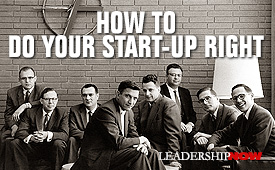
How to Do Your Start-Up Right STRAIGHT TALK FOR START-UPS 

Grow Your Leadership Skills NEW AND UPCOMING LEADERSHIP BOOKS 
Leadership Minute BITE-SIZE CONCEPTS YOU CAN CHEW ON 
Classic Leadership Books BOOKS TO READ BEFORE YOU LEAD |
|

ABOUT
FOLLOW US:
     

Recent Posts
Categories
Full site feed
|
 |
| ||
 | Follow us on:
© 2025 LeadershipNow™  |
| |
