
Leading Blog


« Lead Your Boss | Leading Blog Main Page | Newswire: 10 Crucial Consumer Trends for 2010 »


11.23.09

Do the Leaders within Your Organization Have the Skills They Need To Be Successful In the Future?
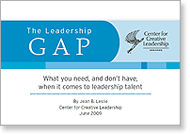
CCL Leadership Gap Do the leaders within your organization have the skills they need to be successful in the future? This is the basic question that the Center for Creative Leadership asked 2,200 leaders from 15 organizations, in three countries between 2006 and 2008.

The findings from this research project identified the following seven leadership skills as most critical for success, now and in the future:
  1. Leading people: directing and motivating people.
  2. Strategic planning: translating vision into realistic business strategies, including long-term objectives.
  3. Managing change: using effective strategies to facilitate organizational change.
  4. Inspiring commitment: recognizing and rewarding employees’ achievements.
  5. Resourcefulness: working effectively with top management.
  6. Doing whatever it takes: persevering under adverse conditions.
  7. Being a quick learner: quickly learning new technical or business knowledge.
You can find these skills adequately discussed in more depth by George Ambler and John Spence so I won’t take the time here. Clearly, these are skills that are vital and need to be addressed.

However, what I found interesting in the report was the following comment:
These data show that many leaders’ strengths are not in areas that are most important for success. Organizations report greater bench strength in areas of
  • building and mending relationships,
  • compassion and sensitivity,
  • cultural adaptability,
  • respecting individual differences,
  • composure,
  • and self-awareness.
In organizations where this is the case, sufficient skill-level has been established in these areas and further large-scale efforts to boost these areas are unnecessary.” [Emphasis mine.]
The above listed five skills were categorized as over-investments or competencies that are strengths but not considered important. (Additionally, confronting people, putting people at ease, managing one’s career were considered to be competencies that are not strengths and not considered important.)

This finding struck me as rather odd for two reasons. First, these competencies are areas where we find people continually getting themselves into trouble and secondly, most of the nine competencies listed have a direct and even causal effect on the seven competencies that the participants found to be insufficient to meet future leadership requirements.

Respecting individual differences and lack of self-awareness are two popular weapons of self-destruction. The fact that we think we have these skills sufficiently mastered to render them unimportant suggests that we have blind spots that have not been fully explored.

Consultant Wally Bock rightly observed, “The ‘important’ list includes ‘leading people’ and ‘inspiring commitment.’ Those two are among the competencies that the respondents thought they were not good at. Maybe there wouldn’t be a gap on those competencies if they thought things like ‘building and maintaining relationships’ were important.” Absolutely correct.

If leadership is about anything, it is about relationships. All our hopes, dreams, goals, metrics, sales, market share and aspirations are going to be accomplished through people. The “important” skills are founded on the “unimportant” skills. Learning how the nine “unimportant” competencies impact and drive the seven “important” competencies will help to fill the leadership gap now and for decades to come.

Posted by Michael McKinney at 05:32 AM
| Comments (5) | TrackBacks (1) | Leadership Development


TrackBack

TrackBack URL for this entry:
http://www.leadershipnow.com/cgi-bin/mt/mt-tb.cgi/664

Listed below are links to weblogs that reference Do the Leaders within Your Organization Have the Skills They Need To Be Successful In the Future?:

» Are You Equipped for 21st Century Leadership? from Big M Management
There has been a study released conducted by the well respected Center for Creative Leadership, where this question was posed, “Do the leaders within your organization have the skills they need to be successful in the future?”  Several tho... [Read More]

Comments

All the skills like relationship building, compassion, self-awareness, etc all boil down to perhaps the single most important leadership skill there is: communication. Great leaders all have the ability to clearly communicate their vision and great communicators lead.

This latest study revelation just disturbs me, yet I am not surprised.

As a management coach and national seminar leader I hear about this truth regularly....from the people who bear the consequences of the absence of these qualities.

What I want to say is, "Are you kidding me?" But then again, this is what keeps me in business.

The bottom line? Business is about behavior. Behavior is about character developed by what we think and how we manage our feelings (emotional intelligence).

The answer? For those of us in the field of leadership and management development to continue to write, influence, speak, and coach to penetrate the business leader's psyche in a way that will demonstrate meaningful awareness and thereby reflect tangible organizational change.

I truly admire the content of your article. After more than 20 years in several different leadership roles, I have found that the most complex of all abilities required to exist within a leader is the leaders ability and will to communicate, inspire and lead. Diversity in skill is a reward to those leaders that embrace the work needed to both accomplish leadership goals and encourage those similar lessons in others. The weighing of which ability holds the most value, should truly be measured against the challenge at hand. Not the opinion at hand.

Provocative post Michael - I just had to share with my readers in my weekly Rainmaker 'Fab Five' blog picks of the week (found here: http://www.maximizepossibility.com/employee_retention/2009/11/the-rainmaker-fab-five-blog-picks-of-the-week-3.html) to get them thinking about the potential for leadership skill deficiencies in their organization.

Keep rockin'!

- Chris

Leadership is the art of mobilizing others toward shared aspirations. In a business enterprise, management is responsible for taking care of employees who, in turn, are responsible for taking care of customers, stakeholders, and related outside parties, such as the government and the community, in an ethical manner. This approach also considers implications for the environment and results in profitable growth combined with an increase in the welfare of all parties involved.
Great leaders are visionaries whose intuition helps them to recognize and capitalize on business opportunities in a timely manner. Their success is based on surrounding themselves with “like-minded” professionals who complement them to help reinforce their strengths and eliminate their weaknesses. They build teams consisting of individuals who complement one another in a way that ensures consistent performance in line with corporate goals. The mantra embodied herein is “Build grand castles in the air while ensuring that they rest on solid foundations.” This is in direct contrast to mediocre leaders who surround themselves with yes-people who, by their very nature, are unable to contribute positively to the bottom line!
The wisdom of effective leaders enables them to appreciate the views of their inner circle and others. In situations where consensus cannot be reached, they have an uncanny ability to cut to the chase and make informed decisions. They foster an environment that encourages the sharing of ideas through brainstorming while realizing that innovation need not be preceded by the existence of committees.
True leaders place a great deal of emphasis on culture and shared values. They realize that business involves human beings and that profitable growth results from fruitful relationships. They normally possess both formal and informal power. Formal power is entrusted to them by virtue of their position in the company. Informal power results from their core belief system. They lead by example, thus earning the respect and admiration of their peers and subordinates. As a result, employees are enthusiastic about going beyond the call of duty for “their” leaders.
Great leaders build organizations that are vibrant and performance driven. They structure employee compensation packages in a way that promotes and reinforces the right behaviors and rewards people on the basis of individual as well as team performance. They believe that a base salary pays the bills, whereas variable compensation, including earnings before interest, taxes, dividends and amortization (EBITDA)-based bonuses, motivates employees to challenge themselves and increase their contribution to the firm on a consistent basis. These leaders find reasons to pay bonuses as opposed to those leaders who find reasons to deprive employees of bonuses they truly deserve!
Leadership traits can create a virtuous cycle for the firm’s management, employees, clients, stakeholders, and others. Great leaders have a natural flair. There are those who believe that their effectiveness can be increased through education, other methods of training and development, and experience, though to a limited extent.
Ethical leadership calls for morals, fairness, caring, sharing, no false promises or unreasonable demands on others, etc. Is “ethical leadership” an oxymoron?
I have a policy of distributing free abridged versions of my books on leadership, ethics, teamwork, motivation, women, bullying and sexual harassment, trade unions, etc., to anyone who sends a request to crespin79@hotmail.com.

Maxwell Pinto, Business Author
http://www.strategicbookpublishing.com/Management-TidbitsForTheNewMillenium.html

Post a comment

(If you haven't left a comment here before, you may need to be approved by the site owner before your comment will appear. Until then, it won't appear on the entry. Thanks for waiting.)


excerpts


Copyright ©1998-2009 LeadershipNow / M2 Communications All Rights Reserved
All materials contained in http://www.LeadershipNow.com are protected by copyright and trademark laws and may not be used for any purpose whatsoever other than private, noncommercial viewing purposes. Derivative works and other unauthorized copying or use of stills, video footage, text or graphics is expressly prohibited. LeadershipNow is a trademark of M2 Communications.