Why Do Seemingly Smart People and Companies Make Such Blunders?
In business, don’t we have structures in place that are designed to bring in a variety of expertise when making major decisions and ensure that no one person can send the business in the wrong direction? Don’t we do our due diligence?
As a species we are not as rational as we would like to think. We tend to be overconfident, too quick to come to a conclusion and not inclined to learn from our mistakes. In the well-executed
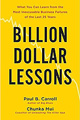
Billion-Dollar Lessons, Paul Carroll and Chunka Mui write that “humans are hardwired to come up with bad strategies.” Doing due diligence is extremely difficult because of these natural tendencies:
- People home in on an answer prematurely, long before they evaluate all information
- People have trouble being objective about many kinds of information because they aren’t set up very well to deal with abstractions.
- People conform to the wishes of a group, especially if there is a strong person in the leadership role, rather than raise objections that test ideas.
- People also don’t learn as much as they could from their mistakes, because we humans typically suffer from overconfidence and have elaborate defense mechanisms to explain away our failings; sharp people appear to be even less likely to learn from mistakes or to acknowledge their errors.
Organizational structures and their accompanying social structures also hurt decision making. It’s hard to deliver bad news any time but especially in a culture that doesn’t support it. They relate that “Saddam Hussein did personally shoot a senior minister in his government when the minister suggested, quite mildly, that Iraq might want to consider looking for a peaceful settlement of its 1980s war with Iran.” That certainly puts a lid on things.
Inertia too, is a big contributor to poor strategy. The hoops that one has to jump through and layers of bureaucracy that have to be appeased “make it hard to derail a strategy once it has reached a certain point. It’s just too painful to go back and start over.”
The authors say it is not enough to be aware of these issues. If we are to learn from our mistakes, there has to be some incentive to do so.
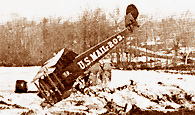
“In the early days of flying, transporting mail became a huge business. But it was dangerous in those flimsy planes that were used right after World War I. Of the first forty pilots with the U.S. Mail service, thirty-one died carrying the mail. The life expectancy of a pilot was four years. Finally, in 1922, the pilots worked out a deal. If the manager of a field told a pilot that he had to take off to deliver the mail even though the pilot thought the weather was too dangerous, the manager had to be willing to sit in the plane’s second seat and fly once around the field. That year, U.S. Mail pilots had zero fatalities.”
Posted by Michael McKinney at 12:39 PM
Permalink
| Comments (0)
| This post is about Problem Solving