  |
|
03.25.06

Scholars Rate the Worst Presidential Blunders
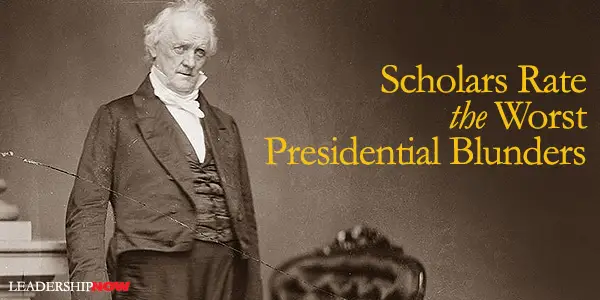
THE McConnell Center asked about 90 political scholars nationwide to nominate mistakes of former presidents because a current administration cannot be judged with historical hindsight, Gary Gregg, a political science professor who directs the McConnell Center, said. Thirty-seven scholars responded. Gregg then compiled a shortened list of 10 for the public to rank. That online survey had 423 responses. So who had the worst blunder? President James Buchanan, for failing to avert the Civil War, according to a survey of presidential historians organized by the University of Louisville's McConnell Center. The survey's top 10 presidential blunders were announced Saturday during a President's Day weekend conference called "Presidential Moments." "We can probably learn just as much - or maybe even more - by looking at the mistakes rather than looking at why they were great," said political scientist and McConnell Center Director Gary Gregg. Scholars who participated said Buchanan didn't do enough to oppose efforts by Southern states to secede from the Union before the Civil War. The second worst mistake, the survey found, was Andrew Johnson's decision just after the Civil War to side with Southern whites and oppose improvements in justice for Southern blacks beyond abolishing slavery. "We continue to pay" for Johnson's errors, wrote Michael Les Benedict, an Ohio State University history professor emeritus. Lyndon Johnson earned the No. 3 spot by allowing the Vietnam War to intensify, Gregg said. Where does Bill Clinton's Monica Lewinsky scandal rank? Many scholars said it belonged at No. 10, saying that it probably affected Clinton's presidency more than it did American history and the public. The rest of the top 10 blunders: 4: Woodrow Wilson's refusal to compromise on the Treaty of Versailles after World War I. 5: Richard Nixon's involvement in the Watergate cover-up. 6: James Madison's failure to keep the United States out of the War of 1812 with Britain. 7: Thomas Jefferson's Embargo Act of 1807, a self-imposed prohibition on trade with Europe during the Napoleonic Wars. 8: John F. Kennedy allowing the Bay of Pigs Invasion that led to the Cuban Missile Crisis. 9: Ronald Reagan and the Iran-Contra Affair, the effort to sell arms to Iran and use the money to finance an armed anti-communist group in Nicaragua. 10. Bill Clinton’s affair with White House intern Monica Lewinsky   Like us on Instagram and Facebook for additional leadership and personal development ideas. Like us on Instagram and Facebook for additional leadership and personal development ideas.
Posted by Michael McKinney at 08:34 PM
|
 |
BUILD YOUR KNOWLEDGE


How to Do Your Start-Up Right STRAIGHT TALK FOR START-UPS 
Grow Your Leadership Skills NEW AND UPCOMING LEADERSHIP BOOKS 
Leadership Minute BITE-SIZE CONCEPTS YOU CAN CHEW ON 
Classic Leadership Books BOOKS TO READ BEFORE YOU LEAD |
|
ABOUT
FOLLOW US:
     

Recent Posts
Categories
Full site feed
|
 |
| ||
 | Follow us on:
© 2025 LeadershipNow™  |
| |