
LeaderShop
Title Index
A-K  L-Z

. Search Books . Bestsellers . What's New . LeaderShop
Main Page
. Help . View Cart

BookInfo
 Description and Reviews
 Reader's Index
 About the Author
 Table of Contents
 Customer Reviews
 Find Similar Items


.
See Also:
. Business

. . .

3ways.gif - 4229 Bytes
Secure Online Ordering Guaranteed!


connections

Visit the author's web site Good To Great


Good to Great: Why Some Companies Make the Leap... And Others Don't


Jim Collins
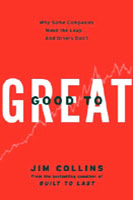


0066620996
Retail Price: $29.99
LS Price: $20.39
You Save: $9.60 (32%)


Availability: Usually ships within 24 hours.

Format: Hardcover, 320pp.
ISBN: 9780066620992
Publisher: HarperCollins
Pub. Date: October 16, 2001

Average Customer Review:
leadership
classic leadership book

.

.
 
Order This Book!

Add To My Cart

view cart
email friend
 

Secure Order Guarantee

Item No: 9780066620992


leadership
Reading Group Guide for Good to Great: Why Some Companies Make the Leap... and Others Don't

Click here for a printer-friendly version.

About This Book

Can good companies, mediocre companies, even bad companies achieve enduring greatness? And if so, what are the distinguishing characteristics that cause a company to go from good to great? Using tough benchmarks, Jim Collins and his research team embarked on a five-year pursuit to identify a set of elite companies that made the leap to great results. How great? These companies generated cumulative stock returns that beat the general stock market by an average of seven times in fifteen years, better than twice the results delivered by a composite index of the world's greatest companies, including Coca-Cola, Intel, General Electric, and Merck.

The research team contrasted the good-to-great companies with a carefully selected set of comparison companies that failed to make the leap from good to great. Why did one set of companies become truly great performers while the other set remained only good? After sifting through mountains of data and thousands of pages of interviews, Collins and his team discovered the key determinants of greatness -- why some companies make the leap and others don't. The findings of the Good to Great study will surprise many readers and shed light on virtually every area of management study and practice. "Some of the key concepts discerned in the study," comments Jim Collins, "fly in the face of our modern business culture and will, quite frankly, upset some people." Perhaps, but who can afford to ignore these findings?

Discussion Questions

  1. Collins states in the Introduction to the book, "I'd like to say we planned the timing, but we began this project in 1996 and had no idea that it would fit perfectly the zeitgeist of 2001. We got lucky." Do you believe that Collins and his team of researchers were simply "lucky"? Why or why not?

  2. What do you think of the research methods employed by Collins and his team? Do you agree with the methods that they used? What would you have done differently?

  3. One of the most crucial criteria set forth was the requirement for companies to have achieved success and maintained it for fifteen years. "We picked fifteen years because it would transcend one-hit wonders and lucky breaks (you can't just be lucky for fifteen years) and would exceed the average tenure of most chief executive officers (helping us to separate great companies from companies that just happened to have a single great leader)." Do you agree with this assessment? How would the results of the study have differed if this particular criteria had been altered?

  4. The research team identified a series of steps that characterize good-to-great transitions: Level 5 Leadership, First Who...Then What, Confront the Brutal Facts, The Hedgehog Concept, A Culture of Discipline, Technology Accelerators, and The Flywheel and the Doom Loop. Which of these factors is the most crucial to a company's success? Do you think it is imperative for a successful company to have all of these factors?

  5. Collins called Level 5 Leadership "one of the most provocative [steps] of the whole study." Do you agree? Of the CEOs profiled in the book, who do you think most exemplifies the qualities of Level 5 leadership? Explain why you chose this person.

  6. Collins and his team "were surprised by the list" of good-to-great companies: Abbott, Circuit City, Fannie Mae, Gillette, Kimberly-Clark, Kroger, Nucor, Philip Morris, Putney Bowes, Walgreens, and Wells Fargo. Were you surprised by the companies that appeared on the list? Are there any companies that you expected to appear that were absent?

  7. He also says that "this became the first of many surprises that led us to reevaluate our thinking about corporate greatness." The fact that they were surprised means that they went into the study with certain assumptions. What were those assumptions?


Discussion questions provided courtesy of Harpercollins.


Click here for a printer-friendly version.


Find Items On Similar Subjects
How The Mighty Fall: And Why Some Companies Never Give In
Built to Last: Successful Habits of Visionary Companies

.
 
leadership
TITLE INDEX: A-K  L-Z | SEARCH | BESTSELLERS | WHAT'S NEW | OUT OF PRINT | HELP | PRIVACY & SECURITY | Leading Blog | LeaderShop Main Page

All prices subject to change and given in U.S. Dollars.

Copyright ©1998-2009 LeadershipNow / M2 Communications, LLC All Rights Reserved


All materials contained in http://www.LeadershipNow.com are protected by copyright and trademark laws and may not be used for any purpose whatsoever other than private, non-commercial viewing purposes. Derivative works and other unauthorized copying or use of stills, video footage, text or graphics is expressly prohibited. LeadershipNow is a trademark of M2 Communications, LLC.
.