
 |

|
How The Mighty Fall: And Why Some Companies Never Give In Jim Collins 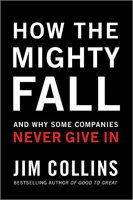

 Format: Hardcover, 240pp. ISBN: 9780977326419 Publisher: HarperBusiness Pub. Date: May 19, 2009 Average Customer Review: 
For Bulk Orders Call: 626-441-2024  Description and Reviews From The Publisher: Decline can be avoided. Decline can be detected. Decline can be reversed. Amidst the desolate landscape of fallen great companies, Jim Collins began to wonder: How do the mighty fall? Can decline be detected early and avoided? How far can a company fall before the path toward doom becomes inevitable and unshakable? How can companies reverse course? In How the Mighty Fall, Collins confronts these questions, offering leaders the well-founded hope that they can learn how to stave off decline and, if they find themselves falling, reverse their course. Collin’s research project—more than four years in duration—uncovered five step-wise stages of decline: Stage 1: Hubris Born of Success Stage 2: Undisciplined Pursuit of More Stage 3: Denial of Risk and Peril Stage 4: Grasping for Salvation Stage 5: Capitulation to Irrelevance or Death 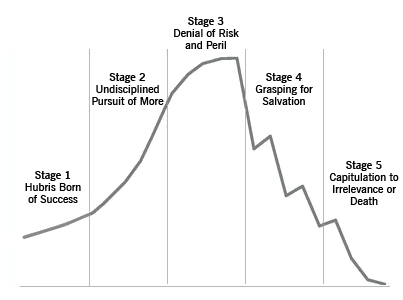 By understanding these stages of decline, leaders can substantially reduce their chances of falling all the way to the bottom. Great companies can stumble, badly, and recover. Every installation, no matter how great, is vulnerable to decline. There is no law of nature that the most powerful will inevitable remain at the top. Anyone can fall and most eventually do. But, as Collin’s research emphasizes, some companies do indeed recover—in some cases, coming back even stronger—even after having crashed into the depths of Stage 4. Decline, it turns out, is largely self-inflicted, and the path to recovery lies largely within our own hands. We are not imprisoned by our circumstances, our history, or even our staggering defeats along the way. As long as we never get entirely knocked out of the game, hope always remains. The mighty can fall, but they can often rise again. Picking up where Good to Great and Built to Last left off, bestselling author Jim Collins introduces a framework for diagnosing and correcting a company’s decline. Good to Great and Built to Last identified the distinguishing characteristics shared by companies that not only achieved greatness, but also sustained it. In How the Mighty Fall, Jim Collins considers the "dark side," offering a perspective on how a fall from greatness can happen -- to even the seemingly invincible. Adapting the very methodology that established Good to Great as a landmark, How the Mighty Fall shows that every institution, no matter how great, is vulnerable to decline, but recovery is possible. In some cases, companies emerge stronger -- even after having crashed into the depths of a near-catastrophic fall. Collins presents a framework that will help business leaders and companies identify the "silent creep of impending doom" and swiftly set a correction course. Rigorous in its analysis, surprising in its findings, How the Mighty Fall is an in-depth look at the decline of some of our nation’s greatest companies and a useful tool for companies and individuals seeking to avoid such a fate. Themes from How the Mighty Fall:
About the Author Jim Collins is a student of companies -- great ones, good ones, weak ones, failed ones -- from young start-ups to venerable sesquicentenarians. The author of the national bestseller Good to Great, he serves as a teacher to leaders throughout the corporate and social sectors. His work has been featured in Fortune, Business Week, The Economist, USA Today, and Harvard Business Review. Table of Contents
Find Items On Similar Subjects  Good to Great: Why Some Companies Make the Leap... And Others Don't Built to Last: Successful Habits of Visionary Companies Good to Great and the Social Sectors: Why Business Thinking Is Not the Answer • A Monograph to Accompany Good to Great Revival of the Fittest: Why Good Companies Go Bad and How Great Managers Remake Them Good to Great: Why Some Companies Make the Leap... And Others Don't Built to Last: Successful Habits of Visionary Companies Good to Great and the Social Sectors: Why Business Thinking Is Not the Answer • A Monograph to Accompany Good to Great Revival of the Fittest: Why Good Companies Go Bad and How Great Managers Remake Them
 |
|
Books by Jim Collins LEADERSHOP 
The Essential Lists BOOKS TO READ BEFORE YOU LEAD 
Grow Your Leadership Skills NEW AND UPCOMING LEADERSHIP BOOKS 
Classic Leadership Books BOOKS TO READ BEFORE YOU LEAD |
 |
| ||
 | © 2019 LeadershipNow All materials contained in https://www.LeadershipNow.com are protected by copyright and trademark laws and may not be used for any purpose whatsoever other than private, non-commercial viewing purposes. Derivative works and other unauthorized copying or use of stills, video footage, text or graphics is expressly prohibited. |
| |